1. The Sea and the Plant Kingdom; The Flax Field and the Flowering Sea
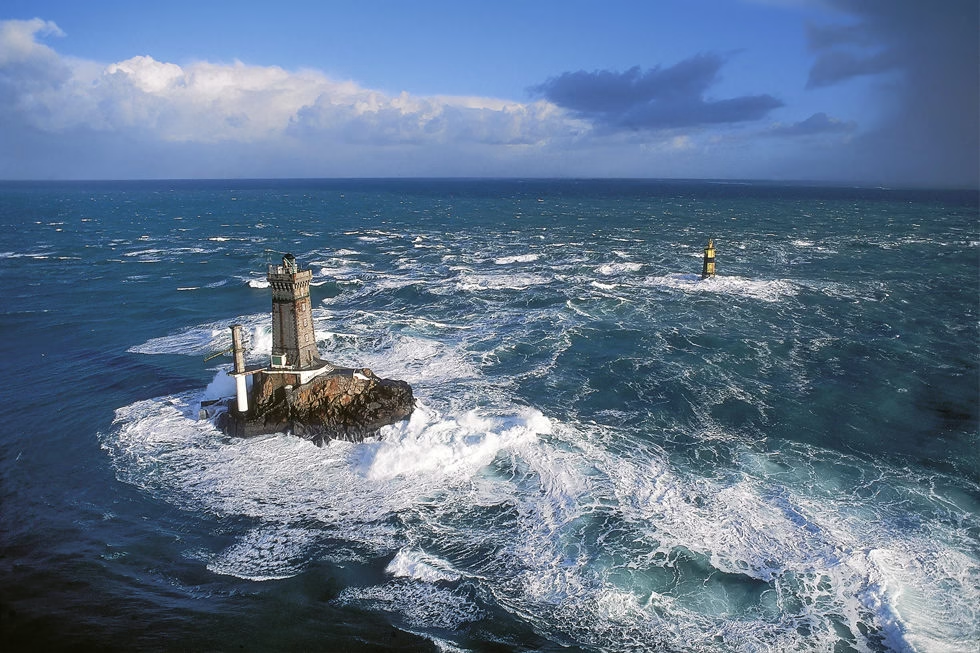
For French sailors, the sea is above all the Great Water. When they simply speak of “the water,” without any further qualification, it is generally understood that they mean the sea.
In Lower Brittany, the sea is called Mor braz, literally meaning “the great sea.” In the Gironde, it is known as la gran’ ma, while in Upper Brittany it is called the grand’ mé salée (“the great salt sea”).
Along the shores of the English Channel, the sea is sometimes referred to as the great pond, the great spring, or the inexhaustible source.
Sailors also call it the great highway. This comparison is no accident: for centuries, the sea has served as the principal route for travel and commerce. To them, “to sail on the great highway” simply means to put out to sea.
Other expressions extend this same idea of vastness. The sea thus becomes the great bowl, the great basin, or even the great cauldron—familiar images that attempt to capture the boundless expanse of the maritime world.
2. The Sea and the Plant Kingdom; The Flax Field and the Flowering Sea
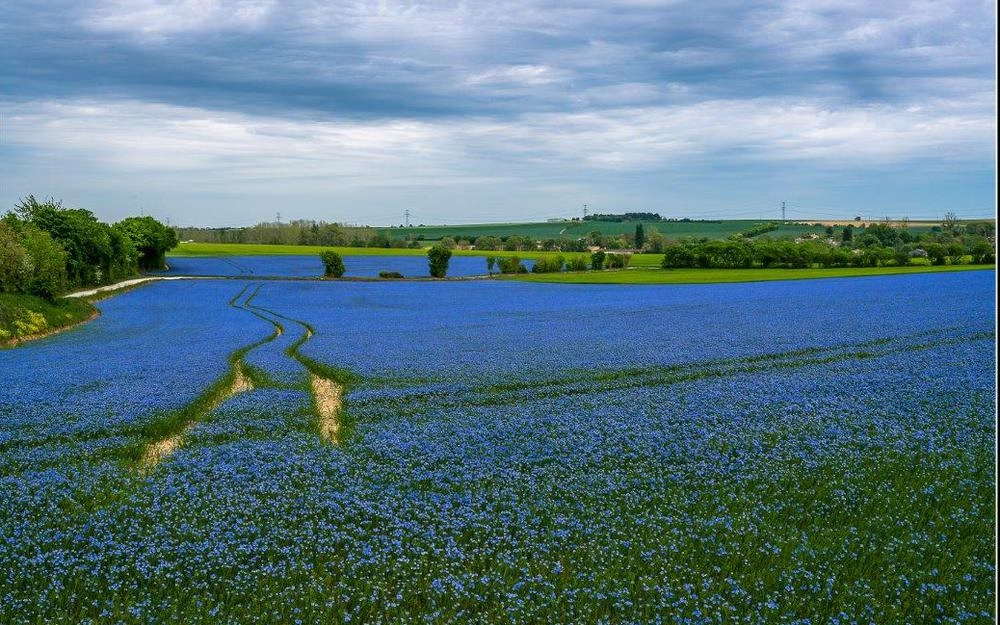
Flax Field
Its greenish hue has notably earned it the nickname the great meadow. This expression also found its way into French slang, where “to mow the meadow” once meant being sentenced to hard labor. The phrase is thought to date back to the era of the galleys, when convicts pulling at the oars appeared to be mowing the greenish waves like reapers working side by side across a meadow.
In Basque tradition, the sea is sometimes called Landa lihoa, literally meaning “the flax field.” In Saint-Jean-de-Luz, a popular anecdote tells of two peasant women who, upon seeing the sea for the first time, exclaimed, “Oh, what a beautiful flax field!” The comparison is hardly surprising. When flax is in bloom, its bluish blossoms and the way it ripples in the wind closely resemble the surface of the sea stirred by a gentle breeze. This image also appears in several folktales from across France. In these stories, travelers mistake a field of flowering flax for the sea and strip off their clothes, intending to take a swim. Such characters are generally portrayed by neighboring communities as especially simple-minded.
In Upper Brittany, ce rôle est parfois attribué à des Normands de passage ou aux habitants de Saint-Jacut-de-la-Mer, appelés les Jaguens, bien que ceux-ci soient pour la plupart marins. Dans le conte des Six compagnons, recueilli par Étienne Henry Carnoy (Contes picards merveilleux ou plaisants), six compagnons tout aussi crédules confondent les ondulations d’un champ de blé avec celles de la mer et tentent de nager au milieu des épis :
« Six paysans se trouvaient un soir réunis à la veillée. — J’ai toujours eu l’intention, dit l’un, d’aller voir la mer. Malheureusement il ne m’a pas encore été permis de me contenter. Vous plairait-il de partir demain avec moi pour voir cette grande masse d’eau dont on dit tant de merveilles ? Tous ayant accepté, on convint de partir le lendemain. Le jour d’après, les paysans se mirent en marche. Ils arrivèrent bientôt en vue d’une grande plaine remplie de blés auxquels le vent communiquait des ondulations pareilles à celles de l’Océan. — La mer ! la mer ! s’écrièrent à la fois les six compagnons, qui se jetèrent à plat ventre dans les épis pour nager. […] »
“One evening, six peasants were gathered together at a village vigil.
‘I’ve always wanted,’ said one of them, ‘to go and see the sea. Unfortunately, I’ve never had the chance to satisfy that wish. Would you like to set out with me tomorrow to see that vast body of water everyone speaks of with such wonder?’
Everyone agreed, and they decided to leave the following day. The next morning, the peasants set off. Before long, they came within sight of a great plain covered with ripening wheat, its surface rippling in the wind like the waves of the ocean.
‘The sea! The sea!’ cried the six companions in unison, throwing themselves flat into the wheat to swim. […]”
Lorsque la surface est parfaitement calme, certains parlent d’une « mer de roses ». Ailleurs sur le littoral, on dit que le flot « fleurit » lorsque l’écume vient couronner le sommet des vagues. En Upper Brittany, l’expression mer fleurie désigne une mer dont les vagues blanchissent sous l’effet du vent sans pour autant devenir dangereuses. Cette image est illustrée par ces vers consacrés au littoral malouin :
« Et lorsque le vent frais sème les flots mutins De bouquets blancs qui font songer aux aubépins, On dit à Saint-Malo que la mer est fleurie. »
“And when the fresh wind strews the playful waves With white bouquets that bring hawthorn blossoms to mind, In Saint-Malo they say the sea is in bloom.”
3. Animism: Waves Likened to Animals
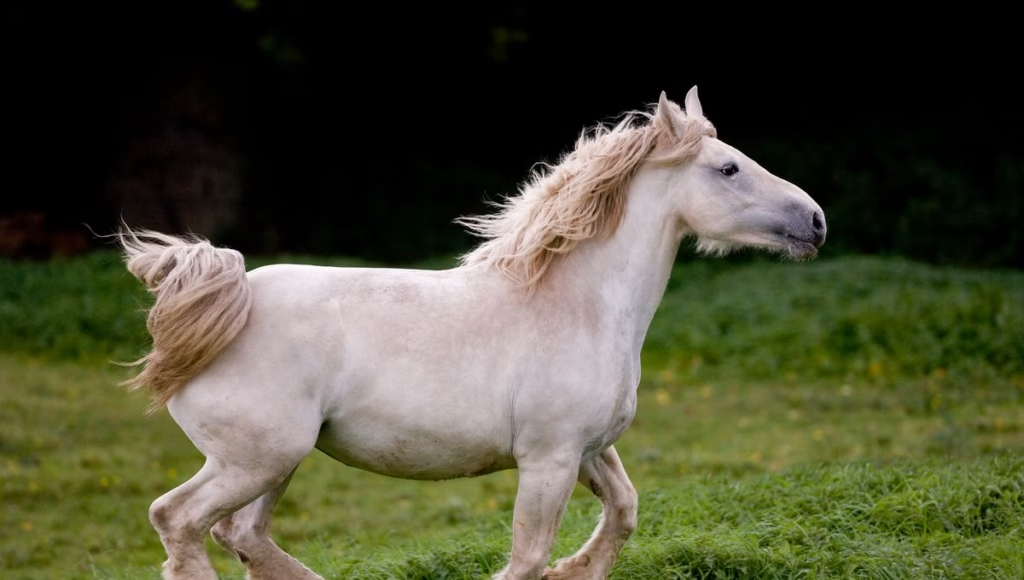
The White Mare: An Animistic Manifestation of the Sea
The sea lives, stirs, transforms itself, and at times seems to possess a character of its own. To describe its movements, colors, and tempers, maritime communities have often drawn their imagery from the animal world. Some of these expressions appear as early as the 16th century. Noël du Fail, for example, speaks of the “salt-tax collectors and salt workers of Le Croisic” being sent to the bottom of the “great mare Margot, bridled by her tail.”
Among the animals most frequently associated with the sea, the horse holds a special place. In Poitou, the sea is called la grand Jument blanche (“the great White Mare”). In the Tréguier region, ar gazek gwen (“the White Mare”) refers to a rough, rolling sea, while ar gazek klanv (“the Rabid Mare”) describes a raging, storm-tossed sea. This latter expression is also found on the Île de Batz. By contrast, when the sea is calm, people in the Trégor region speak of ar marc’h glas, “the Blue Horse,” while on the Île de Batz it becomes ar gazek c’hlaz, “the Blue Mare.” These equestrian images recur in many maritime expressions. In the Tréguier region, certain successive waves are called ar marc’h hep kavalier, “the Horse Without a Rider,” or ar marc’h hep he vestr, “the Horse Without Its Master.” When a storm breaks, the sea is likened to a horse that has broken free from its pasture or to a mare driven mad.
La mer a également été comparée à une vache. En Upper Brittany, elle est parfois surnommée la vache gare, ou varia, en référence aux nuances de bleu et de blanc qui colorent les vagues. Sur les côtes du Finistère, l’expression ar vioc’h lezek, « la vache à lait », souligne davantage les ressources qu’elle procure aux populations littorales. Pêche, commerce maritime ou récupération des épaves : la mer est alors perçue comme une source permanente de subsistance. Cette fonction nourricière lui vaut aussi le surnom de nourrice des gens d’Arvor.
When the waves subside, the vocabulary changes dramatically. Almost everywhere, the sea is described as “beautiful” or “lovely.” Its tranquility inspires comparisons with the gentlest of animals. In Upper Brittany, it is said to be “as gentle as a sheep”; in Finistère, “as gentle as a lamb.” In this peaceful state, the sea is also frequently described as white. The Bretons call it Mor gwen, while in Provence it is known as Mar blanco. Along the coast of Finistère, people speak of a “white calm.” In the Pas-de-Calais, the sea is described as “white as a sheet.” When the waves gradually die down, it is said to have become “whitened.” Other comparisons emphasize its serenity even more strongly. In Lower Brittany, people say: Mor sioul e-c’hiz al leaz—that is, “as calm as milk.” Even more commonly, a perfectly calm sea is compared to oil, an image found not only in Brittany but also in the Gironde, along the Boulogne coast, and throughout the Mediterranean.
A sea without a ripple has always fascinated those who behold it. In Provence, people say that it becomes a mirror (Fai mirau). Elsewhere, it is described as “clear as a mirror,” “smooth as glass,” “flat as a sheet of paper,” or “calm as a pond.” In some regions, fishermen even say that “it is looking at itself.” In Lower Brittany, people say that the sea “is waiting for fortune” or that it “does not move any more than a sleeping child.” The same image appears in the writings of Victor Hugo:
« l’apaisement de la mer était inexprimable ; elle avait un murmure de nourrice près de son enfant ; les vagues paraissaient bercer l’écueil ».
“The sea’s calm was beyond words; it murmured like a nurse beside her child; the waves seemed to rock the reef to sleep.”
When the surface becomes perfectly smooth, the Bretons say that the sea is calm enough for flies to stroll across it. Sailors from the Boulogne coast express the same idea with a colorful saying: “The flies are grooming themselves on the water.”
À l’opposé, la mer agitée est souvent décrite comme un être animé. On dit qu’elle est « en démence », « en folie » ou simplement « mauvaise ». Dans le Boulonnais, elle « se courrouce », « s’arpiffe » ou « se met en colère ». Quand souffle la tempête, elle devient « enragée » ou « déchaînée ». Son bruit lui-même est interprété comme une manifestation de vie. Les pêcheurs disent parfois qu’elle chante. Dans un conte gascon, la mer personnifiée encourage même deux enfants perdus en leur chantant de garder courage. Mais elle peut aussi gronder, crier ou se lamenter. En Upper Brittany, lorsqu’elle produit un grondement plaintif, on dit qu’elle « brait ». Sur les grèves, elle chante ; au pied des falaises, elle « brait comme un âne ». Parfois encore, elle prend la voix d’un taureau : elle mugit ou beugle. En Provence, selon Frédéric Mistral, « la Mar bramo ».
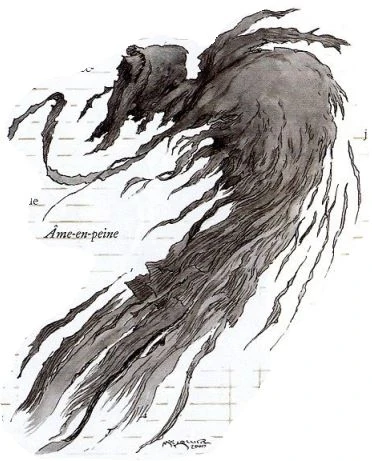
Popular belief has sometimes given a supernatural origin to the sounds of the sea. On the Île d'Arz, in the Morbihan, the mournful cries heard during stormy nights are attributed to the bolbiguéandets, malevolent spirits believed to foretell shipwrecks. In Finistère, some people claim that the rumbling of the waves is the cries of sailors lost at sea. According to this tradition, the souls of those who have drowned cannot find peace until they have received a Christian burial. As long as their bodies are tossed about by the waves, their spirits continue to weep and wail through the surf. Throughout much of Brittany, these wandering souls are known as the Krierienn, the “Cryers.”
L’écume et la rapidité des vagues ont naturellement inspiré d’autres comparaisons avec le monde équestre. Dans le Finistère, lorsque la mer moutonne, on dit qu’elle fait danser les chevaux blancs. En Upper Brittany, la tempête transforme la mer en jument enragée. Les marins de la Manche annoncent l’arrivée de la houle en déclarant : « V’là la grande vache gare qui va ruer ». En Guyenne, le mot rouartpeut désigner à la fois un taureau et une vague particulièrement violente.
The most widespread image, however, is undoubtedly that of sheep. When the wind whitens the surface of the sea with whitecaps, people naturally say that the sea is “fleecing” or “covered with sheep.” Some fishermen even speak of “sheep in the meadow,” echoing a comparison also used for certain kinds of clouds. This image also appears in a Basque version of the tale of the Master Thief. When a priest, believing him to have drowned, catches sight of him in the midst of a flock and questions him, the hero replies:
« Je les ai tirés du fond de la mer ; il y en a beaucoup comme cela ; ne voyez-vous pas ces moutons blancs comme ils paraissent sur la mer ? »
“I brought them up from the bottom of the sea. There are many more like them down there. Don’t you see those white sheep appearing out on the sea?”
Even the smallest waves have their place in this rich animal imagery. In Lower Brittany, the wave that follows the largest one is called “the dog following its master.” It is yet another example of the popular tendency to imagine the sea as a living being, endowed with familiar behaviors, moods, and personality.
4. Waves and Numbers; The Causes of Storms
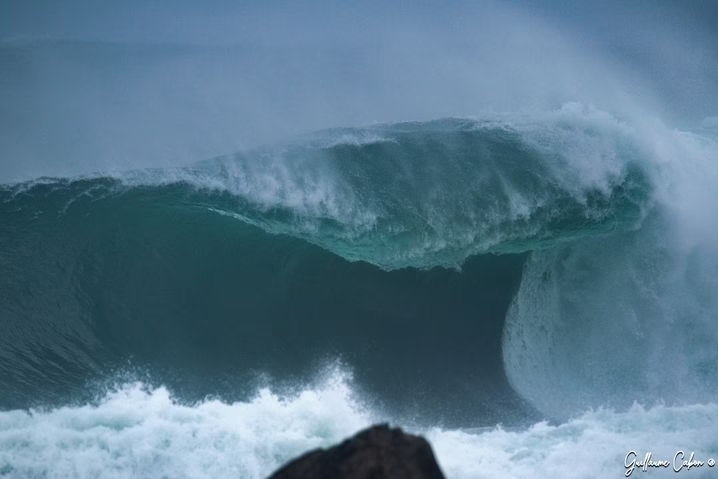
Photograph of the Annaëlle Wave off the coast of Finistère
Certaines séries de vagues ont longtemps été considérées comme différentes des autres : trois, neuf, dix, des qualités ou des forces particulières, parfois même une puissance surnaturelle. En Upper Brittany, une croyance populaire affirme que les vagues se succèdent par séries de trois et que la troisième est toujours la plus forte. Cette observation s’applique notamment à la marée montante. Alors que les deux premières vagues ne font qu’humidifier le sable, la troisième est celle qui le recouvre véritablement. Sur les grèves, elle est également réputée produire le bruit le plus puissant. Cette idée est encore plus fortement ancrée sur le littoral du Finistère, où la troisième lame est traditionnellement considérée comme la plus redoutable. Les marins estiment qu’il faut toujours attendre son passage avant de tenter de franchir une barre, sous peine de s’exposer à un danger plus grand que prévu. Cette conviction se retrouve dans plusieurs proverbes bretons : « Avec la troisième lame on sort de peine ou l’on marche à sa perte. » Ou encore : « Quand la vague fait son troisième saut, elle jette son morceau sur la grève. »
The third wave is not the only one to enjoy a special reputation. Along parts of the Charente coast, sailors long maintained that it was the tenth wave that rose the highest and possessed the greatest force. This belief belongs to a much broader body of maritime traditions in which numbers play a symbolic role. From one region to another, sequences of waves were carefully observed, counted, and interpreted as signs that could help predict the sea’s changing moods and sudden whims.
Along the coast of Paimpol, another popular explanation was passed down from generation to generation. Those who drowned without dying in a state of grace were believed to be condemned to labor on the seabed. Their ceaseless toil was said to stir the waters and give rise to the swell. This belief offered an explanation for those days when the sea remained restless even though no wind blew across its surface. Whenever waves appeared without any obvious cause, people would say: “The drowned are stirring; they are working to make the sea tremble.”
5. The Sea, Love, and Women
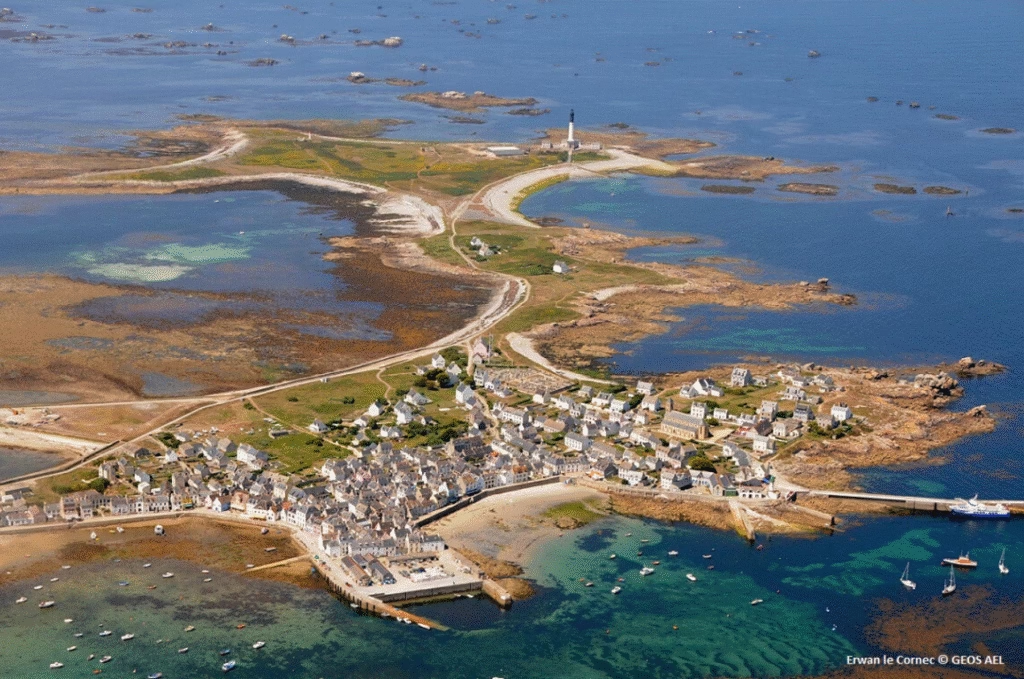
The Île de Sein
In the popular imagination, the sea does not respond solely to natural forces. Like a living being endowed with feelings, it can also be affected by human behavior, especially when it concerns love or marriage. An old belief, recorded as early as the 15th century, thus maintains:
« Qui prend sa commère par mariage, toustefoiz qu’ils se conjoindent charnellement, il fait orage en terre ou en mer. »
“Whoever marries his godmother, whenever they come together in the flesh, a storm will arise on land or at sea.”
According to this tradition, certain unions regarded as contrary to accepted custom were believed capable of unleashing storms and disturbing the natural order.
A legend collected on the Île de Sein likewise illustrates the idea of a sea capable of passing judgment on human relationships. The story tells of a nobleman from the mainland who became engaged to a young woman from the island and brought her to his castle at Kerglas. There, however, she was mocked and humiliated. Faced with the situation, the lord eventually decided to take her back to her island. When the time came to leave, not a single fisherman would agree to carry them across. They all claimed that the sea was angry because the couple was poorly matched and that it was far too dangerous to put out to sea under such circumstances.
Other traditions directly attribute to women the unwitting power to provoke the sea’s anger. Off the coast of Saint-Jean-du-Doigt, a local belief held that the sea became furious whenever it caught sight of a woman or a young girl. The surviving accounts are extremely brief and offer no clear explanation for the supposed source of this hostility. Some folklorists have nevertheless suggested that it may be connected to older beliefs linking female nudity with certain maritime taboos.
Breton beliefs of the 19th century also invoke the legendary creatures of the sea. In Lower Brittany, people said that any sailor unfortunate enough to glimpse a naked mermaid was courting imminent disaster. The mere sight of this supernatural being was believed to be enough to unleash a hurricane.
6. Violence Toward the Morgans
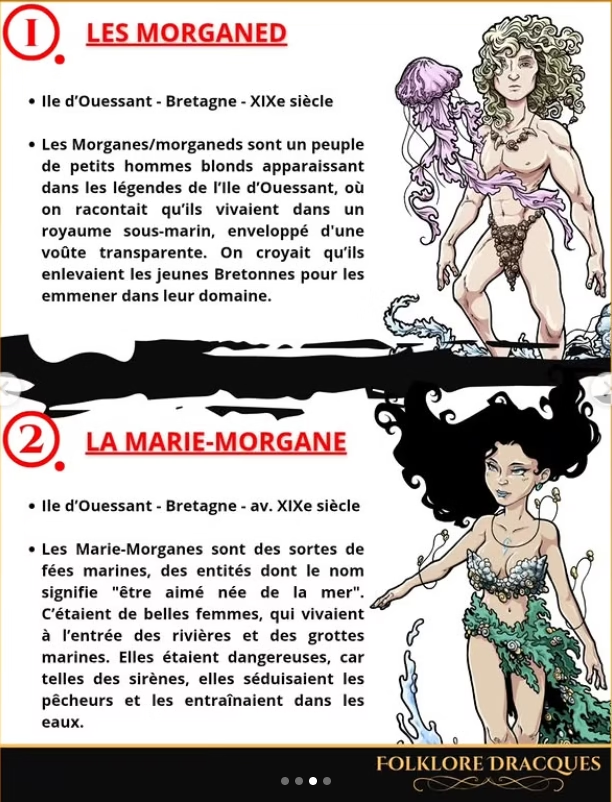
Introduction to the Morganeds and the Marie-Morganes (Morgans), Folklore Dracques
In the legends of the Breton coast, the sea is inhabited by mysterious beings whose presence must be respected. Morgans, sea spirits, and spirits of the waters are not merely figures from folktales. They are believed to play a part in maintaining the balance of the marine world and, according to popular tradition, can unleash terrible disasters when they are offended. Any act of violence against them is said to bring immediate punishment, most often in the form of a violent storm or a devastating gale.
A tradition from Douarnenez tells of a man who one day caught sight of a Morgan sitting on the rocks of the Raz. Curious—or perhaps reckless—he approached in an attempt to seize her. But no sooner had he drawn near than the creature plunged into the sea. At that very moment, an exceptionally violent wind arose. The storm was so fierce that twenty boats were driven ashore.
Another Breton belief, recorded in an early source but regarded as unreliable by some collectors of folklore, holds that merely touching a Morgan was enough to unleash a hurricane. Even unintentionally, if a fisherman's oar happened to strike one of these creatures, a violent storm was said to arise at once.
In southern Finistère, a long-standing belief likewise attributed to the Morgans a direct influence over the state of the sea. The song of “Marguerite Bad Weather”, the name given to a legendary mermaid, was believed to make the swell rise and the waves grow ever larger.
Along the coast of Tréguier, other beings are held responsible for storms. Popular tradition speaks of the Dud-vor, the “Sea Men,” as well as the Cornandonet (kornandon), described as small black demons that dwell in close association with the forces of the sea. According to local belief, it is they who raise the waves and unleash the storms that batter the coast.
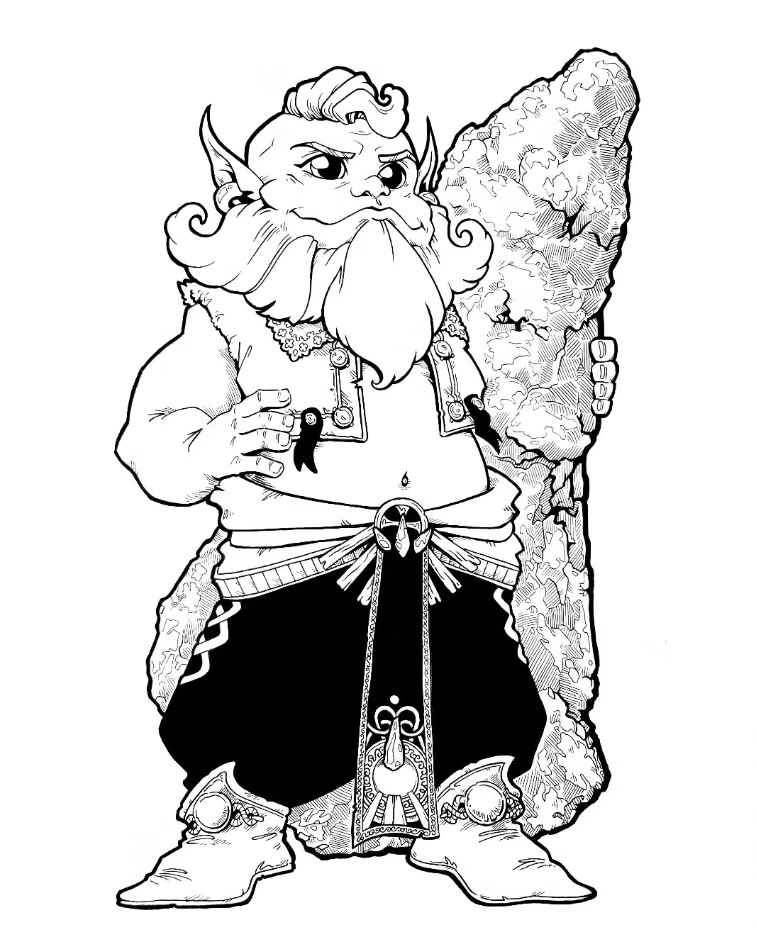
Omens of an approaching storm sometimes take on even stranger forms. Jacques Boucher de Perthes relates that, before great hurricanes, some sailors claimed to see a little white dwarf dancing on the coastal rocks. This apparition was regarded as a warning. To glimpse the mysterious figure meant that the sea would soon unleash its fury.
7. The Saints and the Storms
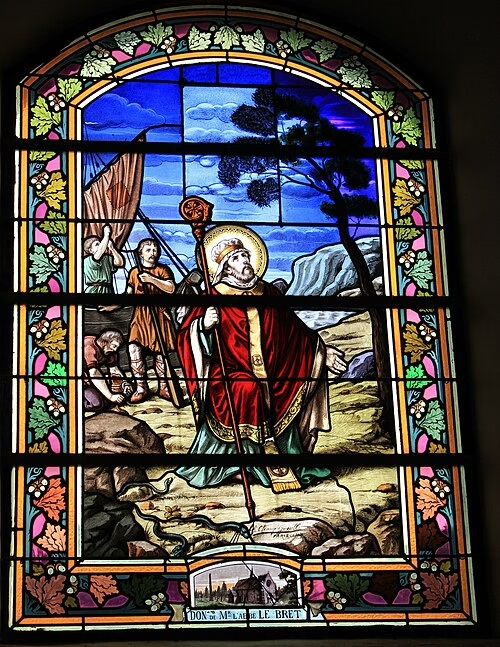
Stained-Glass Window Depicting Saint Maudez, Church of the Holy Cross, La Croix-Helléan
In several communities along the English Channel, a popular belief held that a jubilee would invariably be followed by a spell of bad weather. Fishermen believed that after taking part in this religious celebration, they were almost certain to encounter a violent storm on their first voyage back to sea. This belief appears to be connected with another widespread maritime superstition: the presence of a priest aboard a vessel was often regarded as an ill omen. In many seafaring traditions, the religious world inspired both reverence and mistrust whenever it came into contact with the unpredictable forces of the sea.
Finistère has preserved a remarkable legend in which a saint himself makes use of the winds and storms to ease his travels. The older inhabitants of Clohars recounted that Saint Maudez left Ireland every year on his feast day, celebrated on November 26, to visit the chapel dedicated to him by the sea. A violent southerly storm carried him swiftly across the water and brought him to the Breton coast. Upon arriving at Loc-Maudé, he tethered his horse to a stone that was once shown to pilgrims. He then watched over the faithful, inquired after their needs, and bestowed his blessing upon them. His journey did not end there. After visiting the chapel, he continued on to Pouldu to pay a visit to his friend Saint Julian. Once that visit was over, the winds suddenly shifted direction. Now blowing from the north, they stirred up another storm that carried the saint back to Ireland before nightfall. In this local tradition, the storm is no longer a scourge—it becomes the favored means of travel for a wandering saint.
Breton beliefs also attributed a direct influence over the state of the sea to certain human events. At the end of the 18th century, as in traditions preserved into later times, people said that the sea flew into a rage whenever a great personage died. The passing of an extraordinary individual was believed to unleash storms and upheavals, as though the forces of nature themselves reflected the significance of the event.
Storms could also herald an event of a very different kind. According to several Breton folk beliefs, whenever a criminal died, a sudden squall would arise at the very moment the person's soul left this world. This violent disturbance of sea and sky was interpreted as a sign that the Devil himself had come to claim the deceased and carry the soul away into the afterlife. The storm thus became the visible manifestation of a spiritual struggle hidden from human eyes.
8. Acts Performed on Land
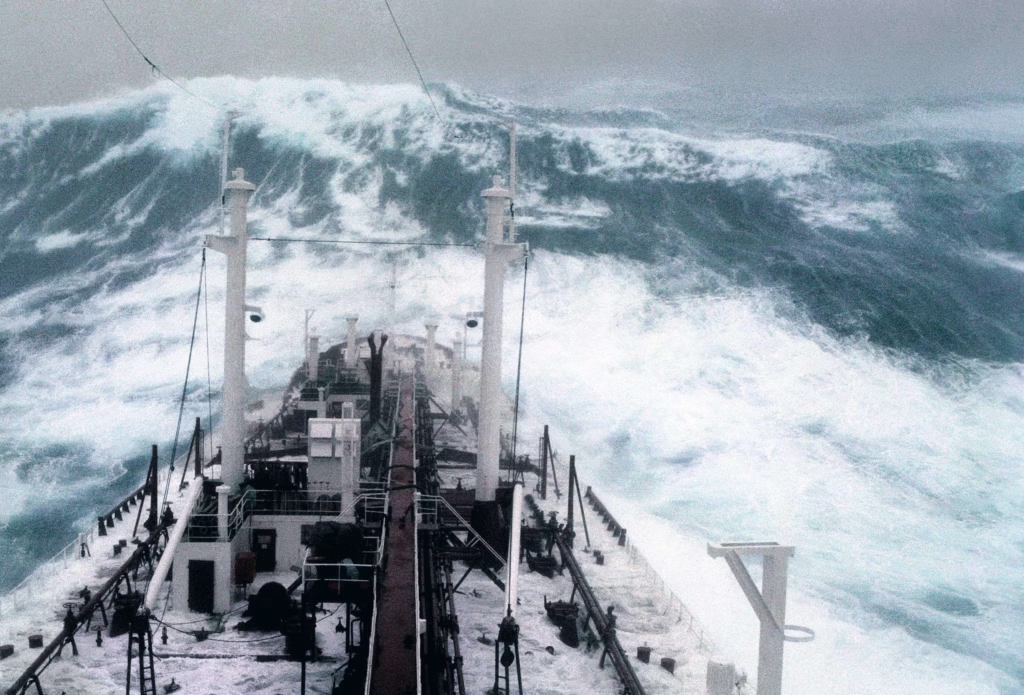
Rogue Wave Threatening a Boat
Certain actions performed in the village were believed to have a direct influence on the state of the sea. Thus, whenever a husband, a relative, or a loved one was at sea, a woman was expected to avoid combing her hair after nightfall. This seemingly harmless act was thought capable of bringing on bad weather. Other taboos concerned animals. Drowning a cat was especially dreaded. Along several French coasts, people believed that killing a cat—whether aboard a ship or on land—would inevitably expose sailors to an approaching storm.
Like the waves, storms themselves were believed to follow the symbolism of numbers. Sailors from Saintonge maintained that a storm could last only three, six, or nine days. This belief reflects older traditions that assigned special significance to numbers in the interpretation of maritime phenomena. Three, six, and nine thus emerge as recurring numbers in coastal folklore, where they were used to explain not only the succession of waves but also the duration of storms.
Along the coast of Finistère, another belief sought to explain how storms came to an end. The winds and waves would not subside until the sea had cast ashore the impure bodies or corpses it had kept hidden in its depths. In this tradition, the storm was seen as a form of purification. As long as those remains lay beneath the water, the sea continued to rage and roar.
The sea could also warn people of imminent danger. A tradition recorded in Plévenon, in the Côtes-d’Armor, tells of a group of fishermen who were out at sea on the feast day in mid-August. Suddenly, an enormous wave rose before them. As high as a mountain, it towered in their path without damaging their boat or directly threatening them. The sailors interpreted its appearance as a warning sent by the Virgin Mary. Convinced they had received a sign, they immediately abandoned their fishing and returned to port without delay.
Among the most remarkable tales in Breton folklore is a legend describing a journey to Paradise. During his travels, the traveler comes upon a strange and terrifying sea. Its waves seem alive. They rise in enormous masses before hurling themselves against one another with unimaginable violence. The sea appears to be literally devouring itself. The breakers surge forward:
« avec des abois désespérés et des bonds effrayants de bêtes ».
“with the desperate howls and terrifying leaps of wild beasts.”
When the traveler returns to the world of the living, he learns the meaning of this vision. These raging waves represent people trapped in unhappy marriages or forced into unions they did not choose. Condemned to struggle against one another for all eternity, they bite and tear at each other without respite until they destroy one another.
9. Sea Foam Compared to Culinary Processes
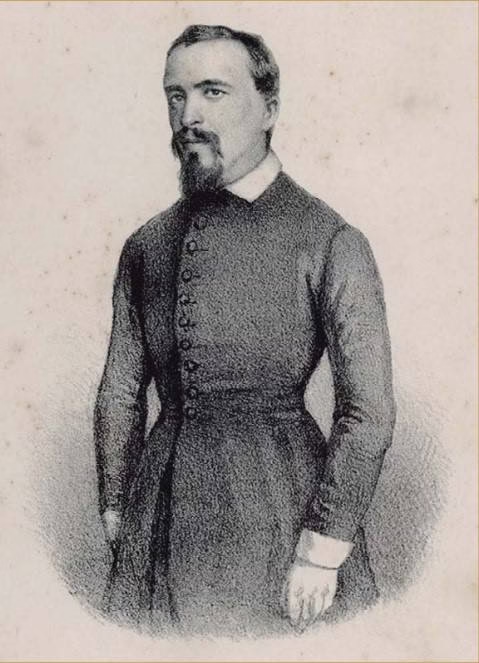
Portrait of Augustin Chaho
The folklorist Augustin Chaho records a popular belief that a fairy named Amigna is responsible for certain changes in the sea after storms. Whenever the ocean is violently churned and its waters appear thick and stirred to their very depths, local people say that the fairy has just finished boiling her stewpot. After a gale, the sea does indeed take on a distinctive appearance. Laden with suspended matter, it sometimes resembles a vast cauldron of bubbling broth, its surface looking rich and oily. This observation is said to have given rise to the image of the giant cooking pot tended by the mysterious Amigna. It is worth noting that a Lamigna is a fairy in Basque folklore.
At high tide, as the sea reaches its fullest extent, the water often washes ashore seaweed, plant debris, organic matter, and a yellowish foam that clouds the shoreline. According to the tradition recorded by Chaho, this means that “the fairy Amigna has not yet skimmed the foam from her stewpot.”
The comparison becomes even more vivid once the tide begins to recede. The material that had been floating near the shore gradually drifts back out to sea. The water then regains its clarity and seems to cleanse itself before the observers' eyes. In the figurative language of Basque folklore, this transformation means that: “The fairy Amigna has soaked her soup.” Once the broth is finally ready, it should be drunk so as not to offend the fairy.
The fishermen of the Saint-Malo region had their own playful explanation for sea foam. During the summer months, when the surface of the sea is covered with abundant froth, they simply explained the phenomenon by saying that the fish had been eating food that was too rich. As they put it:
« Les poissons mangent gras, et ils écument leur soupe. »
“The fish are eating rich food, and they're skimming the foam from their soup.”