The French coastline provides an ideal landscape for the imagination. Sheer cliffs, rugged headlands, mysterious caves, strangely shaped rocks, and spectacular seascapes seem naturally suited to inspiring tales of wonder. Yet legends connected to the sea are far less numerous there than those found inland.
This observation is all the more surprising because some coastlines with a particularly strong maritime heritage possess relatively few known traditions. This is especially true of the shores of the Basses-Pyrénées, homeland of the Basque sailors, as well as the coasts of Picardy and Flanders, where fishing and seafaring nevertheless played an essential role. As for the low, sandy coastlines of Languedoc and Gascony, their relative scarcity of legendary tales is easier to understand, given their historically less densely populated maritime communities.
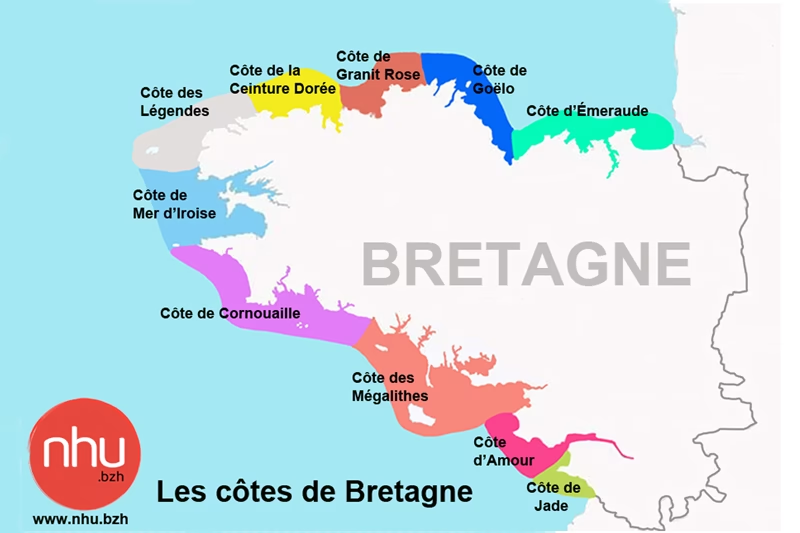
Against this backdrop, Brittany stands apart. The former province alone accounts for nearly two-thirds of the traditions, beliefs, and folk tales collected along the French coast. This is a remarkable proportion when one considers that its shoreline represents less than one-fifth of the coastline of mainland France.
This exceptional richness can be explained in part by the historical importance of Brittany’s maritime communities. For a long time, the number of Breton sailors and fishermen nearly equaled that of the rest of the country combined. Added to this was a coastline of remarkable diversity: storm-battered cliffs, treacherous reefs, isolated islands, deep bays, and wild landscapes provided an especially fertile setting for the birth and transmission of legends.
However, the natural characteristics of Brittany alone are not enough to explain this predominance. The inhabitants’ attachment to folk traditions certainly played a role, but another, more practical reason deserves to be emphasized: the Armorican Peninsula is virtually the only maritime region of France to have been the subject of extensive research into its coastal folklore.
In most other maritime provinces, traditions connected with the sea have been studied only occasionally. The Glossary of the Sailors of Boulogne by Ernest Deseille stands as an exception, although its author was more interested in the language and customs of fishermen than in their beliefs or superstitions. Works devoted to Normandy, Poitou, Provence, and other coastal regions generally devote little space to maritime folklore, which rarely appears as a subject of study in its own right.
2. The Seas of the Sky and the Underworld
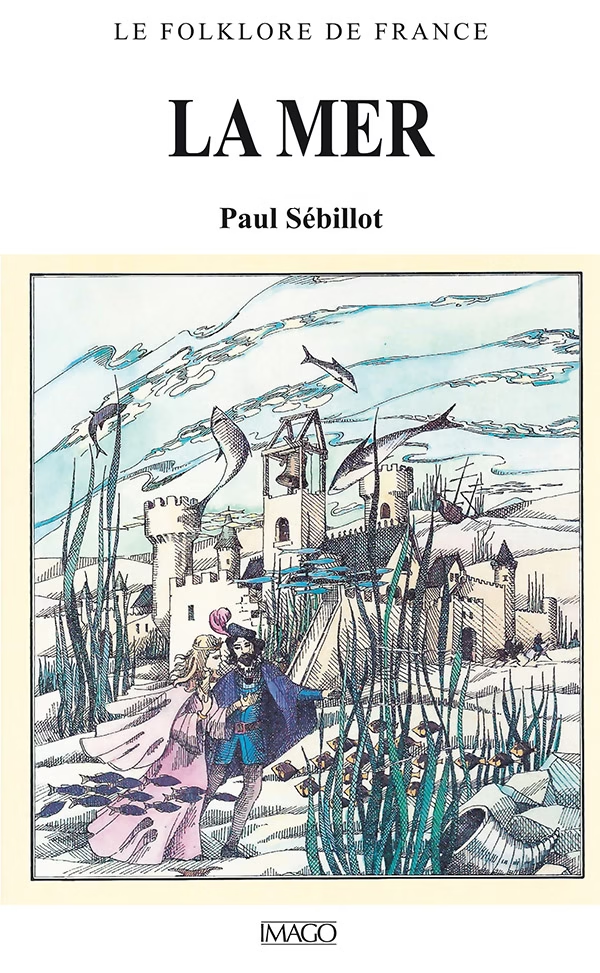
Front Cover of The Sea, by Paul Sébillot
When Legends of the Sea was being prepared between 1886 and 1887, a difficulty quickly became apparent: outside of Brittany, information relating to maritime beliefs remained scarce and scattered. Faced with this lack of documentation, the author undertook to gather testimonies personally by creating a questionnaire designed to encourage local investigations. The initiative, however, met with only limited success. Few correspondents responded to the appeal, and the results remained modest outside Breton territory. A few years later, the situation improved thanks to the Review of Popular Traditions. By opening a section devoted to the sea and waterways, the author was able to publish numerous examples from different regions and thereby facilitate the collection of new traditions. This effort gradually brought to light an oral heritage that had often been overlooked, yet was deeply rooted in popular beliefs and traditions.
Traditional beliefs are not limited to the sea known by sailors and fishermen. In popular imagination, other oceans exist, lying far beyond the visible world. Some traditions speak of a celestial sea, a mysterious expanse occupying the heights of the sky. Others tell of an underground sea hidden deep within the earth. Added to these ideas are stories describing unseen extensions of the ocean flowing beneath the ground, or attempting to explain the place our world occupies in relation to the waters that surround it.
3. The Sea Created by God, by the Devil, or Carved by Birds
Duality Between Satan and God
Along the French coast, when people were once asked about the origin of the ocean, the answer often seemed self-evident. For many, the sea had existed since the beginning of the world and had even covered the earth before the appearance of the continents. This view is not unique to French maritime communities; it is found in numerous cosmologies around the world, whether among the peoples of the New World, Polynesia, India, Persia, Classical Antiquity, or the Biblical tradition.
In the Bay of Saint-Malo, some fishermen told that God created the sea from a simple bowl of water into which He added three grains of salt. This single act was said to have given the ocean its salty taste for all eternity. But other tales, probably older, offer a different explanation. In these versions, the sea does not exist from the beginning of the world; instead, it appears after the creation of the earth.
In Brittany, several legends are based on a dualistic view of creation. God and the Devilplay opposing yet complementary roles. According to these beliefs, whenever God creates something beautiful or useful, Satantries to imitate Him. For this reason, he is sometimes nicknamed “God’s Ape”. His efforts, however, never fully succeed: where God creates harmony, the Devilproduces only imperfect or harmful works. After God had fashioned the dry land, Satanis said to have created the waters in the hope of swallowing up His creation. The ocean thus becomes the result of a rivalry between the forces of good and evil, a theme found throughout many European traditions.
Other tales assign an unexpected role to birds in the birth of the oceans. In Gironde, peasants told that God had entrusted them with the task of digging the bed of the sea using their beaks. A tradition collected in the vicinity of Dinan develops this idea further. According to this version, the story takes place after the Flood. When the waters receded, the earth became so dry that no springs remained. To remedy the situation, God commanded all the birds to journey to Paradise. Each was to collect a drop of dew from the heavenly trees and carry it back to a designated place. The birds obeyed at once. Trip after trip, the drops accumulated until they formed the sea as humankind knows it today.
Only one bird refused to take part in this work: the woodpecker. The legend says that while all its companions carried out the divine mission, it remained apart. This act of disobedience earned it a special punishment. Godis said to have condemned it to never drink from rivers, ponds, or springs. According to a popular belief that remained widespread for a long time, the woodpecker can quench its thirst only by catching raindrops as they fall from the sky. This tradition, recorded by Lucie de V. H. in the Review of Popular Traditions, 08/01/1901 (Vol. XVI, p. 420), perfectly illustrates the way folklore linked the origin of natural phenomena to symbolic narratives. Behind the creation of the sea lie stories in which God, the Devil, birds, and even the humblest inhabitants of the forests each play their part in turn.
4. It Comes from an Inexhaustible Barrel
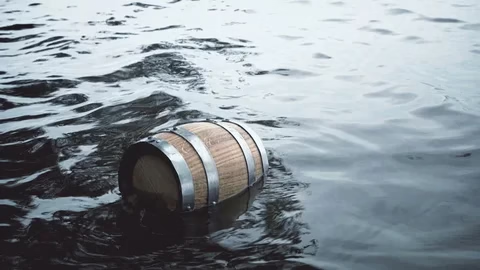
Barrel Floating on the Ocean
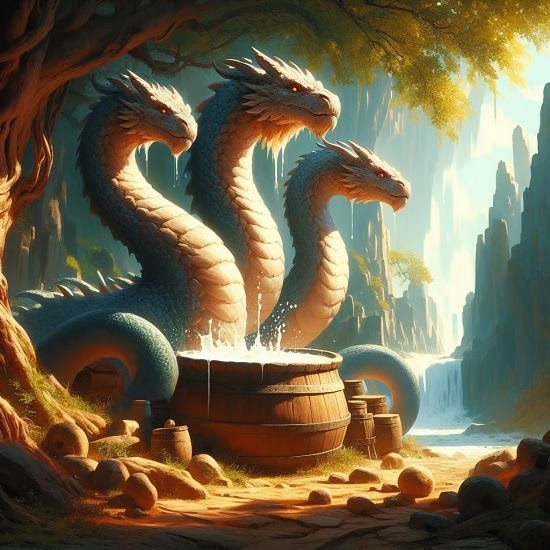
Among the many tales that seek to explain the birth of the oceans, some feature marvelous objects endowed with extraordinary powers. In the folk traditions of Brittany, a legend collected in Binic, in the Côtes-d’Armor, attributes the origin of the sea to nothing more than a small barrel.
According to the tale, there was once a time when springs were extremely scarce. Those fortunate enough to possess one generally refused to share it with their neighbors. One day, Godwas traveling across the earth accompanied by Saint John and Saint Peter. Weary from their journey, the three travelers asked for a glass of water at several homes. Everywhere, they were turned away. Not a single inhabitant was willing to share even a drop. It was only when they arrived at the home of a humble old woman that they finally found hospitality. The good woman welcomed them generously, offering everything she had despite her poverty. More than that, she refused the reward they wished to give her.
To thank this charitable woman, God gave her a small barrel that Saint Peter had been carrying under his arm. Before departing, He gave her a simple instruction: the first wish she made when opening the barrel’s spigot would be granted immediately. A few days later, as she returned home on a Wednesday evening, the old woman discovered that she no longer had a single drop of water. Her situation was all the more troubling because a local lord had forbidden anyone, under penalty of death, from drawing water from the springs between Thursday and Saturday. It was then that she remembered the mysterious gift.
She opened the barrel’s spigot with the simple wish of obtaining water. At once, a stream of perfectly pure water began to flow. But an unexpected problem arose: she could no longer shut off the spigot. The water continued to pour out without interruption. Before long, the flood overflowed the house and spread across the surrounding land. The water level rose higher and higher until it submerged the entire country. The inhabitants who had refused to help the travelers were drowned and, according to the legend, transformed into fish. Only the old woman escaped the disaster by taking refuge atop a mountain.
The story does not end there. The marvelous barrel is said to be pouring out water even today. From this inexhaustible flow were born not only the sea, but also all the rivers and streams of the world. As long as the barrel is not empty, the storytellers explain, the oceans will never cease to exist and the rivers will continue to flow.
Reported by Paul Sébillot in Legends of the Sea (Vol. II, pp. 331–333), this story belongs to a family of tales found in several parts of the world. Among certain Indigenous peoples of Vancouver, one tradition tells of a gigantic basket that once contained all the water on earth. When a slave stole it from its owner, a giant, its contents spilled out and formed the seas. Another legend, collected in Brazil by Alexandre José de Mello Moraes, attributes the birth of the ocean to a sacred gourd that shattered upon the ground, releasing waters capable of flooding the entire world.
5. The Saints’ Urine
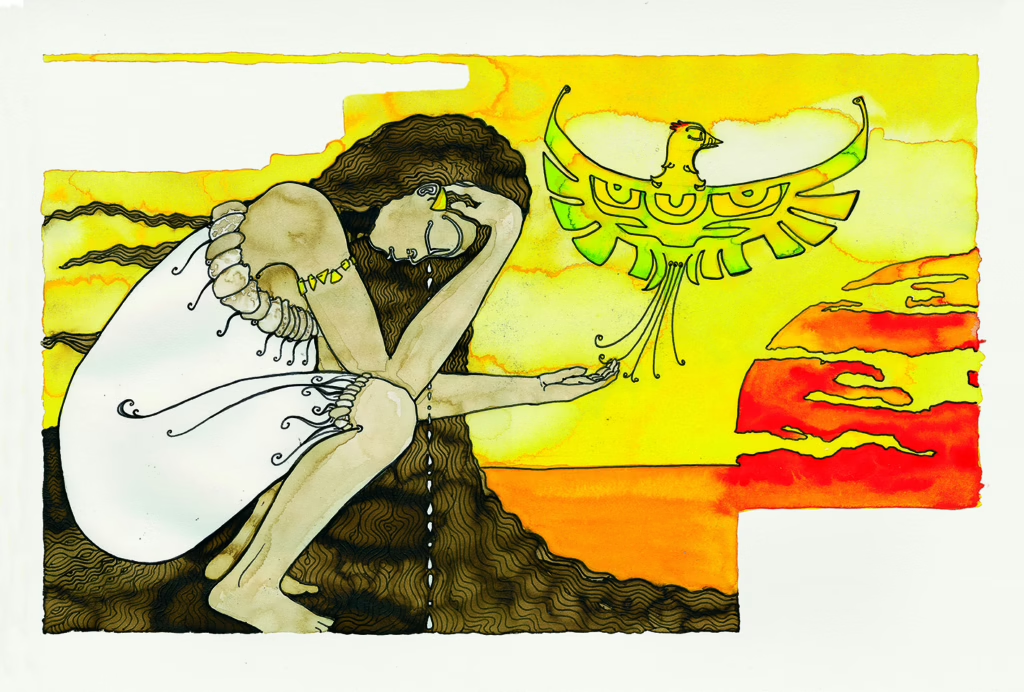
Illustration of the Polynesian goddess Hina
According to the sailors of the Bay of Saint-Brieuc, there was a time when the Sundid not remain in the sky. In this tradition, it appears as a living being, probably a giant similar to those frequently encountered in Breton folktales. One day, it descended to the earth and settled there. Its presence quickly brought disaster. The heat became so intense that many people perished, suffocated or burned by its rays. Faced with this calamity, the survivors prayed to God and begged for His protection. Moved by their pleas, Goddecided to intervene. He sent all the saints of Paradisedown to earth to command the Sun to return to its place in the heavens. But despite their orders, the celestial body stubbornly refused to leave. The saints then chose a most unexpected method.
Unable to persuade the rebellious celestial body, the saints began to urinate without stopping. Day after day, the water accumulated. After eight days, the storytellers say, the entire earth was covered by a vast expanse of water. Seeing the waters rising around him, the Sun became frightened. Fearing that he would be swallowed up, he finally abandoned the earth and returned to the sky. Since that episode, the legend claims, he has never again left his place. The immense mass of water left behind became the sea.
The tale also provides an explanation for another ancient question: the origin of the salt contained in the ocean. For the storytellers of the Bay of Saint-Brieuc, the answer is simple. If seawater is salty today, it is precisely because it comes from the urine of the saints themselves. This folk interpretation thus combines, within a single story, the permanent placement of the Sun in the heavens, the creation of the sea, and the salinity of its waters.
As surprising as it may seem, this legend belongs to a much broader tradition in which liquids produced by supernatural beings shape the landscape. French folklore notably attributes the creation of certain springs, rivers, and ponds to Gargantua or Mélusine through comparable means. Similar stories can also be found in other cultures. On Nuku Hiva, in Polynesia, the female deity Hinais likewise said to have created a saltwater lake through an act of the same nature.
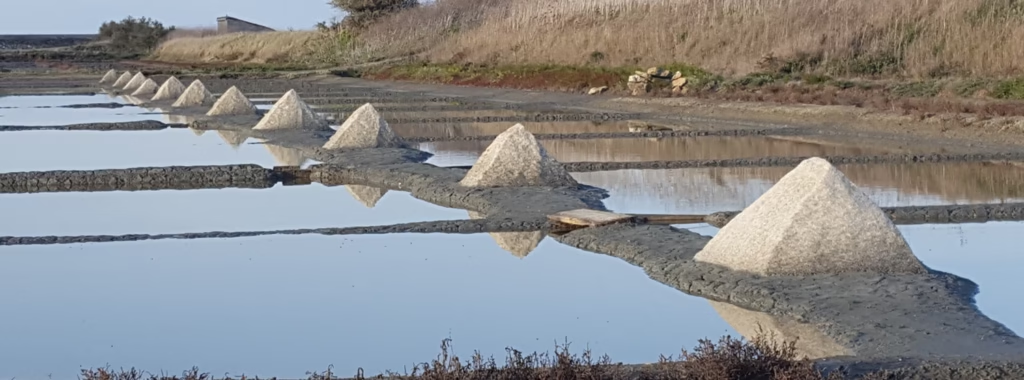
6. Salt Production and Salt Quarries
Salt Marshes of Île de Ré
Many other legendary explanations for the bitterness of the waters of the Ocean have been collected along the coasts of France. In the tale that follows, the Sea appears as a kind of living character—one that can be spoken to, can move about, and possesses all the emotions of a human being. This animistic conception reappears in many different contexts and is also reflected in the expressions used to describe the sea’s various moods and conditions.
Pendant l’absence d’un capitaine au long cours un puissant seigneur avait enlevé sa femme ; la Sea indignée de ce rapt, submergea le château où il la retenait prisonnière, mais eut soin d’épargner la dame. A son retour, le capitaine vint remercier la Sea, et lui dit que, si elle voulait le suivre, chacun admirerait désormais le goût de ses eaux. Elle accepta, et il la conduisit dans un pays rempli de carrières de sel : c’est en les baignant qu’elle a acquis la salure qui lui est particulière.
Moreover, in Upper Brittany, where this legend was told, people believed that the sea covers vast mountains of salt. In the Bay of Saint-Brieuc, it was also said that beneath its waters lie volcanoes in constant eruption, spewing forth flames and salt.
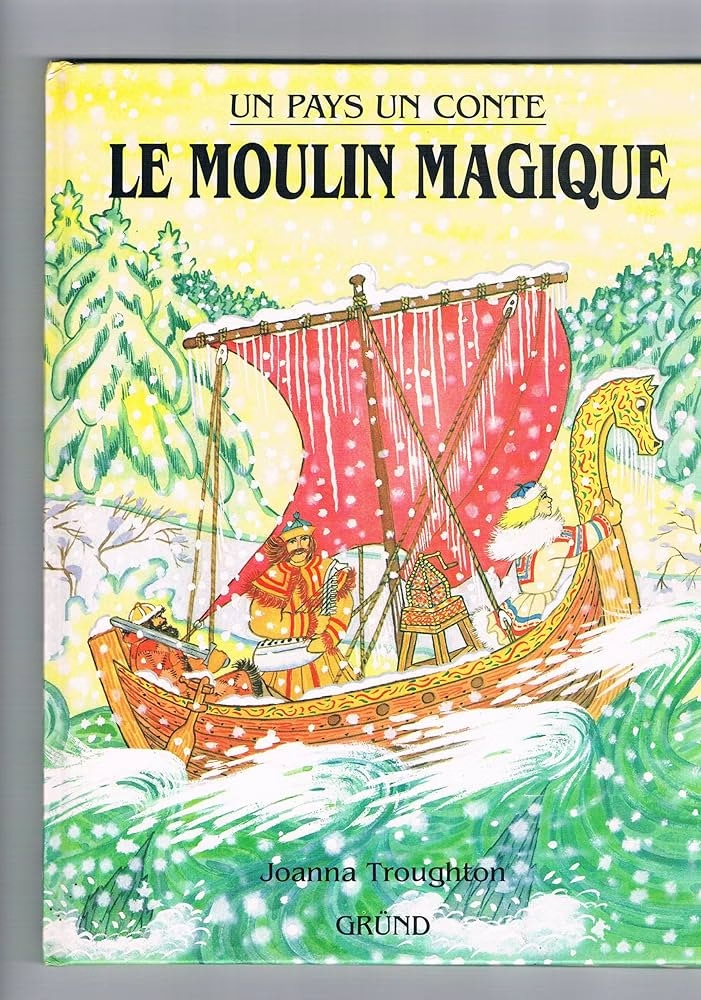
7. The Magic Mill; The Vessel Filled with a Bitter Drink
The wondrous mill to which Scandinavian and Finnish traditions attribute the salting of the sea is also known along the shores of the English Channel. A Newfoundland fishing captain stole from a sorcerera mill that could grind whatever it was asked to produce. Once at sea, he ordered it to grind salt, and the ship’s hold was soon filled with it. But because he did not know the words needed to stop the magical device, the vessel sank along with the mill, which continues to grind salt to this day (read the tale here). This story closely resembles the final episode of a much more detailed Norwegian folktale, and it is possible—though not certain—that sailors of the Breton Channel coast, who maintained frequent contact with those of Norway, adapted a tale they had heard from them and reshaped it in their own way.
This marvelous talisman appears to be unknown in the Tréguier region, where people say that the sea owes its bitterness to the ships laden with salt that have been swallowed by its waters since the beginning of the world. It is believed that the sea will become increasingly salty as more vessels carrying the same cargo are wrecked and lost beneath the waves.
Sometimes, all it took to alter the taste of the sea forever was the casting into it of a vessel filled with a magical or exceptionally bitter liquid. According to a Basque tale, which appears to have been embellished but may preserve some older elements, Amigna, the oldest of the Euskarian fairies, became angry because her husband complained that her broth was too salty. In a fit of irritation, she seized the cooking pot and hurled it into the Ocean, where it shattered against an enormous rock. Ever since that time, the sea has been salty. According to a literary tale that its author claimed to have heard in Gascony, the salinity of the sea is explained by a similar event. One Easter day, the angels had prepared an exquisite soup for the inhabitants of Paradisewhen the Devilmanaged to pour into it the contents of an enormous salt cellar. When the Lordtasted the soup, it was so unbearably salty that He seized the pot that contained it and hurled it through the air. It fell into the Ocean and made its waters salty forever.
The motif of a liquid powerful enough to alter the taste of the waters is also found in Upper Brittany. A fairy, in love with a fisherman, uses her enchantments to compel him to come to a rock along the shore. She appears before him, beautiful as the Virgin Mary, whispers the sweetest words to him, and offers him a cup filled with a magical drink, inviting him to taste it. Had he drunk it, he would have been forced to love her and follow her forever. Just as the young man was about to touch the cup to his lips, he remembered his fiancée and hurled the vessel into the sea. As the enchanted liquid spread through the waters, it made them bitter as they are today, for before that time the sea had not been salty.