Engraving of the Monk the Venerable Bede, Magos Foundation Collection
Before the astronomical mechanisms behind the tides were understood, the inhabitants of the French coasts sought to explain why the sea advanced and then retreated with such remarkable regularity. These folk beliefs, recorded primarily along the Breton coast, blend observation, analogy, and marvelous tales. They reflect an effort to make sense of a daily phenomenon that governed the lives of fishermen, sailors, and coastal communities.
According to a widespread belief in Brittany, the sea could not rise in one place without immediately falling along the opposite shore. The old people compared this movement to the water in a container: when one side rises, the other must necessarily sink. Alongside this explanation was an even more remarkable tradition, preserved as far inland as regions far from the coast. People said that at low tide, the sea literally left the Earth and ascended into the sky. The water was believed to spend six hours in the heavens before returning over the next six hours to refill the oceans.
Along certain stretches of the Breton coast, another belief attributed the movement of the tides to the action of the Sun. For six hours, the heavenly body was thought to draw up part of the sea's waters. According to this tradition, it removed the salt before sending back to the ocean water that had become pure, which then took another six hours to return the sea to its usual level. This folk explanation illustrates how coastal communities linked the great phenomena of nature to the daily cycles of the heavens.
The Moon also holds an important place in Breton tradition. It is portrayed as the force that continually compels the sea to advance and then retreat. According to the legend, this endless motion is a punishment inflicted upon the sea for having once flooded the lands where the salt quarries were located—a mythical event to which folk tradition also attributes the origin of the oceans' salinity. The tides thus become a perpetual reminder of that ancient transgression.
Marvelous explanations for the tides are not unique to Breton folklore. As early as the Middle Ages, the monk the Venerable Bede, referred to here as the Pseudo-Bede, recorded a belief that an enormous serpent was responsible for the phenomenon. The creature swallowed the waters of the sea before disgorging them some time later, alternately producing the ebb and the flood tides.
Along certain shores of the English Channel, another legend presents a similar idea in a different form. At the bottom of the ocean lies a well of unfathomable depth, inhabited by a gigantic Trombe—not a waterspout or meteorological phenomenon despite its name, but a living creature. Every six hours, it draws part of the sea's waters down into the abyss, thereby causing the ebb tide. Eager to keep the water for itself, it refuses to give it back. But the Dalu, a sacred wind, guardian of the sea and the Trombe's enemy, regularly compels the creature to return what it has swallowed. The waters' release then gives rise to the flood tide.
2. Miraculous Tides
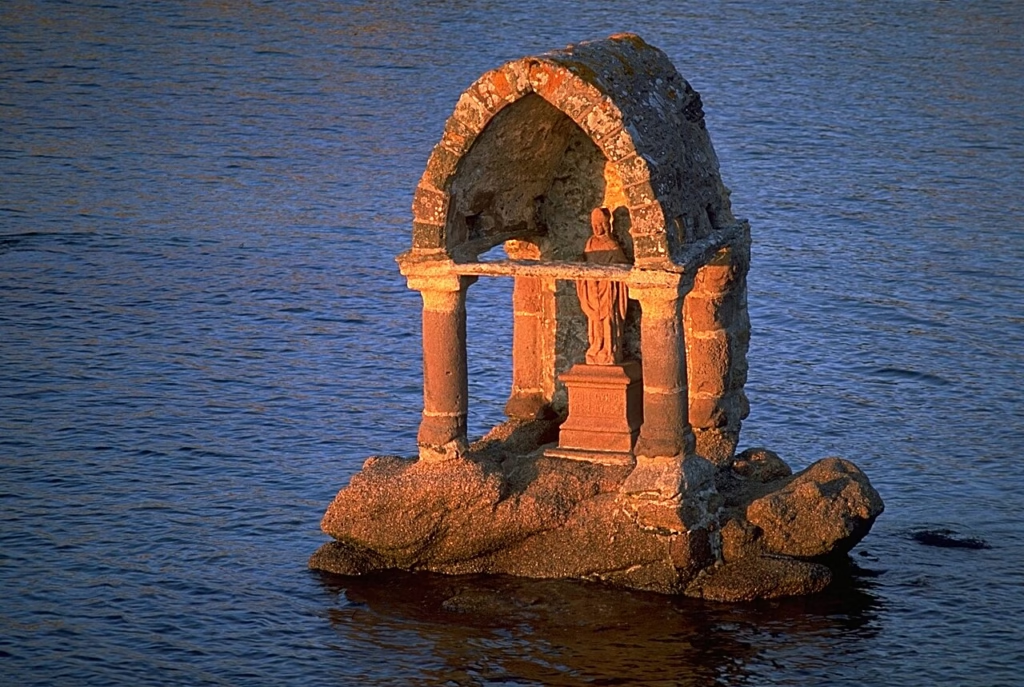
Oratory of Saint Guirec (Kirek) on the Beach of Saint-Guirec Cove
The tide is not merely a natural phenomenon. It can suspend its course or alter its rhythm whenever Heaven wishes to protect pilgrims, honor a saint, or show favor to certain individuals. Several Breton sanctuaries preserve the memory of miraculous tides. At Ploumanac’h (formerly in the Côtes-d’Armor), on the feast day of Saint Kirek (or Guirec), the sea was said to recede before the saint's statue and his oratory. At Loaven, people recounted that the tide delayed its rise by an hour to make it easier for pilgrims to reach the shrine of Saint Liboubane (Eliboubane). A similar tradition also existed at Concarneau. Whenever the procession of the Feast of Corpus Christi made its way around the town walls carrying the Blessed Sacrament, the sea would withdraw if the tide was high, allowing the faithful to complete the entire circuit of the town.
Mont-Saint-Michel lies at the heart of several miraculous tales dating back to the Middle Ages. According to Jacques de Voragine, the sea that normally surrounds the mount parted twice on the feast day of Saint Michael, revealing a passage for pilgrims. Another legend tells of a pregnant woman who was caught by the sudden return of the tide. While the other pilgrims fled, the Archangel protected her. She gave birth amid the waters and then safely reached the shore, as the sea had parted to open a path before her.
The miracles attributed to Saint Michael sometimes serve as moral lessons. An old collection of sermons recounts the story of a pilgrim who was caught by the rising tide. In a panic, he cried out:
« Saint Michel, délivre-moi du danger et je te donnerai ma vache ! »
“Saint Michael, deliver me from this danger, and I will give you my cow!”
The tide, however, continues to rise. He then promises even more:
« Saint Michel, sauve-moi, et je te donnerai la vache et le veau ! »
“Saint Michael, save me, and I will give you the cow and the calf!”
Once he reaches the shore safe and sound, he immediately forgets his promises and declares:
« Ni la vache ni le veau. »
“Neither the cow nor the calf.”
Étienne de Bourbon recounts a similar version of this story, which he attributes to Bretons driving a cow and her calf to market.
Historical chronicles occasionally interpreted certain maritime phenomena as signs of Divine Providence. Thus, during the siege of Quimper by Charles of Blois, claimant to the Duchy of Brittany in the 14th century, it was said that the tide remained motionless from six o'clock in the morning until noon, precisely during the assault that led to the capture of the city. Another episode concerns Louis XI and his brother Charles of France. As they met near the mouth of the Sèvre River to be reconciled, the tide—although expected to be the highest of the year—rose about four feet less than predicted. The king himself interpreted this as a sign that God approved of their reconciliation.
If saints could command the waves, some traditions attributed the same power to magicians. The famous Michael Scot, renowned for his occult knowledge, was said to possess the ability to make the sea advance or retreat at will. A legend from Guernsey ascribes a similar power to the Prior of Lihou, who was deeply devoted to magic. Before setting out, he entrusted his mysterious Grand Mêle to his servant, strictly forbidding him to open the book. Curiosity, however, got the better of him. The servant began reading the magical spells. At that very moment, the prior, who was crossing the sea toward his small island, looked on in astonishment as the tide began to rise far more quickly than expected. Realizing that his servant had disobeyed him, he shouted for him to recite the incantations in reverse. The servant obeyed, but too late: before the spell could be completed, the sea had already swallowed the prior.
3. The Influence of the Tides on Living Beings and Plants
Portrait of Pliny the Elder
Along the French coasts, and especially in Brittany, the tides were regarded as far more than a simple natural phenomenon. They were believed to be a force capable of influencing all living beings. Much like the influence attributed to the heavenly bodies in inland regions, the ebb and flow of the tides were thought to govern births, health, death, animals, and even certain agricultural activities.
Certain folk beliefs linked the tides to the destiny of newborn children. In Finistère, people said that boys were conceived during the rising tide, while girls were conceived during the falling tide. Along the Boulogne coast and throughout much of Brittany, children destined for an exceptional future were believed to be born on the rising tide. Around Saint-Malo, the belief was even more specific: a man destined for greatness—and especially one fated to become a distinguished sailor—had to be born while the tide was rising. Near Saint-Brieuc, Christmas Eve was thought to hold particular significance. A child born on the rising tide was destined to command a ship, whereas one born on the falling tide was believed to be fated to perish in a shipwreck.
The tides were also believed to influence the condition of the sick. In the Tréguier region and throughout much of the Breton coast, suffering was thought to increase during the rising tide. Patients experienced a measure of relief at slack tide, before their condition improved as the sea began to recede. Other traditions claimed exactly the opposite. In the Bay of Saint-Malo, strength was believed to return with the rising tide, illnesses reached their peak at high tide, and patients weakened again as the tide ebbed. Still in the Saint-Malo region, a child born on the falling tide—especially at mid-tide—was believed to suffer from epilepsy during certain phases of the Moon and whenever the sea returned to the same stage of its tidal cycle.
The idea that the tides accompany death dates back to Antiquity. Pliny the Elder already recorded (Natural History, Book II, CI.) the belief that people died only during the ebb tide, a claim that, according to him, had been confirmed by observations made along the coasts of Gaul:
« CI. (XCVIII) [1] Toutes les mers se purgent à la pleine lune, et quelques-unes dans une saison déterminée. Auprès de Messine et de Myles, les flots rejettent sur le rivage des ordures semblables à du fumier, d’où la fable que les bœufs du Soleil ont là leurs étables. A cela Aristote (car je ne veux rien omettre sciemment) ajoute qu’aucun animal n’expire, si ce n’est au reflux. Ce fait a été l’objet de beaucoup d’observations dans l’Océan des Gaules, et il ne s’est vérifié que sur l’homme. »
“CI. (XCVIII) [1] All seas are cleansed at the full moon, and some at a particular season. Near Messina and Mylae, the waves cast ashore refuse resembling manure, giving rise to the fable that the cattle of the Sun have their stalls there. To this Aristotle—for I wish to omit nothing knowingly—adds that no living creature dies except at the ebb tide. This claim has been the subject of many observations on the coasts of Gaul bordering the Ocean, and it has proved true only in the case of human beings.”
At Boulogne, as well as on Guernsey, the expression “to go out with the tide” simply meant to die. In parts of Lower Brittany, however, the opposite belief prevailed: people maintained that it was the rising tide that claimed the greatest number of lives.
Les marées imposaient également de nombreuses règles de conduite. En Upper Brittany, il était déconseillé de faire des grimaces ou des contorsions lorsque la mer montait, sous peine de conserver définitivement ces déformations. Se couper les cheveux au moment du flux exposait, disait-on, à attraper un gros rhume. À l’inverse, plusieurs pratiques étaient recommandées pendant la marée descendante. C’était le meilleur moment pour prendre des bains, nettoyer les plaies ou puiser l’eau destinée aux purgations, la baisse des eaux étant supposée entraîner avec elle les maladies.
Les animaux n’échappaient pas non plus à cette influence. En Lower Brittany, un chien qui buvait l’écume déposée sur le rivage à la fin du reflux devenait, disait-on, inévitablement enragé. Les chiens atteints d’hydrophobie étaient réputés sentir l’arrivée de la marée montante. C’est alors que survenaient leurs accès de fureur, tandis qu’ils perdaient leur agressivité lorsque la mer redescendait. Les chats occupent également une place importante dans ces croyances. Dans le Finistère, la couleur et la taille de leur pupille étaient censées changer au début du flux. En Upper Brittany, certains affirmaient même pouvoir connaître l’état de la marée en observant simplement les yeux d’un chat. Enfin, sur l’ensemble du littoral breton, on attendait toujours la marée descendante pour mettre les œufs à couver.
Les activités quotidiennes étaient elles aussi réglées par le mouvement des eaux. En Upper Brittany, le lait fraîchement trait ou l’eau puisée pendant la marée montante entraient plus rapidement en ébullition. Lorsque le beurre tardait à prendre dans la baratte, on expliquait ce retard par le fait que la mer était encore montante. Il fallait attendre le reflux pour que le beurre se forme correctement. Les édredons et les matelas remplis de plumes d’oiseaux marins étaient également réputés se gonfler au moment du flux.
Les travaux agricoles et l’élevage obéissaient eux aussi à ces règles. En Upper Brittany and in Boulonnais, on préférait tuer les cochons pendant la marée descendante. Dans le Finistère, la pratique variait selon le sexe de l’animal : les truies étaient abattues au reflux, tandis que les porcs mâles devaient être saignés à marée montante. On croyait alors que le lard monterait dans le saloir comme la mer monte sur le rivage. Pour cette même raison, le salage de la viande s’effectuait souvent pendant le flux. Certaines cultures dépendaient également des marées. Dans le pays de Tréguier, on évitait de semer le trèfle à marée descendante, de peur que les vaches qui le consommeraient n’en meurent. En Upper Brittany, on estimait plutôt que le trèfle perdrait prématurément ses graines si les semailles avaient lieu au mauvais moment.