The Treasures of the Lamignak and Margot the Fairy
1. Treasures of the Lamignak
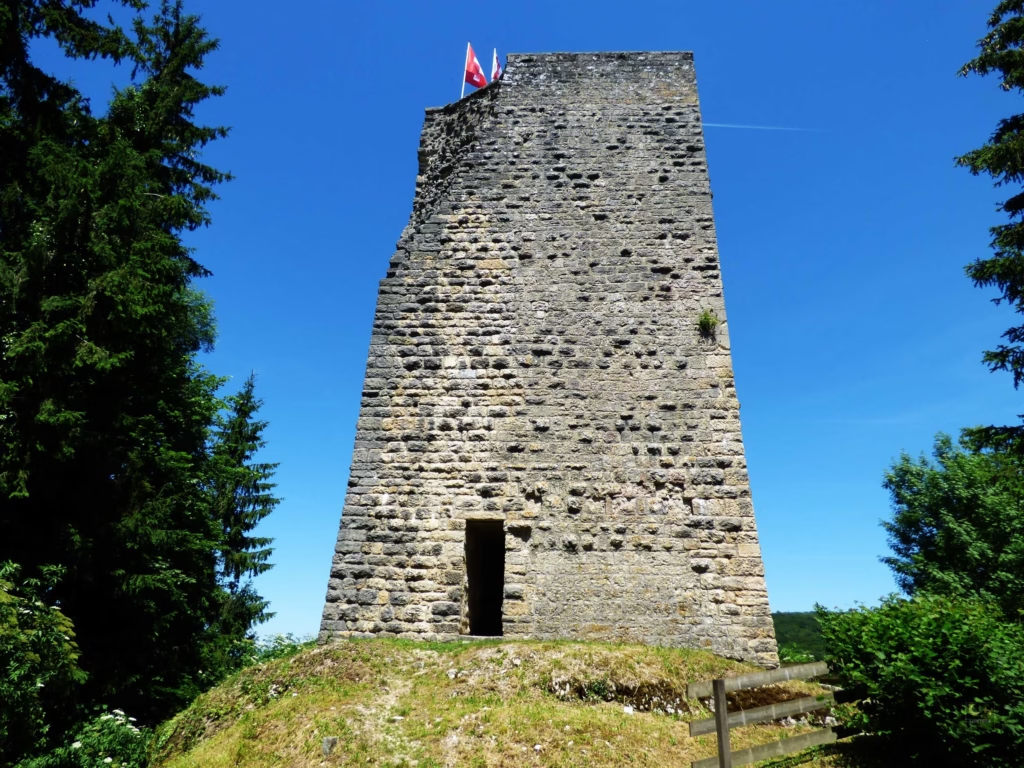
In Franche-Comté, Aunt Arie — sometimes called the Lady of Milandre — was said to watch over treasures buried deep inside caves. Tradition placed her dwelling in a dark grotto near the Castle of Milandre, between Delle and Montbéliard. According to local tales, a strange force drew visitors deep into this cavern, “like a magnet.” The fairy appeared there seated upon her strongbox, holding between her transparent teeth two keys as red as fire. It was said that anyone who could discover, in some ancient grimoire, how to seize those keys without being burned would gain access to the treasure and become immensely wealthy. (read the text here)
Another tradition, however, claims that the key to the chest was held between the teeth of a fire-breathing dragon deep within the cave itself. Some versions of the legend also say that once every century, the gold coins emerged from the underground cavern to glitter in the moonlight. Anyone who knew the exact day and hour could gather them without facing any danger.
An old Béarn tradition also surrounded the Castle of Beaumont-sur-l’Osse, which was said to conceal a treasure guarded by fairies within an underground chamber. A local proverb declared:
« Que bau mez et casteyt d’Ousse
Que toute France e Saragousse. »
In other words:
“The Castle of Osse is worth more than all of France and Saragossa.”
Every Maundy Thursday, children would gather near the site singing:
« Hate, hate, da-m argent, que-t darèy leyt e bren. »
Which means:
“Fairy, fairy, give me money, and I will give you milk and bran.”
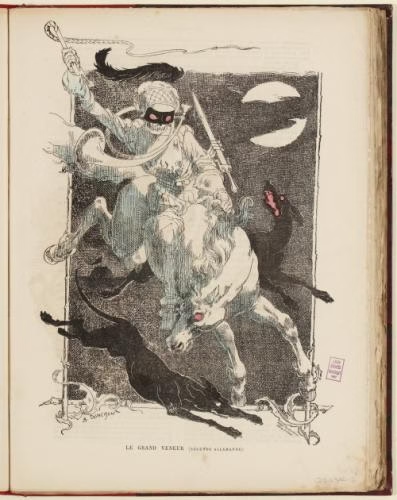
the mysterious treasures of the Lamignak are said to be hidden deep within caves reached through long underground passageways. These dark tunnels were believed to be broken by deep chasms filled with piles of gold coins. Near the village of Arbouet, several local men reportedly attempted to seize one of these treasures. Carrying a book meant to break enchantments, they entered the cavern. A cat first appeared before them. The animal behaved in an oddly familiar way, rubbing against them before vanishing into the darkness. Soon afterward, a serpent emerged in turn. It coiled itself around the men and brushed their faces with its tongue. Despite the strangeness of the encounter, the visitors did not give in to fear: the power of the reading seemed to protect them. Just as they believed they could already see the outline of a chest filled with gold rising from the ground, a terrifying apparition suddenly appeared — a headless man riding a white horse. The horror of the vision was so overwhelming that they immediately abandoned their quest and fled the cave.
Another legend tells of a shepherd who entered a cave of the Lamignak and beheld supernatural wonders inside. He then asked a Lamigna to give him a golden candlestick, which he later placed in Saint-Sauveur as an offering. According to another version of the tale, this precious candlestick had actually been stolen from a wild lady who was combing her hair with a golden comb. (read the legend here)
2. Treasures of Margot the Fairy and the Goblins
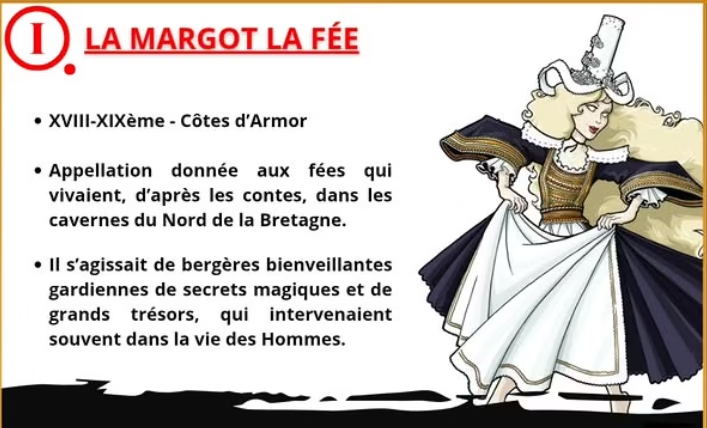
Popular traditions of the Côtes-d’Armor attribute immense hidden riches to the mysterious Margot-la-Fée. One of these fairies once gave a key to a poor tailor. She explained that it opened three doors behind which treasures were hidden, and that he could take whatever he wished. The man entered an underground passage leading to a gallery where three enormous heaps of coins were piled high. Upon the first, made of gold louis, rested a white sheep; upon the second, made of silver coins, stood a slightly less white sheep; upon the last, formed of copper coins, watched a gray sheep. The white sheep asked the tailor who had sent him, then allowed him to draw from the treasure. The man filled his pockets with gold until he was loaded “like a mule.” The sheep pointed out that, with a sack, he could carry away far more. Overtaken by greed, the tailor emptied his pockets and rushed off to fetch a bag. But when he returned, the doors had vanished.
Near an almost inaccessible cave in the Fier Gorges there supposedly appeared, according to legend, a mysterious White Lady. Whenever storms broke out, her ghost was said to appear bent beneath the weight of a sack filled with coins, leaving visible traces behind her as she passed. Tradition claims that she was the spirit of a cruel castellan’s wife. During a plague epidemic, she is said to have taken refuge inside this cave with her treasures before having its entrance sealed shut. The spirits of darkness were then charged with guarding the passage forever.
The Vendée goblins were likewise believed to possess immense treasures hidden within the impenetrable caves where they lived. In Remonot, in the Doubs region, the famous Treasure Cave — also known as the Devil’s Cave — was said, according to a tradition dating back to the 17th century, to contain riches guarded by a winged dragon. Other tales also speak of vast treasures concealed within the Vaux Cave, near Amancey.
According to an old belief associated with the Balme Cave, in Isère, the Waldensians massacred in this place possessed the sinister power to turn stones into gold ingots. In 1859, men reportedly still attempted to uncover a treasure there by digging at midnight. A few years earlier, a priest accompanied by two sacristans was said to have succeeded in removing from the enchanted vault a stone destined, through magical incantations, to become a block of silver. But by the very next day, tradition says, the stone rose from the ground on its own and returned to attach itself once more to the ceiling of the cave.
3. Treasures Left Behind by Persecuted Peoples: The Difficulties of Seizing Them
The inhabitants of Colombugne told that the Saracens driven from the land of Montmaur had taken refuge in a cave in the mountains. Besieged and refusing to surrender, they were said to have died of starvation inside their shelter. Before perishing, they supposedly hid the treasure of their tribe within a kind of underground pit, sealed inside a dog’s skin. This tale echoes many legends in which defeated peoples leave behind riches that become forever unreachable, as though the earth itself had chosen to swallow them.
In the Hautes-Pyrénées, several tales also circulated about treasures hidden within mountain caves. One of them tells of a shepherd who discovered magnificent silver tableware deep inside a cavern. Dazzled by such wealth, he immediately filled his smock before leaving the place. But scarcely had he emerged from the cave when a red rooster appeared behind him and began chasing him. The creature attacked the poor man so fiercely that, hoping to calm its fury, he gradually threw down the silver pieces he was carrying. One by one, he abandoned all the stolen riches until his smock was completely empty.
4. Times When They Reveal Themselves

The Pietra chiavata, literally “the locked stone,” refers to a cave where the Devil was said to have hidden his treasures. Its name comes from a black stone embedded in the granite, shaped like the handle of a key. One day, a shepherd discovered the entrance open and dared to enter the cavern. By the light of diamonds set into the vault above, he saw a marble table covered with riches and countless garments. He seized a pointed cap and was trying it on when a voice suddenly rang out: “O shepherd!” Terrified, the shepherd fled. But when he tried to retrace his steps, the entrance to the cave had already closed once again. Tradition says that this cave is normally guarded by a demon who leaves his post only during the Midnight Mass. At that exact hour, all the spirits of darkness were believed to descend into Hell to mourn the birth of the Savior. Yet reaching the cave remained extremely difficult: one had to arrive before nightfall in order to avoid the traps and illusions scattered along the path. Only one man is said to have nearly succeeded in reaching the treasure. Just as the door was about to open before him, a goblin climbed onto the rock against which he was leaning and showered his head with a cascade of stones, forcing him to retreat. The treasure of the Fols of Allier is likewise said to lie buried beneath the cave where this tribe once lived. The stone slab covering it is believed to rise on its own at two precise moments:
- during the Midnight Mass of Christmas, at the moment of the Elevation;
- on Palm Sunday, when the priest strikes the church door three times.