Origins and Wonders of French Caves
1. Those who dug the caves
Terrestrial caverns are not ordinarily thought to be the result of human labor; the legends concerning their creation, rare and lacking in detail, are limited to stating the belief; in certain regions, these formations are attributed to mysterious beings:
- in Languedoc and Vivarais, the wondrous caves are said to have been dug by the Doumayselas, also called “maidens”
- at La Boullardière, in Terves (Deux-Sèvres), they are said to have been shaped by goblins before they came to live in them
- in Haute-Loire, the caverns and rocky hollows are said to be the work of ancient wild men
Inside certain caves, one can observe rock formations that resemble human figures or everyday objects. These shapes, produced by natural phenomena, have been interpreted by the people as traces of supernatural transformations. According to these beliefs, fairies were turned to stone, and their objects and furnishings suffered the same fate.
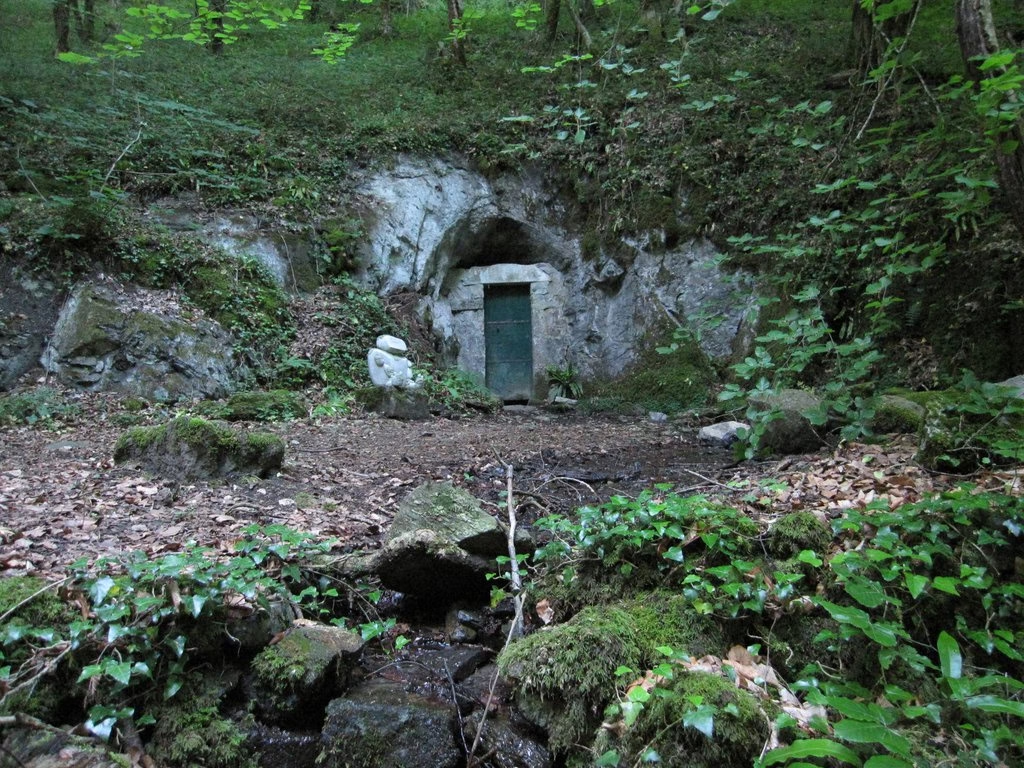
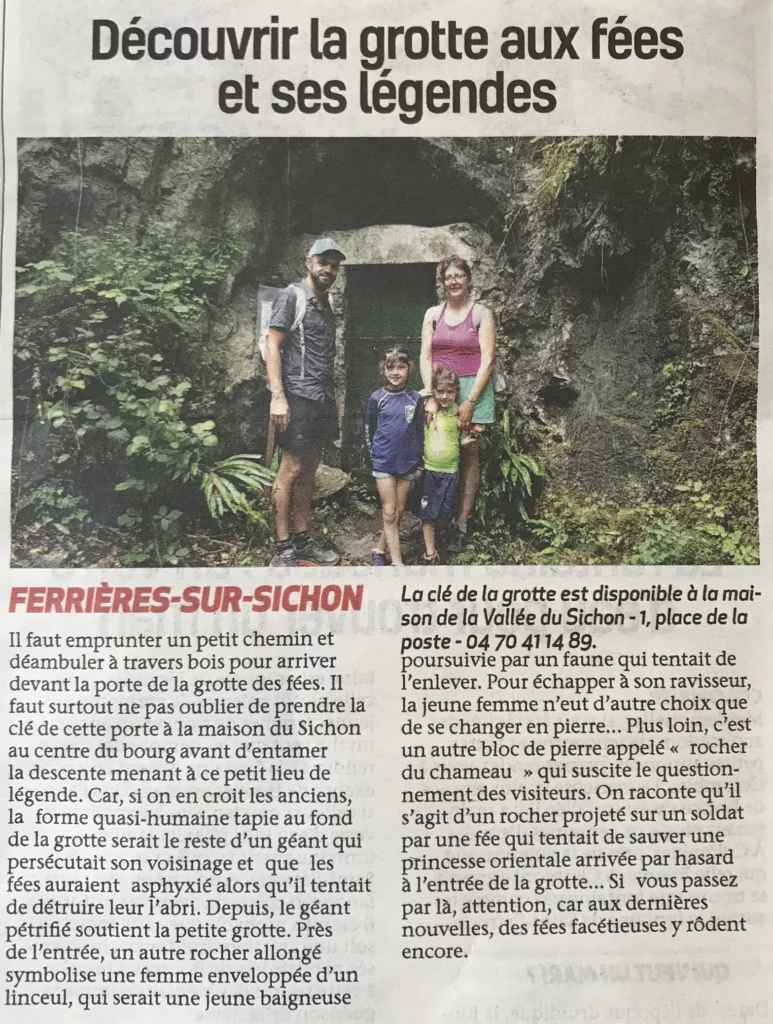
In a fairies’ cave located on the banks of the Sichon, a little downstream from the Fairies’ Spring, water seeping through the vault gradually deposits a الجيريous substance. This phenomenon forms concretions of varied and sometimes striking shapes.
2. Anthropomorphic, animal, or object petrifications
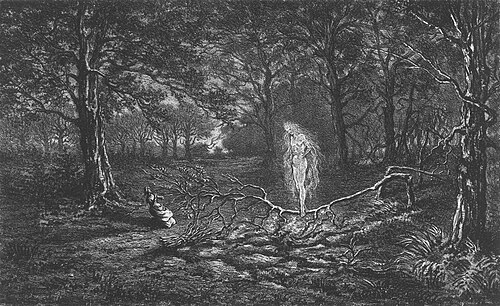
Some rock formations evoke human or animal figures, or everyday objects. These natural shapes, often resulting from geological phenomena, have been interpreted by local populations as traces of metamorphoses. Thus, an elongated block is said to represent a naked woman wrapped in a shroud. According to tradition, it is a fairy who, pursued by a magician rivaling her power, turned herself to stone to escape him.
One of the three superimposed caverns, located in Féterne and known as the Fairies’ Caves, also housed astonishing wonders. In the mid-18th century, Voltaire gave a precise description of them in Des singularités de la nature (chapter XV).
The water that drips into the upper cave, passing through the rock, has traced in the vault the shape of a hen brooding over her chicks. Nearby, another formation suggests a spinning wheel with its distaff. The women of the surrounding area once claimed to have seen, in a recess, a woman turned to stone above the spinning wheel. For a long time, these caves inspired fear: people hardly dared approach them. But since the female figure has disappeared, the inhabitants have become less fearful.
In another region, in the area of Liège, a cave called Trou del Heuve offers an equally unsettling sight. In the shadows, one can make out two white shapes resembling ghosts with long veils, known as Marguerite and Pierrette. Farther on, other stalagmites with human-like forms appear. Arranged in a square, they surround a massive, shapeless stone that the locals call the Bayard Horse.
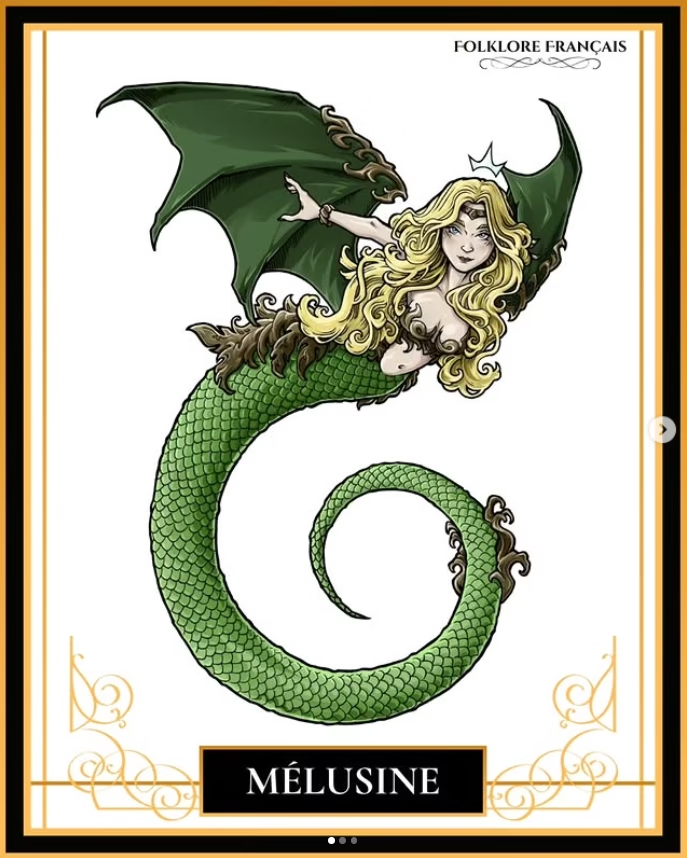
Around 1820, the inhabitants living near a cave of the Périgord, once inhabited by fairies, said that one could still see there a cradle where they hid their infants. One could also make out the imprint of a horse, a mule, as well as other equally enigmatic marks. In a cave of the Dauphiné, a natural basin is said to have served as a bathtub for Mélusine when she lived there. Not far from there, a flat stone, called Mélusine’s Table, is said to have been the place where she took her meals. Farther north, the fairies of Vallorbe lived in a two-tiered cave. They were said to make their natural organ buffet, formed by stalactites, resonate, producing melodious sounds that delighted visitors.
These mysterious musics may perhaps find their origin in natural acoustic phenomena. Near the grotte d’Espezel, peasants once believed the place to be haunted by fairies. In reality, the sound of the waters of the Rebenty, amplified and transformed by underground echoes, produces surprising effects. Depending on the location, these sounds sometimes become a harmonious murmur, sometimes powerful rumblings reminiscent of the majestic organs of cathedrals.
3. Dimensions of Small Caves and Their Decline
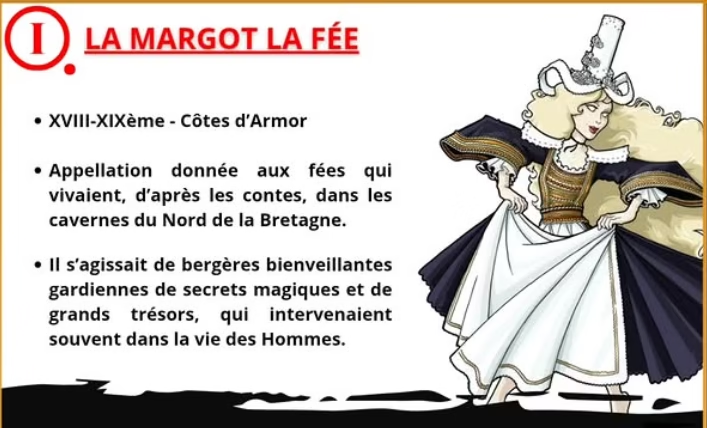
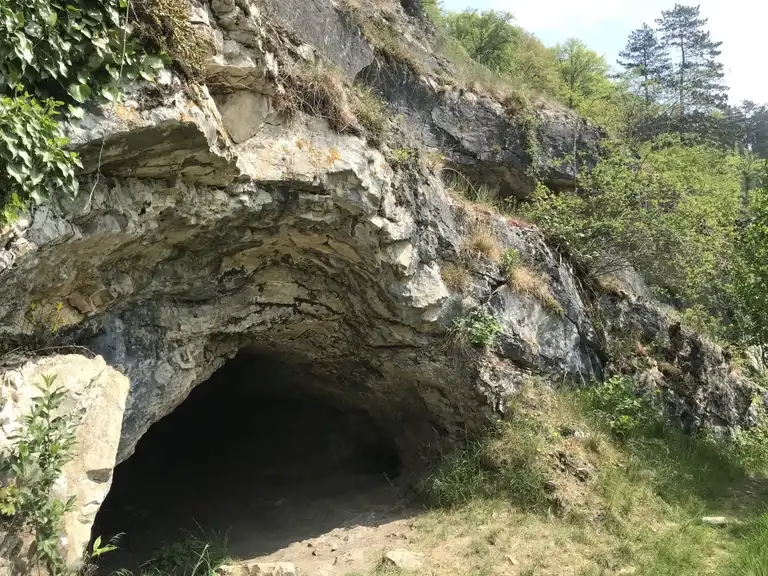
Contrary to the spectacular image often associated with caverns, not all of them had monumental proportions. Some were even discreet, almost invisible, as if they sought to escape the human gaze. These caverns were not always comparable to the great balmes of the Dauphiné, sometimes preceded by a vast natural porch. On the contrary, the dwellings attributed to the Margot-la-Fée, on the mountainous plateau of the Côtes-d’Armor, most often opened near large stones scattered across the hills or along streams. Their entrances were sometimes so discreet that they went unnoticed: a simple crack between two superimposed blocks, a narrow gap in the rock. To enter, one often had to crawl, as if crossing a threshold reserved for those who dared venture into the unseen.
Yet popular tales tell a very different story. Peasants claimed that in the time when these places were inhabited by supernatural beings, their entrances were vast, comparable to the doors of a church. With their departure, everything is said to have changed. The openings would have gradually collapsed, as if the magic that held them open had faded away. In Normandy, this idea took on an even more striking form: it was said that the entrances to the caves were shrinking day by day. A slow, almost imperceptible disappearance, suggesting that one day they would be completely sealed—taking with them the last remnants of an ancient world.
4. A Miniature World
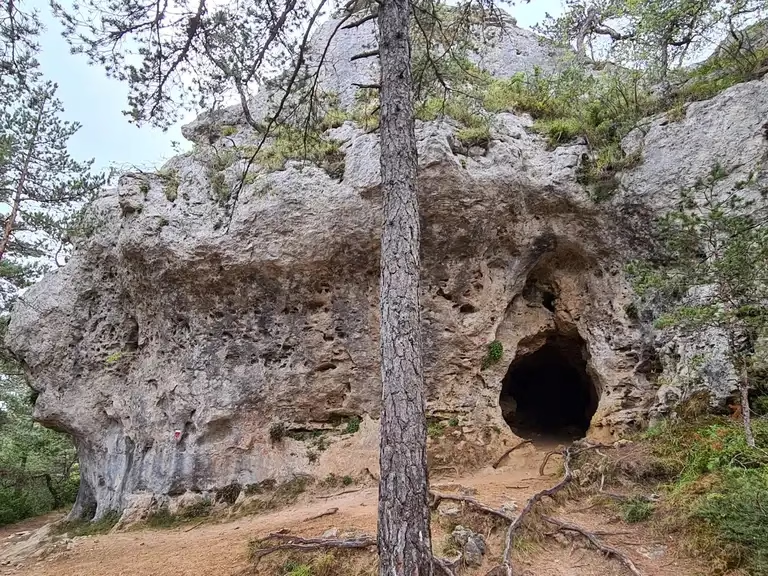
Some caverns contain an entire world. In the Fairies’ Cave at Accous (Basses-Pyrénées), people spoke of the existence of a true underground land, with its plains and wide expanses. Other caves seemed to stretch over considerable distances, sometimes for several leagues. This is the case of the Cas Margot near Moncontour-de-Bretagne, as well as a cavern in the Allier said to contain treasures, and the cave of Biâre in Poitou.
The Cave of the Dead Man, at Saint-Pierre-des-Tripiers, was said to be inhabited by enchanted women—fairies transformed into witches, called encantados, dounzelos, fados, or sourcieiros. This cavern is believed to extend for more than a league and a half. Inside, one can make out statues, pillars, as well as two pig’s ears fixed to the vault. At its center flows a stream that no one was said to have been able to cross before the end of the evil law and the wicked lineage of that time—that is to say, the Saracens and the heretics. Since this passage became possible, some claim to see on the ground the footprints left by these mysterious enchanted women.
Other tales suggest the existence of real underground connections between caves and religious buildings. The Grotte à la Dame, located one kilometer from Grand-Auverné (Loire-Inférieure), is said to extend beneath the church. Likewise, the cavern of Roc’h Toull is believed to emerge beneath the high altar of Guimiliau (Finistère), where a rooster is even said to have been heard crowing beneath the choir. Along the coasts, this belief continues: it is used to show that the “houles,” these sea caves, are thought to extend deep inland.
In Béarn, popular imagination attributed immense dimensions to an underground passage located in the heart of an ancient forest once inhabited by fairies. Some claimed to have heard there the footsteps of an invisible being, guardian of the bones that lay within.
Some caves, like the underground passages of castles, were said to have a second exit located sometimes very far from their entrance. The cavern of the Pertuis-Fourtière at Langon, on the banks of the Vilaine, offers a striking example. Narrow at first for about fifteen meters, it then widens to form a kind of underground chamber extending as far as opposite the Langon train station. Even more remarkably, several tales surround this place:
- sheep are said to have entered it without ever reappearing;
- a white goose introduced into the cavern is said to reemerge in the Vilaine at Port-de-Roche with black plumage;
- conversely, a black goose would come out of it white.
Finally, the cistern—or cavern—of Elhorta, dwelling of the wild lord, had a second opening through which a shepherdess he had once abducted was seen to reappear.
5. Caves in Tales: Fairies and the Bécuts
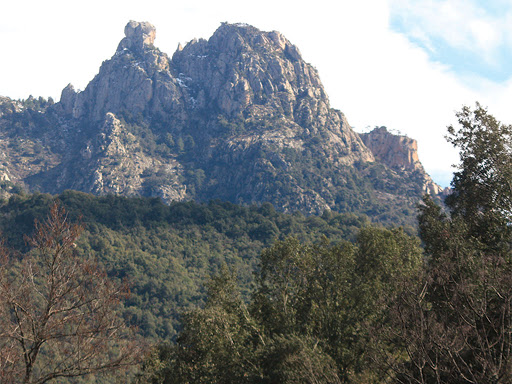
Caves, though omnipresent in local traditions—whether located inland or along the coasts—appear rather rarely in folktales proper. The fairies of the enchanted world, whose location remains undefined, do not seem, unlike their rustic counterparts, to be tied to an underground dwelling. When they do inhabit a cavern, it is generally mentioned only briefly, without detailed description. It is also rare for the cave and its mysterious occupant to be bound by a strong relationship. A notable exception appears in a Corsican tale: a fairy of great beauty, living in a time when animals spoke and stones walked, possessed immense magical powers. But this power had a strict limit: she could leave her cave only for three days. If she remained away for even one hour longer, she would immediately lose all her powers.
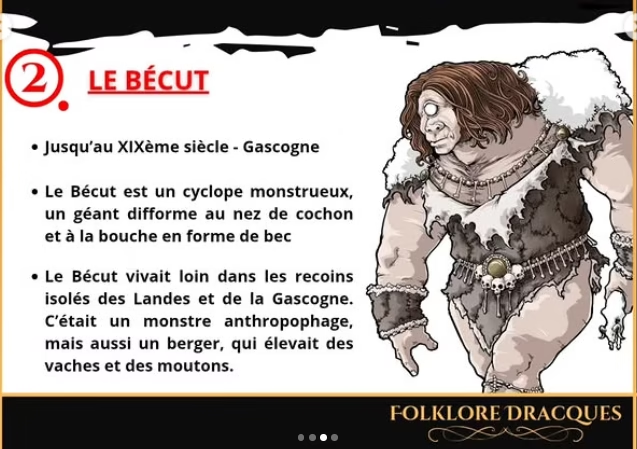
In contrast to these fairy figures, the Bécuts embody a far more unsettling presence. In the past, they inspired genuine fear among both children and peasants, suggesting that before becoming figures of folktales, they were associated with real places. In Gascon stories, the Bécuts are described as giants reaching up to seven fathoms in height. Like the Cyclopes—and strongly recalling the myth of Polyphemus—they possess only a single eye, set in the middle of the forehead. They live in caverns, in the heart of a wild and shadowy land. Their cruelty is unmistakable: when they capture Christians, they cook them alive before devouring them.
Several tales take up motifs similar to the legend of Polyphemus: young boys, through their cleverness, manage to deceive these giants and escape from them. In a version from the Albret, two twins set out on a journey to discover where the world ends. After a long wandering, they reach a vast heath where a Bécut is tending his sheep. The giant forces them to enter his cave, which he closes with a massive stone. Once inside, he seizes one of the two brothers, kills him, and roasts him on a spit. When the monster, glutted, falls into a deep sleep, the survivor seizes his chance: he drives the spit into its eye. Then he takes refuge among the sheep, covers himself with an animal skin, and when the Bécut lets his flock out, he manages to escape by hiding among them.
6. Horned Men, Marvelous Birds, and Thieves
Un conte d’aventures de la Upper Brittany raconte l’histoire d’un prince lancé à la poursuite d’un lièvre insaisissable. Après une journée entière de chasse infructueuse, l’animal disparaît soudain dans une caverne. Le prince, intrigué, s’y engage à son tour — mais au lieu du gibier, il découvre un homme aux dents longues comme la main. Ce personnage n’est autre que le diable. Contre toute attente, celui-ci lui laisse la vie sauve, à une condition : devenir son domestique. La grotte devient alors un lieu de basculement, où l’aventure se transforme en servitude.
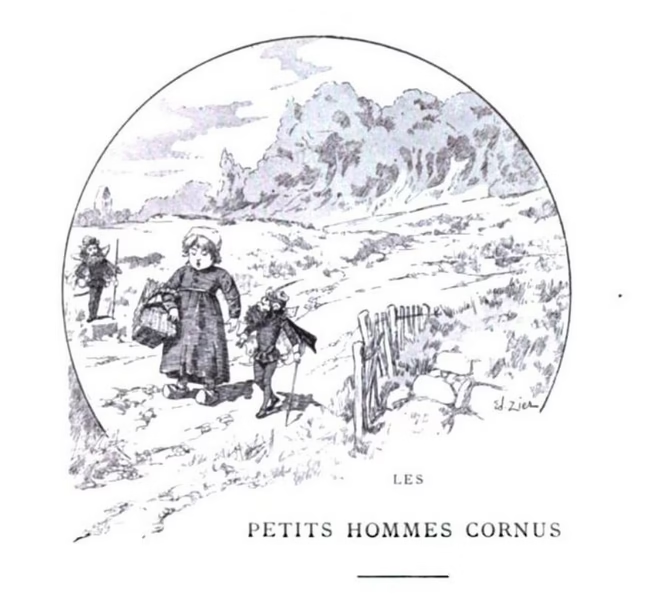
In other tales, caves serve as prisons for fearsome creatures. When the king of the horned men is defeated by a young adventurer, the latter cannot bring himself to kill him. Instead, he chooses to chain him inside his own cave, sealing the entrance with heavy stones. The captive is condemned to suffer from hunger and thirst there until Judgment Day. These caverns do not hold only human or monstrous beings: they also imprison marvelous creatures. The White Blackbird, for example, is guarded by two dragons (Henry Carnoy, Contes, petites légendes, croyances populaires, coutumes, formulettes, jeux d’enfants, tale VI.), while the Firebird is held captive by a giant.
Closer to reality, yet just as unsettling, thieves also frequently occupy underground dwellings. In a tale from Sospel, a cave serves as a refuge for murderers who hold a young girl captive there. She is eventually freed thanks to the intervention of an old woman who manages to loosen her bonds.
In another tale, brigands abduct the king’s daughter and hide her in their cavern, lost deep within the forest. More ambiguous still, some stories describe thieves capable of hospitality. A woman, lost in the woods with her three children, sees a light and discovers a vast cave inhabited by brigands. They do her no harm, shelter her for several days, then ask her to entrust one of her sons to them so that they may teach him their trade. Finally, other thieves take in a young girl abandoned in their underground dwelling. She remains there for years, eventually marrying one of them.
7. Bears That Abduct Women
In a Provençal tale, a she-bear abducts a small child and carries it off to her cave to replace one of her cubs that has recently disappeared. The act, both instinctive and unsettling, blurs the boundary between humanity and animality. A Basque story presents the reverse situation: this time, it is a bear that captures a young woman, throws her over its back, and carries her into its den. She is held there and becomes a mother. This same motif also appears in a Picard tale, evidence of the wide diffusion of this theme across different regions.
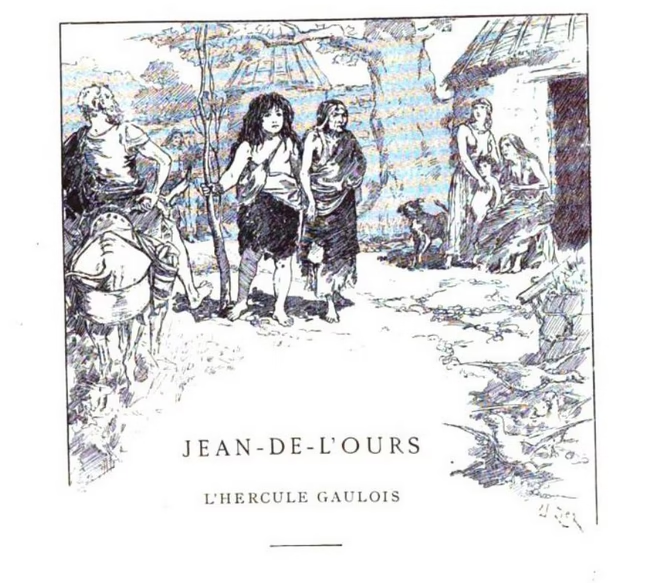
In a tale from Menton, a woman who has taken refuge in a cave finds herself forced to live alongside a bear. From this union is born a singular child, known as Jean de l’Ours (Legends of France, Henry Carnoy). Like his many counterparts in folk traditions, this child possesses exceptional strength and lives through prodigious adventures. His birth, at the boundary between two worlds, makes him an emblematic figure: neither entirely human nor wholly animal.