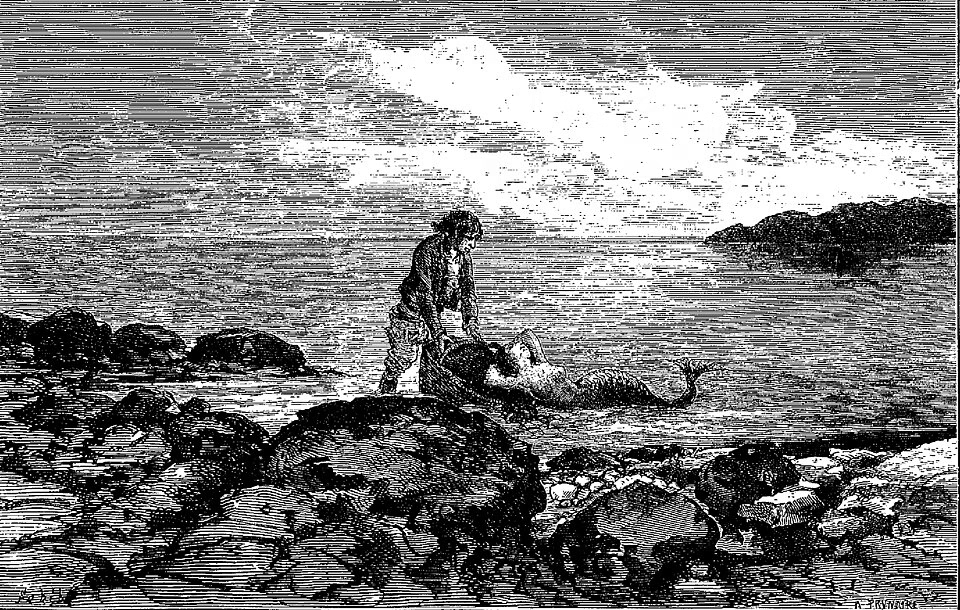
The Clog Maker Pulls the Mermaid of Fresnay from the Water, illustration from the tale The Mermaid of Fresnay
The belief in the existence of mermaids had not completely died out, even in modern times. Some people still claimed to have caught sight of them, but more often to have heard them. In Guernsey, where they were not associated with any particular legend, an old man from La Forest claimed that while standing on the cliffs, he had seen a company of six Seirènes. They were resting below on the shore and were described as creatures half-woman and half-fish. The old man had immediately hurried down to observe them more closely. But as soon as they saw him approaching, the mermaids threw themselves into the sea and disappeared.
In Brittany, it was once said that several of these mermaids had an underwater dwelling not far from the shore. They sometimes appeared a short distance from the coast, and some seemed particularly attached to a specific place. Some forty years earlier, a family of mermaids, whose singing was frequently heard by fishermen from Trégor, was said to dwell between Riouzic and Melban, two of the Seven Islands. Their presence thus appeared to be tied to particular locations, from which their singing could sometimes reach human ears from the depths.
The Mermaid of Fresnaye (Tales of Land and Sea, Paul Sébillot) was particularly fond of the bay that bore her name, especially the mouth of a small river flowing into one of its coves. It was there that people listened to her melodious voice as she glided across the waves while the tide was rising. Wherever she passed, she left behind a luminous trail. One day, a clog maker found her asleep, gently rocked by the waves. He captured her, but later agreed to return her to her natural element. In gratitude, the mermaid showered him with gifts. When she eventually left Brittany for India, she gave her children an inexhaustible purse. Another mermaid rewarded a young fisherman in much the same way after he returned her to the sea. She gave him a flute and came to his aid whenever he played it.
2. Mermaids Were Not Always Malevolent
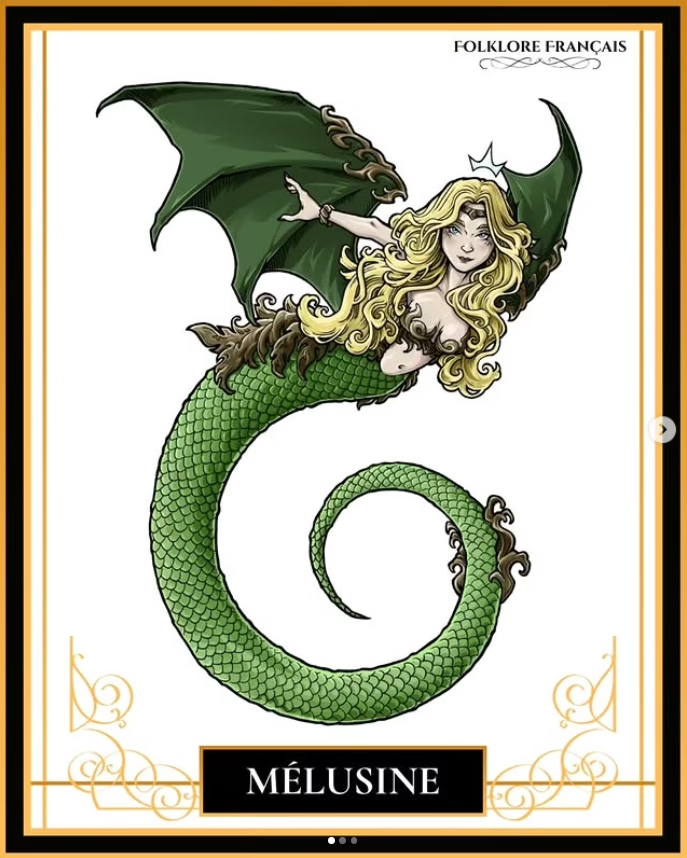
Illustration of the Fairy Melusine, Folklore Dracques
Maritime traditions did not always portray mermaids as dangerous creatures. In many tales, they were instead benevolent toward those who came to their aid, rewarding them with riches, magical objects, or even supernatural powers.
The mermaids of Noirmoutier Island and the Vendée coast would approach people while singing. When they encountered someone who came to their aid, particularly when they had been stranded and were returned to the water, they rewarded them by offering money or revealing the location of a treasure hidden beneath a stone.
The Breton tale Marc’haït Charlès tells of a mermaid who had been stranded on the beach. The hero Rannou’s mother helped her return to the sea. In gratitude, the mermaid gave her a conch shell filled with a magical liquor. She instructed her to give it to her son to drink: thanks to the potion, Rannou would become the strongest and most powerful of men (In Lower Brittany – Impressions and Travel Notes – Côtes-du-Nord, Revue de Bretagne et de Vendée, 1865–1866, François-Marie Luzel).
The prosperity of Châtelaillon was once associated with a mermaid whom the inhabitants believed to be the fairy Melusine. She lived on a rock in the surrounding area, which was still known as son hôté. As long as the inhabitants respected the creature, the town remained prosperous. But one day, a fisherman wounded her. Before she died, the mermaid uttered a terrible prophecy: “the capital of Aunis shall retreat into the sea by one furrow and one denier each day.” The town’s prosperity was thus bound to the respect shown toward the creature that dwelled near its shores. (read also: The Legend of Châtelaillon (Melusine) – The Ancient City, Called Chastel-Aillon)
These tales showed that mermaids generally rewarded those who had spared them or come to their aid. The traditions recorded among fishermen along the English Channel went even further: mermaids were not usually said to drown men and would sometimes come to their rescue. In Lower Brittany, the gwerziou and tales without a specific location likewise portrayed them in a benevolent role. In The King of Romania by François-Marie Luzel (Popular Songs of Lower Brittany), a maiden from the depths of the sea came each day to untangle the blond hair of the children of the King of Romania, who had fallen into the water.
In Marie and Yvon and the Mermaid (Bulletin of the Archaeological Society of Finistère, Volume XV (pp. 63–77), François-Marie Luzel), a mermaid took in a young girl whom her wicked nurse had thrown into the sea. She gave her a magic ointment with which the girl could bring her brother back to life. Another mermaid also rescued a young girl and welcomed her into her cave. Her kindness, however, had its limits: she chained the girl to a rock with four golden chains.
3. Mermaids Who Summoned the Storm
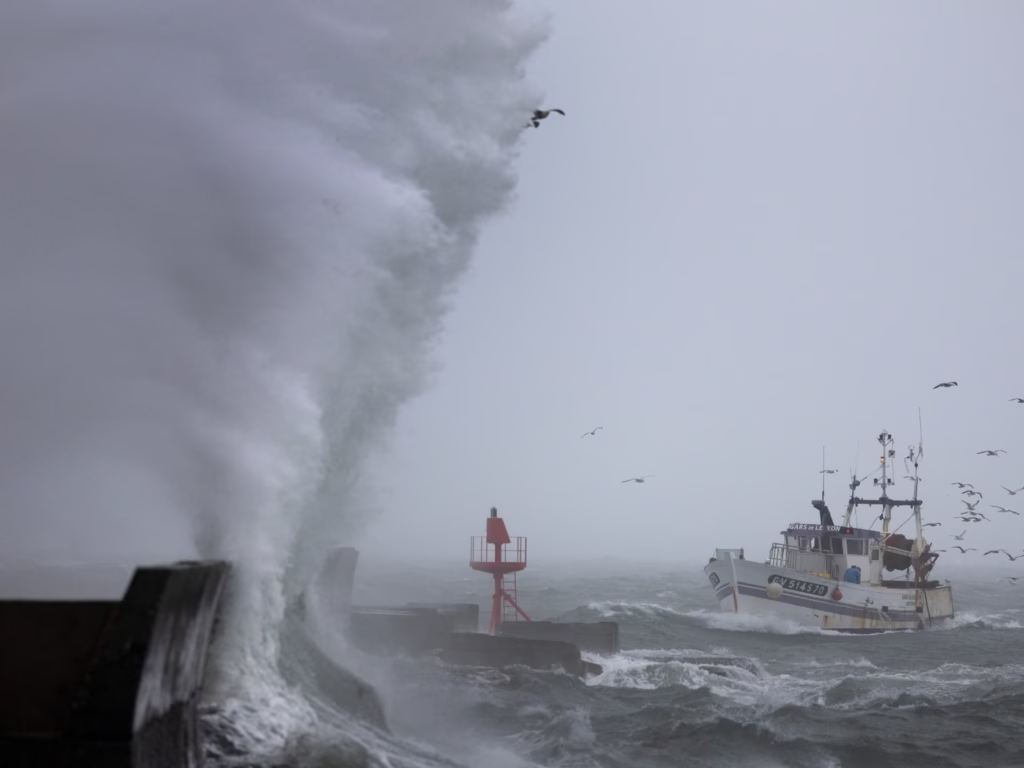
Photograph of Storm Benjamin
The ladies of the sea, the mermaids, were more often described as deceitful, malevolent, or cruel creatures. It was in this guise that they most frequently appeared in proverbs and legends.
On the coast of Finistère, the mermaid was called Mac’harit an gwall amzer, meaning “Marguerite Bad Weather.” When her voice was heard, sailors had to hurry back to port. As long as she continued to sing, the poor sailor, people said, had nothing left to do but weep: her song foretold the dangers threatening those at sea. The mermaid was thus directly associated with bad weather and the perils of navigation. Her appearance or her song was less a promise of wonder than a warning of an approaching storm.
This distrust was also found in other regions of the French coast. A saying that appeared in numerous collections of proverbs from the Midi asked God to protect sailors from the sound of the whale and the songs of the mermaid. In Gascony, this invocation concluded the prayer that sailors recited before setting out to sea. The mermaid also appeared in a particularly cruel light in a song from Poitou, one of the few French songs in which she was mentioned. She was accused not only of malevolence, but also of cannibalism. The tale told of a diver who had drowned while searching for the golden keys of a princess. All the fish and carp had mourned his death, except for the mermaid, who had continued to sing:
N’y a ni poissons ni carpes Qui n’en aient pas pleuré. N’y a que la sirène Qui a toujours chanté. Chante, chante, sirène, T’as moyen de chanter, Tu as la mer à boire Mon amant à manger.
There are neither fish nor carp That did not weep for him. There is only the mermaid Who continued to sing. Sing, sing, mermaid, You have cause to sing: You have the sea to drink And my lover to eat.
The four final lines of this song were found almost word for word in a dialect fragment from Albret.
4. Mermaids Who Drag the Living Beneath the Waters
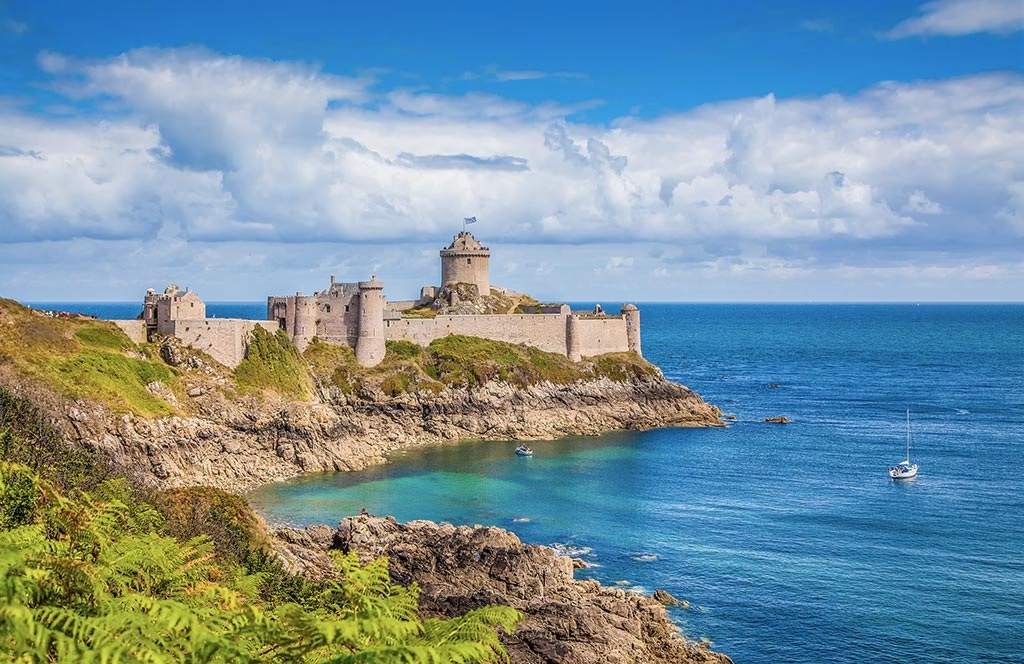
Fort La Latte, Château de La Roche Goyon, Côtes-d’Armor
While some mermaids showed generosity toward men who came to their aid, others proved far more dangerous. They sometimes possessed supernatural means of luring the living into their underwater dwellings, without giving them any chance to return.
A life of Saint Tugdual, composed in the 11th century, tells how a group of schoolboys were walking along the banks of the Tréguier River. The last of the group, who was remarkably handsome, suddenly stopped in the middle of a sentence. When his companions turned around, he had disappeared. After calling for him and searching in vain, they invoked Saint Tugdual. A moment later, the young man emerged from the water, his right foot still entangled in a silk girdle. His companions asked him what had happened. He replied:
« Des femmes de mer m’ont saisi, entraîné sous les roches de l’Océan. Enlevé par elles et bien loin, j’entendais pourtant vos voix. Alors s’est dressé devant moi un personnage de figure vénérable, revêtu d’ornements sacerdotaux. D’un bras puissant, il m’a arraché aux femmes de mer, et, à travers les ondes refoulées, il m’a ramené au rivage. A sa vue, les nymphes ont fui, mais l’une d’elles a oublié de détacher la ceinture dont elle m’avait enlacé ; en preuve de mon enlèvement, la voici. »
“Sea women seized me and dragged me beneath the rocks of the Ocean. Carried away by them and far from you, I could nevertheless still hear your voices. Then a venerable-looking figure appeared before me, clothed in priestly vestments. With a powerful arm, he tore me away from the sea women and, through the waters he had forced aside, brought me back to the shore. At the sight of him, the nymphs fled, but one of them forgot to untie the girdle with which she had bound me. Here it is, as proof that I was carried away.”
The young man’s testimony was thus accompanied by material proof of his abduction: the silk girdle that one of the sea women had left behind in her flight.
The mermaids sometimes possessed an even more fearsome power. The mere contact of their bodies, or even the slightest brush against any part of them, could be enough to compel a man to plunge irresistibly into the sea. This was how the “Seraine” of Fort La Latte was said to have carried off a great many young men. As soon as she managed to touch one of them, even with the tip of her finger, he could no longer resist her power and followed her into her underwater palace.
A poem in verse recounted an episode that also appeared to have been drawn from popular tradition. A fisherman from the Vendée was about to return a mermaid to the water when she warned him. She asked him to carry her in his arms, assuring him that he had nothing to fear as long as her hair did not touch his hand. But if his fingers happened to brush against her blond hair, he would no longer be able to free himself from her. The mermaid would then be forced to drag him, despite herself, into her deep cave:
Porte-moi dans tes bras. Pourvu que mes cheveux Ne touchent pas ta main, sois sans inquiétude. Mais tes doigts ne pourraient jamais s’en détacher S’ils effleuraient, hélas ! ma chevelure blonde ; Je devrais, malgré moi, dans ma grotte profonde T’entraîner sans que rien puisse m’en empêcher.
Carry me in your arms. As long as my hair Does not touch your hand, have no fear. But your fingers could never tear themselves away If they brushed, alas! against my blond hair; I would have to drag you, despite myself, Into my deep cave, with nothing able to stop me.
5. The Dwellings of the Mermaids
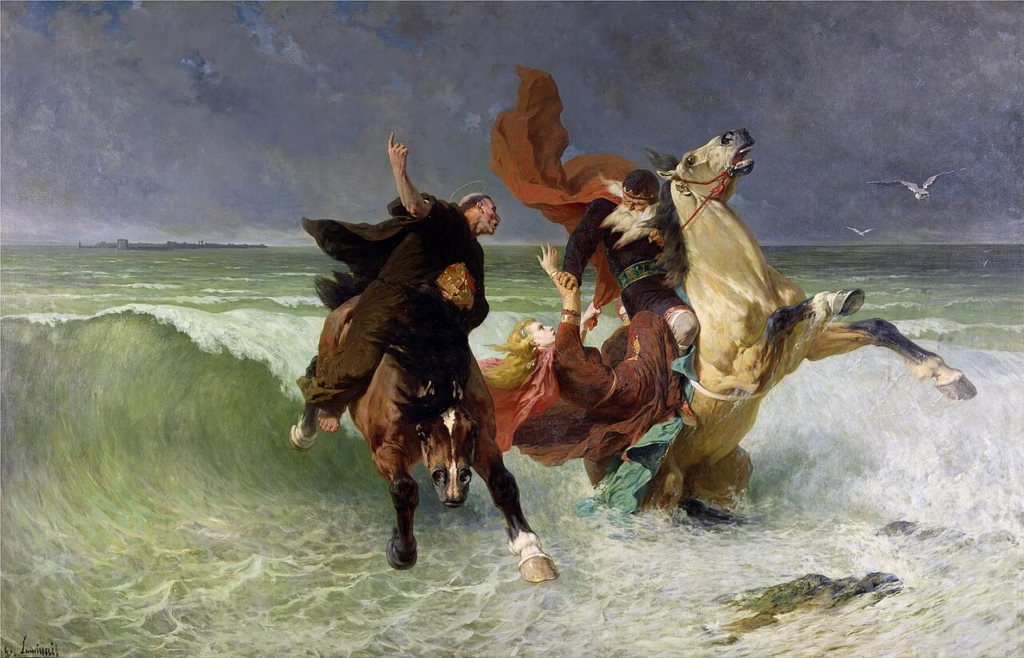
The Flight of King Gradlon, Évariste-Vital Luminais, c. 1884 (Musée des Beaux-Arts de Quimper)
Beliefs concerning a supernatural underwater world, inhabited by spirits and sometimes accessible to humans without drowning, had been widespread. They had been attested across almost every latitude and were already known along the French coasts in the Middle Ages. This conception of a hidden kingdom beneath the waves had also survived into the 17th century. It appeared, in particular, in the tale Fortunio from the Cabinet des fées (Volume II), which incorporated several elements drawn from popular traditions. In this tale, part of the sea belonged to the empire of the Sirens. Their queen one day spotted a prince aboard a ship. Through her songs, she lulled him to sleep before abducting him and carrying him away to her kingdom. She then led him to her palace, which had been built beneath the waves, upon the sands of the sea.
The Trégor sailors claimed that they had sometimes caught sight of a mermaid, but even more often declared that they had heard her song. They described her as having the head and breast of a woman, with the rest of her body shaped like a fish. According to this tradition, the mermaid was Dahut, the daughter of King Gradlon. Saint Guénolé, to punish her for having sold the city of Ys to the devil, was said to have forced her to throw herself into the sea at Poul-Dahut in Trestel. All mermaids were said to have descended from this first creature. Their song was melodious, but one must never linger to listen to it: the mermaids lured sailors in order to lead them to their doom.
At Cap Sizun, a mermaid, likewise regarded as an incarnation of Dahut, appeared fairly often near boats. Her presence invariably heralded a storm, and she was known as Marie du Cap. More broadly, many fishermen from Finistère claimed to have seen at least one of these sea deities. They described them as exceedingly beautiful creatures, one of whose favorite occupations was combing out their long, thick blond hair with a golden comb. The penetrating sweetness of their voices and the seductive power of their songs were also praised. They knew wonderful soniou, which, it was said, could make those who lingered to listen forget their father, their mother, their wife, and their children.
In the vicinity of the Îles d’Hyères, the many shipwrecks were likewise explained by the seductive power of mermaids. Sailors, fascinated by their soft and melodious songs, would lose all sense of direction and thus stray from their course. The fishermen of the Bay of Saint-Malo, for their part, distinguished between daytime and nighttime appearances of the “seraine.” During the day, they enjoyed hearing her song. At night, however, they feared it, for it was a sign of storm and death.
6. The Mari-Morgans and Their Underwater Palaces
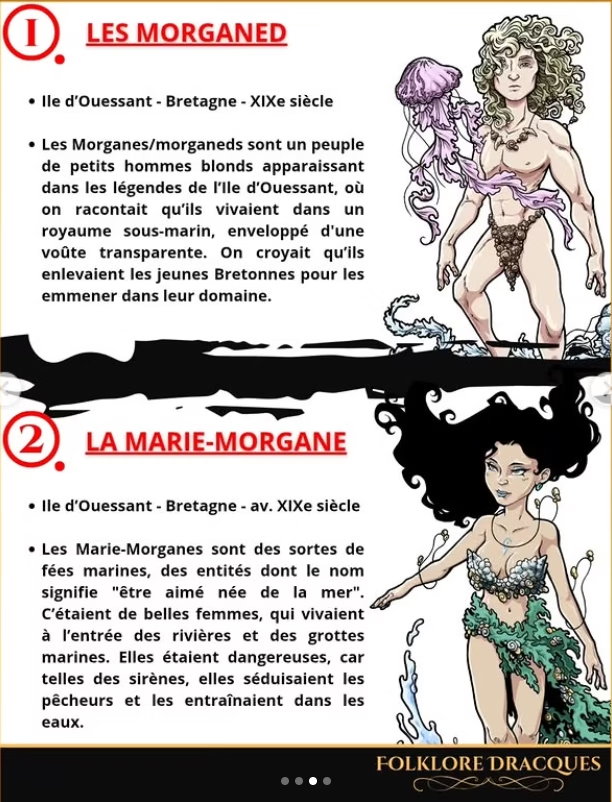
The Mari Morgan shared many characteristics with mermaids. By the end of the 19th century, they were in fact generally confused with the latter, although they did not have a body ending in a fish’s tail. According to the most widespread belief, the Mari Morgan had disappeared long ago. Yet a legend mentioned in the chapter devoted to caves claimed that some still lived in a cavern near Crozon.
It was rare for the Mari Morgan to be encountered far out at sea. They preferred to remain close to the shore, particularly at the entrances of caves and the mouths of rivers. Their presence was therefore closely associated with places where land and sea met, these liminal spaces being especially conducive to the supernatural creatures of maritime folklore.
The Mari Morgan were described as very bold creatures, particularly skilled in the arts of sorcery. They pursued young fishermen with their amorous advances and sought to lure them into their world. Those whom they managed to seduce were eventually dragged beneath the waters. They disappeared without leaving a trace, and they were never seen again.
In Upper Brittany, la mer formait parfois une véritable contrée enchantée. Par une puissance magique, les eaux étaient rendues solides et enveloppées d’une voûte transparente, à travers laquelle on voyait presque aussi clairement que sous notre propre ciel. Cette contrée abritait de vastes campagnes où poussaient des arbres et des plantes étranges, mêlant les caractéristiques de la flore terrestre et de la flore maritime. De longues avenues conduisaient à de magnifiques châteaux, ornés de toutes les richesses que recelait l’Océan. C’était dans ces demeures que les dames de la mer, auxquelles on attribuait des passions amoureuses, attiraient les hommes qui leur avaient plu. Elles pouvaient également y recueillir des naufragés que la mer avait épargnés. Une fois installés dans ce royaume, les hommes y trouvaient presque tout ce qu’ils pouvaient désirer, à une exception près : ils ne conservaient pas nécessairement la liberté de retourner à terre. Certaines dames de la mer se montraient toutefois moins sévères. Lorsque des pêcheurs regrettaient trop vivement leurs femmes pauvrement vêtues et leurs petits enfants, elles les autorisaient parfois à regagner leur village.
The sailors of Lower Brittany who had succumbed to the charms of the Mari Morgan also discovered a wondrous underwater kingdom. After being drawn beneath the waves, they arrived in a palace of mother-of-pearl and crystal, where all manner of pleasures awaited them. They married the Mari Morgan who had carried them away. Although they were forbidden from ever hoping to resume their place among men, they eventually ceased to regret their former lives too deeply. Wealthy, pampered, and served according to their desires, they led happy and abundant lives. They lived long, in comfort and prosperity, and had many children.
7. The Morgans and Morganes of Ouessant
Front cover of the book Les Morgans de l’île de Ouessant, published by OUEST-FRANCE
In Gascony, a drac would seize a young girl while she was bathing and carry her away to his magnificent castle, built beneath the sea in the midst of a garden where trees and marine flowers grew. The Morgans(the male counterparts of the Mari Morgan) likewise carried the daughters of the land away to their underwater kingdom.
Some thirty years earlier, the inhabitants of Ouessant still placed the dwelling of an entire group of these spirits beneath the waters, a short distance from their island. Their name was similar to that of the Mari Morgan, but they formed a distinct tribe, one that was more benevolent toward humans. Unlike the Mari Morgan, who were almost always female, this population consisted of Morgans and Morganes, men and women. Though they were not truly dwarfs, they were small in stature and possessed a graceful appearance. They were said to have rosy cheeks, blond, curly hair, and large, bright blue eyes. They were described as being “as kind as angels.” Yet they could not enter heaven because they had not been baptized. The men were called Morgans (Morganed) and the women Morganes (Morganezed, plural of Morganès). When François-Marie Luzel visited Ouessant in 1873, the traditions concerning them were already beginning to fade. They nevertheless remained known to the island’s old women. One of the legends he collected told the story of Mona and described in detail the existence of this underwater people in the tale The Morgans of the Isle of Ouessant (Contes populaires de Basse-Bretagne):
A young girl named Mona was one day on the shore with her companions. As they spoke of their lovers, Mona declared that she was as beautiful as a Morganès and that she would never marry anyone but a lord or a Morgan. An old Morgan, hidden among the rocks, heard her words. He sprang upon her and carried her to the depths of the sea. He was the king of the Morgans, and his palace was more magnificent than all the royal residences on land. His son fell in love with Mona and asked his father for permission to marry her. The old Morgan refused, however, and forced his son to marry a Morganès. The bride and groom then set out for the church. For the people of the sea also possessed their own religion and underwater churches, although they were not Christians. According to tradition, they even had their own bishops. Mona was ordered to remain at the palace and prepare the wedding feast. She was given only empty pots, which were in fact nothing more than large seashells. She was told that if she did not prepare an excellent meal in time, she would be put to death.
The bridegroom then pretended that he had forgotten his ring and slipped away to join the kitchen. The old Morgan realized that Mona had received help. He nevertheless told her that she was not yet free of his demands. When the newlyweds retired to their bridal chamber, he ordered Mona to enter it with a lit candle and to warn him when it had burned down to her hand. When the candle was almost entirely consumed, the young Morgan asked his wife to hold Mona’s candle for a moment. When the old Morgan learned that the candle had burned out completely, he entered the chamber and, without looking, struck the person holding it with a single blow of his sword. He then uttered a few magical words and touched the various objects one after another. At once, he conjured up a magnificent feast.
At daybreak, the young Morgan told his father that he was a widower and asked for permission to finally marry the daughter of the land. The marriage took place, and the young Morgan proved deeply attentive to his wife. Mona nevertheless wished to return to her parents. Her husband refused to let her leave, fearing that she might never return. Seeing her grow sad, he finally said to her: “Follow me, and I will take you to your father’s house.” He then uttered a magic word. At once, a magnificent crystal bridge appeared, connecting the bottom of the sea to the land. The old Morgan wanted to follow the two spouses. But as soon as they had set foot on land, the young Morgan spoke another magic word. The bridge then sank into the waters, carrying the old Morgan with it to the bottom of the sea.
Mona’s husband advised her to return at sunset. He also warned her not to allow any man to kiss her or even touch her hand. Mona nevertheless forgot this warning. She then lost all memory of everything that had happened since her departure for the land of the Morgans. Yet she often heard groans. One night, she distinctly recognized her husband’s voice, reproaching her for having abandoned him. She then remembered everything. She found her husband lamenting behind the door and threw herself into his arms. From that day onward, she was never seen again.
8. The Devil Beneath the Waters; The Realm and Capital of the King of the Fish
Front cover of the illustrated Contes des landes et des grèves, published by MOJE ÉDITIONS
Coastal traditions often mentioned dangerous places haunted by the Devil, but they rarely attributed to him a true underwater dwelling comparable to those of the fairies or mermaids. This motif appeared chiefly in tales associated with certain dangerous shoals off Brittany. It also occurred in a rather obscure Mentonese tale, in which the fallen angel seemed to have taken the place of an ancient deity.
The story took place near Roquebrune. A fisherman tried to keep his son away from a particularly fish-rich spot where he wanted to cast his nets. To dissuade him, he explained that the Devil lived there. One morning, however, the family had no bread left. The young man then went despite the warning to the forbidden spot to fish. But scarcely had he arrived when the Devil carried him away to his underwater palace.
The King of the Fish, who, in popular tales such as The Fish and the Fisherman from Contes des landes et des grèves by Paul Sébillot, spoke like a human being, appeared either as a transformed man or as a spirit belonging to the realm of wonder. The fish had their own country, situated within that indeterminate realm of fairyland. This kingdom even included a capital built beneath the waves, much like the underwater palaces mentioned above.
A fisherman from the English Channel, who had rendered a service to the King of the Fish, received a magic potion from him. Thanks to this potion, he gained the power to descend beneath the waves without drowning. When a shipwreck occurred, he was thus able to plunge into the sea and reach the capital of the King of the Fish. The city was described as extraordinarily rich: its streets were paved with gold, precious stones, and diamonds. The fisherman thus discovered a kingdom whose splendor surpassed everything the earthly world could offer. Yet, despite its wonders, he eventually grew bored in this underwater city. The King of the Fish then allowed him to return to his homeland in an equally marvelous manner: a tuna carried him on its back and brought him back to the vicinity of his village.
9. Legendary Ships Beneath the Waters
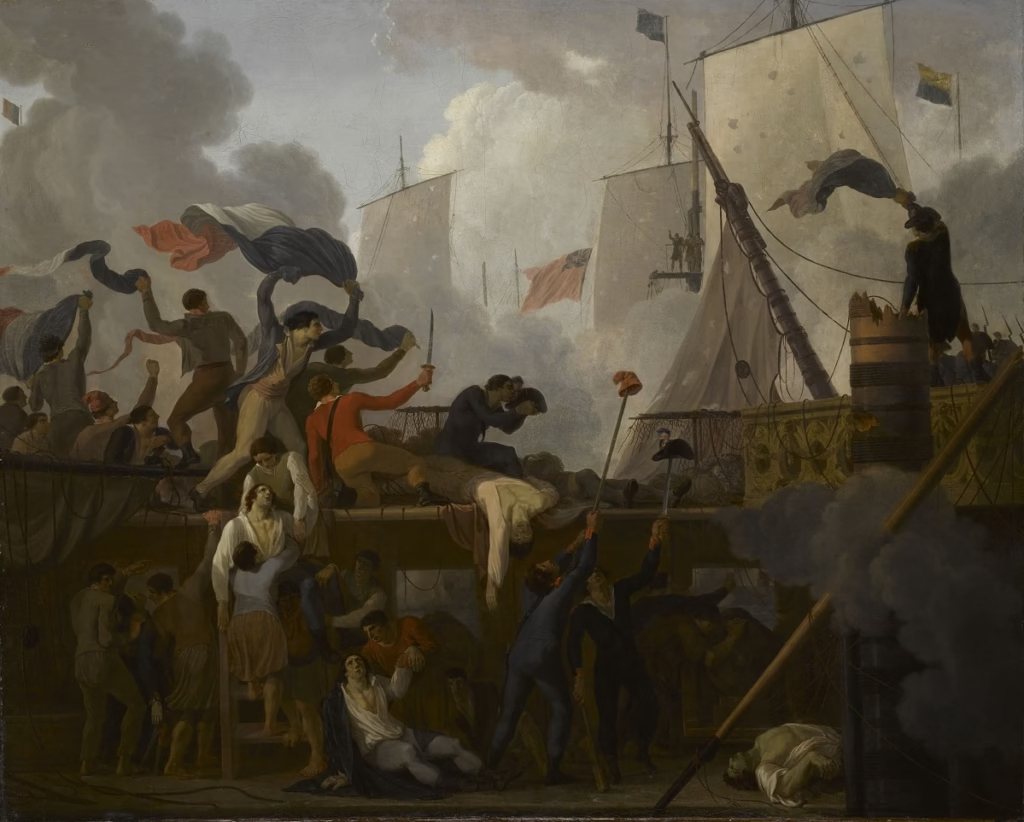
Heroism of the Sailors of the Ship Le Vengeur, Commanded by Captain Renaudin, Nicolas Antoine Taunay, 1795.
Sailors rarely spoke of ships or objects that a supernatural power had kept at the bottom of the sea. Yet several traditions told of legendary vessels lying beneath the waves, preserved underwater as mysterious witnesses to events from long ago.
Near Cap Fréhel, in the Côtes-d’Armor, it was said that an enchanted vessel remained intact beneath the waters of Fresnaye Bay. Several accounts explained how it had been sunk. The most complete version told how a captain had abducted a young English girl and hidden her aboard his ship. A fairy, who was her godmother, sought to rescue her. She failed, however, because the captain was protected by the Devil, whose power was greater than that of the fairies. Seeing that all her efforts were in vain, the fairy transformed the abductor into a dog and chained him to the bottom of the vessel with an enormous chain. She then put her goddaughter to sleep, dressed her in beautiful clothes, and adorned her with precious jewels. Finally, she caused the vessel to descend to the bottom of the sea. The Devil, who had witnessed the entire scene without being able to prevent it, then granted the captain immortality and promised him that the young woman he loved would never belong to another.
The legend added that a priest carrying the Host might perhaps be able to rescue the young woman. He would merely have had to go down to the shore on a day of a particularly low tide. When the sea receded exceptionally far, the inhabitants could sometimes see part of the sunken vessel. Another sign, however, revealed its presence: the howls of the dog were often heard. They became especially furious whenever a boat stopped to fish above the vessel. The dog then believed that the fishermen had come to take away the woman he loved. He was ready to throw himself upon the unwary men and devour them.
Other beliefs associated shipwrecks with supernatural phenomena. According to a tradition from the Morlaix coast, although it was reported in a collection of short stories, ships that had sunk to the bottom of the sea were said to grow larger year after year. In the region of Tréguier, it was instead believed that places where richly laden vessels had sunk were guarded by dragons. These creatures watched over the sunken treasures, making the wrecks particularly dangerous for anyone who attempted to approach them.
The inhabitants of the coast who lived near the sites of ancient naval battles also knew of ships that appeared only during exceptionally low tides. At Erquy, in the Côtes-d’Armor, around 1850, it was said that such a wreck was that of the corvette La Salamandre. It was said to have run aground while attempting to escape an English cruiser, and its wreck was reputed to be haunted. Among the reefs of the Pointe du Raz, fishermen, for their part, believed they could make out the hull of the Vengeur, even though the Battle of 13 Prairial had taken place some distance from this location.
10. The Miraculous Statue at the Bottom of the Sea
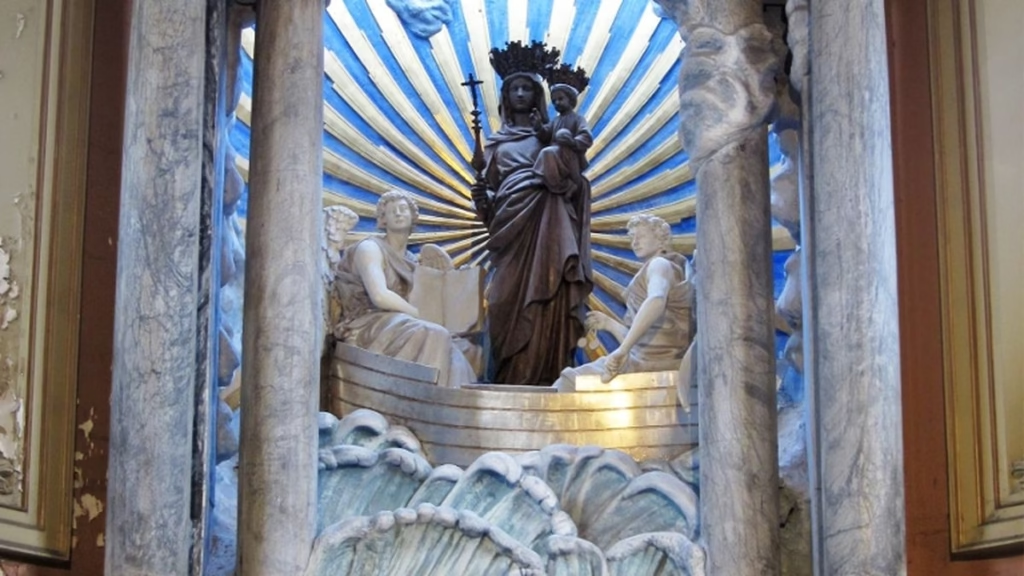
Statue of the Virgin Nautonière, the miraculous image of Boulogne.
The Boulogne sailors used to tell that the old miraculous statue of Boulogne, the Virgin Nautonière, was being held by the Devil in a mysterious underwater harbor, located some distance from the shore. According to the legend, the statue could only be restored to the veneration of the faithful if an absolutely pure young woman agreed to undertake the task of reclaiming it from the demon. But this young woman had to fulfill another condition: she had to love a sailor who did not love her in return.
The young woman who managed to fulfill these conditions would then have to find the courage to descend into the Devil’s underwater domain and reclaim the statue. She would, however, lose her life in the attempt. Once the miraculous statue had been restored to its faithful, Boulogne would regain a new prosperity and, according to the prophecy, become a city greater than Marseille. The legend thus linked the fate of the statue to that of the city itself: its return would herald a period of greatness for Boulogne.
This tradition echoed an idea found in other urban legends: a city’s exceptional prosperity came at the expense of the decline of a rival city. In the case of Boulogne, the city’s rise to the rank of a great city was therefore expected to coincide with the decline of Marseille.