The Legend of the City of Ys (Part One)
1. Geographical Distribution of the Legends of Ys
Legends recounting the submergence of vast stretches of land or flourishing cities were widespread along the coasts of France. Yet their geographical distribution suggested that these traditions had probably been collected incompletely, or had already been forgotten in many regions. Neither reading local monographs nor repeated appeals to scholars and provincial journals had yielded a single tradition of a sunken city between Dunkirk and the westernmost tip of the Cotentin Peninsula. This absence was all the more remarkable given the major changes that had taken place along this long stretch of coastline since historical times.
On the coast of Calvados, however, people spoke of the Hautefeuille Forest, which was said to have stretched from Asnelles to Luc-sur-Mer before being swallowed by the sea. If a legend had ever been associated with it, however, it seemed to have been forgotten. The inhabitants merely said that the timber framing of the church at Bernières and that of a nearby castle had been built with wood from this ancient forest.
It was only around Granville that legends devoted to the encroachment of the sea truly began. From there onward, they could be found, often in considerable detail and almost without interruption, from the mouth of the Couesnon to the Raz de Sein. From there onward, they could be found, often in considerable detail and almost without interruption, from the mouth of the Couesnon to the Raz de Sein. Beyond this point, as far as the Gironde, memories of submergence remained, but they were almost always much more fragmentary. South of the Gironde, no tradition of this kind had been recorded. Along the Mediterranean coast, they did not reappear until the area around Toulon. This distribution therefore revealed an area particularly rich in tales of sunken lands and cities: the coasts of the English Channel, and especially those of Brittany, contained the overwhelming majority of the traditions that had been collected.
Of all maritime legends, that of Ys was undoubtedly the most universally known. It was told in the villages of Lower Brittany and, most likely, sung before spreading to other regions of France, particularly through the literary form given to it by Emile Souvestre (Le Foyer breton, 1844) and Auguste Brizeux. Later, the legend of Ys spread far beyond the confines of Breton folklore. It inspired beautiful passages by Renan, while painters drew subjects for their canvases from it and musicians found melodic themes in it. Countless poets, many of them not Breton, also celebrated it in their verse.
This exceptional prominence had led the legend of Ys to be treated separately, with a substantial number of texts reproduced or summarized. Some accounts were relatively old and made it possible to trace the various stages of the tradition before the literary embellishments of the nineteenth century. The accounts collected afterward, meanwhile, were scattered throughout a wide variety of works and were sometimes difficult to find. Until then, no one had brought them together and compared them.
2. The Origins of Submergence Legends Are Linked to Some Real Circumstance
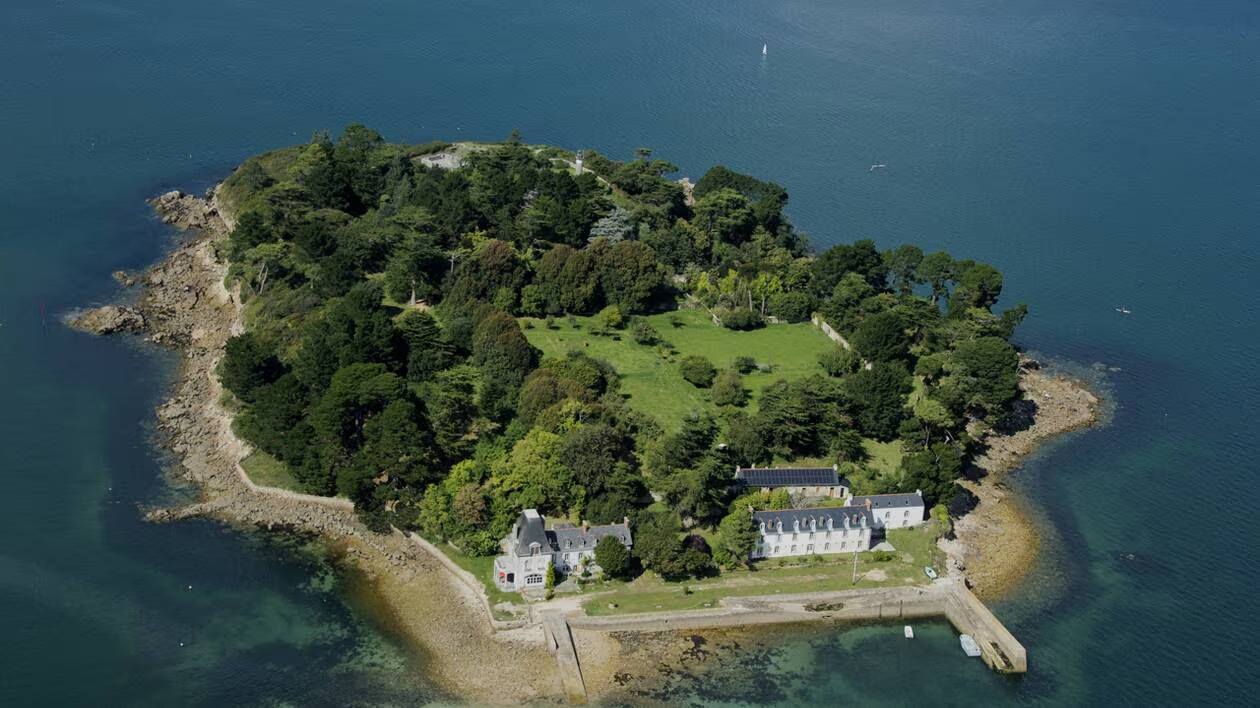
The cities whose submergence was recounted in traditional tales were not pure creations of the imagination. By carefully examining the places with which these traditions associated them, or by consulting the history of the regions concerned, one often encountered a physical circumstance or an event that may have contributed to the birth, development, or preservation of the legend.
The Bay of Douarnenez, for example, had certainly not always had its present configuration. It had expanded at the expense of the surrounding coastline. At the site of the isthmus that once connected Tristan Island to the mainland, a dolme
La question demeurait toutefois de savoir si cette cité s’appelait réellement Ys or Kêr-Ys. Les traditions ne permettaient pas de le déterminer avec certitude. Kêr-Ys n’était d’ailleurs pas nécessairement un nom propre. Pour un Breton qui l’entendait prononcer sans autre explication, le terme évoquait directement l’expression « ville basse », qui en constituait la signification littérale. Cette appellation pouvait ainsi désigner une ville construite au bord de la mer, presque à son niveau, voire en dessous. Elle avait peut-être été donnée à la cité en raison de sa situation particulière. Son véritable nom aurait alors pu disparaître avec le temps, tandis que son ancienne caractéristique topographique serait restée dans la mémoire collective. L’amiral Antoine Jean Marie Thévenard, dans ses Mémoires relatifs à la marine, publiés en 1804, avançait déjà cette interprétation. Il estimait que le mot Ys signifiait « bas », tandis que Kêr-Ys, c’est-à-dire « ville basse », avait vraisemblablement été détruite par la mer lors d’un violent ouragan :
“Keris, the lower town, was probably destroyed by the sea, driven inland by a furious hurricane which, having eroded and undermined the low-lying ground on which it stood, toppled and caused to disappear this settlement, which may have been no more than a village.”
The existence of a sunken city in the Bay of Douarnenez, where the oldest and most numerous accounts placed Kêr-Ys, therefore seemed particularly likely. The situation was different, however, for the other cities bearing the same name. Contemporary traditions knew of at least a dozen of them, scattered from Tréguier to Quiberon. Some may have corresponded to genuine settlements that had disappeared. This was notably the case with Coz-Guéodet, where ruins were still visible. For others, however, there were no equally obvious remains to confirm the existence of an ancient city. Nevertheless, near the places to which popular tales connected these sunken cities, there were rocks that remained visible or appeared only at the lowest tides. Their distinctive shapes may have been interpreted as the remains of crumbling walls. The Sept-Îles and the islets of Chausey, among the best-known examples, had precisely this appearance. These rocky formations, appearing and disappearing with the tides, may thus have helped give rise to or perpetuate the belief that they were the last remnants of cities once swallowed by the sea.
3. Ys at Douarnenez and Also in Northern Brittany
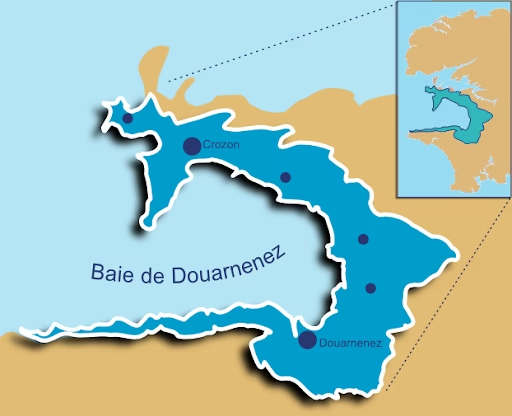
The silhouette of the Pointe du Raz, whose shapes vaguely suggested ruined structures, probably helped keep certain traditions alive. As early as the sixteenth century, one legend placed the city of Ys there, while another, more widely spread, located it beneath the waters of the Bay of Douarnenez.
Two centuries later, the inhabitants of Audierne claimed that a large reef, called le Cammer or la Gamelle, located about a league from the shore, was one of the last remnants of a once-famous city. According to this tradition, the city stretched from Penmarc’h to the Pointe du Raz, over a distance of more than five leagues. It was likely that a legend comparable to that of Ys had become associated with this sunken city. Indeed, it was said that on a rock far from the shore, the souls of King Grallon and Dahut appeared in the form of two ravens.
All writers prior to the nineteenth century placed the city of Ys in southern Finistère, mainly in the Bay of Audierne and, more often still, in the Bay of Douarnenez. A shift nevertheless appeared at the beginning of the nineteenth century. Jacques Boucher de Perthes, who had lived in the Morlaix area between 1816 and 1823, was the first to observe that by then, popular tradition placed Ys much farther north. According to local inhabitants, the city had once occupied an area between Saint-Pol and Brest, along the Pontusval coast. Other traditions placed it even farther east, between Perros and Morlaix. Everyone thus seemed eager to claim the honor of having had the mythical city in their own vicinity. This proliferation of locations showed that the legend of Ys, far from remaining tied to a single site, had gradually been adopted by different coastal communities throughout Brittany.
4. The Relative Modernity of the Tales of the City of Ys
Apart from this brief mention, no written record of the various Keris legends of northern Brittany had been found before around 1880. It could be assumed that these cities had not always borne the names by which they were then known. The fame of King Grallon’s fabulous capital may have led to their original names being replaced by a far more renowned one. A similar phenomenon had occurred with Gargantua. Having become the giant par excellence, he had eventually caused earlier heroes to be forgotten, with his exploits gradually being attributed to them instead. The legends themselves had probably undergone a similar evolution. Tales of catastrophes had preserved certain distinctive, and perhaps very ancient, features while also undergoing transformations under the influence of the tradition of Ys, which had become the most popular. Tales that had once been distinct could thus gradually have grown closer until they became associated with a single mythical city.
As for Ys of Douarnenez, it had been supposed that a city built on low-lying ground just above sea level—Keris, meaning “lower city”—had been destroyed by a sudden tidal wave. History, however, remained silent as to the date and circumstances of this submergence. It was therefore impossible to determine with certainty how a simple port, unknown to geographers, had come to assume in the popular imagination an importance comparable to that of Paris or Rome. Even more remarkable was the fact that its destruction had eventually come to be regarded as a true national catastrophe. This amplification of the legend had probably been gradual. In its origins, the tale of Ys, like that of many cities swallowed by the sea as punishment for a collective transgression, seemed to have drawn closer to the biblical model.
The tradition may have begun to take shape when a monk from Landévennec, wishing to urge the faithful to repent, compared the catastrophe that befell this Breton city, which had remained deaf to the preaching of Saint Guénolé, to that of Sodom and Gomorrah. These two biblical cities, too, had failed to heed the warnings of Heaven. This was precisely the form the legend retained in all writers prior to Saint Albert the Great. At the other end of Brittany, a comparable tale could be found in the submergence of Herbauges. Saint Martin of Vertou played a role there parallel to that of Saint Guénolé in the legend of Ys. This tradition was probably almost as old, but it had undergone far less development.
Pendant longtemps, aucune trace écrite de la cité légendaire n’avait donc été retrouvée. Théodore Hersart de La Villemarqué s’était trompé lorsqu’il avait affirmé, dans l’argument de La Submersion de la ville d’Ys, 1883, qu’il avait existé en Armorique, durant les premiers siècles de l’ère chrétienne, une ville aujourd’hui détruite à laquelle l’Anonyme de Ravenne aurait donné le nom de Chris ou de Keris. Le géographe qu’il citait ne disait pourtant rien de tel. Il mentionnait seulement une île appelée Chrisi, qu’il traduisait par Aurosa. Surtout, il la situait dans le voisinage de Taprobane, c’est-à-dire de l’actuelle Ceylan.
5. Passages by Pierre Le Baud, Bertrand d’Argentré, Jean de Moreau, and Albert Le Grand
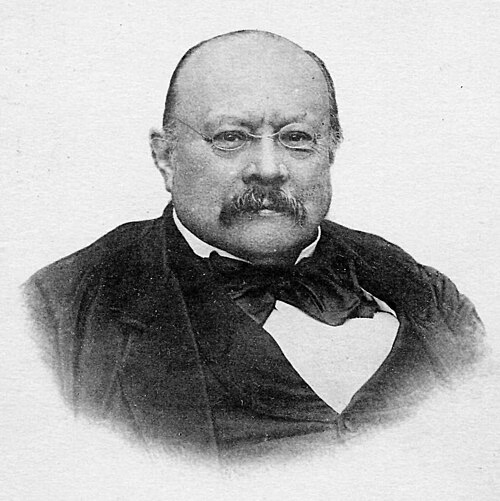
Miorcec de Kerdanet was also mistaken when he claimed that the first mention of the legend of Ys was found in the Lives of the Saints of Brittany. When Arthur de la Borderie answered the question that had been put to him concerning this claim, he had probably been thinking only of hagiographical texts and not historical works. Yet it would have been difficult for him to overlook the passages, admittedly very brief, by Pierre Le Baud (d. 1505), Bertrand d’Argentré (d. 1590), and Canon Jean de Moreau (d. ca. 1620). Arthur de la Borderie had thus written:
“The city of Ys,” he wrote to me, “is mentioned in none of the ancient lives or legends of Saint Guénolé, neither in the oldest, which may be called the original Life, written in the ninth century at the Abbey of Landévennec from early documents preserved in that monastery, nor in the reworkings produced in the twelfth century. Not only is the city of Ys never named in them, but they contain no episode resembling the submergence of the famous city. Albert Le Grand was unfamiliar with the ninth-century Life, or even the twelfth-century version. He probably drew his account from legendary breviaries of a later date. In fact, Albert Le Grand had also made use of d’Argentré’s History of Brittany and Alain Bouchart’s Chronicles, since he lists both among his sources.”
The ancient historians had therefore indeed mentioned the sunken city, even though their accounts were still far removed from the more developed versions that would spread later. Pierre Le Baud thus recounted:
“Grallon became a close companion of the blessed Corentin and gave him his palace. Shortly afterward, Corentin was consecrated bishop of the Corisopitenses… and their great city of Ys, situated near the sea, as is said, was at that time, because of the sins of its inhabitants, submerged by the waters of the sea, which overflowed their bounds. King Grallon, who was then in the city, miraculously escaped this submergence, namely through the merits of Saint Guingalois. And it is said that traces of it can still be seen along the shore of that sea, which, after the ancient name of the city, is still called Ys to this day.”
Bertrand d’Argentré’s account contained almost the same elements, while adding a few details about the remains that tradition associated with the city:
“Some have written,” says d’Argentré, “that during the lifetime of King Grallon, the city of Ys, near Quimper, was swallowed up and submerged by the sea; even today, the inhabitants point out the ruins and remains of the walls, so firmly cemented that the sea has been unable to carry them away, saying that King Grallon was inside when it was destroyed and that he was miraculously spared through the prayers of Saint Guingalois; these are events that have often occurred elsewhere through similar submersions of the sea, and God preserved Lot from a similar fate, but of this there are no reliable testimonies, nor any other evidence than an old tale handed down from one person to another.”
For both historians, the legend thus remained relatively simple: Ys, located near Quimper, had been swallowed by the sea because of the sins of its inhabitants, while King Grallon had escaped the disaster through the intervention of Saint Guingalois (Guénolé).
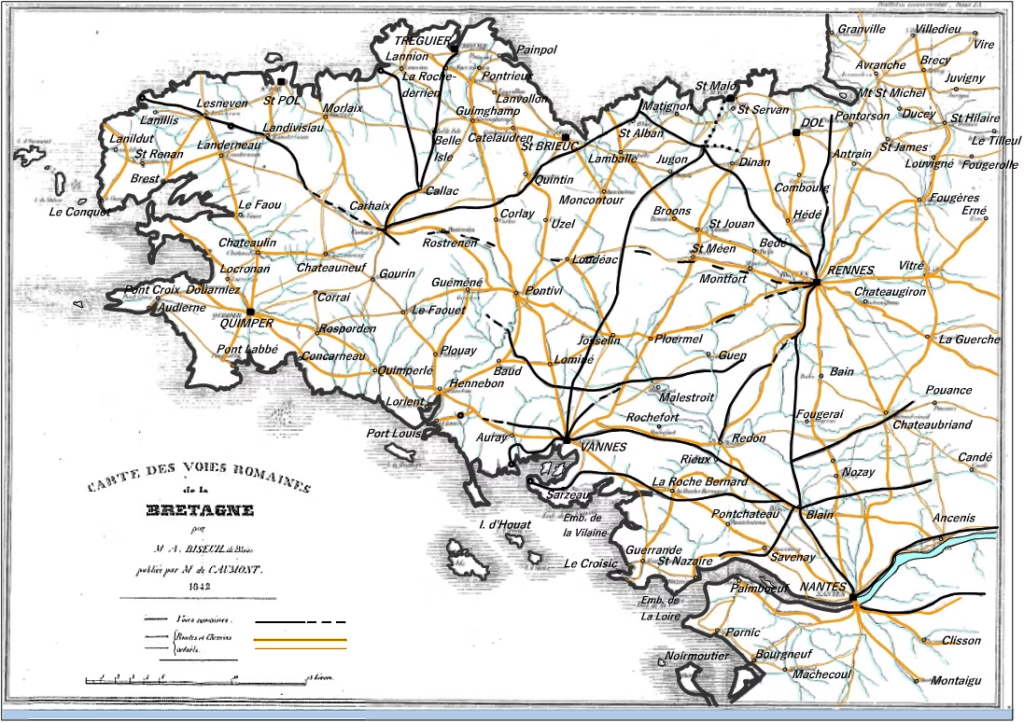
The account of Canon Jean de Moreau, slightly more developed, already introduced several new elements. In particular, it mentioned an ancient paved road linking Carhaix to the Bay of Douarnenez:
“There is here a paved road leading from the town of Carhaix to the said bay (Douarnenez). Nevertheless, there is nothing in writing, nor any record that bears witness to it, but only a tradition or perhaps a popular error; these are the paved roads that once led from every direction to that most famous and purported city called Ys in the mouths of the people of the country, which they say was situated where the Bay of Douarnenez now lies or at the Pointe du Raz, and which was subsequently, over the course of time, conquered by the sea some twelve or thirteen hundred years ago. That is to say, in the time of the holy men Corentin, Guénolé, and Tadec, when the great King Grallon was reigning in Brittany… and all this came about as a just punishment from God for the sins of the people and of the said city, using this furious element to punish the iniquities of the unjust. There are still old people today who dare confidently assert that, at low tide, while out fishing, they have often seen old ruins of walls. A certain person assured me that he had seen and read some pieces of Breton verse that mentioned this city, in handwritten manuscripts, but despite all the diligence and searching I could muster, I was unable to recover them.”
Jean de Moreau was thus the first to report the existence of Breton poems devoted to the submergence of Ys. These texts did not seem to have been widely circulated, however: despite his expressed desire to consult them, he had been unable to obtain a single manuscript. If they had been regularly sung, he would probably have mentioned this particularity. His account also provided an important detail concerning Dahut. At the end of the sixteenth century, she did not yet seem to belong to the legend of Ys. Jean de Moreau mentioned her nowhere, not even when he discussed the paved road leading toward Carhaix. This ancient road had probably borne the name Hent Ahès, meaning “Road of Ahès,” long before that time, like several other roads in Brittany. The name already appeared in a Frenchified form in the Roman d’Aquin, whose original composition predated the fourteenth century:
“Toward Car(a)hès they made their way,
All together, along the great paved road
Built by the woman Ohès, the old bearded man.”
This passage showed that the builder of the roads was not referred to by her own name, but by that of her husband. His name was later forgotten and eventually became hers.
About a century after Jean de Moreau, the builder of the roads was this time explicitly called Dahut. This development appeared in the version of the catastrophe recounted in The Lives of the Saints of Brittany:
“Saint Guénolé often went to visit King Grallon in the splendid city of Ys and preached loudly against the abominations committed in this great city, wholly given over to luxury, debauchery, and vanity, yet remaining obstinate in their sins. God revealed to Saint Guénolé the just punishment he intended to inflict. When Saint Guénolé went to visit the king, as was his custom, and they were conversing together, God revealed to him that the hour had come for the exemplary punishment of the inhabitants of the city. The saint, returning as if from a rapture and ecstasy, said to the king: ‘Ah! Sire, let us leave this place as quickly as possible, for God’s wrath is about to strike it. Your Majesty knows the depravity of these people: they have been preached to in vain; the measure is full, and they must be punished. Let us hasten to leave, otherwise we too shall be caught up and swept away in this same misfortune.’”
King Grallon then had his departure prepared. He gathered his most precious possessions, then rode out of the city with his officers and servants. The catastrophe occurred almost immediately:
The legend had thus evolved considerably. To the earliest accounts, which portrayed Ys primarily as a city punished for the sins of its inhabitants, was added the figure of Dahut, who gradually became one of the story’s central characters. The catastrophe was no longer merely that of a guilty city: it was now linked to the particular transgression of King Grallon’s daughter, whose role would become central in later versions of the legend.
It was here that the legendary princess appeared for the first time, having been ignored by earlier authors. The road leading from Douarnenez to Carhaix was called the Road of Ahès, a name that also referred to Dahut. It could be assumed that this peculiarity had contributed to associating the princess with the ruin of the city. Once her role as a builder had been forgotten, people may have thought that the road bore her name because she used it to travel to Keris. From there to making the city her residence was but a short step, and legends had taken far greater leaps. Nevertheless, her role, which became considerable in later versions, remained very secondary here and was even presented rather confusingly. The only truly precise detail concerned the keys she stole from her father; there was no mention whatsoever, however, of the locks they allowed her to open. It was probably later, when their symbolic meaning had been forgotten, that an attempt was made to assign them a practical function. Perhaps, too, a tradition concerning a sluice closed by keys, similar to one collected at a later date in the Bay of Saint-Malo, had become attached to the older legend.
The 1837 edition of the Lives of the Saints of Brittany contained a note by Kerdanet that, quite apart from its date, which preceded the literary embellishments, was of particular interest. Since Jacques Cambry did not mention the keys, this tradition was presented here out of chronological order. Traditional accounts thus explained the passage in Albert Le Grand: the city of Ys was protected from invasions by the Ocean by a dike, in the middle of which ingeniously designed sluice gates allowed the necessary amount of water to enter to supply the city’s numerous canals. King Grallon had the keys to these sluice gates carefully guarded and personally presided, each month, over the entry of water into the city. But Ahès’s intrigues and crimes had eventually stripped her of the last vestiges of her authority. She then seized the keys. In the turmoil that erupted, amid the unrestrained licentiousness she herself had provoked, she nevertheless failed to keep this precious talisman: it fell into the hands of ignorant and barbarous men, who opened the sluice gates. At once, the Ocean
6. La version de Jacques Cambry
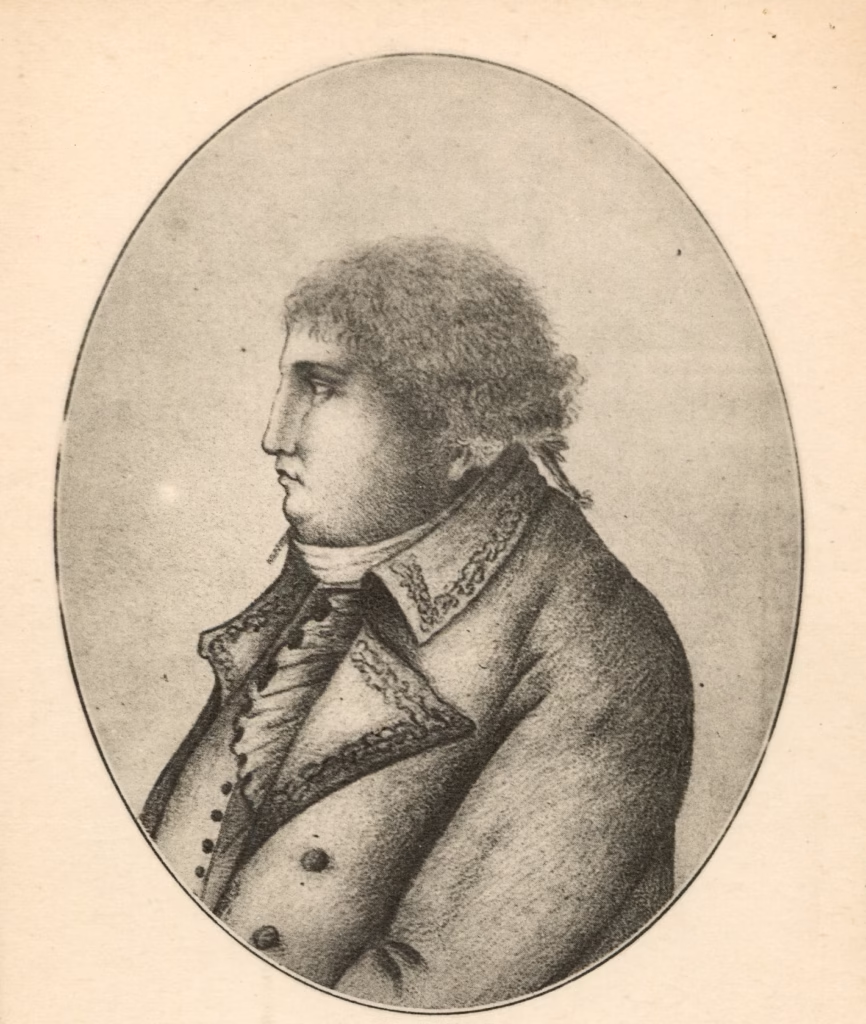
When Jacques Cambry visited Finistère in 1794, he could have collected, at many points along the coast, the accounts then associated with the city of Ys, had he considered the subject important enough. We would thus have particularly valuable testimony concerning the state of the legend at the end of the eighteenth century. Yet, as we shall see, <a href="https://patrimoine.lorient.bzh/histoire/personnalites/c/cambry-jacques" targ
“The magnificent city of Ys, as it is described in the legends, songs, and by the bards of Brittany, was under the rule of King Grallon; every kind of debauchery and luxury prevailed in this wealthy city. In vain did the holiest men preach morality and reform; Saint Guénolé himself was wasting his breath there. The princess Dahut, the king’s daughter, set an example of every kind of depravity. King Grallon alone was not deaf to the voice of Heaven; he attended holy services and kept company with the servants of God. One day, Saint Guénolé spoke these somber words before King Grallon: ‘Prince, disorder has reached its height, the arm of the Eternal is raised, the sea is swelling, the city of Ys is about to disappear. Let us leave.’ Grallon, obedient to the holy man’s voice, mounts his horse and rides away at full gallop, with his daughter Dahut following behind him. The hand of the Eternal descends: the city’s highest towers are swallowed up, and the waves, roaring, press against the holy king’s steed, which cannot break free. A terrible voice is heard: ‘Prince, if you wish to save yourself, shake off the devil who follows behind you.’ Beautiful Dahut loses her life and drowns near the place called Poul-Dahut. The storm subsides, the air grows calm, and the sky clears; but from that moment onward, the vast basin upon which part of the city of Ys had stood was covered with water. It is the Bay of Douarnenez.”
Jacques Cambry, like Canon Jean de Moreau, referred to what might be considered the poetic part of the legend of Ys, but he did so without much precision. If this tradition still survived at the time of the Revolution, it nevertheless seemed to have disappeared afterward. It was difficult, in fact, to regard the version in Barzaz-Breiz by Théodore Hersart de La Villemarqué as genuinely popular. It had been found neither before nor after the publication of that work, even in fragmentary form. François-Marie Luzel, moreover, classified it among the pieces that were presumed or entirely fabricated, of which no trace could be found in the tradition, as remnants of songs that had actually existed. The passage from the Voyage dans le Finistère, however, provided a particularly interesting detail: at the end of the eighteenth century, the legend of Ys already included the episode of Princess Dahut riding behind her father. This episode, which did not appear in the earlier authors, therefore constituted important evidence concerning the evolution of the legend. This observation had notably been noted in De l’authenticité des chants du Barzaz-Breiz, Saint-Brieuc, 1872, octavo, pp. 38–39. The gwerz of King Grallon and Keris, which later became very popular in Lower Brittany, constituted another element in the history of the legend’s dissemination. It had been sung in the region and had also circulated in the form of a pamphlet. It was, however, a very skillful pastiche, whose author was said to have been Olivier Souvestre, nephew of Émile Souvestre.
7. Émile Souvestre’s Romantic Version

A few years after Kerdanet’s note (1837) and the publication of the Barzaz-Breiz (1839), Émile Souvestre in turn proposed a particularly elaborate version of the legend of Ys. His account, much richer in details and wondrous episodes, helped give the tradition a form strongly marked by Romanticism. It was noteworthy, in particular, that Saint Corentin of Quimper replaced Saint Guénolé. A note nevertheless specified that this substitution was said to have been made by the storytellers. In Émile Souvestre’s account, the city of Ys was built below sea level and protected by powerful dikes. Sluice gates allowed the city’s gates to be opened at certain times so that the waters could flow in or out. Princess Dahut, daughter of King Grallon, constantly wore the silver keys to these gates around her neck. A great sorceress, she had also embellished the city with works that could not have been accomplished by human hands alone. The city had become extraordinarily prosperous: its burghers were so wealthy that they measured grain with silver goblets. This wealth, however, had brought about the moral downfall of its inhabitants. Having become vicious and cruel, they drove beggars from the city like wild beasts. The city’s sole church was so neglected that even the beadle had lost its key. The inhabitants spent their days and nights in taverns and theaters, wholly absorbed in the pursuit of their own damnation.
A few years after Kerdanet’s note (1837) and the publication of the Barzaz-Breiz (1839), Émile Souvestre in turn proposed a particularly elaborate version of the legend of Ys. His account, much richer in details and wondrous episodes, helped give the tradition a form strongly marked by Romanticism. It was noteworthy, in particular, that Saint Corentin of Quimper replaced Saint Guénolé. A note nevertheless specified that this substitution was said to have been made by the storytellers. In Émile Souvestre’s account, the city of Ys was built below sea level and protected by powerful dikes. Sluice gates allowed the city’s gates to be opened at certain times so that the waters could flow in or out. Princess Dahut, daughter of King Grallon, constantly wore the silver keys to these gates around her neck. A great sorceress, she had also embellished the city with works that could not have been accomplished by human hands alone. The city had become extraordinarily prosperous: its burghers were so wealthy that they measured grain with silver goblets. This wealth, however, had brought about the moral downfall of its inhabitants. Having become vicious and cruel, they drove beggars from the city like wild beasts. The city’s sole church was so neglected that even the beadle had lost its key. The inhabitants spent their days and nights in taverns and theaters, wholly absorbed in the pursuit of their own damnation.
“Shake off the sin you carry behind you, and with God’s help you will be saved.”
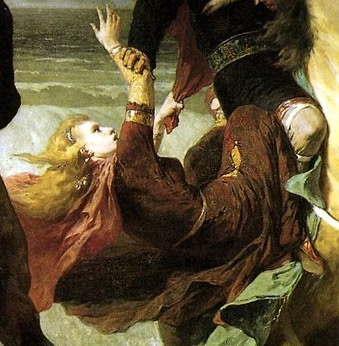
Grallon was still hesitating when the saint touched the princess’s shoulder with his bishop’s crozier. Dahut then slipped into the sea and disappeared into the depths of the chasm, thereafter known as the Chasm of Ahès. Freed of this burden, the horse leapt forward once more and reached the rock of Garrec, where, according to the tale, the mark left by one of its horseshoes could still be seen. The king fell to his knees to thank God. When he turned around, however, the opulent city had disappeared. In its place stretched only a deep bay, whose waters reflected the stars. (Le Foyer b
Grallon was still hesitating when the saint touched the princess’s shoulder with his bishop’s crozier. Dahut then slipped into the sea and disappeared into the depths of the chasm, thereafter known as the Chasm of Ahès. Freed of this burden, the horse leapt forward once more and reached the rock of Garrec, where, according to the tale, the mark left by one of its horseshoes could still be seen. The king fell to his knees to thank God. When he turned around, however, the opulent city had disappeared. In its place stretched only a deep bay, whose waters reflected the stars. (Le Foyer breton, “Kéris,” pp. 235–245.)
Other traditions provided further variations concerning the manner in which the city of Ys had been submerged. A passage from Guionvac’h, which appeared to recount a tradition originating in Morbihan, thus mentioned the existence of a miraculous well at the heart of the city. It was from this well that mountains of water erupted, like a volcano spewing flames, and these waters spread across the guilty city. (Louis-Antoine Dufilhol – L. Kerardven –, Guionvac’h.) A legend collected by Hyacinthe Le Carguet, for its part, gave a role to the structures that directly protected the city from the sea. According to this version, twelve sluice gates defended Ys, the most important of which was called Puits. (Hyacinthe Le Carguet, Légendes de la ville d’Ys.)
8. Probable Embellishments by Émile Souvestre
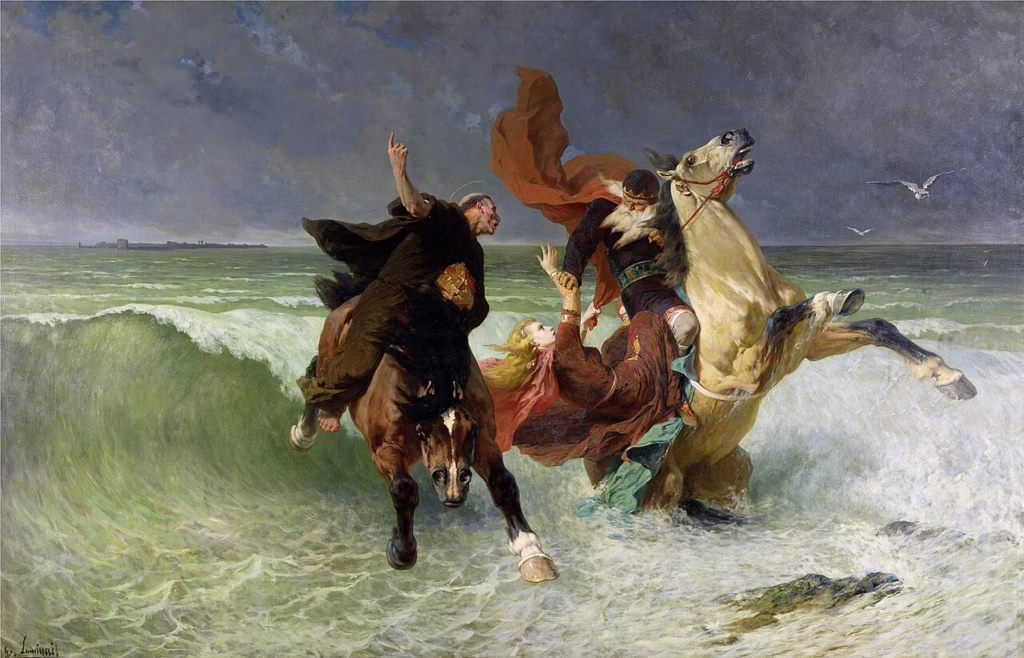
Of all the accounts devoted to the submergence of the city of Ys, that of Émile Souvestre, published in 1844, was both the most complete and the best known. His account was so carefully constructed and contained so many wondrous details that, after the initial pleasure afforded by its literary qualities, a close reading made it difficult not to see it as a highly polished adaptation of a traditional theme. Souvestre seemed to have taken particular care over the sequence of events, multiplied the marvelous details, and given the whole a highly finished form. It therefore seemed legitimate to question the genuinely popular character of certain episodes—quite numerous ones—that were found neither in Albert Le Grand, nor in Jacques Cambry, nor among the writers who, after the publication of the Foyer breton, sincerely collected traditions concerning the vanished cities of the Breton coast. Even by bringing together and logically arranging the various versions of which he might have had knowledge, it was difficult to imagine that Souvestre could have encountered such an abundance of wondrous incidents. Some episodes appeared only in his account, and their Breton origin remained, to say the least, uncertain. Other elements seemed to have been deliberately transformed in order to enhance the effectiveness and appeal of the story.
This seemed particularly true of an episode that Jacques Boucher de Perthes had preserved without associating it with Keris. According to this tradition, Ahès—or, in other versions, Dahut—had had several husbands. After their first night together as newlyweds, she had them thrown into a chasm that could still be seen at Pontaven, near Huelgoat. It was not impossible that Souvestre, concerned above all with captivating his audience, had sought to make the princess more spectacular by transforming the Breton princess into a sort of Marguerite of Burgundy. The resounding success of La Tour de Nesle in 1832 had just revived interest in this old Parisian legend. Other elements of the story seemed even more clearly to belong to the realm of literary imagination. The magical mask given to Dahut’s lovers did not appear in any known Armorican traditions. After serving to conceal their identity, it would automatically tighten around their faces and strangle them. The origin of this motif in Souvestre remained unknown. The demon disguised as a handsome prince, on the other hand, was a common device in Romantic literature. It appeared notably in Robert le Diable by Giacomo Meyerbeer, which premiered in 1831. One of the ballad’s verses, moreover, bore rather striking similarities to the stranger’s arrival at Dahut’s palace:
When there came to her father’s court
A prince, an unknown hero,
And Berthe, until then so proud,
Felt her heart stirred by love;
Fatal mistake, disastrous infatuation,
For this warrior was, so they say,
An inhabitant of the dark realm.
These parallels were not, in themselves, enough to establish a precise source for Souvestre’s account. They nevertheless called for caution when considering all of its episodes as a direct expression of a Breton folk tradition.
The episode involving the keys seemed less suspect in substance. Their presence was already attested in Albert Le Grand’s version, clarified by Kerdanet’s note. This motif also appeared in the account of the submergence of a region along the English Channel, which will be discussed later. However, the Barzaz-Breiz introduced an important nuance. In this version, the keys were not directly in the princess’s possession. Before she could open the sluice gates, she first had to steal them from her father.
9. Fragmentary Legends Collected Since 1846
After the publication of Le Foyer breton, the legend of Ys was found only in fragmentary form. During his lengthy research, François-Marie Luzel himself collected only a few fragments, which he did not consider significant enough to include in his collections. These fragmentary accounts nevertheless shared many common features. The storytellers placed the city of Ys sometimes on the Tréguier coast, sometimes in the Bay of Douarnenez.
At Audierne, tradition placed the marvelous city of Ys across the entire area between Penmarc’h and the Raz. It attributed to it a circumference of nine leagues. A woman from Penvénan, in the Côtes d’Armor, gave it an even greater extent: the city was said to have stretched from Douarnenez to Port-Blanc, while the Sept-Îles were said to have been its ruins. According to this account, Ys had one hundred cathedrals, each served by a bishop. The sailors of Tréguier, for their part, believed that the city lay in their vicinity. Some placed it at the Triagoz. The inhabitants of Penvénan, meanwhile, located it where the present-day beach of Trestel lies. According to tradition, the rocks on this beach bore imprints whose origin varied from one storyteller to another. For some, they were the hoofprints of the Devil’s horse; for others, those of King Grallon. The latter interpretation presupposed a legend close to the one reported by Jacques Cambry.
Popular accounts mentioned the excesses of Ahès with relatively little detail. Albert Le Grand, however, described her as the “shameless daughter of Grallon,” without reporting any specific act that might clarify the nature of her transgressions. A more recent work nevertheless portrayed her as both impious and a sorceress, thereby drawing a parallel with the Héloïse of the Barzaz-Breiz. According to this account, forty lords dressed in purple cloaks went to Mass at Lanval every morning and received Communion for the sole purpose of later bringing their Hosts to Ahès.
10. It Is Simply Covered by the Waters, and the Inhabitants Continue Their Activities

According to a tradition found in southern Finistère and along the coast of the Breton Channel, the city of Ys was not destroyed by the sea. It was simply covered by the waters and continued to exist, enchanted, beneath the waves. The waters were even said to form a kind of protective vault over the city. This conception of the legend was probably ancient, but its first written record dated back only to around 1830. The inhabitants of Ys were then said to have lived for several centuries in eternal youth. Later traditions went further: the inhabitants were said never to have changed since the day of the catastrophe. In the Trégor region, it was said that when the city was submerged, everyone remained frozen in precisely the position they had occupied at that moment and continued with whatever activity they had been engaged in. This state was to endure until the day Ys would rise again and its inhabitants would finally be freed.
Certain difficult acts were said to be capable of restoring the city to its former state and bringing its punishment to an end. A legend told around 1850 by an old man to another man who was then about sixty years old even traced the announcement of this resurrection back to the very day of the catastrophe. After escaping the submergence, Grallon had reached a rock with Saint Guénolé. The saint celebrated Mass there, with the king serving as his acolyte. At the moment of Communion, Guénolé, inspired, addressed Grallon:
“The blood of Christ saved the world; a drop of divine blood will also be able to redeem the city of Ys.”
After these words, he cast the chalice into the sea.
The saint then received a revelation: the city of Ys would remain alive beneath the waves, exactly as it had been when Grallon left it. It could reappear only after completing its penance. For this to happen, the blood of Christ, poured by Guénolé into the sea, had to be recovered, and the saint’s Mass had to be completed. After Guénolé’s death, the ritual was therefore to be repeated every year, on the anniversary of the catastrophe. A Mass was celebrated in the cathedral, and at the moment of Communion, the celebrant went out onto the platform. After completing the Communion, he would cast into the air the chalice bearing traces of the precious blood. The crowd would then rush forward in an attempt to catch it. If someone managed to seize the vessel before it touched the ground and carry it intact to the Bay of Douarnenez, in order to cast it into the sea, the priest would then have completed the Mass of Saint Guénolé. The condition would thus be fulfilled: Ys would return to life, as beautiful as it had once been.
11. Ys Will Rise Again If a Living Person Serves at the Underwater Mass
Most often, the resurrection of the city of Ys was linked to the completion of a Mass celebrated beneath the waters. At Audierne, it was said that a priest had been celebrating Mass when the catastrophe occurred. Ever since, he had continued celebrating it without ever being able to finish, because no one was there to serve him. The city’s deliverance therefore depended on a living person capable of reaching it. If that person managed to respond to the verse at which the priest had stopped, Ys would reappear at the surface exactly as it had been at the moment of the disaster.
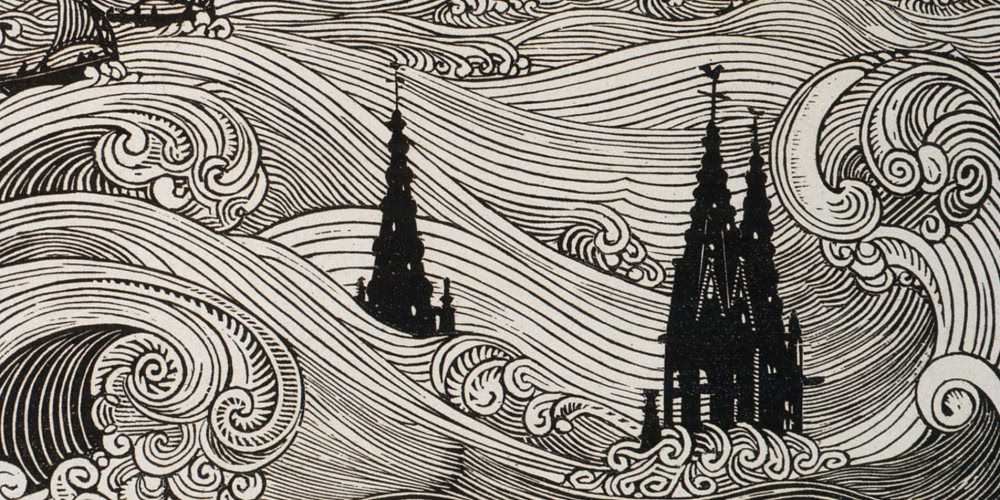
Some accounts told of living people who had managed, by miraculous means, to enter beneath the waters and attend the Mass that was still being celebrated in the enchanted city. A legend collected in 1885 related that a fishing boat from Douarnenez had dropped anchor in the middle of the Bay of the Dead. The seabed lay at such a depth that all the rope available aboard had to be joined together to reach it. After several unsuccessful attempts to raise the anchor, the boat’s skipper, who was an excellent swimmer, decided to descend along the cable himself. After a long dive, he discovered that his anchor had caught on the tail of the golden rooster atop a church steeple. He then had the idea of entering the church to say his prayers.
To his great surprise, the church was filled with people, and a priest was celebrating Mass there. The sailor saw him turn repeatedly toward the congregation, saying: “Dominus vobiscum.” But no one answered him. Intrigued, the sailor leaned toward his neighbor in the choir stall to ask why the altar boy was not giving the response. It was then that he realized with horror that he was not among the living: his neighbor was dead, and everyone around him was dead as well, dressed like the men and women of old. The priest himself was dead. He had stepped down to the foot of the altar and kept repeating: “Dominus vobiscum.” This time, however, his voice had taken on a threatening tone and seemed to be addressing the skipper of the boat directly. Terrified, he fled.
As he reached the church porch, an old woman seized him by the arm and reproached him irritably for failing to answer the priest. If he had done so while he was still inside the church, she told him, he would have saved everyone in attendance. These dead were the people who had been attending Mass when the city of Ys was submerged for its sins. As long as the service remained unfinished, they would remain imprisoned beneath the waters. Once the Mass was finally completed, Ys would be able to reappear and its inhabitants return to the land to do penance. A variant collected in Douarnenez followed the same motif, but with a different discovery. This time, it was a diver who found his anchor caught in the bars of a church window. Through the stained glass, he saw a kneeling crowd and the priest standing before the altar. The priest was asking for an altar boy to come and serve at Mass. The sailors later recounted their discovery to the rector. He replied:
“You have seen the city of Ys; if you had offered to serve the priest at Mass, the entire city of Ys would have risen again from the waters, and France would have changed its capital.”
References :
Croyances, mythes et légendes des pays de France, Paul Sébillot
Mémoires relatifs à la marine, L’amiral Antoine Jean Marie Thévenard
La Submersion de la ville d’Ys, Théodore Hersart de La Villemarqué
Vies des saints de Bretagne, Vies des saints de Bretagne