Why Does the Sea Glow Blue?
1.The Milky Ways of the Sea
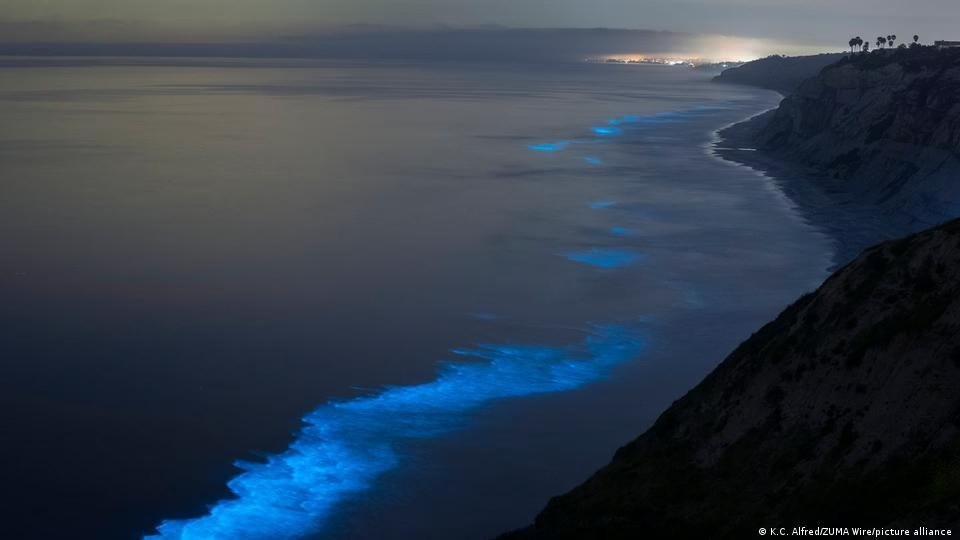
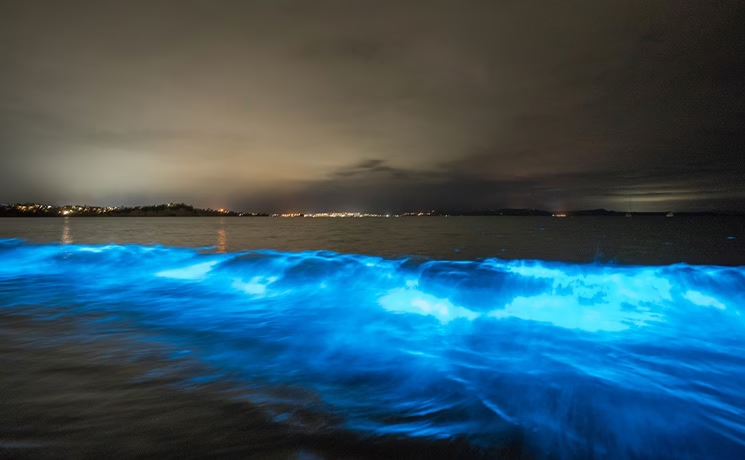
When the sea is calm and the tide is fairly high, long ribbons of lighter blue, with silvery reflections, can sometimes be seen, especially in bays, standing out against the surrounding water. This strange sight naturally evokes a Milky Way of the sea. Like the Milky Way stretching across the night sky, these luminous trails have inspired popular imagination. They were interpreted as the remains of a wondrous path, traced across the waters by the footsteps of gods or saints. According to these beliefs, these sacred figures may have walked upon the waves themselves or left their likeness behind upon the sea.
Around Saint-Malo, when these strange patches appear after a spell of rough weather, they are called the “Paths of the Virgin.” Popular tradition sees them as the traces left by the mother of Jesus. She is said to have descended upon the raging waters and crossed the sea in several places to calm its fury. The luminous trails that subsequently appear on the water are therefore believed to be the marks of her passage.
In reality, this glow comes from billions of bioluminescent bacteria (Vibrio harveyi or closely related species) that multiply in vast numbers at the surface of the water and emit light continuously to attract organisms. (Read the article: “The Magic of ‘Milky Seas,’ Revealing the Health of Our Oceans”.)
2. The Paths of Saint Blanche and the Virgin
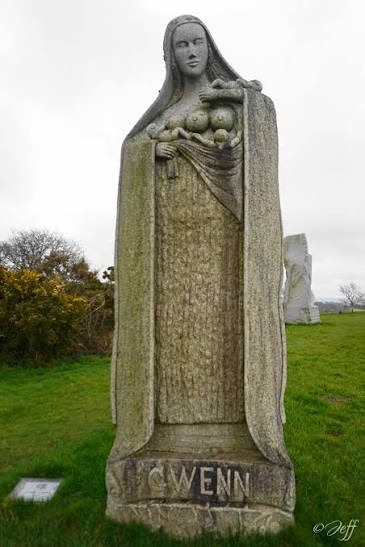
Another explanation for the “Paths of the Virgin” appears in literary form in a work written without any real scientific purpose, although some of its stories may nevertheless be useful for the study of folk traditions. Its author claims to have heard the following story from a priest:
During the 1758 Battle of Saint-Cast-le-Guildo, fought during the Seven Years’ War, a white lady was said to have appeared in the sky, emerging from the old village well at l’Isle, the birthplace of Saint Gwenn (Blanche in French). She was the Virgin Mary, who until then had remained motionless in a small niche carved into the wall. She then descended toward the shore and glided across the water. Her muslin veil, which seemed to unfurl without end, resembled the crest of the dunes. According to the legend, this apparition caused the English to aim too high throughout the battle, thereby inflicting little damage on the French troops. The wake left by the Virgin’s robe was said to have remained visible upon the water, giving rise to the long white trails still observed in these waters today. (See also: The Legend of Saint Blanche and the English.)
Despite its charm, this tale probably does not belong to ancient folklore. It was more likely composed from several genuinely popular elements, particularly traditions attributing to sacred statues the power to walk upon the waters. It may also be based on a much simpler story once told by the elderly, who saw no supernatural intervention in it. On the day of the 1758 battle, a very low-lying fog is said to have formed between the ships and the shore, creating a kind of mirage. The English supposedly mistook this phenomenon for the crest of the dunes, causing them to fire their cannons too high. In Audierne, a similar phenomenon is known as the “Virgin’s Channel.” It consists of a lighter-colored band that sometimes stands out sharply against the blue of the sea. Local tradition, however, attributes no particular origin to it.
The fishermen of Saint-Cast Bay, for their part, most often associate these pale bands with several episodes from the legend of Saint Gwenn, who was born in their principal village and is venerated there. According to tradition, the English once captured the saint and carried her aboard a ship bound for London. She escaped along the way and, walking upon the waters, returned to her homeland within a few hours. The route she is said to have followed, still occasionally visible on the surface of the sea, is known as the “Path of Saint Blanche.” Another version claims that the pale trail was instead the wake left by the ship on which her captors were forced to carry her back. The legend continues with another episode. Later, Saint Blanche married a ship's captain and accompanied him to war. When he was killed in battle, despair spread among the crew. The heroine then leapt into the sea and walked dry-shod toward the English. Terrified by this miracle, they fled in haste. Her statue was said to possess the same extraordinary power. Seized from her chapel by the enemy, it suddenly came to life after being insulted. It then leapt from the ship and crossed the sea, leaving behind a visible path upon the water, before returning to its place in its niche.
The name and exploits of Saint Gwenn, despite her being almost unknown outside this region, are very frequently associated with these pale patches on the sea. It is therefore reasonable to suppose that, as occurs in other folk traditions, an association between the name “Gwenn” and the relatively white color of these streaks helped give rise to their name. This association may also have encouraged the creation and transmission of the various legends intended to explain the mysterious origin of these luminous paths across the sea.
3. The Paths of Saint Germain and Other Saints
In the Bay of Fresnaye, separated from the Saint-Cast Cove by a narrow peninsula, the “Path of Saint Germain” commemorates the miraculous passage of the statue of this blessed saint.
The statue stood at Plévenon, on the coast opposite the ancient church where it is still preserved today. When the day of the annual pilgrimage arrived, however, the weather was so bad that no boat dared venture out to sea to bring it back to its shrine. In the same bay, people also point out the “Path of Saint John”, which was probably once associated with a similar legend. That story has since been forgotten, as has the one that must once have explained “l’ Quémin de Saint-Martin-ye”, the name given by fishermen of Boulogne to the patches of spawn floating on the surface of the water left by herring. Rather than disappoint the faithful who were on their way to its pilgrimage, the statue then supposedly came to life and crossed the entire sea by itself. The wake it was said to have left behind has ever since been known as the “Path of Saint Germain.”
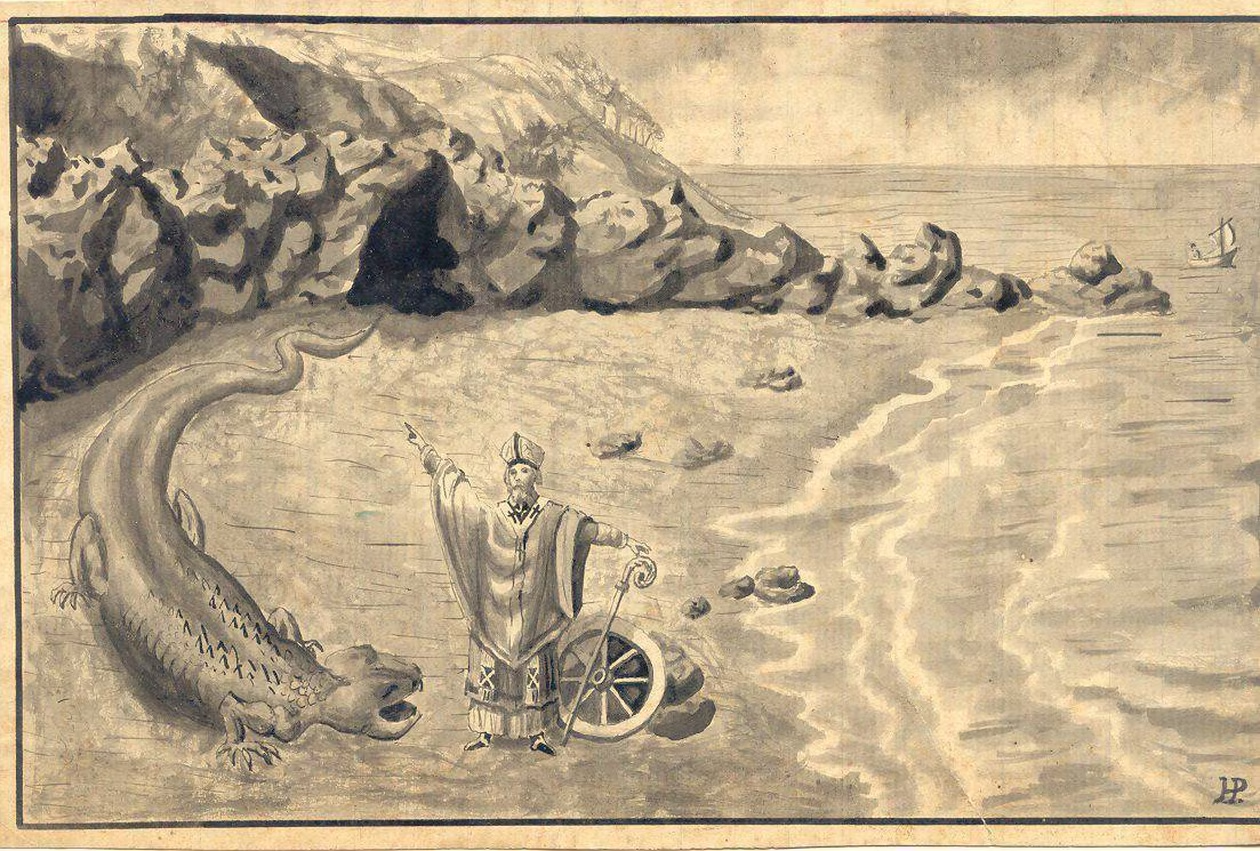
At Diélette, the “Path of Saint Germain” commemorates Saint Germain the Scot, a different figure from the saint associated with Fresnaye. According to tradition, he came to free the region from the tribute its inhabitants were forced to pay to the Serpent of Trou Baligan. One day, as a child was being led to the monster as a sacrifice, the inhabitants saw a man standing upon the sea, which was perfectly calm. He carried a bishop’s crozier, wore a mitre on his head, and was draped in a large cope. The man appeared to glide across the water. As he drew closer, however, they realized that he was being carried upon a cartwheel. It was because of this peculiar means of travel that he supposedly came to be known as Saint Germain of the Cartwheel.
In Lower Brittany, sacred figures are not always believed to have left a visible trace of their passage across the sea, although several traditions credit them with the power to walk upon the water. This is notably the case with Saint Guénolé. After making the waters solid, he is said to have struck the sea with his crozier and walked across the waves with his companions as easily as along an ordinary road. Other saints were said to have used miraculous mounts or talismans to make their crossings. In northern Finistère, some of these pale patches are sometimes called Hent ar Santez, meaning the “Path of the Saintly Women.” The name evokes the passage of spirits from the other world. After the shipwreck in which Saint Ursula and her companions perished, the bodies of the latter were said to have been washed ashore. According to tradition, 7,777 of them were buried in the cemetery at Lanrivoaré. The body of their queen, however, was said to have remained beneath the waves. The legend holds that the saintly women sometimes rise from their graves in search of their queen. They then walk across the sea, leaving footprints upon the surface of the water as they go.
In the same area, the white streaks that crisscross the surface of the sea are also known as Hent ar Devet, meaning the “Path of the Sheep.” The connection with the saints, however, is not entirely absent from this name. The expression “Path of the Saints” is an old one and appears notably in the legend of Saint Paul Aurelian. Before leaving England for Armorica, Saint Paul Aurelian is said to have planted stones in front of his sister's monastery, which were transformed into rocks. Where the saint and his companions had passed, only a narrow path remained, known as Hent Sant Paul, the “Path of Saint Paul.” If a legend was once associated with the white streaks on the sea, it appears to have been forgotten today. The name “Path of the Sheep” may simply derive from a comparison between these disheveled-looking patches of water and the tufts of wool that flocks leave behind when passing through brambles along country paths.
Along the coast of Camargue, a winding line that sometimes appears on the surface of the sea bears a similar name: Lou Camin di santi Mario, meaning the “Path of the Saintes-Maries.” According to tradition, this line marks the route followed by the saints on their journey to Provence.
The Way of Saint James, in the Vilaine estuary, has a particular feature. It is no longer a path identifiable by a pale color, but rather a broad ribbon of foam, especially visible after storms. This band of foam runs along the middle of the riverbed and moves upstream with the current. Local inhabitants say that it appears in the places where Saint James is said to have walked upstream across the water.
With the exception of the Path of Saint Martin in the Pas-de-Calais and the Camin di santi Mario, legends attributing the creation of trails upon the sea to supernatural figures appear to have been recorded exclusively along the coast of the English Channel, particularly around Saint-Malo. Elsewhere, such traditions seem to have been unknown. Since the publication in 1886 of the first volume of Legends of the Sea by Paul Sébillot, in which he recorded some of these beliefs, he repeatedly drew his correspondents’ attention to these pale patches, the names given to them, and the popular traditions they inspired. After making inquiries among their neighbors and attempting to revive the memories of their fellow countrymen by recounting, in particular, the beliefs of fishermen from the Bay of Saint-Malo, they all assured him that, if similar traditions had once existed elsewhere, the oldest sailors no longer knew of them.
Outside France, these beliefs seem to be even rarer. Only two foreign examples came to his attention. In Finland, the pale, luminous streaks observed on the sea after a storm are popularly called the “Path of Väinämöinen,” or, more precisely, the “wake of Väinämöinen’s boat.” In some respects, this tradition recalls the trail left by Saint Blanche’s journey when she was being carried back toward her native village. Along the coast of Belgium, finally, these trails are interpreted as paths leading either to Gibraltar or to America.
4. Goblins, Fairies, Saints, and Ghosts Who Walk Upon the Waters
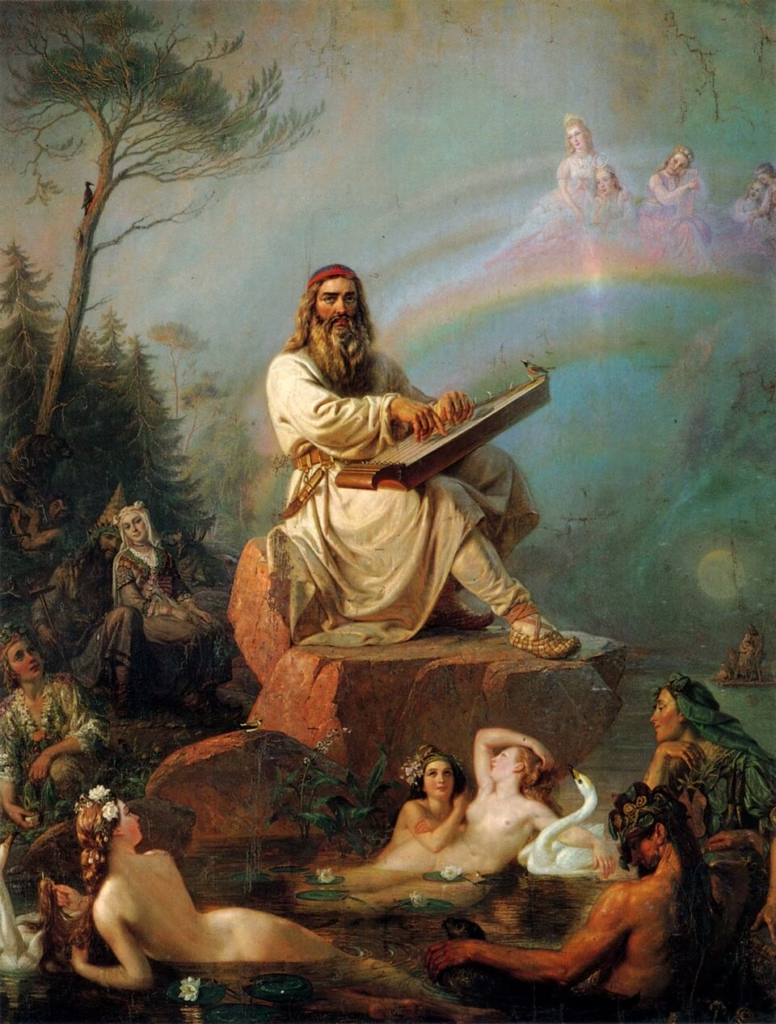
The ability to walk upon the waters, long attributed to saints, already appears in several legends from the Middle Ages. It may derive from the famous episode in the life of Jesus Christ, who walked upon the waters of the Sea of Galilee without sinking. Yet this miracle is not exclusive to Christian tradition and even predates it: Neptune is said to have granted the power to Orion, while the Finnish god Väinämöinen likewise possessed the ability. In more recent legends, this faculty is also attributed to beings with no connection to Christianity. Fishermen along the English Channel claimed to have seen human-like creatures walking upon the waves, their bodies covered in seaweed. They were said to live beneath the waters and appear related to the man of the sea from the caves, as well as to the Tud-gommon, the seaweed-clad dwarfs spoken of around Tréguier. Along the Morbihan coast, people also told of sorcerers who, alone or in great numbers, traveled to Arz Island by walking directly across the water.
Some of these apparitions reveal themselves only during storms or when ships are in danger. When sailors from the Tréguier region find themselves out at sea, surrounded by such thick fog that they can no longer make out their course, small black demons known as the Diawolo bihan dû, or black goblins called the Cornandonet dû, begin dancing around them. These creatures seem intent on distracting the sailors while gently steering their boats toward the rocks. Victor Hugo also described in vivid detail a being half man, half fish, particularly visible when the sea is raging. It was said to rise upright amid the waves, entirely above the foam, and to begin dancing whenever it spotted ships in distress on the horizon. Yet according to Sir Edgar MacCulloch, Bailiff of Guernsey, no one in the islands had ever heard of such a creature. He therefore supposed that, if the poet had not invented the monster entirely, he had at least profoundly transformed whatever tales may have been told to him.
A clearly poeticized tradition, though some of its elements may nevertheless be retained, tells of graceful creatures that once appeared in the Rance estuary. Dressed in the colors of the rainbow, they formed circles upon the waves. The current carried them toward the coves, from which they soon emerged again, in ever greater numbers, following a woman even more beautiful than the others. She was their queen. She traveled aboard an extraordinary vessel made from the shell of a South Seas nautilus and drawn by two crayfish. Her companions were the fairies who ruled over the sea. Among her powers, the queen could command the winds to blow less fiercely. She could also order the Rance to cast ashore the bodies of men whom the storm had swallowed.
The heroes of folk tales quite often cross the sea with the help of talismans or by being carried by magical birds. They are, however, much less frequently able to walk directly upon the water. A few examples have nevertheless been recorded. In the Bay of Saint-Cast, a fairy takes a captain by the hand, and the two of them walk across the waves without even getting their feet wet. In another tradition, a drac, who dwells at the bottom of the Ocean, binds a young girl whom he has abducted with a long, delicate golden chain. By doing so, he grants her the power to walk across the sea without sinking. A hero from a Lorraine tale acquires the same ability after hearing the song of a magical bird. Finally, according to a story from Finistère, a young man protected by the King of the Fish manages to travel a considerable distance across the waves without sinking.
Characters who have passed from this world possess this power as well: blessed souls who have emerged from Paradise, or restless spirits condemned to perform posthumous penances, sometimes wander across the surface of the waves. Their walking possesses the same miraculous quality as that of living saints or supernatural beings. In modern folk belief, particularly as reflected in Breton tales, the dead are not regarded as the weightless, intangible shades of Classical Antiquity. On the contrary, they are described as beings just as solid and just as heavy as the living, capable of performing the same actions as they are. A hymn composed in the 17th century by the Father Julien Maunoir, based on the popular tale of Jean de Calais, provides a characteristic example. A dead man whom a young man had buried out of charity comes to find him on the island where he had been abandoned. He walks across the sea as though it were solid ground, then carries the young man back to the shore on his back. This episode also appears in a Romantic-era version of Jean de Calais. There, the revenant is preceded by a column of white foam that marks his path. A Breton legend likewise tells of a revenant who takes the man who had buried him upon his back and carries him across an arm of the sea.
Several tales thus tell of processions of figures who have come from the other world. An old Poitou legend recounts that a fisherman who had gone out to set his nets at night saw an immense procession of old men and young people dressed in white. The procession seemed to be making its way toward Saint-Michel-en-l’Herm, walking directly across the waves. The company grew larger and larger. Finally, a venerable old man, none other than Saint Giraud, broke away from the procession and approached the shore to speak with the fisherman. The drowned themselves are also sometimes believed to undertake a mysterious procession across the surface of the sea on Christmas night.
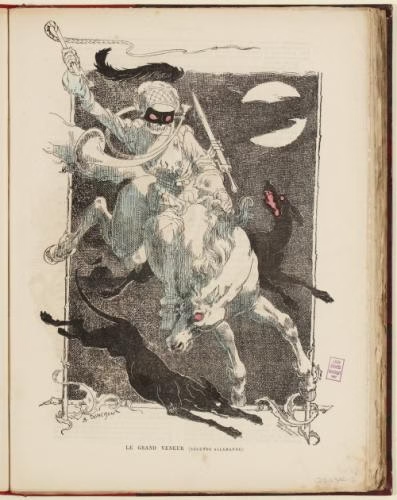
Sailors in Morbihan tell of a shepherd who can sometimes be seen between Locmariaquer and Île-aux-Moines, dressed in a black cassock and walking across the waves without sinking. Holding a whip in his hand, he drives a large flock behind him. He is said to be the restless spirit of a former rector of Baden, denied rest because no masses or prayers were offered for him. Three or four times a year, when the moon is high in the sky, another apparition is said to appear in the same region. A monk emerges from the former Guildo Abbey, in the Côtes-d’Armor, and then makes his way down toward the Arguenon. After walking across the waters of the arm of the sea formed by the river’s mouth, he disappears behind the rocks known as the Ringing Stones. These stones are said to seal the entrance to the Devil’s treasure.
According to a tale from the Tréguier region, the drowned souls held captive by the Red Princess in her enchanted pond were one day freed by a beggar woman who opened its sluice gates. She then saw them rise and, as though resurrected, walk upon the waves. The women who left a nearby island off Arz at night and crossed the sea without getting their feet wet likewise belonged to the world of the dead. The same was true of the two entwined ghosts whom fishermen from Piriac sometimes saw in the evening, running along the crests of the waves. They were a woman and her husband. He had drowned before his wife's eyes, and, overcome with grief, she was later caught by the sea in a cave in the cliffs. (See also: The Legend of the Red Princess of the Island Castle.)
The All Saints’ Day, les âmes des noyés s’élèveraient au sommet de chaque vague. On les verrait courir sur la lame sous la forme d’une écume blanche et fugitive. Toutes celles qui avaient vécu dans ce doux pays et trouvé leur linceul dans les flots se retrouveraient alors dans la baie. Chaque vague porterait une âme à la recherche d’un frère, d’un ami ou d’une bien-aimée. Lorsque deux âmes se rencontreraient face à face, elles feraient entendre ensemble un triste murmure, avant de poursuivre leur course, entraînées malgré elles par le flot qu’elles doivent suivre. Parfois, un bruit confus et prodigieux s’élèverait sur la baie : un mélange de doux soupirs, de rauques gémissements et de cris plaintifs sifflant au-dessus de la houle. Ce seraient les âmes des noyés qui converseraient entre elles et raconteraient leur histoire, poursuivant ainsi, sur les vagues, leur mystérieuse existence.
5. Crossing the Sea with Supernatural Objects
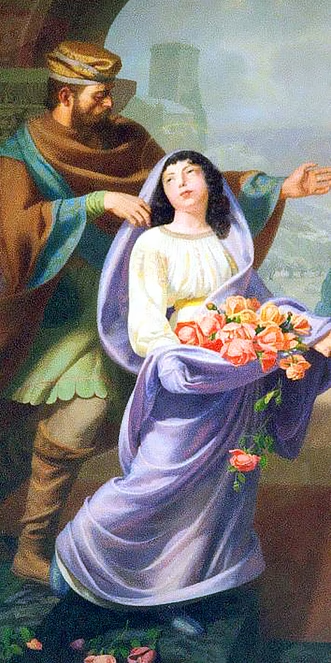
Not everyone who crossed the sea without sinking necessarily walked directly upon the water. Some relied on objects, sometimes remarkably insubstantial ones, which nevertheless enabled them to make their miraculous journey.
Saint Margaret of Antioch, sister of Saint Honoratus of Arles, is said to have crossed the stretch of sea separating the island that bears her name from Sainte-Marguerite Island simply by spreading her veil across the water. A Provençal legend concerning Saint Roseline of Villeneuve likewise tells that, at the moment of her death, the saint appeared to her brother, Hélion de Villeneuve, Master of the Order of Hospitallers, who was then a prisoner of the Saracens. She freed him from his chains and then had him climb onto her veil, spread across the surface of the sea. In this way, she miraculously brought him back to his homeland. (See also: The Legend of the Liberation of Hélion de Villeneuve.)
Saint Gildas, meanwhile, upon seeing the ship on which he had embarked disappear, is said to have sat upon his cloak and fastened it to his crozier in order to “catch the wind.”
This privilege is not limited to saints. Certain figures from other legendary traditions can also cross the sea with the help of magical objects. In the Gulf of Morbihan, women, probably beings from the other world, are said to cross the waters with nothing more than a simple apron beneath their feet. In the tale Jean Rouge-Gorge (Le foyer breton: contes et récits populaires, Émile Souvestre, Volume I, page 100), Jean Rouge-Gorge, the bird of the Passion, gives the shepherdess Blanche Épine a pair of beechwood clogs. With them, she can walk across the waves and reach an island where there is a cow whose milk never runs dry. In another tradition, a fairy gives a captain from the Bay of Saint-Malo a pair of magical boots. Thanks to them, he can cross the sea without getting wet.
In some legends, the objects that serve as means of transport for saints are far more substantial and much heavier. Saint Gravé (the masculine form of Saint Gravide, meaning “pregnant woman,” in reference to the Virgin Mary), like Saint Germain of the Cartwheel, crosses the English Channel upon a wheel that travels with lightning speed. Saint Ninnoc, Saint Budoc, and Saint Evette, meanwhile, climb aboard a stone trough that miraculously begins to float like a boat. When Saint Evette reaches land, her trough moves away from the shore and sinks beneath the sea. It can nevertheless still be seen during the highest tides. Every year, on the day of her pardon, it leaves its watery resting place and rises back to the surface. Saint Evette then climbs back into it and, during the procession, makes the circuit of Audierne Bay. Saint Vougay makes a similar crossing by sitting upon a large rock which, as soon as it is placed upon the water, begins to float. Another tradition tells that a marble altar table enabled Saint Martin of Vertou and his companion to reach the end of their journey.
One of the most striking examples is that of Saint Gerbold. His master, wishing to get rid of him, tied a millstone around his neck before throwing him into the sea. But the moment the stone entered the water, it became as light as cork. The rope came loose, and the saint, seated upon his millstone, sailed peacefully toward the shores of Bessin. What was meant to bring about his death thus miraculously became his means of transportation.
The same motif also appears in folk tales. In the tale The Little Soldier (Tales of a Beer Drinker, Charles Deulin, II, pp. 95–96), which nevertheless belongs to a heavily reworked collection, a princess is carried away at a gallop in a carriage drawn by her horses. When the team reaches the seashore, it does not stop: the carriage plunges into the waves and glides across the watery expanse with the same ease with which it had previously rolled over dry land:
“Thus they sped on in a mad race through towns, market towns, and villages, while people came to their doorways to watch them pass. At last, they reached the seashore. Jean hoped that the carriage would stop, but, wondrous to behold, it entered the waves and glided across the watery expanse just as it had rolled over solid ground. The brave horse collapsed from exhaustion, never to rise again, and the little soldier sat down upon the shore, gazing sorrowfully at the carriage as it disappeared over the horizon.”
6. Rides Across the Waters
After crossings accomplished with the help of sails, cloaks, wheels, or other miraculous objects, some legends go even further: sacred or demonic figures cross the sea on horseback, riding steeds to which they themselves have granted the power to walk upon the waves.
The inhabitants of Carnoët once told that Saint Maudez regularly traveled, on his feast day, to the chapel dedicated to him in the village. To make the journey, he rode a white horse and crossed the sea from Ireland to Brittany. His mount therefore possessed the same extraordinary power, crossing the waves as though they were an ordinary road.
Demonic figures likewise possess mounts capable of defying the laws of nature. A famous sorcerer from La Tranche, in Vendée, would travel to Île de Ré after gathering a little moss from the cemetery gate at midnight. As soon as his ritual was complete, he would be carried away like lightning on a white horse. He would then return on the same steed with such speed that the animal seemed barely to skim the surface of the water.
Other tales take a more ominous turn. The sorcerers from beyond the sea, summoned by the Ankou, the personification of Death, arrive on the shores of Brittany in pursuit of the white saints. They travel in a flaming chariot drawn by four black horses. Fire pours from the animals’ nostrils, casting a dreadful light all around them, which eventually fades into the wake left by the saints. At the end of the 18th century, when the Teus or Buguel Nos put the devil’s chariot to flight, the tales sometimes said that it would plunge into the sea.
Another legend, collected in the vicinity of Morlaix, features a rider even more directly associated with the Devil. One evening, a fisherman was alone in his boat, brooding over his unfortunate lot. Suddenly, he heard a great noise. Looking toward the setting sun, he saw a rider dressed entirely in red, mounted on a magnificent black horse. The animal moved across the sea as though it were a perfectly solid road. Fire burst from all four of its hooves and from its nostrils, illuminating the waters around it. The rider was none other than the Devil. Having heard the fisherman’s laments, he had come to make him an offer: to buy his soul.
7. The Waters That Part
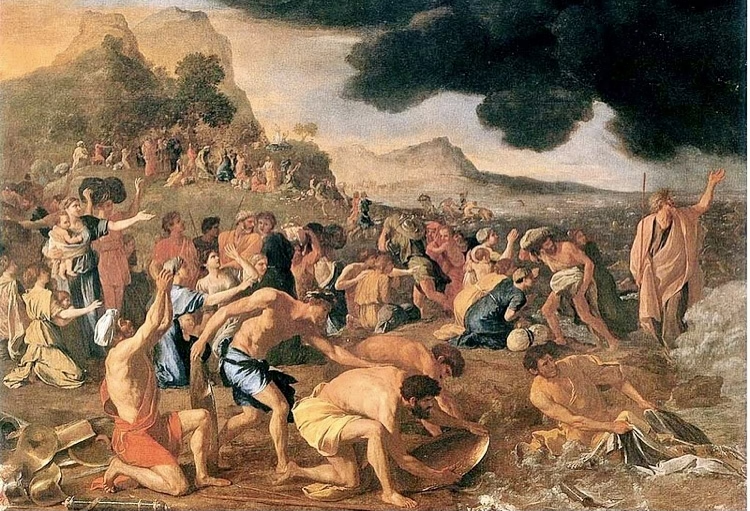
Some of these traditions naturally recall the famous passage of the Hebrews through the Red Sea (Exodus 14:15–31) and may sometimes derive from it. A Provençal legend tells of a lord who, urged on by his stepmother, had his own son thrown into the sea. Soon overcome with remorse, he went to the shore in search of his body. There he met a monk who told him that he could help him find his son. The monk then struck the sea with an olive branch. At once, the waters parted. The lord and the monk were able to walk dry-shod, deep beneath the surface of the sea. Eventually, they reached a cave where the lord discovered his son peacefully asleep.
In the Gascon tale The Three Children (Folk Tales of Gascony, Jean-François Bladé), which is not connected with The Golden Legend by Jacques de Voragine, the power to part the waters belongs this time to an ordinary child. A little boy strikes the sea three times with a stick. With each blow, the waters divide down the middle, forming a passage that allows him to cross. The miracle therefore no longer depends upon a saint or other sacred figure: an object as ordinary as a stick is enough, in the child's hands, to command the waves.
In another tradition, a maiden of the Virgin possesses a magic wand given to her by a hermit. By the sheer power of this wondrous object, she compels the sea to surround a castle. She is then able to order the waters to withdraw. The sea thus appears as a force entirely subject to the wand’s magical power, capable both of creating a watery enclosure around the castle and of making it disappear.
The same miracle is attributed to several sacred figures. Miorcec de Kerdanet records a tradition according to which the sea itself opened to allow Saint Guénolé to pass. In a Breton version of a tale about a journey to Paradise, the phenomenon takes a similar form: as the sea rages, its waters part before Jannik’s wand, allowing the traveler to continue his journey through the midst of the waves.
8. The Phosphorescence of the Sea