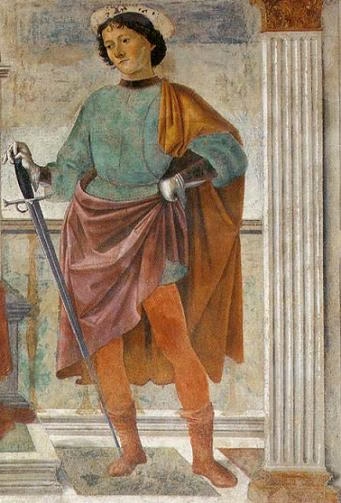
Saint Julian the Hospitaller, detail of the Virgin in Majesty between Saint Sebastian and Saint Julian, fresco by Domenico Ghirlandaio, church of Sant’Andrea in San Donnino (Campi Bisenzio) near Florence.
Several beatified figures are said to have lived in caves, although the accounts of their stays are generally brief. In Locoal-Mendon, Saint Gurval (Gulwal)is said to have dug a cave with his own hands. Near the confluence of the Sarre and the Blavet, a natural cavern served as the dwelling of Saint Rivalain. Likewise, near Castennec, Saint Gildas and Saint Bieuzy are said to have established their hermitage in a cave, according to traditions reported notably by Dr. Alfred Fouquet and Luc Rozenzweig.
Not far from Augan, one can still see the cave where Saint Couturier came to sleep each night, a figure sanctified solely by popular devotion. He would lie there wrapped in his cloak, which he deliberately soaked in the water of the nearby stream in order to increase his suffering and practice a form of mortification. This account is reported by François-Marie Cayot-Delandre in Le Morbihan.
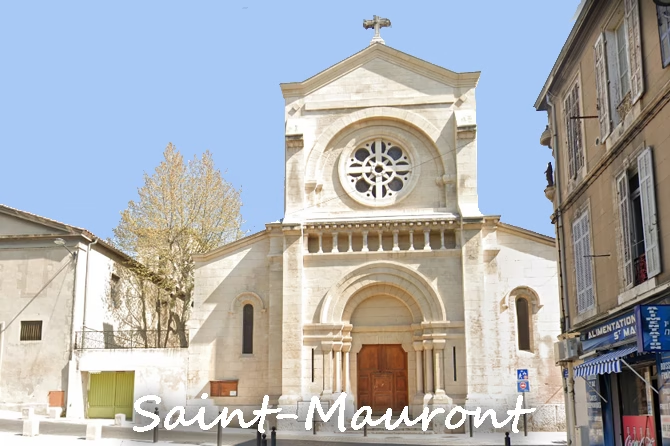
In keeping with accounts in which caves become places of spiritual retreat, some traditions attribute to them an even more mysterious power: that of suspending time. The story of Saint Mauron—or Mauronce—is one of the most striking examples.
The Benedictine Saint Mauron is said to have fallen asleep for a hundred years in a cave located in Anjou, near a tumulus. A more detailed version of the legend, in which he is called Mauronce (a form close to the Latin Mauruntius), recounts this astonishing episode in full. Mauronce was the abbot of a monastery where he tried, unsuccessfully, to impose strict discipline. Faced with the indiscipline of the monks, he one day withdrew into an isolated cave, known only to him, to meditate. But this retreat took an unexpected turn: he fell into a deep sleep, the cause of which no one understood. The years passed. Not seeing him return, the monks eventually appointed a successor.
The abbots who succeeded one another failed to restore order. The indiscipline persisted, even worsened, until one of them considered abandoning the monastery. It was then that, against all expectations, Mauronce awoke. When he emerged from the cave, his appearance bore witness to the passing of time: his white beard, thick as a fleece, trailed along the ground, and his hair formed a cloak over his shoulders. He made his way to the convent of Montglonne. Upon his arrival, the gatekeeper, terrified, took him for a ghost. Surrounded by the monks, he simply declared:
« Je suis votre père à tous, mes enfants ; je suis Mauronce. J’étais allé méditer il y a quelques instants ; mais il me semble que tout est changé. Où donc est le prieur, tel cellérier ? Je ne les vois point parmi vous ! »
“I am your father, my children; I am Mauronce. I went to meditate just a few moments ago, yet everything seems changed. Where is the prior, and the cellarer? I do not see them among you!”
The chapter was convened, and the records were consulted. They confirmed the incredible truth: a hundred years had passed since the abbot’s disappearance, and ninety since the death of those he still named. Recognized at last, Mauronce resumed his place at the head of the monastery. This time, he succeeded in restoring order, unity, and the purity of morals among his community.
3. Angels
The Stones of the Day, Madelaine Mountain
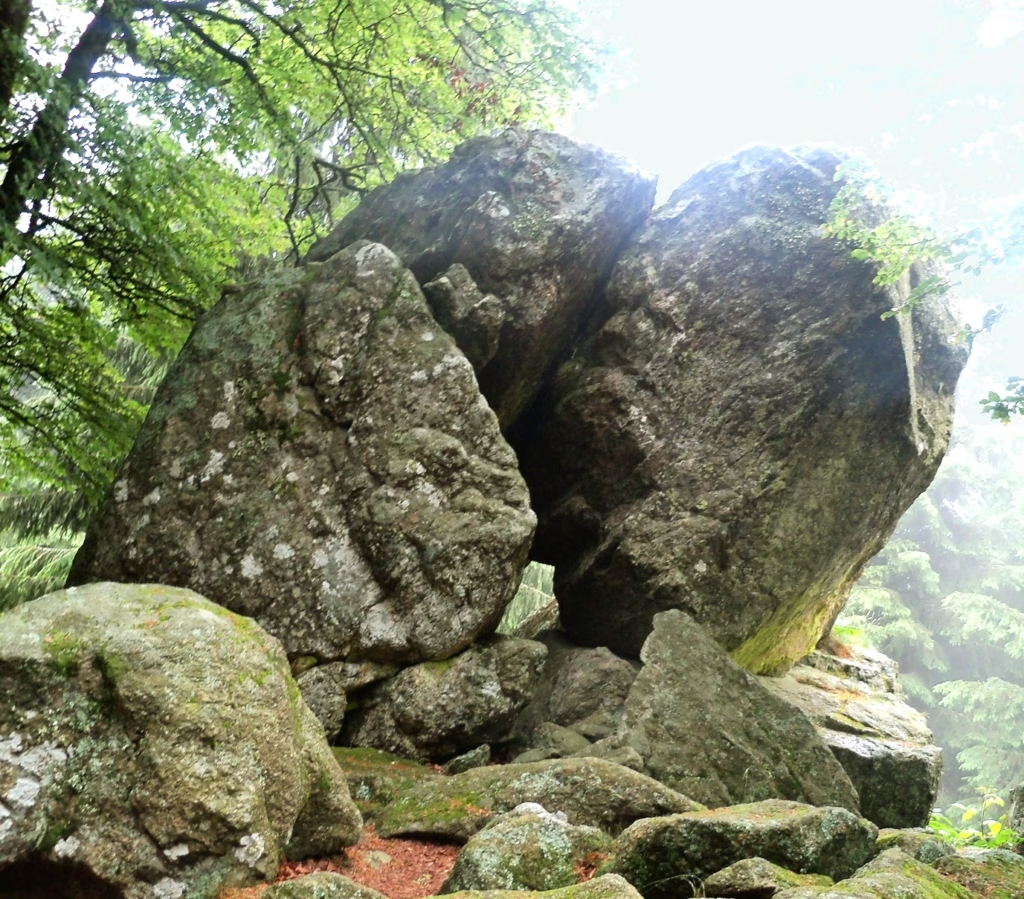
A blessed woman, known as Marie of the Woods, had chosen to live in seclusion in a cave at the Stones of the Day, on the Madelaine Mountain, in the Allier. Her life, marked by simplicity and poetry, was surrounded by almost wondrous signs: the snow formed a kind of halo around her head, while little birds gently came to arrange her hair.
In the Vaucluse, a cave adorned with stalactites bears the name li Baumo dis Ange, though tradition does not clearly explain its origin.
In Franche-Comté, north of the village of Bussurel, another natural cavity is directly associated with angels. In this cave of Bussurel, the angels lived in close relationship with the surrounding inhabitants. They inquired about their needs, exchanged with them, and sometimes brought them cakes or other treats. Their presence was benevolent, almost familiar, like an extension of the celestial world into everyday life. However, this closeness was not without condition. The angels remained in the cavern and continued their kind acts as long as the inhabitants maintained pure and simple morals. When this moral balance was broken, their presence vanished—as if the link between heaven and earth could not endure without a certain harmony.
4. Devil’s Cave
Several caves bear names that directly reflect their supposed link with the demonic world. In the Hautes-Alpes, some caves are called lis Oulo dòu Diable. Near Marseille, in Mazargues, a cavern adorned with stalactites is known as the Capello dòu Diable, now called the Cosquer Cave. In the Barma Rossa mountain, a large cavity is reputed to be inhabited by the devil himself.
Near these places, locals recount having seen small creatures—imps, gnomes, or sprites—appear, run about, make grimaces, and then suddenly vanish in the form of flames. In the region of the Pont-du-Diable, the Clamousse Cave, in reality a simple gallery of an abandoned mine, was considered a former demonic dwelling. Those who passed nearby would take care to make the sign of the cross.
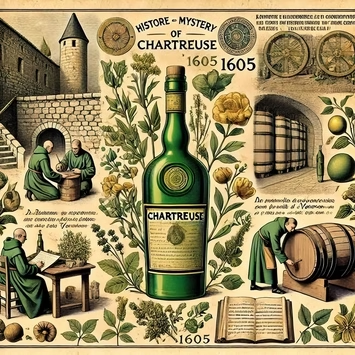
In Périgord, some caverns were regarded as vents of hell. People said that moans could be heard there, as if rising from the depths. In the Furon gorges, near Grenoble, certain caves remain accessible—but only when the waters of the torrent are low. According to tradition, these places are the setting for a peculiar activity: Satan is said to brew exquisite liqueurs there, preventing anyone from disturbing his work when the waters rise. Another legend presents the fairy Mélusine as inhabiting the Grotte de Sassenage in these gorges. A further tradition adds an unexpected dimension to this story: a Carthusian monk is said to have entered one of these caverns and discovered the 130 plants used to make the famed liqueur. Upon returning, he passed this knowledge on to his brothers. According to this tradition, this is the origin of the famous Chartreuse liqueur.
5. Witches’ Chamber
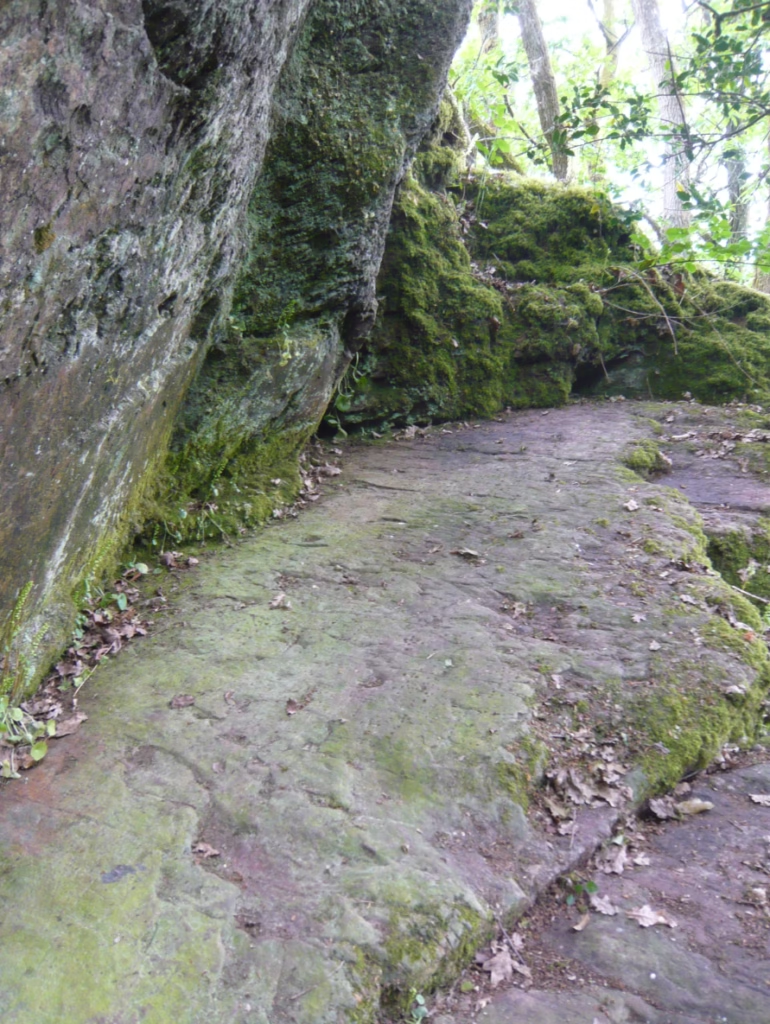
Witches’ Chamber, Saint-Thurial
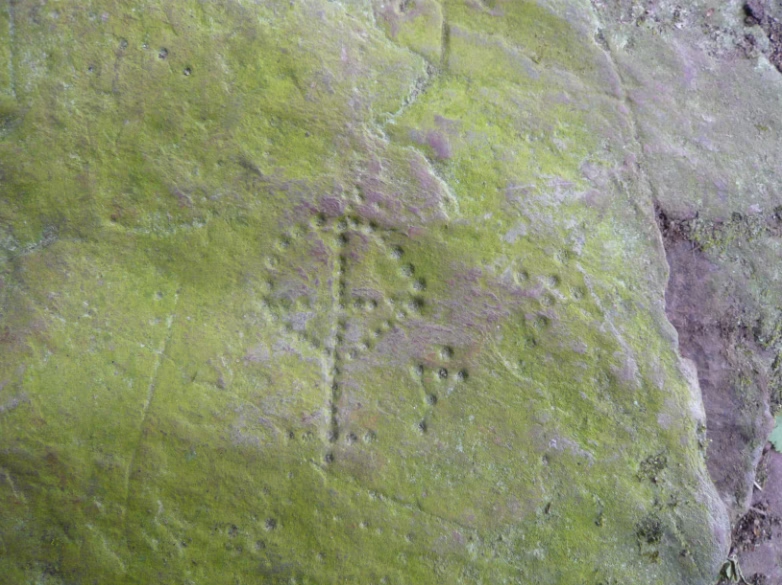
Inscription on the rock of the Witches’ Chamber
The sorcerers of the Montfort region (Ille-et-Vilaine) gathered in a cave between Le Verger and Saint-Thurial, called the Witches’ Chamber, where it was claimed they held their sabbath on Carnival day. In Bruz, a natural excavation was known as the Witch’s Chamber or Witch’s Hole, and people feared seeing a white ghost appear there, whose noise could be heard in the air. The Witch’s Hole in Maubert was once the dwelling of a witch: the locals heard her scraping her oven, and if they asked her for a cake, they would find it placed, still warm, on a furrow in the field. As noted earlier, such acts are usually attributed to fairies; the name given to this figure likely replaced the original one at a relatively recent time.
In Belval-les-Dames, a cave was frequented in the mid-16th century by witches known as the Demoiselles of Lévy, and to win their favor, offerings were left at the entrance. A hundred years later, less credulous peasants decided to uncover the mystery. Hiding nearby, they saw figures dressed in white emerge, sit in a circle beneath a tree, and begin to talk. By their voices, they recognized local rogues—thieves and marauders. They rushed to strip them of the shrouds they used to disguise themselves as fairies, and shortly afterward, they were hanged near their hideout.
The inhabitants of the village of Vingrau (Pyrénées-Orientales) once sealed a cave called Caune de las Encantadas, a supposed lair of witches, with a massive stone in order to protect themselves from spells.
6. Saints Delivering the Land from Cave Dragons
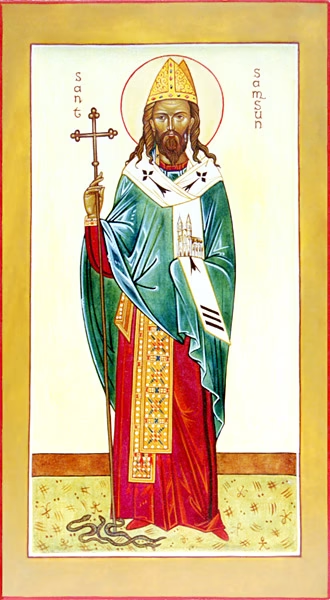
The icon of Saint Samson of Dol, painted for the Orthodox Association of Saint Anne (Brittany).
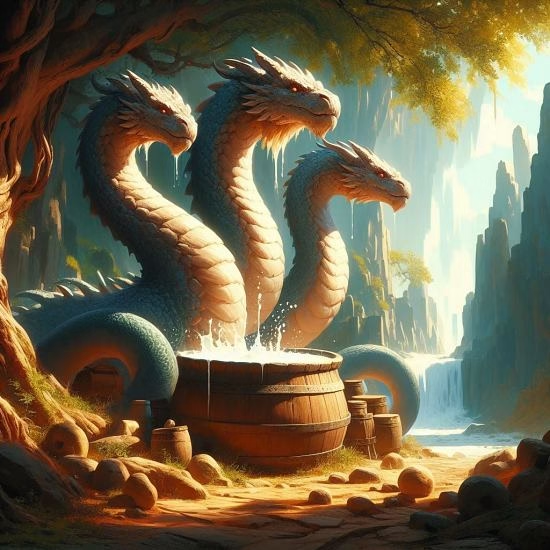
Just as several coastal houles, some caverns are believed to have been the lairs of dragons. They do not bear names directly linked to this belief, but legends, sometimes quite detailed, attest to it and recount how saints or heroes drove away the monsters that inhabited them.
Along the banks of the Seine, one can still point out the cave where the serpent retreated, from which Saint Samson delivered the land. In the forest of Wasmes, another cavern sheltered a fearsome dragon, defeated by the knight Gilles de Chin. At Villiers, near Vendôme, a similar monster was destroyed by Saint Julian, who put an end to the ravages it caused.
Not all accounts describe a violent battle. In Savigny, near the hermitage of Saint Margaret, a dragon allowed itself to be tamed. The saint placed a belt around its neck and led it out of its cave, illustrating a victory achieved through faith rather than force.
Near Vendôme, Saint Bié (Béat or Saint Bienheuré) lived in a cave not far from that of a dragon. He killed the monster with a single blow of his staff to the head. The legend emphasizes the impressive size of the creature: when it drank from the river, about a dozen meters away, its tail still remained in the cave while its head reached the water.
Near Saint-Florent-le-Vieil (Maine-et-Loire), a serpent ravaged the region from a cave near the chapel of Moguette. The inhabitants called upon Saint Mauronce, abbot of Montglonne. Rather than confronting the monster directly, he used cunning: he placed a scythe at the entrance of the cavern, concealed beneath leaves. When the serpent returned at night, it fatally wounded itself upon the blade.
7. 7. Knights or Peasants Who Slay Them
Serpent of Villedieu-lès-Bailleul
It was through cunning that a Basque hero once managed to defeat a monstrous dragon dwelling in the cave of Açaleguy. From its lair, the creature could draw in entire flocks grazing on the mountain slopes with its breath alone. When it descended to drink at the Aphona stream, deep in the valley, its immense body remained coiled in the cave while its head reached the water. Faced with this scourge, the inhabitants called upon the knight of Çaro, recently returned from war. He promised to deliver the land. He filled a calfskin with gunpowder, attached a long fuse, and, taking advantage of the dragon’s sleep, placed the trap at the entrance of the cavern. After lighting the fuse, he quickly rode away. Awakened by the noise, the dragon saw the skin, drew it in, and swallowed it. A minute later, an explosion rang out. The creature burst into the air, spewing fire, its tail toppling beech trees in its wake. It fled toward Bayonne before throwing itself into the sea in an attempt to extinguish the flames consuming it—but there it met its death. (Jean-François Cerquand, Legends of the Basque Country, vol. IV; a shorter variant appears in vol. I, where the hero is called the knight of Athoguy.)
A Norman legend, collected at the beginning of the 19th century, recounts the devotion of a knight who attempted to free the region from the serpent of Villedieu-lès-Bailleul. Amid the quartz blocks overlooking the village, a cave still stands as a witness to an ancient tradition, passed down from generation to generation. It was there that a monstrous serpent withdrew, long feared in the surrounding lands. To appease its wrath, the inhabitants offered it the first fruits of the harvest and the purest milk from their herds. But these offerings were not enough: at certain times, it demanded a young girl, whom it dragged into its lair to devour. The valley, then flooded, became the stage for its appearances, the monster gliding over the waters, leaving behind a trail of fire. A knight from the lineage of the Bailleul, sovereigns of Scotland, resolved to end this threat. Protected by an armor of tinplate covering both his body and that of his horse, he advanced toward the cave. As he moved across the waters, the monster saw him and rushed at him with fury. The knight withstood the assault and struck such precise blows that the dragon’s defeat seemed inevitable. Yet the creature unleashed such violent flames that they eventually suffocated its opponent. In a final tragic turn, the hairs of the horse’s tail—the only unprotected part—caught fire. The flames spread, consuming the animal and its rider from within. The monster, itself mortally wounded, died upon their remains. In memory of this sacrifice, the inhabitants added the knight’s name to that of their village.
In the Aosta Valley, a legend speaks of a winding cavity carved into the rock near the Morettaz bridge. It is said to have been the lair of a dragon that ravaged the region. A man from Perloz, drawn by the reward promised to anyone who could rid the land of the monster, decided to act. Taking advantage of the moment when the creature was watching for prey, he offered it a loaf of bread fixed to the end of a long sword. When the dragon opened its jaws to seize it, the man drove his weapon deep into its throat. Mortally wounded, the beast collapsed. But in a final surge, a stream of poisoned blood burst onto the hero’s arm. Burned by the venom, he succumbed shortly afterward, in terrible agony.