Sacred, fairy-like inhabitants of the rocks
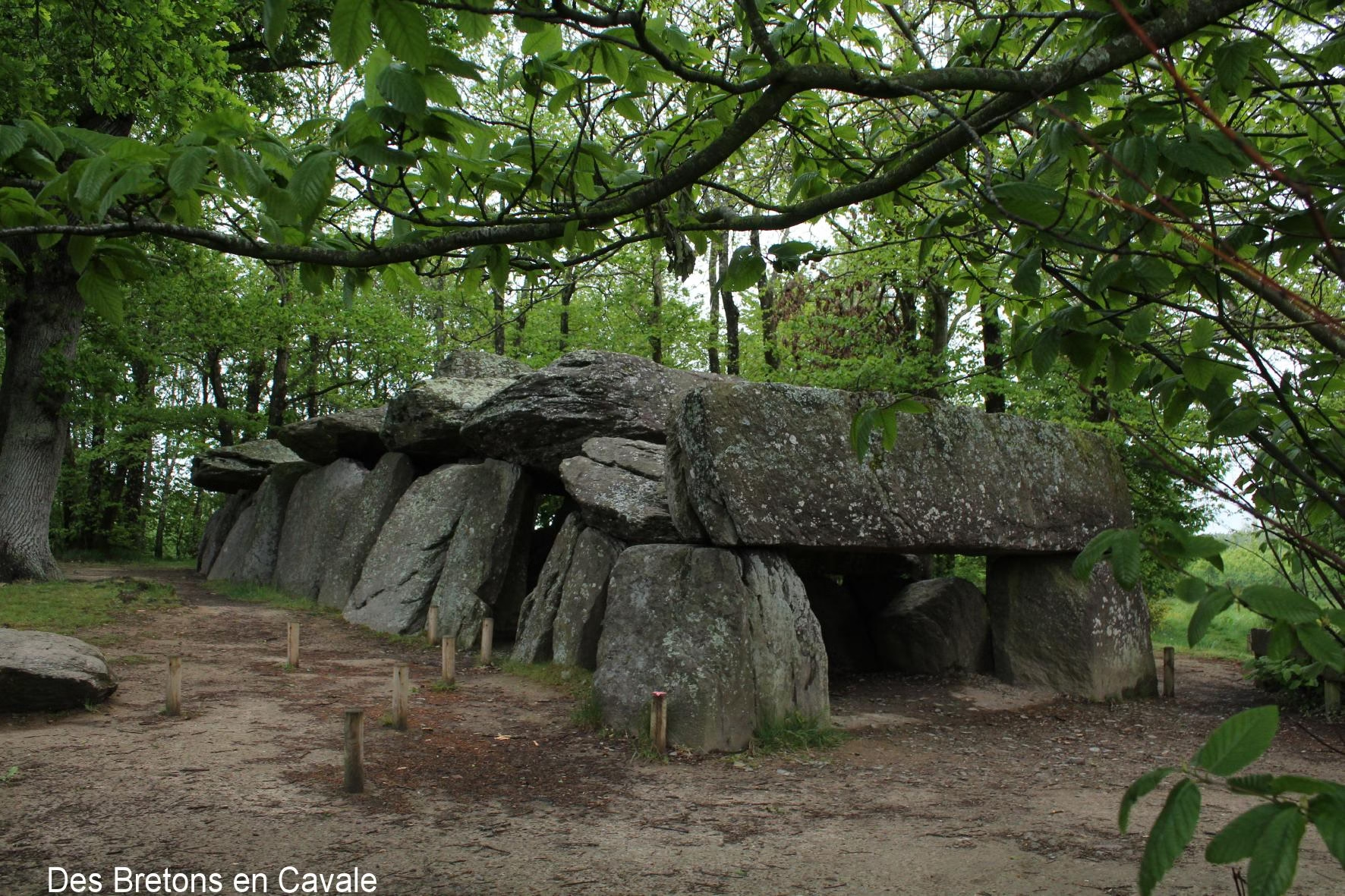
1. Ancient rock shelters
The people associate large rocks — like all natural phenomena likely to inspire wonder — with legendary figures whose exploits they recount. Sometimes, these mythical beings are even believed to have made their homes there. Most of them, however, are said to dwell in caverns, opening below ground level or accessible through fissures, thus linking them to the underworld. Their stories will be discussed later, in the chapter devoted to caves. Their deeds, moreover, are far better preserved than those of their counterparts whom tradition mentions more vaguely as having lived in stone huts, formed by stacks of rocks resembling ruined dolmens, or else out in the open beneath overhanging rocks.
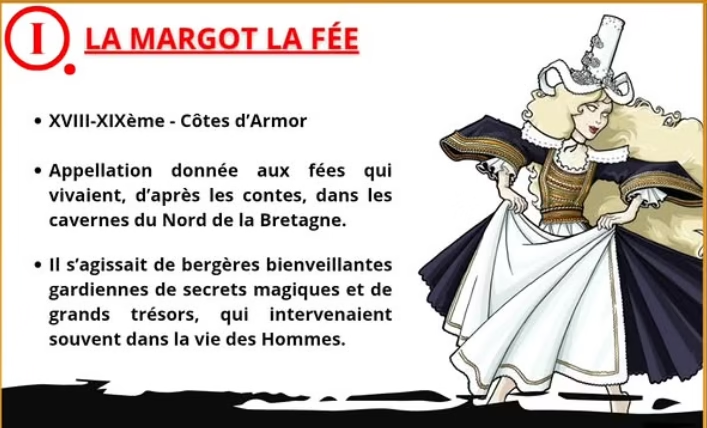
In the central part of the Côtes-d’Armor, between Lamballe and Moncontour, oral tradition relates that some of these natural formations served as dwellings for the Margot-la-Fée, who more commonly lived in caverns.
In the municipalities of Saint-Glen, Le Gouray, and Penguily, several sites are still pointed out as having once been inhabited by these legendary figures. These places share common characteristics:
Sometimes, this rock rises almost vertically above the stony area and is topped by a thick rocky slab, embedded in the hillside, that projects far enough to form a kind of natural canopy.
In the immediate vicinity of these shelters, one can notice various imprints, which tradition attributes to the feet or the utensils of Margot-la-Fée. Some hollowed stones are called their beds or their cradles.
They would light fires there on the flat surfaces, sheltered from the rain by the overhanging sections, and sit on large stones to keep warm. Like their cave-dwelling namesakes, they owned livestock, and their actions are described as essentially identical.
2. The Martes
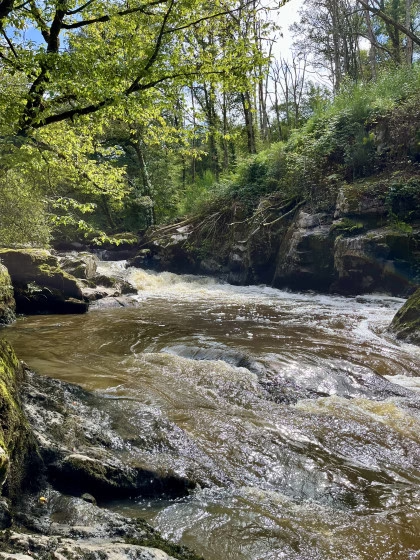
The Martes, a type of fairy described as very ugly and malevolent, are mainly known in the central region of France. Like other legendary figures, they sometimes lived among rocky outcrops, always close to water, a recurring element in the stories associated with them.
Local farmers refer to a place known as the Maison aux Martes as a kind of natural cave, located in the commune of Cromac, near the river. This unusual site is formed by a granite slab serving as a ceiling, held aloft by other rock blocks arranged like a natural support. The whole structure evokes an ancient shelter, well suited to fueling popular imagination and the fearful tales passed down from generation to generation.
The description of the Martes is remarkably consistent throughout the oral tradition. They appear as tall dark-haired women, with bare arms, as well as an exposed chest, and whose breasts hung down to their knees. Their loose, unbound hair fell almost to the ground, heightening their wild and unsettling appearance.
The Martes inspired a deep terror in the peasants, whom they chased while shouting:
"Head, plowman!", all the while tossing their breasts over their shoulders. This violent and grotesque image left a lasting impression on rural memories.
Remarkably, around 1850, the Martes were still spoken of as if they had actually existed, rather than merely as mythical figures. Their memory then seemed to go back less than half a century, evidence of the strength and persistence of these beliefs in the collective imagination.
3. The Fairies
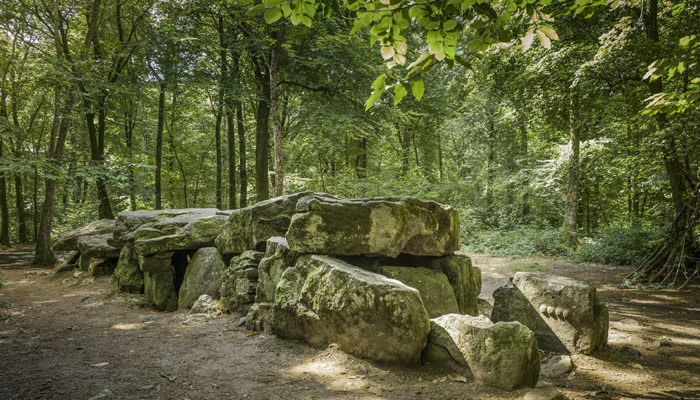
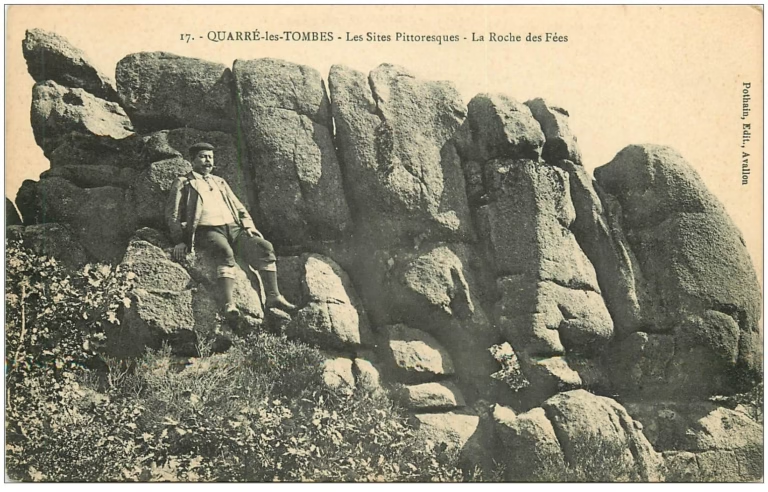
Three stones arranged side by side in the village of Kermorvan, in Maël-Pestivien, are called Ty ar Groac’h, the Fairy House. In Châtel-Gérard (Yonne), a large rocky outcrop is known as the Fairies' Cottage, while a field covered with large stones near the tumulus of Marcé-sur-Esves is referred to as the Fairies' Cemetery or the Maids.
Sometimes, the name is still accompanied by traces of legendary deeds attributed to the fairies. When vapors rise above the Châté de las Fadas, a natural rock in the Creuse, it is said that the fairies are doing the laundry there. In the Beaujolais, they danced silently by moonlight near the Fairies' House, the Fairies' Chimney, and the Fayettes' Table, located in the Couroux Woods. In Savoie, they would come at night to form circles on the platform of the Fairies' Stone, where in the morning the imprint of their feet could be seen on the dew-soaked moss.
The fairies often sat on the Fairies' Rock, near Saint-André-de-Valborgne (Gard), from where much of the valley can be seen. The Néry Woods, in Saint-Just-d’Avray, are dotted with oddly shaped rocks, whose cavities are called the Fairies' Cauldrons and Fairies' Bowls. At the beginning of the 19th century, this wood was covered with oaks where pigs went to forage for acorns. One evening, the finest of them returned with a well-filled purse around its neck. The next day, the pigs were sent back to the woods, but that one never reappeared: the fairies had paid him in advance and taken him for their kitchen. This legend is told in many places and is also associated with the fairies who inhabited the rock formation called the Sealed Stone.
In a meadow near Chazeuls, a flat stone always remains clean, because a fairy is said to secretly wipe it every day. It would cover the underground palace of the Fairies of the Rock. One day, a man smelled the scent of a cake; he asked the fairies for some, and they offered it to him on a white cloth, with a silver knife. The servant seized the knife, and with every turn of the plow wheel, it cried out: "Give back what you owe." Near Courgenay, in the Bernese Jura, a shapeless rock called the Fairies' Stone covered the bakery of the good ladies. At night, one could hear them kneading the dough in the trough, and the flame of the oven was often seen.
Sometimes, as at the Gravot Rocks (Côte-d’Or), the fairies are associated with characters of a darker nature: wizards or malevolent spirits, who would go there at night for the Sabbath. The white or green ladies roamed nearby to lure in new recruits. In the Gard, the fairies once handled the heavy mountain stones as easily as if they were wool, piling them into heaps or stone stacks still visible today. But the power of their magic wand gradually waned. The stones became heavier, and as they picked them up, they would say:
"Let’s hurry, for they are becoming too heavy."
4. The Encantades
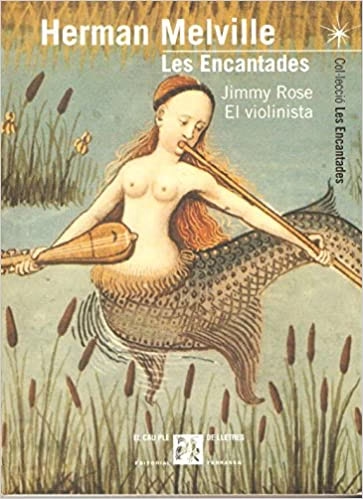
In the land of Luchon, many stones are said to be inhabited by spirits called Encantades. These unique beings hold a special place in the local imagination, at the boundary of the sacred, the legendary, and the mineral. According to tradition, when the forces of good and evil were at war, some spirits refused to take sides. After his victory, God kept the good angels in heaven, cast the demons into hell, and punished the spirits that remained neutral by exiling them to the earth. Their punishment consisted of purifying themselves through frequent ablutions. These spirits, described as half angels and half serpents, are the Encantades. Each inhabits a sacred stone, from which it is forbidden to stray.
They are also found in regions beyond Catalonia, with, of course, some variations. They are enchanting fairies, beautiful and young. They often oppose witches, the famous « Bruixes » (pronounced « brouchéiouz »). They are most often encountered along mountain streams; they seem to have a preference for the isolated torrents of the Upper Conflent, but they can also be found in Cerdanya.
It has been seen — and is said to still be seen — that Encantades perform their ablutions in the nearby spring of their stone, washing a cloth whiter than snow, then spreading it out to dry on the mountain rocks. These spirits sometimes do good, never evil. If they are less visible today, it is because many, having completed their purification, could return to heaven.
The Cailhaou de Sagaret is said to be the home of a spirit, or Encantade, which enters and exits through the arch above the door carved in the granite. On several occasions, it is said to have been seen bathing in the inexhaustible spring, or washing its clothes there. At night, one can hear it whispering or singing mysterious words. No one dares to approach the stone in the darkness. By contrast, during the day, the faithful go there to pray: they touch the stone with veneration, press their lips to its top to address the good spirit, and place their ear against it to hear a response, for it converses with its devotees.
5. Animal Hauntings, by the Devil
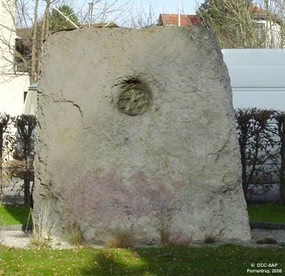
Near Courgenay, in the Bernese Jura, around a shapeless rock called the Fairies' Stone – Pierced Stone –, a large herd of wild boars was said to wander at night. A completely black rider would drive them, and the local inhabitants made sure to leave, not far from the stone, bundles of hay to feed the horse of this strange hunter. This was part of a monument probably erected around 3000 BCE. This slab is the main element (the façade) of a funerary chamber, known as a dolmen,
In Penanru, near Morlaix, one can sometimes hear a sound resembling a hammer striking stone. According to local belief, these sounds are produced by a spirit called the Stone Breaker, invisible yet very much present in the imagination of the inhabitants.
The Kercradet Rocks, near Guérande, are said to be haunted by the devil. A young girl, having bet that she would go alone at midnight to strike three blows on these rocks with a bat-drap, kept her word. The sound of the blows was heard, but she was never seen again, reinforcing the sinister reputation of the place.
Legendary characters that manifest through cries often appear in stories connected to mountains, forests, or waters, but more rarely in direct relation to rock formations. A notable exception is found at Ville-Juhel, near Vieux-Bourg-Quintin. There, a calling imp named the Houpoux inhabited large rocks notable for their size and the strangeness of their positions, some distance from a menhir. Mischievous and sometimes malicious, it was considered a wicked spirit, flitting through the air, now to the right, now to the left. Late at night, one could hear its shrill cry: "Hou! Hou!", which seemed to come from the menhir. Anyone who had the imprudence to answer it more than once was seized and torn to pieces.
In Bourseul (Côtes-d’Armor), the inhabitants only pass by making the sign of the cross near a huge stone located at the edge of a pond. At night, one is said to hear moans and bangs coming from it, attributed to the struggles of the unfortunate souls once thrown into the pit it covers, vainly trying to escape.
6. Stone Chairs
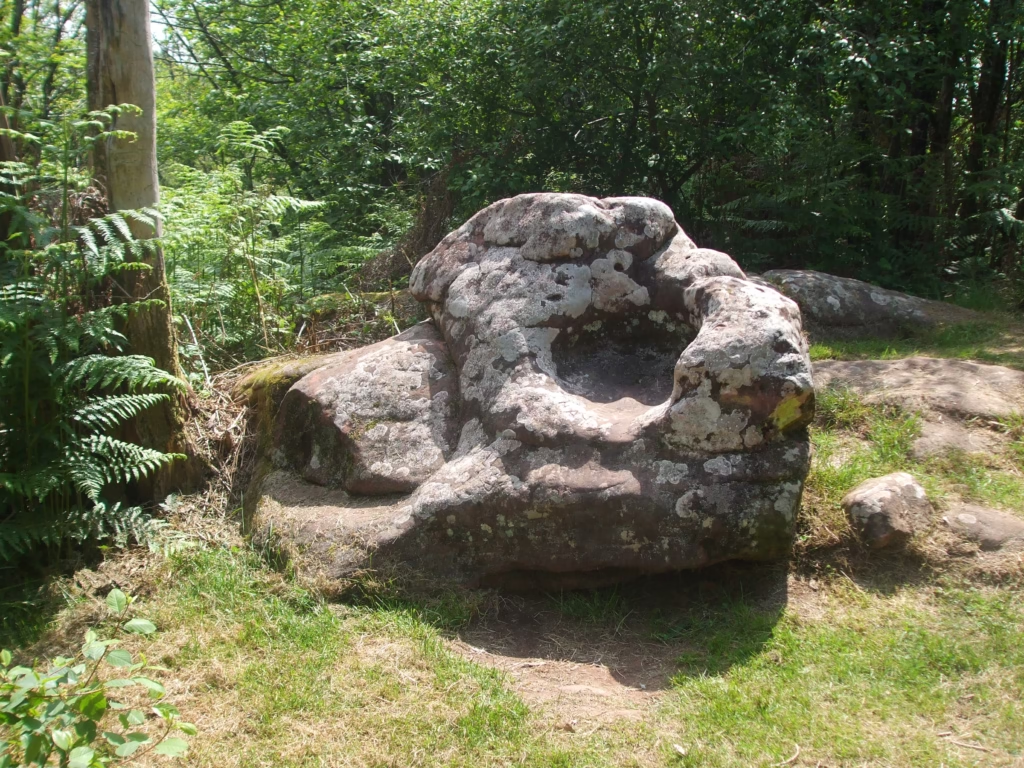
In many countries, one can observe rock blocks whose upper surface features a concave depression, bordered on three sides by sort of ridges. These contours resemble the back and arms of a rudimentary chair, with the central cavity forming the seat. These stones often bear names directly inspired by this unique shape, along with references to supernatural or legendary figures.
In Forez and the surrounding regions, many rocks are thus called:
In the West, these formations are most often referred to as Chaires or Devil's Chairs. However, in Mayenne and Ille-et-Vilaine, the term generally applies to basin stones or wonderful imprints. The legends associated with them will therefore be discussed in the chapter dedicated to Imprints.
Outside of these regions, stories of hauntings linked to stone chairs are relatively rare. A notable exception is at Antonne, near the village of Chause (Dordogne). There stands a large isolated rock, surrounded by debris that time has detached from its mass, known as the Throne of the King of Chause. According to tradition, at nightfall, the King of Chause comes to sit there. The souls of his subjects flutter around him, and cries and moans can be heard in the distance. Many fables circulate about this rock. Perhaps they originate from an ancient cemetery, located just a few steps away, where numerous stone coffins have been discovered.
According to a legend of romantic inspiration, a rock shaped like a chair, called Tsadeyra de la Dama, or Lady's Chair, was haunted by a white lady. At night, she would make her moans heard there. During nighttime storms, she appeared seated on her chair, one arm outstretched toward the east, seeming to indicate to travelers the path to follow so as not to lose their way and perish in the abysses.
7. Wizards and Rocks
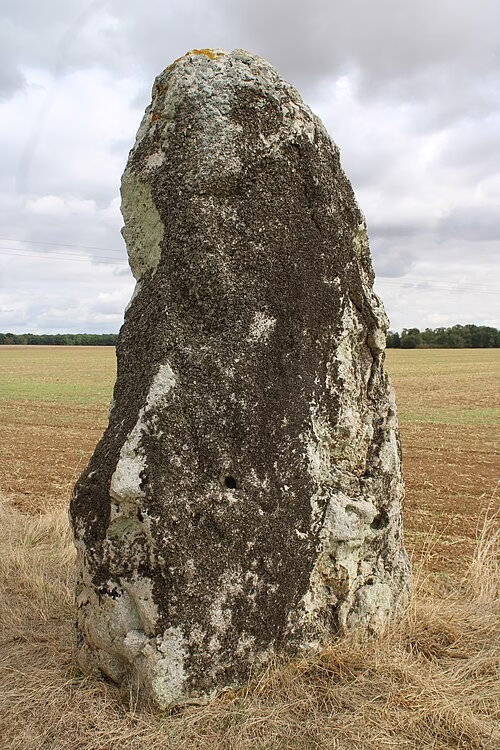
Some large stones are, in popular tradition, associated with wizards, the devil’s minions, or animals endowed with a supernatural role. These rocks then become sites of nocturnal gatherings, often linked to the Sabbath.
Along the road from Alluyes to Dampierre, a medium-sized flat rock is known as the Perron de Carême prenant. According to local belief, all the cats from the neighboring hamlets gather there to hold the Sabbath on Christmas Eve, transforming this simple stone block into a focal point of rural diabolical imagination.
The Split Rock, in Talent, was considered in the Middle Ages a place where the devil’s minions gathered. Later, this rock changed its function without losing its secretive nature: it long served as a trading spot for charcoal burners, and then as a meeting point for the Carbonari during the Restoration, thus layering historical uses with occult beliefs.
In Châtel-Gérard, tradition holds that the Sabbath took place near a large pile of stones called the Fairies' Cottage, already imbued with an older fairy-related imagination.
In Vendée, legend has it that even the hares attend the Sabbath on Mardi Gras night, around the ancient blocks of the Rocherie, illustrating the variety of forms these stories take, where animals and witchcraft intertwine with the mineral landscape.
8. Revenants
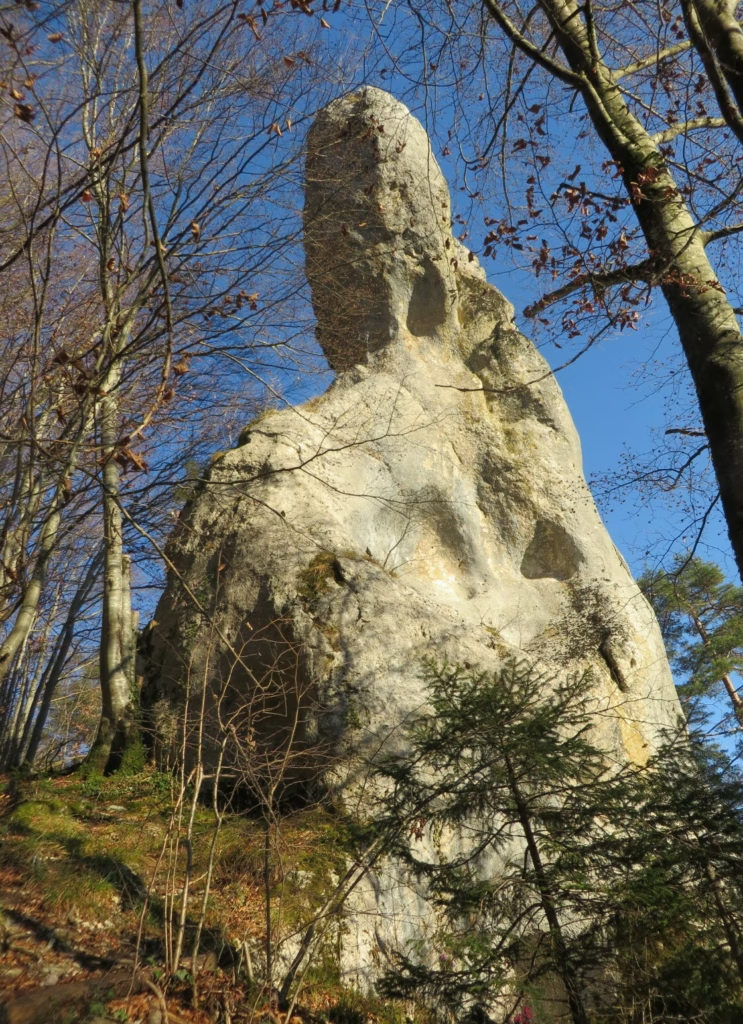
It is relatively rare for large rock blocks to be associated with restless souls. Yet, some stones remain linked to stories of ghosts, where collective memory intertwines guilt, punishment, and nocturnal haunting.
A monk is condemned to return once a year to the Rock of the May Maiden. The elders recount that long ago people danced around this rock during the Brandons festival and on Saint John’s Day. One Brandons evening, a young monk from the Lucelle Monastery, originally from Bourrignou, stopped to watch the dances of his former companions. Recognized, he was involuntarily drawn into the circle. The coraule continued for a long time, and he danced until midnight struck. At the twelfth chime, the unfortunate monk collapsed, exhausted, and drew his last breath. He returns on the anniversary of his punishment, at the stroke of midnight, to the Rock of the May Maiden, where he dances alone in a hellish round. A hoarse and terrible voice seems to intone the song that the monk, in a moment of forgetfulness, once sang.
A daring young man supposedly wanted to test the legend. One Brandons night, he went at midnight to the cursed rock. Immediately, a cold hand seized him and forced him, despite his desperate struggles, to dance with the ghost until sunrise.
The Magnier Stone is a massive granite rock located near the banks of the Serein. According to tradition, an evil coppersmith is said to have killed his wife there, then lifted the stone to bury her. The victim’s cries were reportedly often heard, and her soul is sometimes seen as a small, bright light along the riverbank. To appease this forsaken soul, passersby pick a small branch from the forest and, after mimicking a sprinkling, throw it onto the stone.
9. Sacred Figures
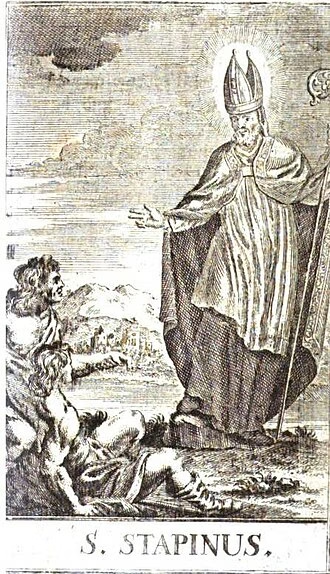
Memories linking sacred figures to large stones are relatively rare, especially when these blocks show no visible imprints. Yet, some traditions have passed down stories in which the stone becomes the site of a miracle, ascetic practice, or divine punishment.
Saint Stapin lived among the blocks of Dourgues, in the Aude. The Stone of Saint Patrice, in Mégrit (Côtes-d’Armor), is pierced along its entire length by a hole where the saint is said to have hidden for a long time. Near Besné, a granite fissure served as a bed for Saint Secondel. Saint Léger celebrated Mass on a large rock known as the Altar of Saint Léger, near the village bearing his name. The top of this stone is marked with small crosses, roughly carved with chisel blows. At Saint-Bieuzy, the enormous rock that Saint Gildas split with his prayers can still be seen, creating a secret exit that allowed him to escape his followers on a day when he was stricken with fever.
The name of certain rocks recalls extraordinary leaps performed by devout individuals. Often, these feats leave a mark; when none remains, the name alone preserves the memory. Thus, a Capuchin brother who had lost the use of his limbs went to Bagnols for a change of air. Seeing two overhanging rocks, whose peaks ended in points, he vowed that if he regained the use of his legs, he would jump from one to the other. The two rocks, being about three meters apart, made the challenge formidable. Recovered, he kept his word, and the site has since been known as the Capuchin’s Leap.
Some stones are said to have collapsed to punish impious words or deeds. One Sunday evening, nine young girls were dancing without respect for the sanctity of the day in a meadow, on the banks of the Gers, at the foot of large rocks. They had not completed the first branle when the blocks detached and crushed them all. In the Viège Valley, a stone located in the middle of the pastures is called the Murder Stone. One day, two shepherd boys and a shepherdess were playing there. One of the boys dug small holes in the grass representing the path of souls: an excavation represented the underworld, small stairs indicated the path to heaven, while other steps descending into the earth symbolized purgatory and hell. Once the work was finished, they would throw a knife into the air; depending on how it landed, the soul would ascend to paradise or descend to hell. One of the children then pointed to the rock overlooking their game and asked what they would do if the stone suddenly came loose. The two boys said they would run away; the girl declared that she would entrust herself to her guardian angel. At that very moment, the stone detached and crushed the two shepherd boys, without causing any harm to the girl.
10. The Maiden’s Leaps
Leave a Reply