Les fées et les dames sylvestres : de la bienfaitrice Mélusine aux terribles Dames blanches et vertes
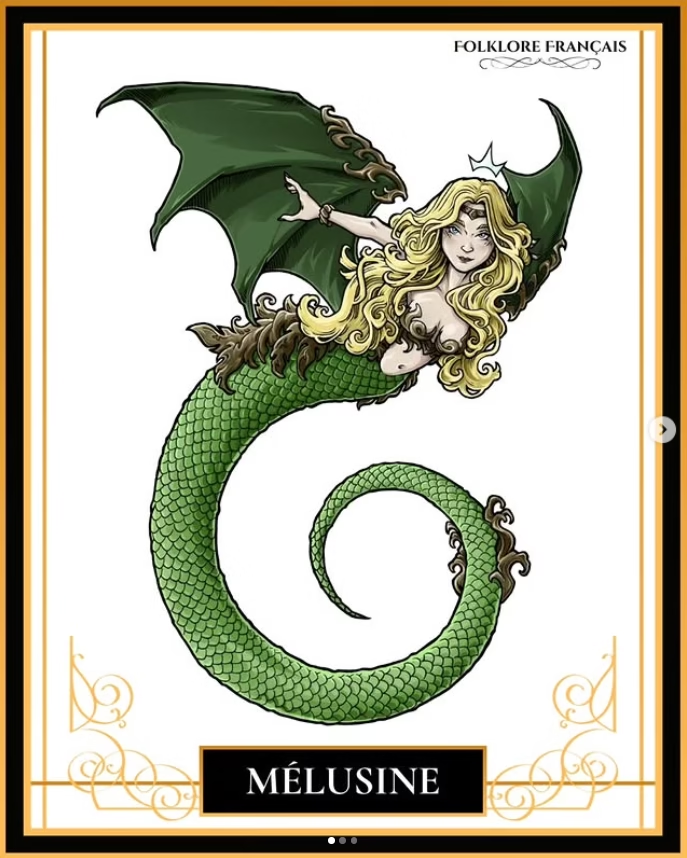
The fairy Melusine, illustration from Folklore Dracques
1. The fairies in the Middle Ages
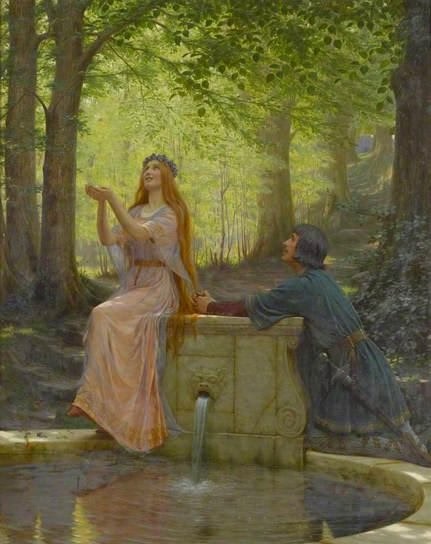
The fairy Melusine and the knight Raimondin at the Fountain of Thirst
In the Middle Ages, belief in the existence of woodland fairies was deeply rooted in the collective imagination. It was said that they appeared in many forests, but none was as famous as the Forest of Brocéliande, a major site of magic and enchantment. The Norman poet Robert Wace himself went there, convinced he would witness these supernatural beings, as he writes:
« Là solt l’en li fées véir, / Se li Bretunz disent veir »
(“There one could see the fairies, if what the Bretons say is true.”)
These creatures often appeared near secret springs, nestled deep within the woods. The most famous of them, the Fountain of Barenton, was said to be a favored place for their manifestations. In medieval tales, it is the meeting point where mystery, magic, and destiny intertwine.
Other legends tell how the fairies lured knights in search of adventure. Melusine, for example, enchants Raimondin by leading him to chase a stag near the Fountain of Thirst, in the forest of Colombières in Poitou. Some fairies even go so far as to transform themselves: one of them leads Graelent by driving a doe toward a spring where she is bathing, while another changes herself into a doe, wounded in that form by Gugemer. So many tales in which love, magic, and nature intertwine to form some of the most beautiful pages of the wondrous literature of the Middle Ages. (see legend)
Even today, in certain forested regions, it is said that the fairies have never left their refuges. While it is rare to find beings comparable to the dryads of Antiquity, some traditions preserve the idea of fairies directly connected to trees. Thus, in Rouge-Vie, twelve fairies from the Vosges once took part in the evening gatherings. At midnight, they would disappear to return to their mysterious dwellings, refusing to be followed. Yet a young man tried the adventure: from the mountain plateau, he saw them wishing each other good night before each entered a tree. His curiosity cost him dearly; three days later, while climbing a fir tree, he suffered a fatal fall.
In other tales, the fairies seem to live literally in the heart of the forests. The musician fairies of Cithers emerged from the trees once night fell. Those of the forest of Grand-Mont had woven their salon amid the entwined branches, turning the massive trunks into natural seats. As for the fairies of the Roches de Thenay, they were seen walking at night near the Grand-Perche Clearing, half a league from their caves. They had made their homes in the largest trees, whose interlaced branches formed hammocks. But beware of anyone daring to raise an axe against the oak or beech serving as a fairy’s chair: according to tradition, any reckless woodcutter would die within the year.
2. Fairies in Love with Men
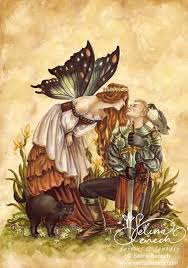
In popular traditions, many gwerziou recount the appearance of a fairy to a lord who came to hunt in the forest. The fairy confesses that she has been searching for him for a long time and that now that she has found him, he must marry her. If the man refuses, she imposes an ultimatum: remain bedridden for seven years or die within three days. In a song from Loire-Inférieure, it is Death that takes the fairy’s place, and the story becomes even more striking:
« Count Redor goes hunting In the forest of Guémené, On his way he encountered Death, who spoke to him: — Do you wish to die today Or to languish for seven years. »
In Gascony, another tradition tells the story of two twin brothers encountering two fairies in a wood. The fairies offered to marry them the next day, on the condition that they neither eat nor drink until then. One of the young men made the imprudent mistake of biting into an ear of wheat: the fairy immediately rejected him. The other became the husband of his companion, after promising never to call her “fairy” or “mad.” After seven years, while she was cutting wheat before it ripened to avoid a storm, her husband broke his promise and called her mad. She vanished immediately, never to return.
While fairies in love with men were once common in popular tales, this theme seems to have disappeared from recent traditions. They now live among themselves, without forming “families” as in other regional legends; male fairies, or féetauds, are not even seen. One exception, however: in the forest of Jailloux (Ain) lived very old fairies called the Sauvageons. One of them had a child who ran endlessly over the fir trees cut by the woodcutters. One day, they made small red shoes and attached them to a trunk. The child placed his feet in them and became trapped. Silent and sad, he refused to speak until a method known in Brittany was used: placing eggshells in front of the fire. The child finally broke his silence and declared, according to Gabriel Vicaire:
« I have seen many days and many years, Yet never have I seen so many little white tupains. »
3. Dances of the Woodland Fairies
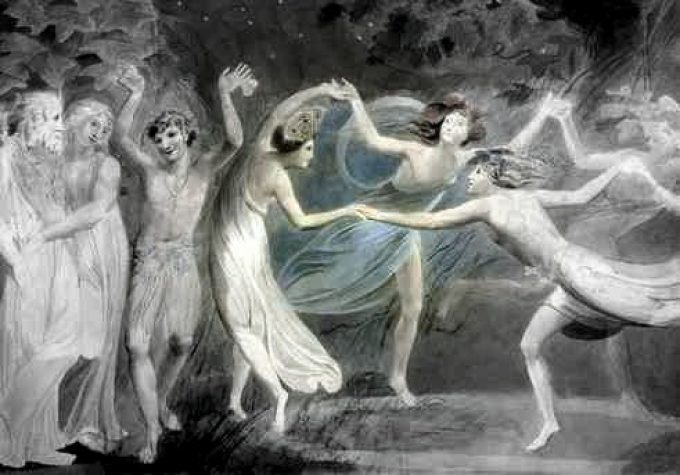
Round of white fairies
In the Middle Ages, forest fairies held an important place in popular imagination. It was said that they appeared at dusk, in clearings where they were accustomed to dance. A Poitevin legend, written around 1500 but probably much older, tells of three young men, sons of the lord of Luzignan, who were traveling through a forest at night. There they encountered three young fairies from the court of Melusine, “beautiful, charming, and wonderfully graceful.” Drawn by their arrival, the fairies invited the young men to join some of the dances they usually performed in the “fairy kingdom.” Enchanted, the young men agreed. All night, they danced, leaped, responded to each other, rested, and even played a “certain game of which the fairies never tire any more than natural women do.” Surprised by the rising sun, the fairies announced that they had to return to the enchanted realm. Before disappearing, the eldest granted them a gift: “the first wish each of you makes will certainly come true,” advising them to desire nothing that is not useful or honorable. Never again, it is said, did the young men hear of them.
This love of dancing has not disappeared from popular traditions. Long ago, near Orléans, there was still shown a “Fairy Tree,” so named because the fairies danced there at the full moon. In Picardy, a wood called Bacchan Sœurettes owed its name to fairies — the Sœurettes — who performed nightly dances reminiscent of the bacchantes. At the end of their festivities, they would fly away, leaving a mysterious golden cup for the landowner, although no one, even to this day, has ever found it.
Further south, in Beaujolais, traditions still speak of the fayettes who come to dance in the woods of Couroux. These tales, passed down from generation to generation, show how strongly the image of fairies remains linked to nocturnal clearings, invisible music, and enchanting circles. Across the centuries, these forest legends continue to fuel the imagination, reminding us of the fragile yet persistent presence of fairy magic at the heart of natural landscapes.
4. Fairies Who Mock Men
Fairies in the Form of Will-o’-the-Wisps
Local traditions report that fairies sometimes enjoy playing tricks on men, especially in the heart of forests. In the forest of L’Isle-Adam, they appeared at night in the form of will-o’-the-wisps, called the Fays. Witnesses recounted that, when approached, distinct female silhouettes could be seen. Around 1850, a farmer claimed that at midnight, his carriage was surrounded by these Fays dancing in circles. One of them grabbed the bridle of his horse and led him under the trees, turning endlessly until dawn. At first light, the man found himself completely lost.
Further south, in the forest of Bruandeau, on the border of the Chartrain region and Berry, appear the Figots — will-o’-the-wisps that mingle with the nocturnal dances of fairies, said to live in the very heart of the forest. In the Bernese Jura, the forest of Montoie is also known to be haunted by spirits or fairies who mislead travelers brave enough to approach their circles. Even today, many refuse to venture there alone.
In Upper Brittany, les rares légendes sylvestres recueillies montrent également des fées qui aiment tester les humains. Dans la forêt de La Nouée, une dame vêtue de blanc apparut un jour à un homme occupé à faire des fagots. Se plaignant de sa pauvreté, il accepta lorsqu’elle lui proposa de remplir son petit pot de soupe d’or. En découvrant les pièces jaunes, la fée l’envoya chercher un récipient plus grand. Mais, à son retour, elle avait disparu : le pot ne contenait plus qu’un reste de soupe. Un rocher voisin porte depuis le nom de Pertus doré.
A similar misadventure occurred in the forest of Loudéac, where fairies spread their silver on large white sheets to test a passerby.
5. Wicked Fairies
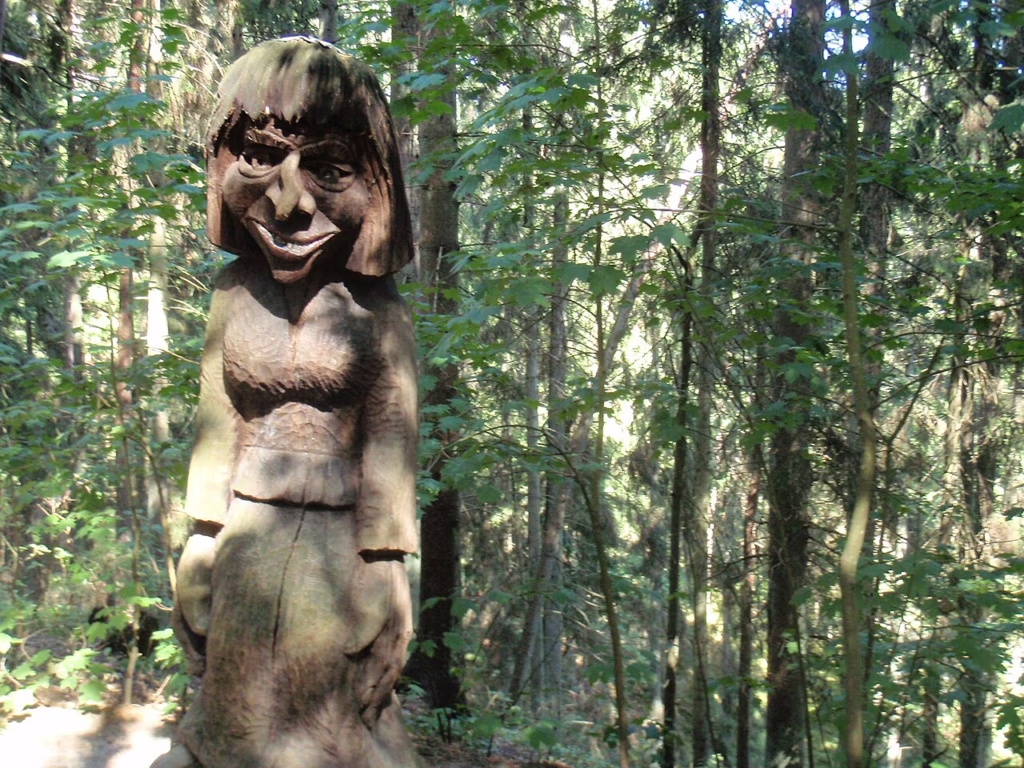
“Laumė / The Good Witch,” Lithuanian fairies with zoomorphic forms, often transforming into wild goats, wooden sculpture from 1980 by Romas Venckus on the Witches’ Hill
Not all fairies are benevolent. In Normandy, the forest of Andaine sheltered a protective fairy, while that of La Ferté-Macé was dominated by the Grande Bique, feared for her multiple appearances, sometimes in the form of a goat. Located at the crossroads of the Six Paths, she liked to mislead travelers. Near Clarens, in a wood adjacent to the Four aux Fées, white female silhouettes ran after passersby.
In the woods of the Faye d’Épannes (Charente-Maritime) — between Surgères and Saint-Félix — the fairies living near two dolmens set nightly ambushes. At Moulé de Fressines, mysterious ladies — fairies without a defined role — strolled at dusk, to the great fright of the locals. In the forest of Rouvray, an old oak attracted many fantastic figures, including a lady who seemed to offer a chair to travelers. Those who stopped there imprudently were, it is said, doomed to die shortly afterward.
6. White Ladies and Green Ladies
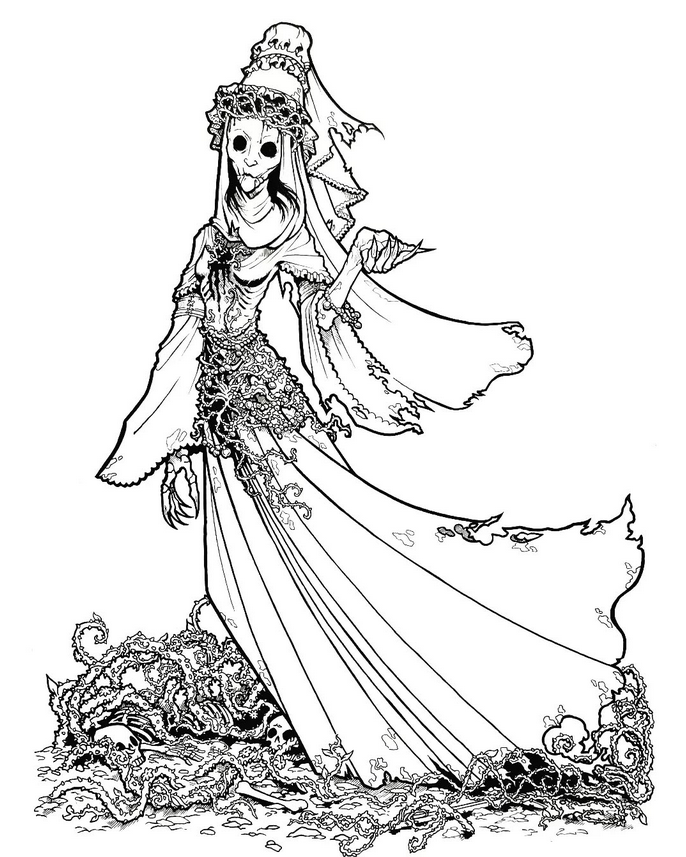
White Lady, drawing from Folklore Dracques
A Green Lady
French medieval legends abound with fascinating tales of fairies and woodland spirits. Among them, the white ladies and green ladies hold a special place. These supernatural beings often appear in forests, especially in the North and East of France, and their actions resemble those of classical fairies. It is said that in the Bois Boudier, in Montbarey, white ladies danced until two in the morning, torch in hand. Around Saint-Germain-en-Bresse, three young ladies were seen dancing along forest paths, victims of a lord’s treachery, but freed from their misfortune after death. These fairies are not merely playful spirits: they also perform charitable acts. For example, a child lost in the Bois de Poligny was found after three days, sitting in a clearing, fed by a beautiful white lady.
The kindness of the white ladies also manifests in their role as guides. A shepherdess lost in the Bois des Écorchats recounted that a white lady had brought her food. In Burgundy, these ladies guided travelers lost in deep, wooded ravines, holding their hands to lead them safely. In Saint-Georges-de-Rouelley, a white specter appears to passersby, sometimes joyful and singing, sometimes sad and weeping. In the woods of the Fau, near Dôle, some white ladies seemed to carry romantic passions and sought encounters with travelers.
The green ladies, on the other hand, are more mischievous, sometimes malevolent spirits. In the Vosges, they appear deep in the forests, and in Franche-Comté, the Dame Verte of Relans and her companions, dressed in green tunics, sometimes lure walkers into isolated places. While their initial charm is enchanting, it often turns into a threat: they become ruthless shrews, laughing, singing, and chasing their victims. In Lower Normandy, the Milloraines, women of gigantic proportions, burst from the trees with a crash, startling passersby. In the Nord department, there are also the Femmes de mousse, forest fairies who appear to woodworkers, reminding us that the French forest remains a mysterious place where magic, beauty, and danger may be encountered. (see more details)





Leave a Reply