When the carvings on the rocks are legendary furnishings and utensils
1. Chariot Wheels and Fairy Furniture
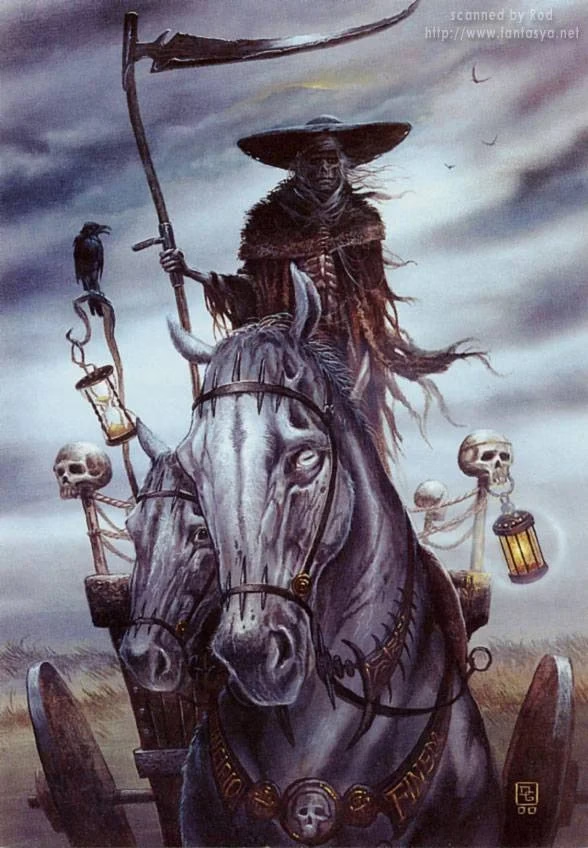
Ankou’s Cart
The assimilation of these markings to everyday objects is extremely common in folk traditions. Their shape, often round or oval — which earned them the names “bowls” or “basins” — naturally gave rise to legendary interpretations. Some depressions are not circular, but instead elongated.
Several of them were indeed used to polish tools, and their legends are often connected to that purpose. Others, more rare, evoke the passage of wondrous vehicles. Over time, as carts traveled along rudimentary paths where rock outcrops surfaced, they sometimes carved ruts as clean and straight as rails. When these traces are found today in isolated places or along abandoned paths, they become the subject of traditional explanations.
At Locronan, the wheels of the cart that carried the body of Saint Ronan are said to have left their mark on the rocks. Near Tréguier, on a boulder beside a chapel where people once came to implore Saint Yves to judge a dispute between two enemies, one can still make out the imprint of a wheel. Tradition claims that it is the Chariot of Death, which would set out from that place to fetch, at the appointed time, the one who, being in the wrong, had accepted his opponent’s summons. On the island of Arz, the ruts carved into the stone are said to have been traced by the devil’s cart. Elderly villagers claimed to have seen it roll by “in the midst of a terrifying light.” At the foot of the cliffs of Fréhel (Côtes-d’Armor), a streak visible in the red sandstone was said, according to tradition, to bear witness to the passage of a plow.
In the woods of Montgommery, on the Lande de Goult (Manche), a groove on a rock commemorates the passage of Gargantua’s cart as he was returning from Tombelaine after having hurled that islet and the Grand Mont into the sea.
At Bredons, in the Cantal, a hollow visible on the Pierre du Carrosse is said to outline a chariot. The very name of the site seems to preserve the memory of this legend. Near Saales, in Alsace-Lorraine, people point out on granite boulders what is believed to be the imprint of Noah’s Ark.
The regular hollows on the surface of rocks have also inspired another category of interpretation: that of fairy furniture. The imprints of the fairies’ larger household furnishings are rare—no doubt because popular tradition places their dwellings underground or in caves rather than out in the open.
However:
One can find a Fairy Bed in Aisy-sous-Thil, in the Côte-d’Or.
On the hills in the mountainous part of the Côtes-d’Armor, scattered boulders bear what are known as the cradles of the fairies’ children.
According to widespread traditions, these places were frequented by the Margot the Fairy.
2. Beds of Saints
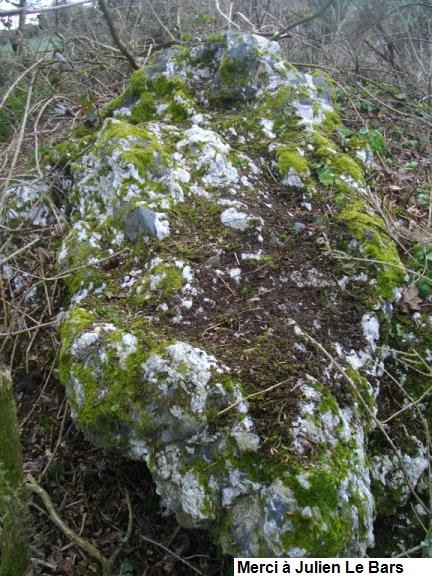
Bed of Saint Pol, Lampaul-Guimiliau
The beds of saints are particularly numerous in Brittany. These rock formations, naturally hollowed out or shaped by erosion, have been interpreted by popular tradition as the resting places of saints who came to evangelize or bless the area.
At Lampaul-Guimiliau, a hollow at the top of a rock, roughly shaped like a human body, was said to serve as the bed of Saint Pol. Not far from Saint-Renan, in Fréminville, people pointed out on a flat rock a man-sized cavity, with the place for the head clearly marked. It was believed to have been the resting place of the town’s patron saint.
At Noyal-Pontivy, near the Sainte-Noyale chapel, two rocks with hollows were known as the bed of Saint Noyale and her prayer stool. At Pluzunet, a slightly hollowed flat rock was said to have been the shared bed of Saint Idunet (Yben) and his sister, Saint Dunnvel.
Near Besné, a granite fissure in a rock is said to have served as the resting place of Saint Secondel. At Bailleul (Orne), a block beside the Roche Saint-Martin was regarded as the bed where the apostle rested when he visited the region. Near Thil-sur-Arroux, the basins of two stones known as Saint Martin’s stones bear the names “the saint’s bed” and “his horse’s manger.”
In the Loire, at Marlhes and at the Suc de la Violette, hollowed stones are likewise referred to as the beds of Saint Martin. The latter was located near a spring that bore the name of the Apostle of the Gauls.
3. Seats of Fairies and Heroes
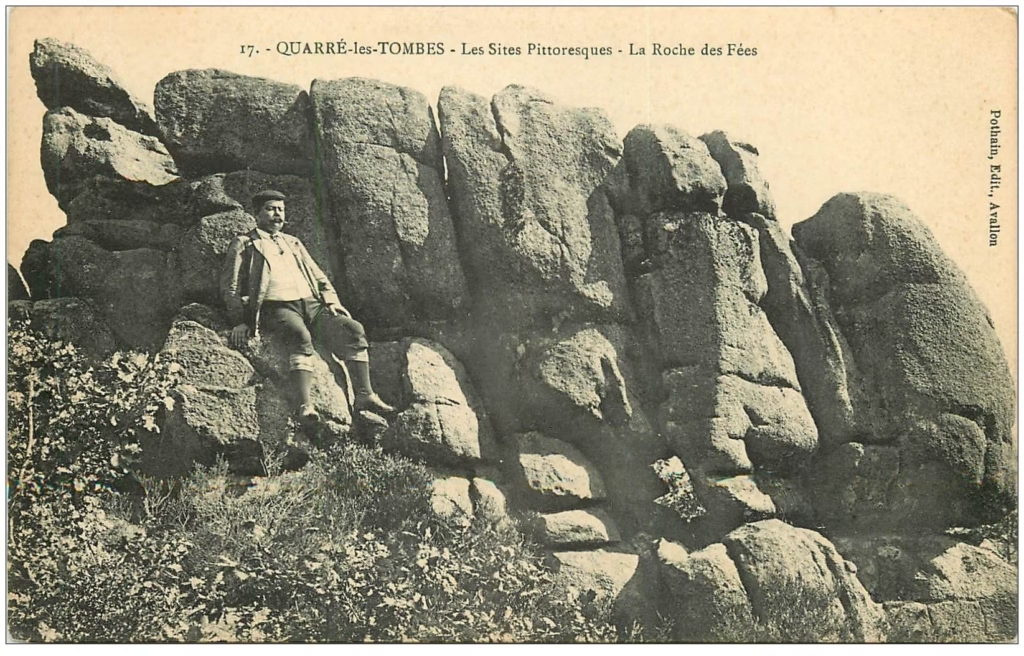
Postcard of the Roche des Fées, Quarré-les-Tombes
It is rare for fairies to be associated with these seats, yet certain traditions persist. In the mountainous part of the Côtes-d’Armor, people still point out the seats of the Margot the Fairy.
Near Quarré-les-Tombes, a Fairy Armchair is pointed out. At Louvigné-du-Désert, the Devil’s Chair of the Tertre-Alix is said to be a place where fairies come to sit and spin their distaff. Tradition adds that this is why tufts (remnants of a woolen ball) can be found near the rock.
Near Saint-Pierre-de-Varengeville, a chair of Gargantua is of particular interest. As early as the 12th century, a charter attributed it to an unnamed giant under the name Curia gigantis. Between Baume-les-Dames and the village of Hyèvre, one can also notice a chair of Gargantua.
At Plédran, near a fairy rock, stood the chair of the giant Michel Morin. At Plestin, an isolated stone featuring a seat-shaped hollow is known as Cador Rannou — Rannou’s chair, he too a giant.
These natural seats illustrate a recurring pattern:
A hollow becomes an armchair
A natural backrest becomes a throne
An unusual formation becomes proof of a giant’s passage
4. Seats of Saints
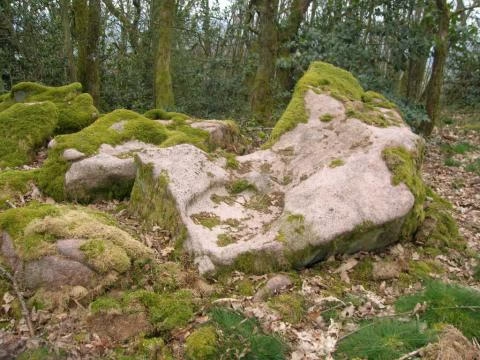
Saddles of Saint Léger and Saint Julian, Saint-Léger-sous-Beuvray
Near Moncontour (Côtes-d’Armor), a rock roughly resembling a chair marks, according to tradition, the spot where the Virgin Mary, fleeing the wrath of Herod, stopped to give the child Jesus something to drink. On a mountain near Saint-Léger-sous-Beuvray, two rocks carved in the shape of seats are said to have served as resting places for Saint Léger and Saint Julian. They still bear the name Saddles of Saint Léger and Saint Julian. Between Saint-Quirin and Le Petit-Donon, Saint Quirin, returning from a pilgrimage to Palestine, is said to have sat down, exhausted, on a stone shaped like a seat, leaving the imprint of his body upon it. In the Brie, people also point out the hollow said to have been formed when Saint Fiacre sat upon a rock, crushed by the accusation of sorcery brought against him.
At Saint-Idunet, a rock bears the name Chair of Saint Yves. Tradition tells that this blessed man, having gone to beg in Belle-Île, entered a house where bread was being baked. The women gave him a little dough to make a cake. But when his turned out larger than theirs, they believed he had stolen some of the dough and set off in pursuit of him. Weary, the saint sat down on a stone, which bent beneath him and took the shape of a seat. At Moëlan, at the top of a hillside, a rock that once served as a hermitage for an early cenobite features a hollow known as the chair where he rested.
Saint Ronan would sit, to contemplate the countryside, on a rocky outcrop at the summit of the mountain of Locronan. Near the place where the missionary Michel Le Nobletz withdrew for a year before beginning his preaching, there rises by the sea, at Saint-Michel-de-Plouguerneau, an immense rock with steep sides where he would go to meditate. One can still today sit in the stone armchair of Michel Le Nobletz.
5. Seats of the Devil
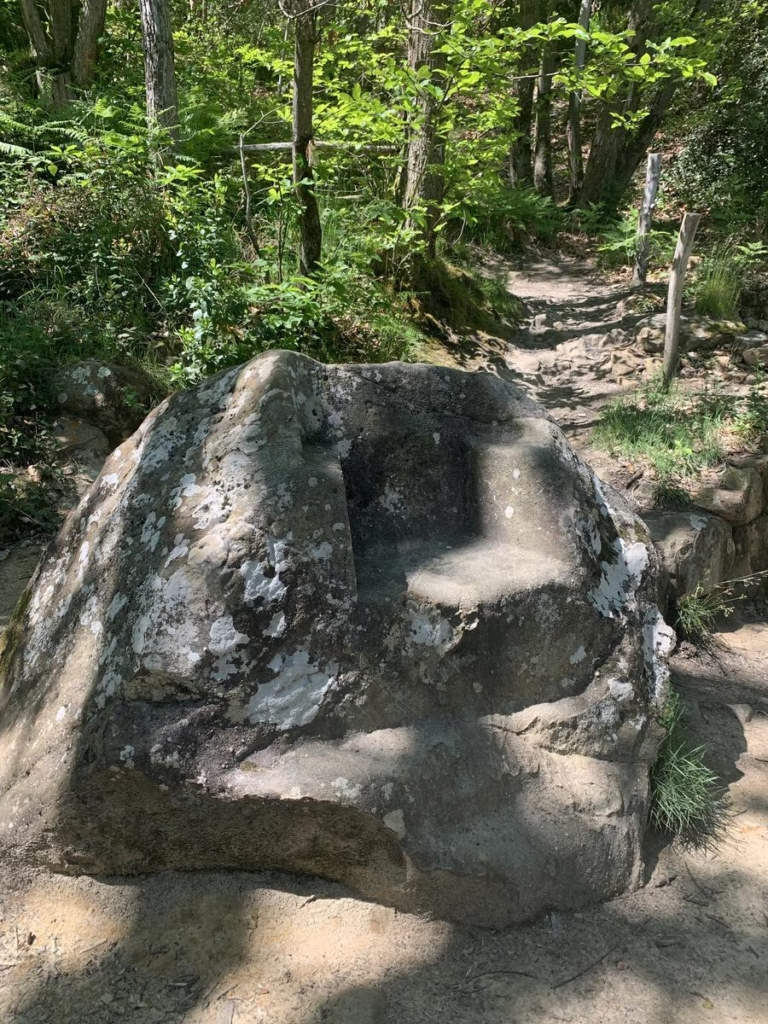
Devil’s Chair, Rennes-le-Château, Occitanie
In northern Ille-et-Vilaine, many basin-stones are called “Devil’s Chairs.” At Louvigné-du-Désert, where several can be seen, tradition relates that he once came—under the appearance of a goat—to sit upon one of the most remarkable among them.
In the Mayenne, such stones are not uncommon. One of them was already known in the 17th century. Abbé Lebœuf wrote:
« Je lis, dit l’abbé Lebœuf, dans un mémoire qui m’est venu d’un savant de Mayenne, qu’aux environs de Jublains serait un bloc de pierre élevé sur un petit tertre et que le vulgaire appelle encore chaise du diable. »
“I read,” says Abbé Lebœuf, “in a memorandum that came to me from a scholar of Mayenne, that in the vicinity of Jublains there stands a block of stone raised upon a small mound, which the common people still call the Devil’s Chair.”
At Hambers, a stone bearing a circular hollow— the remnant of a dolmen — was also called the Devil’s Chair. At Aron, again in the Mayenne, the Devil’s Chair, carved into a block of granite, is said to have been formed beneath the weight of the demon who came to rest there after building a bridge for the inhabitants. Deceived in his reward — he was given a cat instead of a man — he supposedly left the mark of his imprint upon the stone.
At Sardant, in the Creuse, a cluster of cup-marked rocks bore the name Devil’s Chair. At Tinchebray, a Devil’s Chair is associated with a legend recalling the temptation of Jesus on the mountain. At Gemeaux (Côte-d’Or), in the Trou aux Fées, a section of rock where Satan would sit was designated by the same name. At Mont-Foran, in the same region, another Devil’s Chair inspired superstitious fear among shepherds. At Dompierre-en-Morvan, an enormous rock basin was called the Devil’s Armchair. Finally, at Censerey, the demon was said to preside over the sabbath seated upon a rock hollowed by a cavity known as the Preaching Chair.
6. The Tubs and Utensils of Fairies, Heroes, the Virgin, and the Saints
Above the village of Beaumont, at Saint-Yriex-des-Bois, a hill crowned with natural rocks bears the name Châté de las Fadas. Three rocks there each feature three small basins connected by a channel. A fourth, larger one, called bujou or cuvier, can be seen on a flat stone at the foot of the escarpment. When vapors from the spring rise above the trees, the inhabitants say that the fairies are doing their laundry. At Quarré-les-Tombes, people pointed out the fairies’ cauldron and tub on a granite outcrop.
At Aisy-sous-Thil, in a valley known as Galafre, a regular, cauldron-shaped hollow is called the Fairies’ Cauldron or the Fairy’s Tub. Tradition speaks of a very wicked fairy whose house, stables, and barn—caves formed by stacked blocks—are still visible. It is said that she died not long ago; her furniture is believed to have been turned into stone: tub, clog, bed, bucket.
At Pont-d’Aisy, a cup-marked stone is called the Fairy’s Cauldron or the Cauldron of the giant Galafre, who used it together with the fairy Befnie.
On the dolmen of Miré, one can see the imprint of a fairy’s skillet. In the woods of Lavaud du Frétoy, several basins on the surface of a rock are said to be the dishes from the fairies’ feast.
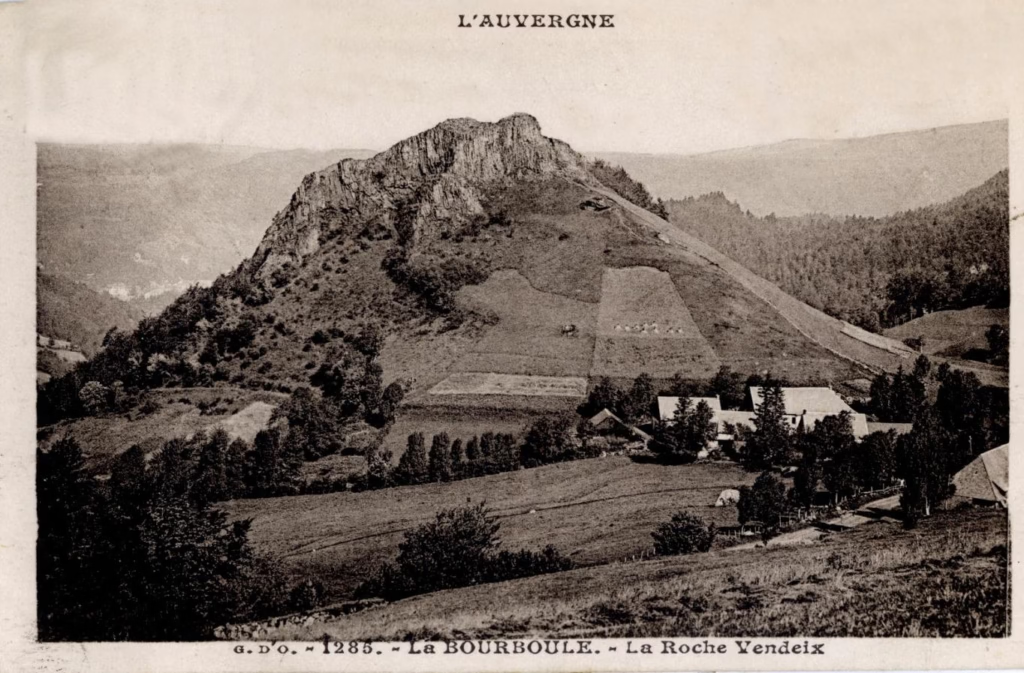
At La Bourboule, the hollows of the Roche aux Fées are attributed to benevolent fairies who protected the region from the incursions of Aymerigot Marchès, lord of the Roche Vindeix castle. One day, while they were singing, drinking beer, and eating an omelet, he surprised them. They fled, but by their own will left the imprint of their glasses and their skillet upon the stone.
At the Portefeuille waterfall, the Martes of Berry are said to have left in the rock the shapes of their cauldron, their skillet, and their utensils. The Flat Rock of Chambretaud featured a large basin known as the Goblin’s Stew Pot, where they cooked their soup on the night of Mardi Gras.
On the great Hohnach (Vosges), the Witches’ Cauldron—a basin-shaped block—is said to have been used for pagan ceremonies. On the Île d’Yeu, on the table of the dolmen of the Roche aux Fadets, the small hollows are believed to have been caused by the burning tripod upon which Satan would come to sit each Saturday. At Soulans (Vendée), a basin beneath the menhir of the Verie bears the name Fountain of the Virgin. At Boissy-Maugis, a recess in the dolmen of the Grosse Pierre is called the Spring (or Washing Place) of the Virgin.
Near Gahard (Ille-et-Vilaine), the Gargantua’s Bowl is hollowed out of a large block, and his drinking glass stands nearby. At Verdes (Loir-et-Cher), his soup tureen is a vast excavation not far from a notched stone called Gargantua’s Glasses — a name also found at Travers, near Beaugency. At Pontaven, a rounded rock pierced with a hole about three feet in diameter bore the name Gargantua’s Foot Bath.
In the Center of France, the name of Saint Martin is associated with numerous cup-marked stones.
At Saint-Quentin (Haute-Loire), the fissures and hollows of a large stone are said to be his cookware: pot hook, cauldron, stew pot, saucepan, and bowl.
Near Villapourçon, Saint Martin’s Bowl is a small round hollow, often filled with water, located just a few steps from the Saint Martin Spring.
At the Suc de la Violette, as well as at Bully, Bussière, Bussy, and Saint-Haon, other hollows bear the same name.
Near Thil-sur-Arroux, a basin is said to be the feeding trough of the saint’s horse.
At Louvigné-du-Désert, the Roches Saint-Guillaume feature a washing place, a spring, and a bowl attributed to him.
At Saint-Viaud, near a cave where the local saint once dwelled, the inhabitants believe they can make out on a stone the imprint of his feet, his book, his cap, and his staff.
The stone becomes:
Fairy’s Cauldron
Goblin’s Stew Pot
Giant’s Soup Tureen
Saint’s Bowl
Fountain of the Virgin
7. Devil’s Utensils
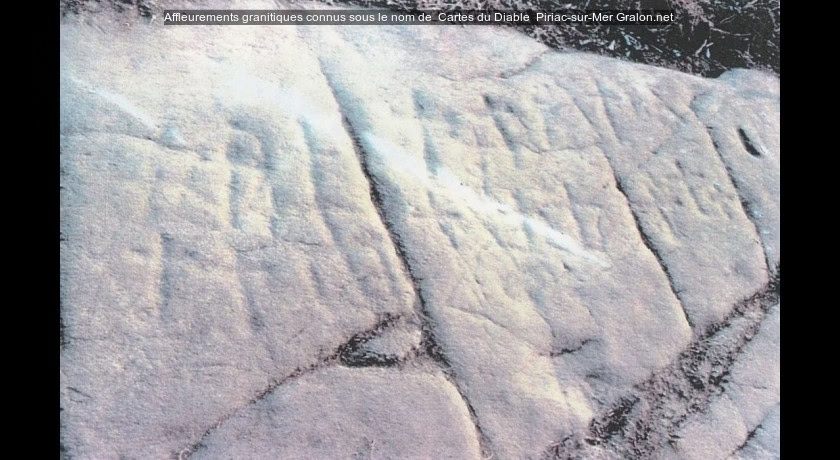
Granite outcrops known as the Devil’s Cards, Piriac-sur-Mer, Pays de la Loire
On the island of Herreu (Loire-Inférieure), where many rocks are covered with basins and circles, one of them is called the Devil’s Kitchen. The inhabitants identify there his stew pots and his skillets. Near La Turballe, a round hollow on an enormous granite outcrop bears the name Devil’s Fountain. At Piriac, large stones engraved with hollow crosses in two rows are called the Devil’s Cards.
At Hambers (Mayenne), on the remains of a dolmen, certain hollows are referred to as the devil’s stew pot and bowls. At Lauterbach, near Guebwiller, a double depression on a granite rock bears the same name. At Faux-la-Montagne, on a dolmen considered rather doubtful, the devil is said to have left the imprint of the spoon and fork he used for his meal. At Bruz, on a basin-marked rock, people point out the sorcerer’s bowls.
8. Imprints of Ropes, Sabers, Staffs, etc.
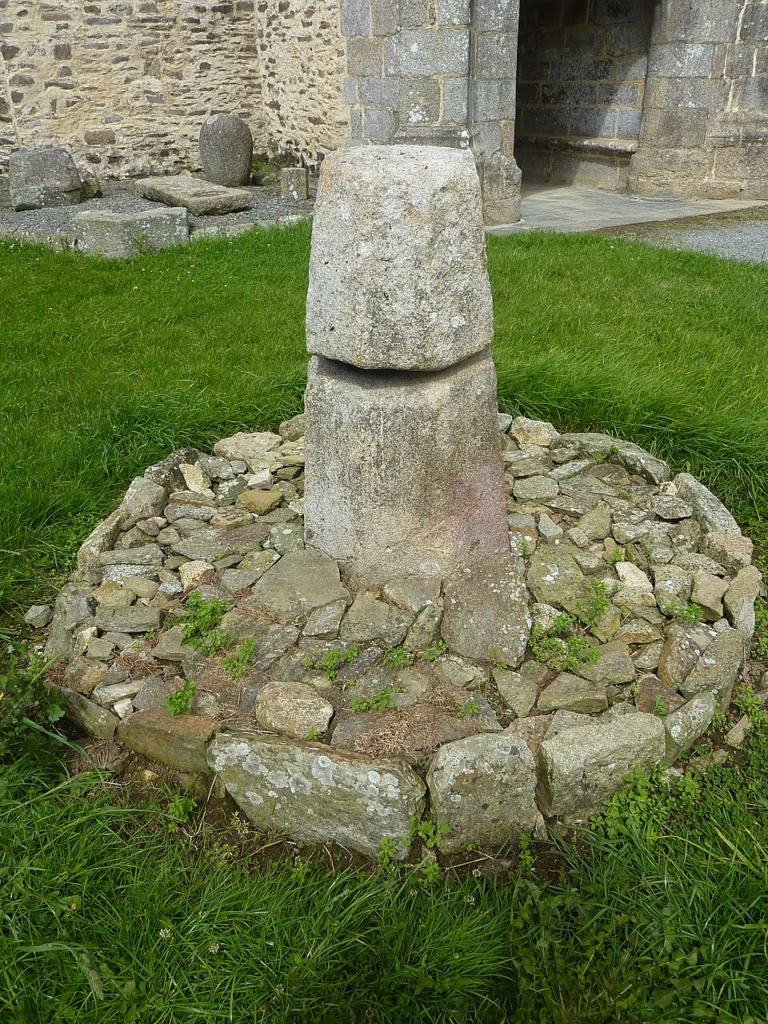
The lec’h (stele) of Le Drennec, cemetery of Landouzen
In Lower Brittany, several imprints commemorate tales of threatened children. A poor man, the father of triplets, is said to have intended to drown them near the Chapel of the Springs. Having set the basket down upon a stone, he was stopped by the apparition of a beautiful lady who promised that he would never lack bread. The mark of the basket is said to have remained engraved in the rock.
At Erdeven (Morbihan), a woman who had given birth to seven children wished to have six of them drowned. The servant placed them in a sieve, but when she set it down on a rock, it sank into the stone. A voice cried out: “Take the children back to their brother.” The imprint of the sieve and the marks left by the servant are still shown today.
Near the temple of Lanleff, on the rim of a spring, one can see the imprint of a gold coin that Satan is said to have placed there to pay for a child sold by his mother.
Certain notches suggest the pressure of a rope. In the cemetery of the chapel of Landouzen in Le Drennec, an octagonal lec’h is said to have been deeply cut when Saint Ursin of Landouzen (a French rendering of Touzan or Ourzan—unrelated to Saint Ursin of Bourges) tied a dragon to it. Legend tells that when this saint was evangelizing the region, a dragon was terrorizing the countryside and preventing people from going to him. One day, Ursin succeeded in capturing the dragon and fastened it to a tall stone near his church. He then entered the chapel to give thanks to God. The dragon pulled at the chain in an attempt to free itself and swore it would break loose before the end of the Mass and bring the building down upon Ursin, but it was unable to complete its destructive work. Saint Ursin then drowned the dragon in the marshes (or in a bottomless well). The chapel still stands, and near the porch there remains a stone bearing a curious notch.
In the Lanvaux heath, certain peulvans bear a carved collar: it is said to be the mark of the rope with which M. de Keriolet tied up the devil there. At Saint-Derrien, the grooves of an inverted cross are attributed to the rope with which the saint carried the heavy stone upon his back.
Les rayures profondes sont souvent attribuées à des coups portés par des héros. Sur le rocher dit Huche pointue, près des roches Saint-Martin, trois petites croix et deux entailles marqueraient l’endroit où saint Georges, premier évêque du pays, trancha à coups de sabre le corps d’un serpent monstrueux. En Upper Brittany, on montre la marque de l’épée de saint Liphard. À Bailleul (Orne), les rainures de la pierre de Saint Martin seraient dues aux coups d’épée du saint. À la Martinière in Peaulx (Loire-Inférieure), une énorme entaille aurait été faite par la scie des fées, tombée de leurs mains au chant du coq.
At Plestin (Côtes-d’Armor), on the stone called Cador Rannou, Rannou’s chair, one imprint is said to be that of the giant’s spade. From Guimaëc (Finistère), on the banks of the Douron, he is said to have hurled the stone at birds ravaging his field. In the forest of Talensac (Ille-et-Vilaine), the Grès of Saint Méen is covered with fine scratches attributed to the saint, who sharpened his carpenter’s tools there—a practice later continued by woodcutters. At the Tertre-Girault in Saint-Briac, a basin-marked rock is said to be the devil’s whetstone.
At Pluzunet, the devil’s staff is said to have left its imprint. On the dolmen of Pierre de Césée at Soucelles, people point out the mark of a fairy’s staff. A polishing stone in the Aube bore three grooves attributed to the blows of the staff of Saint Flavit. At Port-Briac, near Cancale, certain hollows are said to have been caused by the beads of the rosary of Saint Méen; at Esquibien (Finistère), by those of the rosary of Saint Evette.
In the Puy-de-Dôme, a tradition holds that in the month of March, on Saint Joseph’s Day, birds come to be married upon the Rock of Brezou, or the Little Cradle, which features several basins.