Dance Circles: The Nocturnal Rounds of Marvelous Creatures
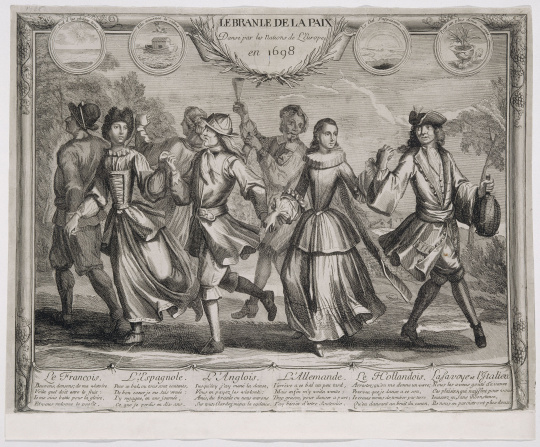
The Peace Branle Danced by the Nations of Europe, 1698
1. Fairy Dances
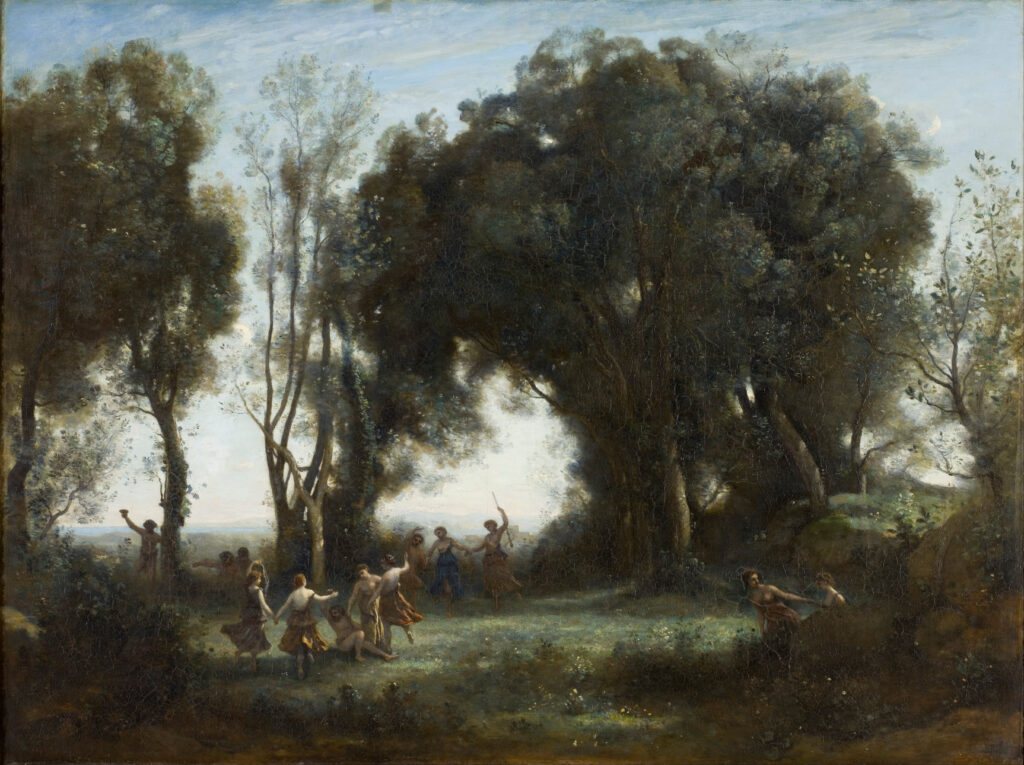
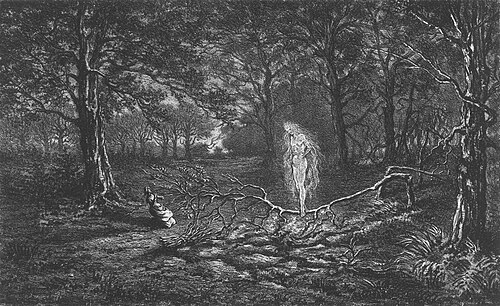
A Morning, the Dance of the Nymphs, Jean-Baptiste Camille Corot, 1850
Throughout France, popular traditions tell of mysterious fairy circles. Like the nymphs of antiquity, they appeared in the light of the moon or at the first rays of the sun, in clearings, at the edge of woods, or in meadows still glistening with dew.
In the meadows of the Bessin, they were imagined dancing in circles, their long hair carried by the wind. At the center of the circle stood a fairy adorned with a golden crown. But beware anyone who dared to disrupt their dance: they risked being flung over a kilometer away, into a tangle of brambles and thorns.
In Franche-Comté, other accounts speak of small white maidens playing in the Pré des Îles, just before sunrise. Carried by the ground’s vapors, they appeared as light and transparent as the mist itself.
Even though the fairies were reputed to be light and almost immaterial, their dances still left visible traces on the ground. These circular imprints, often seen in the meadows, have long been associated with fairy circles.
Today, they are known by various popular names, but it seems that the idea of their magical origin dates back well before the 17th century. However, at that time, few authors were genuinely interested in popular traditions related to natural phenomena.
One of the few literary witnesses is Dassoucy, a writer and traveler of the Grand Siècle. He recalled “the pleasure of walking sometimes on the green velvet of a grassy carpet, and sometimes along a small stream, treading underfoot the very traces that the Fairies, dancing in a circle, had left imprinted in the enamel of a meadow.”
2. Dance Circles
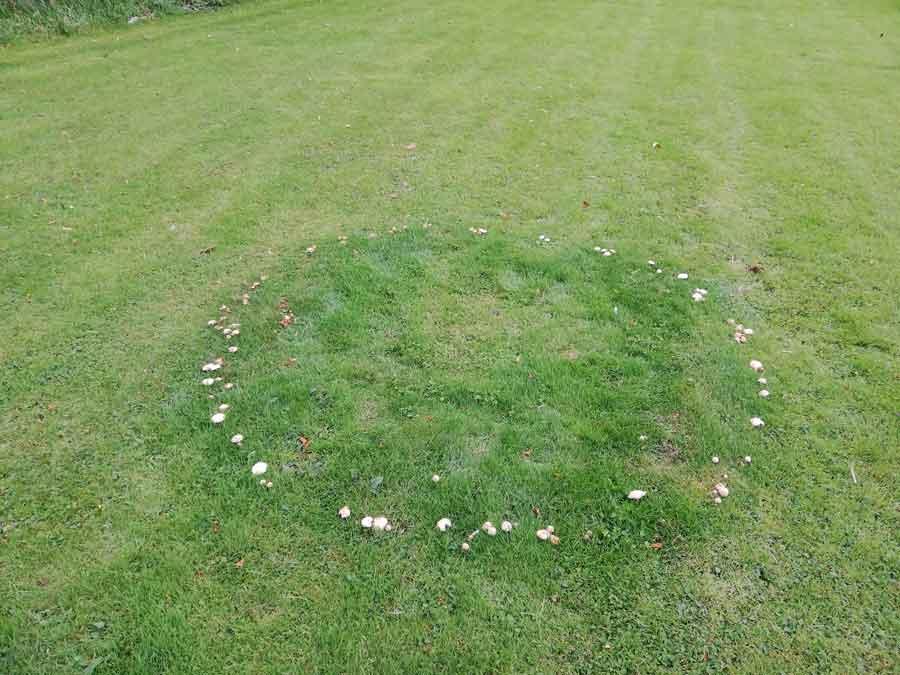
Bare Circle of Greenery, Namibia
Throughout France, popular tradition holds that fairies and other supernatural creatures left visible traces of their dances. These sites, often circular, are referred to as enchanted “ballrooms.” Their distinctive feature? Barren land, where the grass no longer grows.
In the Aveyron, they are called the Fairies’ Ball. In Saint-Cast (Côtes-d’Armor), a completely bare patch of land still marks the spot where the “good ladies” came to dance. In the Cantal, the Fairies’ Circle was said to be so lively that these spirits sometimes responded to curious passersby. Further north, in the Ardennes, grass never grows at the Lady’s Circle. Legend has it that a peasant, having risen too early to go harvest, saw the fairies dancing under the moon. When they asked him the time, he answered, “three o’clock in the morning.” The fairies burst out laughing: “Fool! If it were three o’clock, you wouldn’t have found us! Move along!”
These enchanted circles are reported in other regions as well: the Fairies’ Field in Warloy-Baillon (Somme), where a large bare space once marked their nocturnal sabbaths, and in Orvilliers (Aube), where peasants claim that the crops grow poorly within these cursed circles. Everywhere, the same idea persists: the fairies’ dance leaves an indelible mark on the earth.
3. Sabbath circle
Circle of the Oreads’ Languishes, (Photo by Luke Emski; C.C. 4.0)
Fairies are not always benevolent creatures. In some traditions, they are associated with the sabbath, likened to witches, or even connected to the infernal realm. Around Semur (Côte-d’Or), one can still spot, in the meadows or on the hills, discs of astonishing regularity. In spring, the grass there is green but shorter; in autumn, it appears scorched. The elders claimed that this was where goblins, witches, fairies, and devils gathered under the moonlight to dance fiery rounds, leaving these cursed circles behind.
One of the most famous was located at the Vic de Chassenay, near an ancient Roman road called the Chemin des Fées, just steps away from a legendary tree and a place called la Grosse-Borne—which may indicate the former location of a menhir. Legend has it that a villager, passing by the circle at night, saw a round of men and women led by the devil himself, horns raised and lively music playing. Among the dancers, he recognized familiar faces. He was then offered a silver vase filled with a strange liquor. Suspicious, he spilled it on the ground. When invited to keep the cup, he made the sign of the cross, and immediately everything vanished in a terrifying clamor. In his pocket, only a simple stone remained.
Such stories are not isolated. In Bas-Vivarais, a similar legend is told, and in the Creuse, the fades—malevolent fairies—made these circles even more fearsome. Travelers lingering too long had to avoid these enchanted places at all costs, lest they be torn to pieces by the angry ladies. Thus, the sabbath circles remind us that the marvelous can turn terrifying, and that the steps of fairies were not always a blessing.
4. Circles of Witches and Goblins
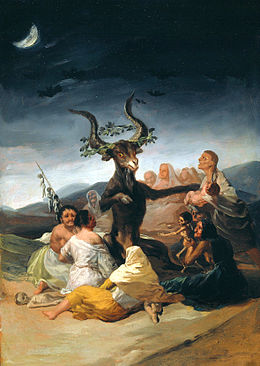
Sabbath circle
Just like the fairies, witches and goblins left behind visible traces of their sabbaths. These mysterious circles, where the grass appears scorched or torn up, became unmistakable marks of the supernatural. Long before the 17th century, they were already credited with the barren circles scattered across certain meadows. In 1645, a traveler awaiting passage to Portugal was led to one of these sites. His description is striking:
« Un pré où l’on dit que les sorciers tiennent leur sabbat. Il y a dedans plusieurs ronds où l’herbe n’est pas seulement foulée, mais il semble qu’on l’ait bruslée. Il est vray qu’alentour on voit comme un rond d’une herbe bien plus belle et plus verte. »
“A meadow where it is said that witches hold their sabbath. Within it are several circles where the grass is not only trampled, but seems to have been scorched. Indeed, all around, one can see a ring of grass that is far more beautiful and greener.”
This contrast between scorched grass and lush greenery reinforced the idea of a cursed space, trodden by occult forces. Two centuries later, near Questambert (Morbihan), people still spoke of the Witches’ Meadow, where yelps and howls replaced all music—the infernal rhythm of their nocturnal rounds.
Accounts multiply across France: in the Aveyron, an elderly man from the 19th century claimed to have witnessed with his own eyes an assembly of witches and hideous masks dancing by torchlight. On the Puy de Pège, the Devil’s Path remains a barren circle where it is said that Satan himself leads his followers in an endless dance. In Burgundy, at the Combe de Nervaux near Meursault or in Lusigny (Côte-d’Or), the yellowed and scorched circles are still shown as evidence of the devil’s minions’ passage. Further south, in the Allier, reapers say that these circles appear after the criminal practices of witches, on the night of May Day.
In Lower Brittany, other beings join the dance: the courils, mischievous little imps who scorch the grass in circles under the moonlight. As for the circles drawn by exorcists to trap the souls of the conjurés, these too remained forever devoid of vegetation, like an indelible scar of their battles against the invisible.
5. Dangers of circles
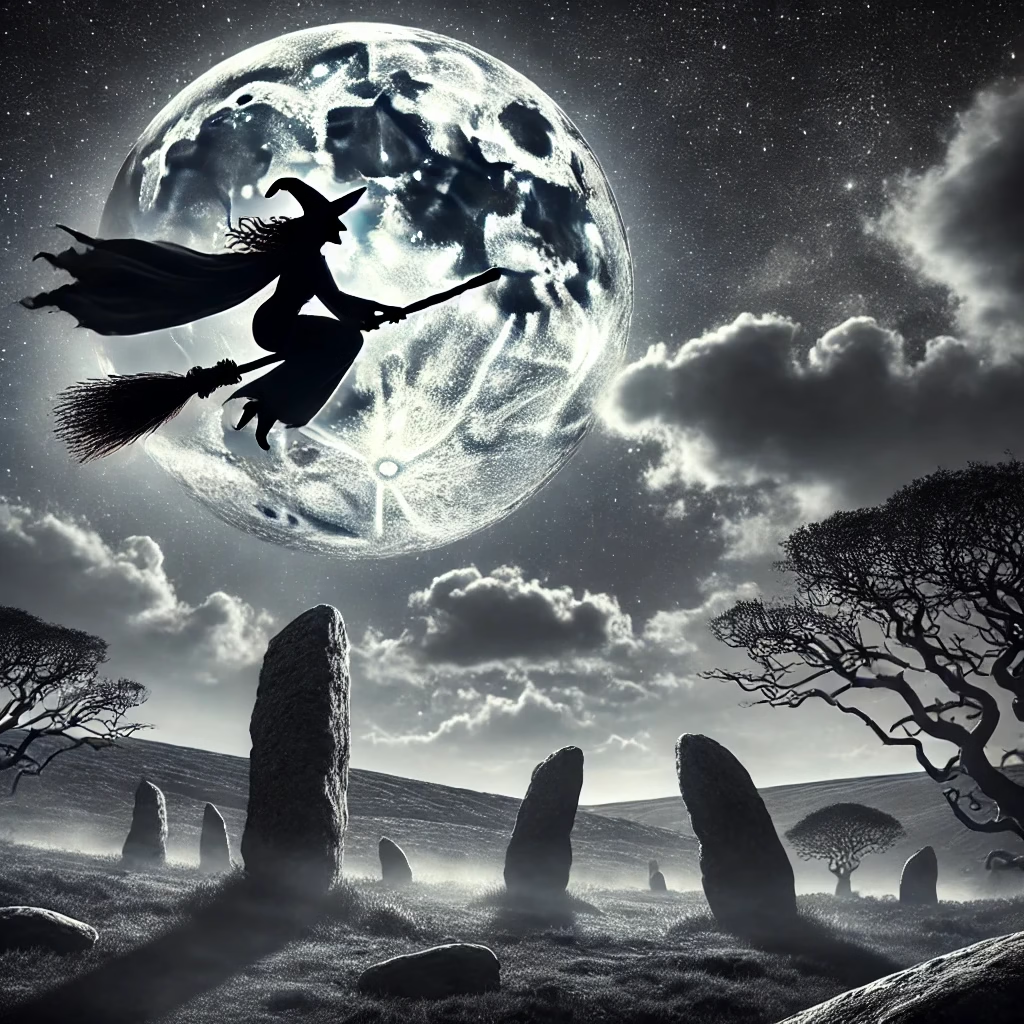
Witch on her broomstick flying over a moor, at night, image generated by DALL-E
The circles left by the dances of fairies, witches, or goblins fascinate as much as they disturb. In the countryside, these circular traces on the ground are seen as supernatural imprints, filled with curses or strange powers. In Lorraine, peasants carefully avoided the circles left by lightning or whirlwinds, which they considered to be the remnants of enchanted dances. In the Vaudois Alps, it was forbidden to sit in the riola, places where witches had danced. In Lower Brittany, cows were even kept from grazing around these circles, for fear the hay might bring illness or parasites. The mowers of Allier went so far as to claim that this cursed hay produced lice for the entire winter.
Beliefs, however, vary. In Brittany, the circles could be dangerous, as the conjured souls that had been trapped there through exorcism could, one hour a day, harm anyone reckless enough to enter them. Conversely, in Berry, the “fairy rings” were seen as true sacred refuges: in the event of being chased by a malevolent beast, ambushed, or even attacked by a demon, seeking shelter within these circles guaranteed inviolable protection.
Sometimes, instead of an unsettling sterility, these circles were associated with exceptional fertility. In Berry and Côte-d’Or, the “Fairy Circle” stood out for its greener, more abundant grass. In Gascony, the traces of the “Blanquettes” made a nourishing turf grow, which quickly fattened the bulls. Farther north, near Samer (Pas-de-Calais), the thicker, more flowered grass marked the places of their nocturnal round dances. And near Écordal, a vast thirteen-meter circle, always green, recalled the location of the witches’ sabbaths. In the Norbert meadow in Avaux, the spirals of their dances remained visible in the bent grass—lush in every season.


Leave a Reply