Mountain Fairies: Their Powers over the Land and over Men
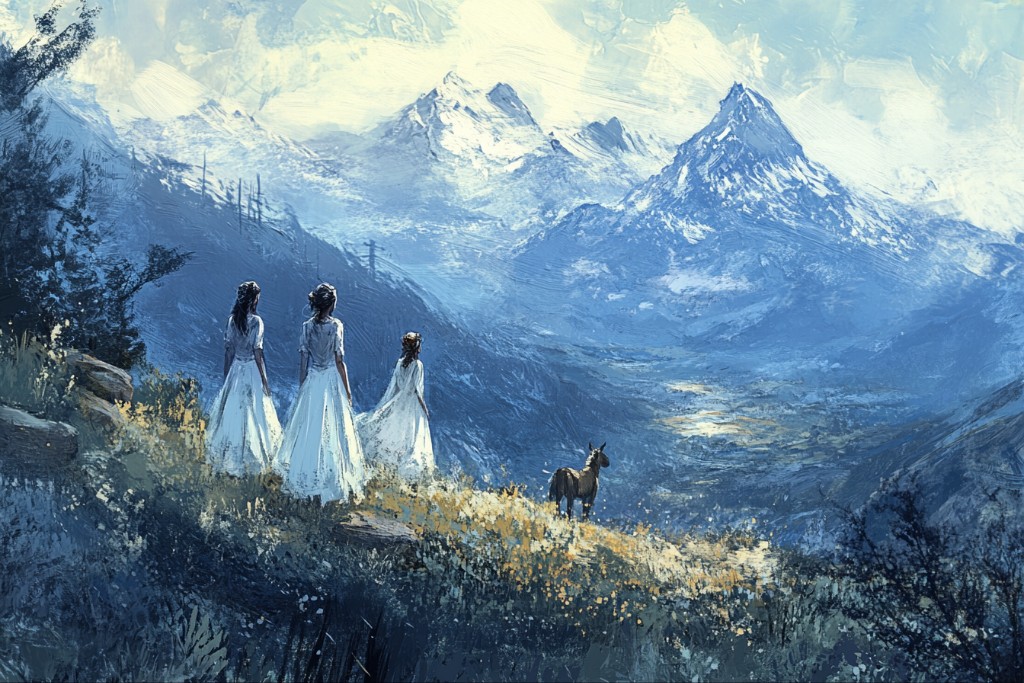
Mountain Fairies with a Donkey, Midjourney
1. Alpine Fairies and Flowers
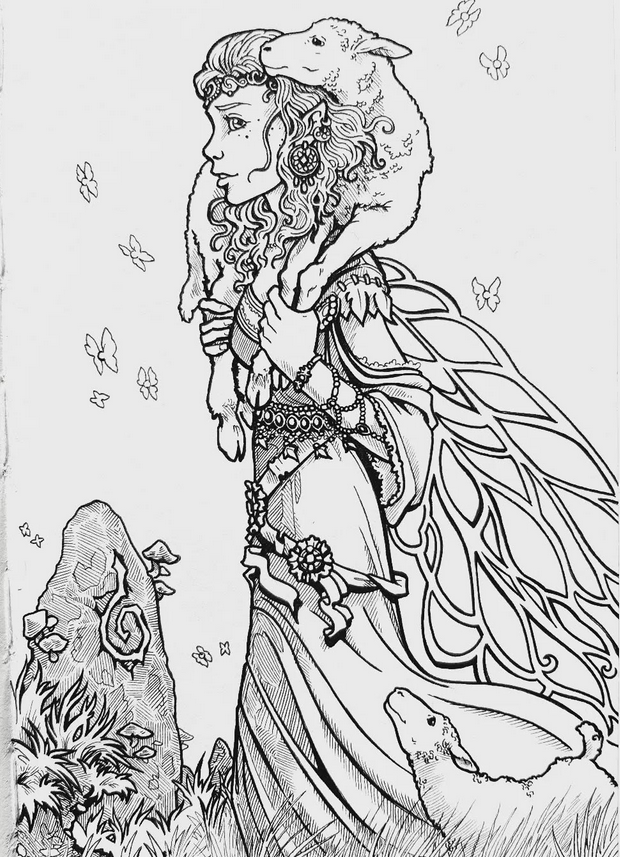
Fairy carrying a sheep, drawing by Folklore Dracques
In the Alps, the Alpine fairies jealously protect the plants and flowers of the peaks. According to tradition, one day a young man ventured onto a steep rock overlooking an abyss to pick flowers with white bells. Suddenly, he found himself face to face with a beautiful young woman, dressed in a snow-white gown and crowned with fir foliage. She warned him:
“Do not touch these flowers; they belong to God; only God may gather them.”
But the young man ignored this warning and seized the bouquet. Immediately, the sky darkened, the ground seemed to give way beneath his feet, and he tumbled into the abyss, bruised and bleeding. Since that day, the legend says, the Alpine rose is red, the color of the blood shed by this daredevil, reminding all of the respect owed to the mountain’s forces and to the protective fairies.
2. What are they? Where do they live?
Fairy Guardian of Nature
The mountain fairies, like the benevolent spirits of local traditions, were long considered the protectors of the peaks and valleys. Until the mid-19th century, the elders told that their grandfathers had seen them: graceful creatures, dressed in white and crowned with flowers, capable of easing ailments and helping medicinal plants grow.
In the Pyrénées, some fairies are said to have persisted on the peaks and high valleys. It is said that on the summit of Mount Cagire, they make plants with healing properties grow. At Saint-Bertrand, by the fountain that bears their name, they can be heard at night singing in a soft and plaintive voice. They sometimes enter the peak of Bergons, where they transform coarse flax left at the entrance of their cave into fine and valuable silk garments.
For those seeking wealth and treasures, one must turn to the Fairy of Escout. Beneath a millennial oak lies a deep lair: anyone who places a vessel near this spot may sometimes find it filled with precious metals, but only if the request is made in terms pleasing to the fairy. Mastering this secret language then guarantees success.
3. Their Unions with Men
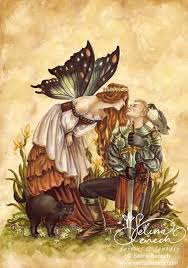
Enchanted Kiss, Selina Fenech
In the Aude, some fairies lived in a crystal palace on the hill of Taich, while in the Vaud Alps, the Fairies – called Faïes, Fatas, or Fadhas – preferred isolated and quiet sites: caves, mossy excavations, elevated places, or barma. These creatures watched over the pastures, the lives of shepherds, and springtime, bringing benefits and protection to humans.
Their dwelling places included green plateaus, rocks (scex), caves (tannes), and streams, where they lived far from the human world while still intervening in mortal affairs. At times, they formed bonds with men, imparting to them the mysteries of nature and magical arts. These unions were happy only if the man observed certain rules of politeness and speech toward the fairy.
A popular legend in several villages of the Lower Valais illustrates these unions. A young man from Clebe fell in love with a fairy and asked for her hand. After some resistance, she accepted on the condition that he should never raise his voice at her and that he should never utter the phrase: “You are a wicked fairy.” The couple married and had beautiful children. One day, anticipating a terrible hailstorm, the fairy harvested the still-green wheat with the help of her companions and stored it safely in the barn. When she returned, the husband said to her, “Why ever did I marry a wicked fairy!” No sooner were these words spoken than the fairy vanished in a rustling sound like a snake sliding among the stones. Later, she reappeared, on the condition that the father follow precise instructions, reminding him that mutual respect was essential if the union were to endure.
According to Paul Sébillot, local tradition often places the fairies on mountaintops or in inaccessible caves, though some lived near villages, in excavations in small hills. The stories show a striking similarity between these fairies and those of the Alps or the Pyrenees, sharing the same protective virtues and interventions in human life. These legends reveal that, in mountain folklore, fairies are not merely fantastical beings but also kind guardians of people and of nature.
4. Dancing fairies
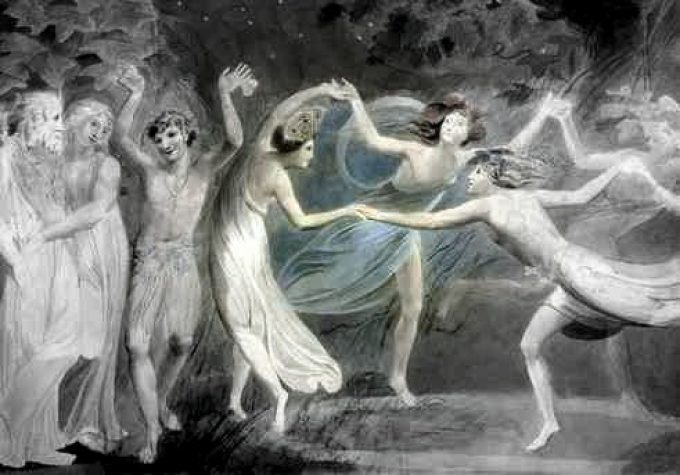
Round of white fairies
Other regions bear witness to similar traditions: at the Hohneck, the fairies danced by moonlight on the summer pastures; in Gascogne, the Blanquette fairies took part in dances at midnight on the hills; in the Aude, the plateau of Donnezan bears the name Fairies’ Dance; and near Ruffach, white ladies were seen dancing around a fire.
D’autres régions témoignent de traditions similaires : au Hohneck, les fées dansaient au clair de lune sur les pâturages d’été ; en Gascogne, the fées Blanquettes prenaient part à des danses à minuit sur les collines ; dans l’Aude, le plateau de Donnezan porte le nom de Danse des fées ; et près de Ruffach, des dames blanches étaient aperçues dansant autour d’un feu.
A small legend from the Loire-Inférieure shows the consequences of disturbing these dances. On the Rohouan mounds, benevolent fairies formed rounds by moonlight, but the villagers, disturbed by the singing, destroyed their stone houses. Punishment was swift: a lasting famine struck the village. In Guernsey, the fairies of the Fairies’ Hollow danced at night on Mont-Saint, and in 1896, the locals warned a lady that it was unwise to build there.
Sometimes, the dancers forced passersby to join them, but they were then considered degenerate fairies or witches. One example: near the Suc, a man saw three young ladies talking among themselves. He tried to walk away, but was forced by the fairies to dance until sunrise.
In the Cantal, near the Fairies’ Lake, a boy was drawn into a magical round on a Saturday night. Exhausted, he fell to the ground as the beautiful girls transformed into frightening skeletons, ready for a macabre feast. He escaped the worst by invoking Saint Géraud, but retained physical marks from this vision. In Châteaugay (Puy-de-Dôme), ladies dressed in black, feared for their gaze, also danced at night on a mound.
5. Departure of the Fairies
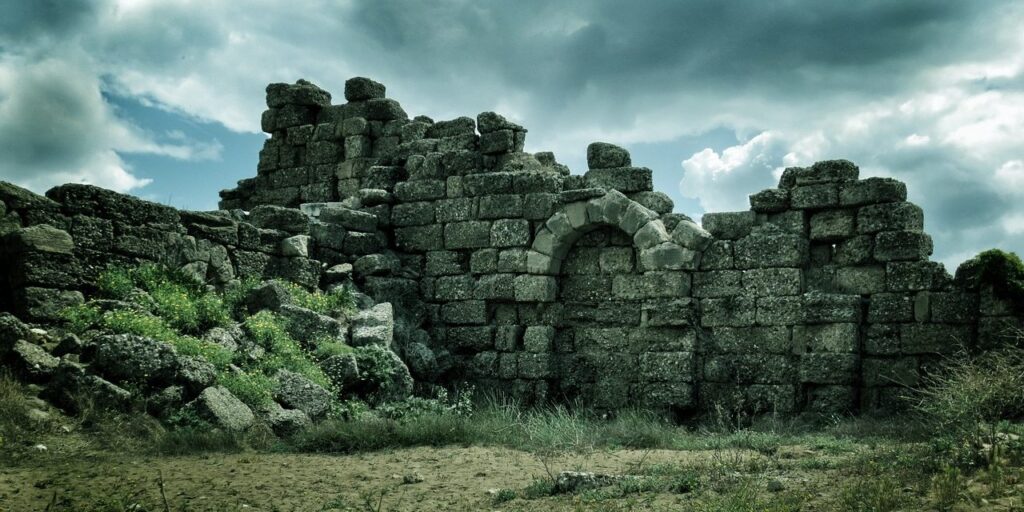
Ruins
Nowadays, the fairies and their kin rarely appear on the mountains. Legends often tell why they abandoned them. In the Basque part of the Pyrenees, the Lamignac disappeared after Roland crushed them with stones while they were feasting with stolen cows. In the Vaud Alps, some fairies left because of the lack of respect from men. A shepherd, married to one of them, threatened to hit her with his staff: she left the house to join her companions in another region.
The Fairy of the Tannes de Javerne, married to a man with the obligation never to speak three forbidden words, also fled when he broke his promise. In the Ormonts and neighboring valleys, the fairies left when the shepherds soiled the springs where they bathed or the cream tub set aside for them according to an old custom.
In the Valais, it was again human ingratitude that caused the fairies to depart. A shepherd, needing to be away, asked the fairies of Arpales to watch over his flock. They agreed, on the condition that he return to fetch his sheep at the breath of the wind from Mount Joux. But the shepherd hesitated and acted only when the wind turned into a cyclone. Upon his arrival, he found only ruins and carnage. From atop a rock, the fairies cried that they were leaving this inhospitable land, and that vineyards and woods would vanish, making way for an arid and desolate terrain.