In mountainous regions, the still waters — lakes, ponds, and chasms perched high above — are often shrouded in mystery. These peaceful, almost unreal places have inspired countless legends that recount their origin, their secrets, and the beliefs associated with them. Some traditions even go so far as to forbid disturbing the surface of these waters, under the threat of invitingterrible misfortunes upon oneself.
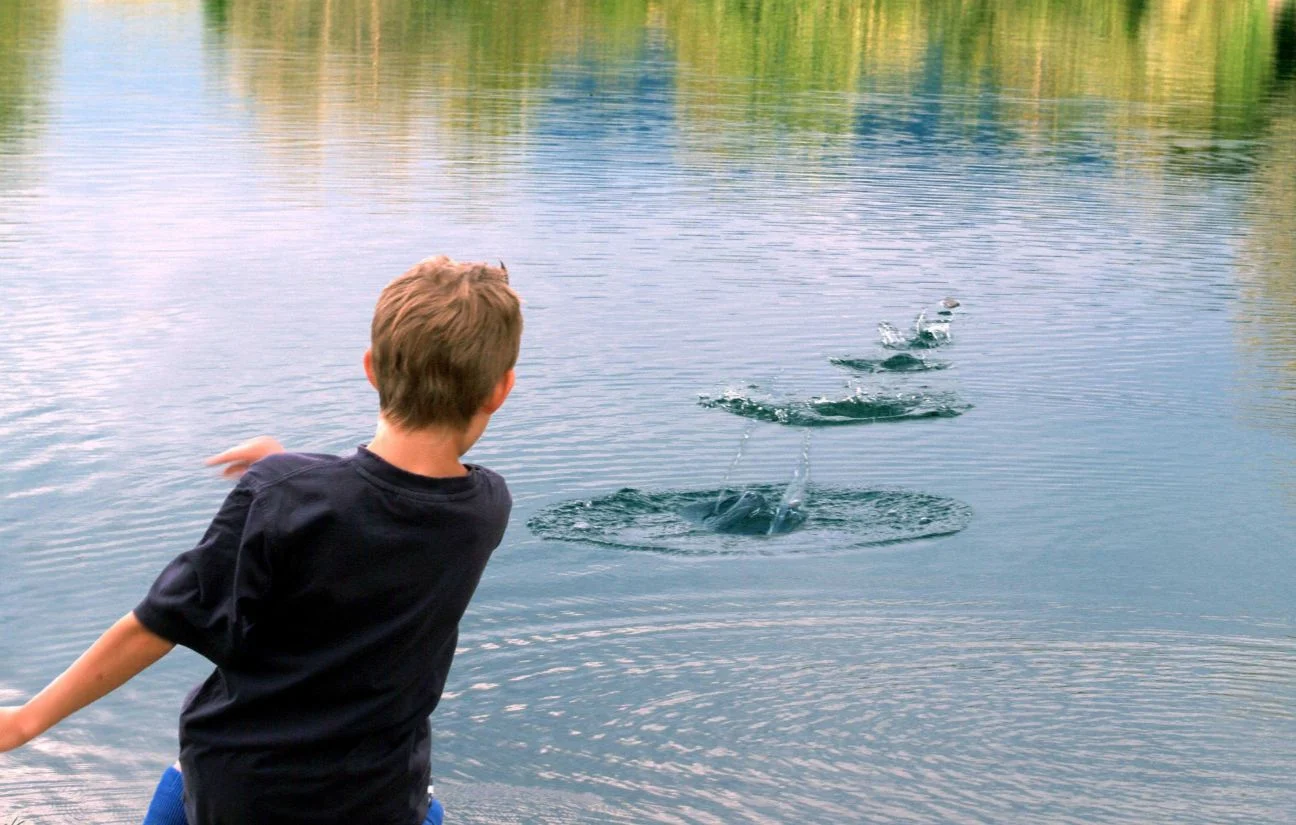
One of the most famous tales concerns Tabe Pond, locally called the Chasm or the Devil’s Pond. Located in the heart of the Pyrénées, its difficult access has undoubtedly fueled many stories. Locals say that Pic de Saint-Barthélemy, which surrounds it like a funnel, is held in place by enormous chains and heavy rings. According to legend, if anyone dares to throw a stone into the water, the pond rages and unleashes lightning.
Not far from there, on a mountain near Villefranche, three chasms are said to be haunted by the devil himself. It is said that simply tossing a pebble into them can trigger a storm.
2. Water Contained Within the Mountain
Source d’eau de karst, Slovénie
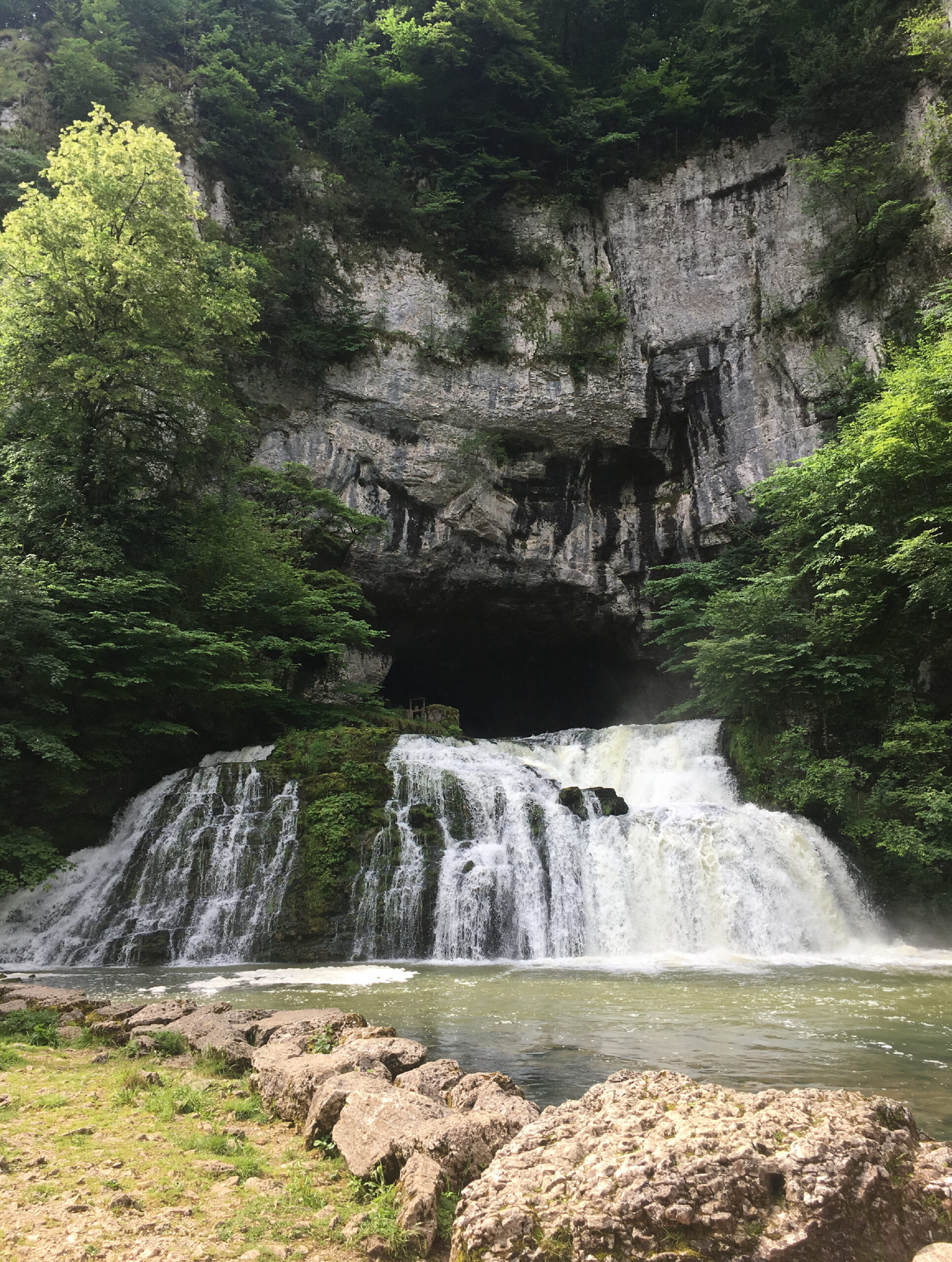
In the heart of the Vosges, some traditions tell that the mountains are not as solid as they seem. Beneath their slopes lie colossal masses of water, ready to burst forth at any moment. In the Galilee Valley, locals whisper that Mount Ormont contains within its depths an amount of water so immense that, if it were to surge, it could engulf the entire valley.
According to the same belief, a solemn mass is said to be held every year on November 4 in the chapel of the Saint-Charles Hospital. Its purpose? To prevent the disaster, or at least hold back the buried waters that threaten the region. Tradition holds that this celebration protects the valley from a flood foretold for centuries.
When the storm rumbles and the rivers swell, the old women of the region make the sign of the cross. They fear that the iron circle, forged long ago by the power of the fairies and meant to keep Mount Ormont sealed, might break. For if this barrier were to fail, the unleashed waters would rush down on Saint-Dié, engulfing the old Vosges town under a torrent from the very heart of the mountain.
3. His Treasures
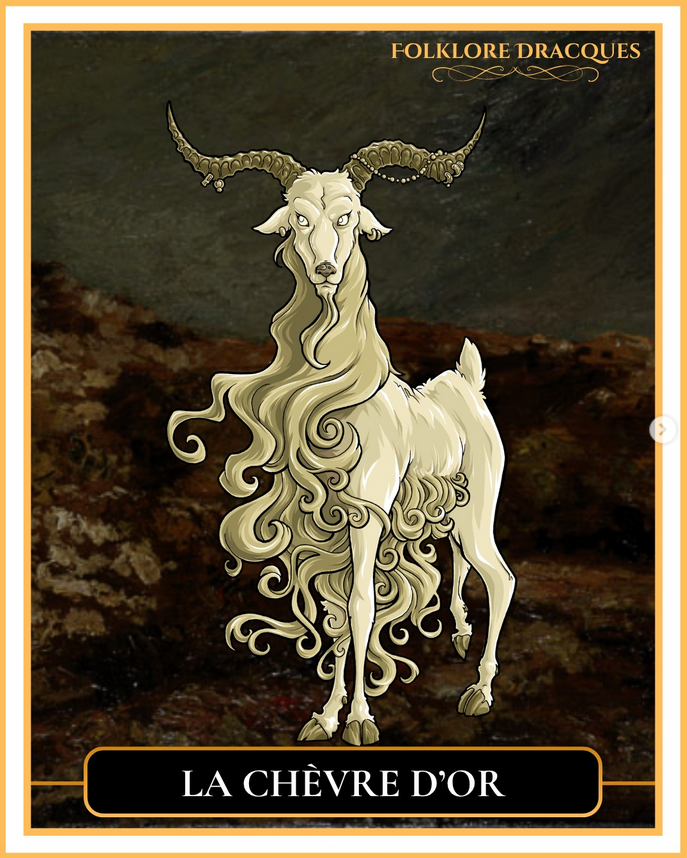
Illustration de la Chèvre d’or, Folklore Dracques
Like deep forests or bottomless lakes, the mountains are said to hide within their depths fabulous treasures, guarded by spirits or magical creatures. These riches, it is said, only reveal themselves to those who know how to wait for the right moment… and resist fear.
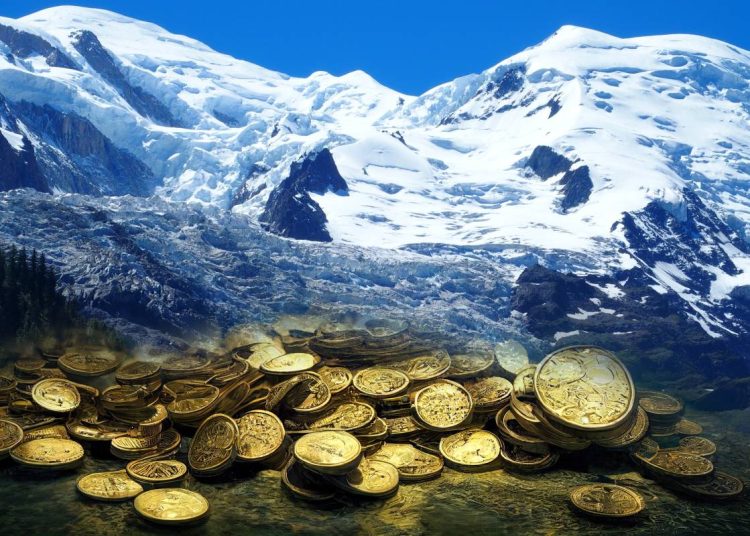
In French-speaking Switzerland, legend has it that Dent de Vaulion shelters gold. But these treasures are under the watch of the Grobelh Ion, a strange spirit that crosses the valley of Lac de Joux every Christmas Eve. It is accompanied by fantastic beings riding wild boars whose tails serve as reins. In the Pyrénées, each treasure is guarded by a supernatural red goat. Three times a year, it must expose these riches to the sunlight. One day, a shepherd saw a pile of gold shining near a lake where the mysterious goat was keeping watch. He ran to fetch a companion, but upon their return, all that remained was a thick fog.
In the Gard, at Landun, it is during the St. John’s festival that the mountain lets loose the famous Golden Goat, a guide to hidden treasures. The stories are many. Near Salvan, on the path leading to Fenestral, a treasure is said to appear only once every hundred years, at midnight. A man there encountered a beautiful young lady, combing her hair with a golden comb. She called herself a “sorrowful soul” and promised wealth and eternal rest in exchange for three kisses. But with each embrace, the young woman took on a more terrifying form: first a billy goat, then a monstrous serpent. Terrified, the man fled, losing the treasure forever. Further along, near the Tenneverges pasture, a large black stone is also said to hide riches. One only needs to lift it with a stick, but beware of shouting: fear immediately closes the stone again, trapping the gold and the secret once more.
The mountains of Gard and Savoie are also full of similar legends. At Pic de Saint-Loup, on the eve of St. John’s Day, a magic door opens at midnight: three tunnels lead to rooms filled with coins, silver, and then pure gold. But when the clock strikes midnight, the door closes, trapping the unwary. In Poisy, near Annecy, it is said that if one places an earthen pot on the ruins of a fairy castle on Christmas Eve, it will be found at sunrise filled with gold coins.
But greed comes at a high price. The elders say it is dangerous to try to steal the buried treasures. The gnomes who guard them cause rocks to collapse on the curious or fling them into the glaciers. On Mount Arrée, at Commana, the treasure guardian would sit each night of the full moon on the highest rock, watching for lost travelers. Woe to anyone who met its gaze: the gold they sought would instantly become their curse.
4. Mysterious Bells
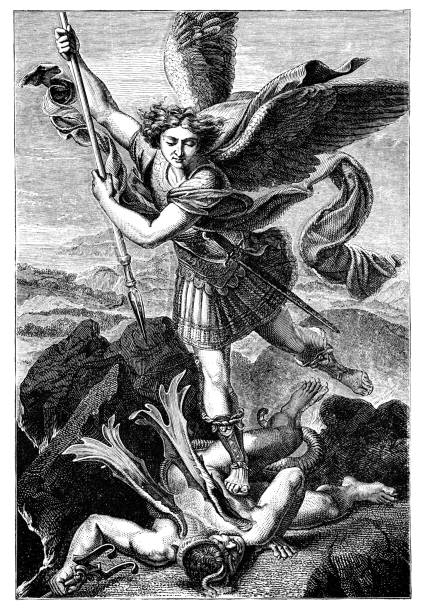
L’archange Saint Michel battant Satan
The tradition of mysterious bells, those sounds that seem to resonate underground, is very rare in mountainous regions. Only one example has been recorded in these lands: around Becca-France, in the Aosta Valley. There, locals say that on Sundays, one can hear, over the rubble of Thora, the sound of bells ringing as if divine services were still being celebrated. A legend of submersion, similar to those of lake cities, seems to have left its mark on this place.
Several peaks in the secondary ranges, once perhaps sites of pagan worship, today bear the name Mount Saint Michael. The sanctuaries erected on these heights in honor of the archangel demon hunter were intended to obliterate the memory of the ancient deities venerated at these sacred sites.
In Brittany, tradition holds that Saint Michael sometimes visits the chapel dedicated to him at the summit of Mount Saint-Michel de Brasparts, in the Mountains of Arrée. According to a legend collected at the end of the 18th century, on clear summer nights, one could see the archangel spread his wings of gold and azure before vanishing into the air.
The archangel’s appearances are said to be motivated today by a spiritual battle. When the “conjurés”, hurled in the form of demonic dogs into the marsh of Yeun Elez, begin to howl at night, Saint Michael then lowers his blazing sword toward the dark waters. Immediately, the tumult subsides.
Other accounts tell that the saint descends to confront the devil himself. His arrival is heralded by terrifying signs: the sky darkens, hail devastates the crops, and thunder rumbles violently. On the mountain summit, the devil and the archangel engage in a celestial duel. When Saint Michael triumphs, he is seen traversing his domain while warding off storms, or standing upon the steeple of his chapel. In his hand, an immense reel holds thousands of demons wrapped within. The archangel spins it at full speed to daze the evil spirits, who scream but cannot escape. Then, with a solemn gesture, he disperses them to the four cardinal points, before casting them into the quagmires of Yeun Elez. Finally, his wings of gold unfold, and Saint Michael rises toward the sky.
5. Heavenly Powers on Sacred Heights
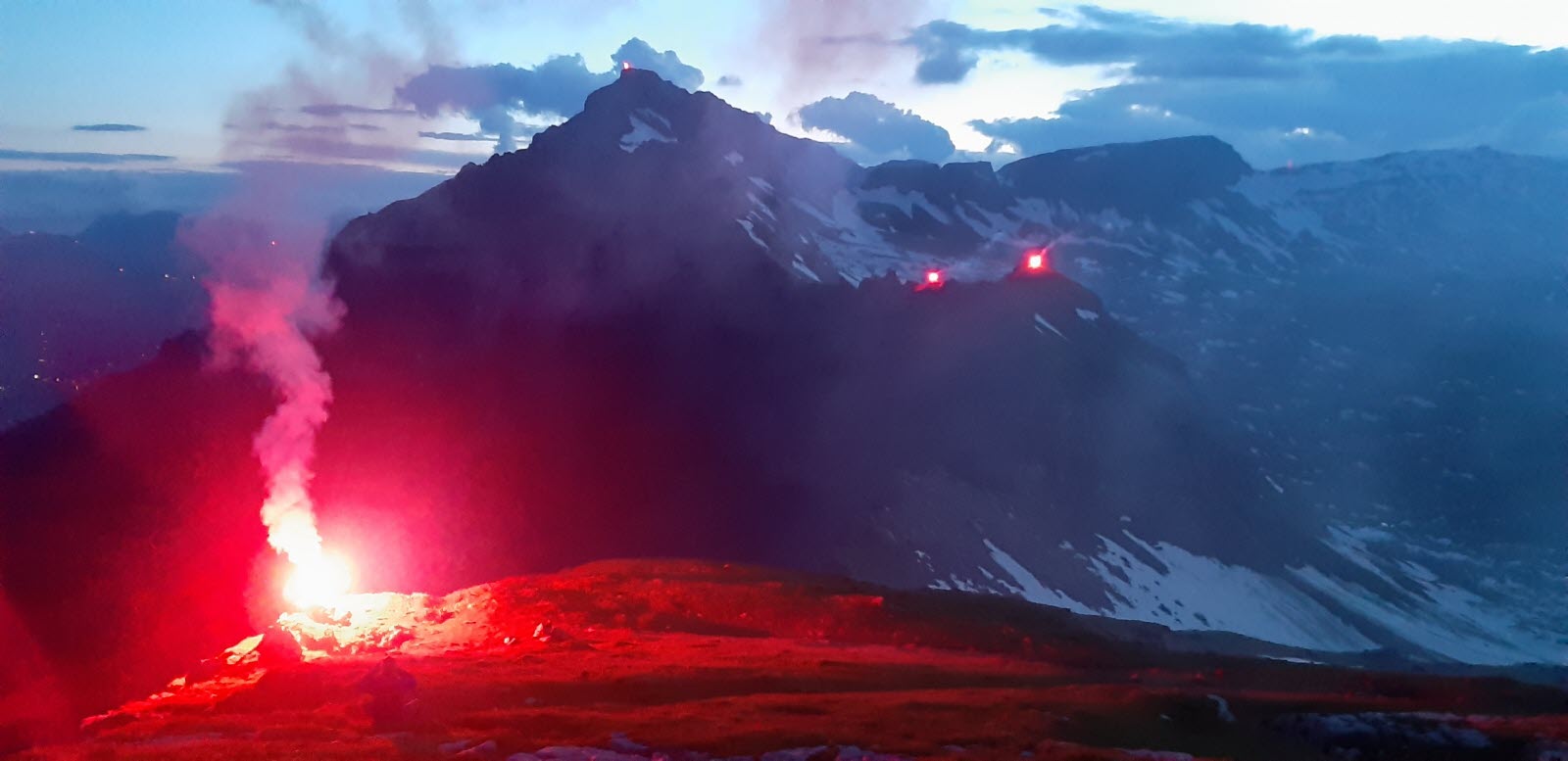
Feux de la Saint-Jean sur une chaîne montagneuse
On Mont-du-Ciel, in the Doubs, tradition holds that battles still take place between heavenly powers and infernal forces. It is from the highest peak that, it is said, the souls of the righteous ascend to the sky.
A shepherdess once recounted that, while tending her flock nearby, she witnessed a strange scene:
“On the day of the death of someone I knew, I saw, through the fog, two ghosts — one looked like an angel, the other was surely the devil. They clashed, and the angel triumphed.”
The mountains have always been seen as places of passage between earth and sky. According to ancient beliefs collected in several regions, miraculous phenomena can be observed there. It is said that on the morning of major feasts, particularly the Feast of the Trinity, three suns appear on the horizon. The inhabitants of Thillot, in the Vosges, even claim that Christians in a state of grace can, from Ballon de Servance, behold at dawn the three persons of the Trinity in all their glory.
In the Dauphiné, another legend holds that the moon dwells atop a mountain, and that the Winds, also personified, often make their home there. These poetic images reflect the ancient reverence for the heights, places where the visible world seems to touch the invisible.
Many mountains remain shrouded in respectful fear, but the ancient worship once offered to them seems to have vanished. Only the trace of a symbolic offering remains: in the past, one set aside a portion of dairy for the servants and fairies believed to inhabit these places.
The round dances and nocturnal dances, where tradition today places sorcerers and demons, may be the <strongdistant memory of cultic rites once practiced on these sacred heights. A 19th-century custom in the Hautes-Alpes still preserves an echo of this: on St. John’s Day, shepherds and villagers would gather atop the pastoral mountains to dance in a circle under the summer sky.
Until the early 19th century, in the region of Beurizot (Côte-d’Or), children would light bonfires on the summit of the nearby mountain at dusk. These fires were lit on symbolic dates: January 1, Epiphany, and the first Sunday of Lent. Around the flames, the children danced, unknowingly perpetuating an ancestral heritage, that of ritual fires celebrating the renewal of time and light.
6. The Soul of the Mountains
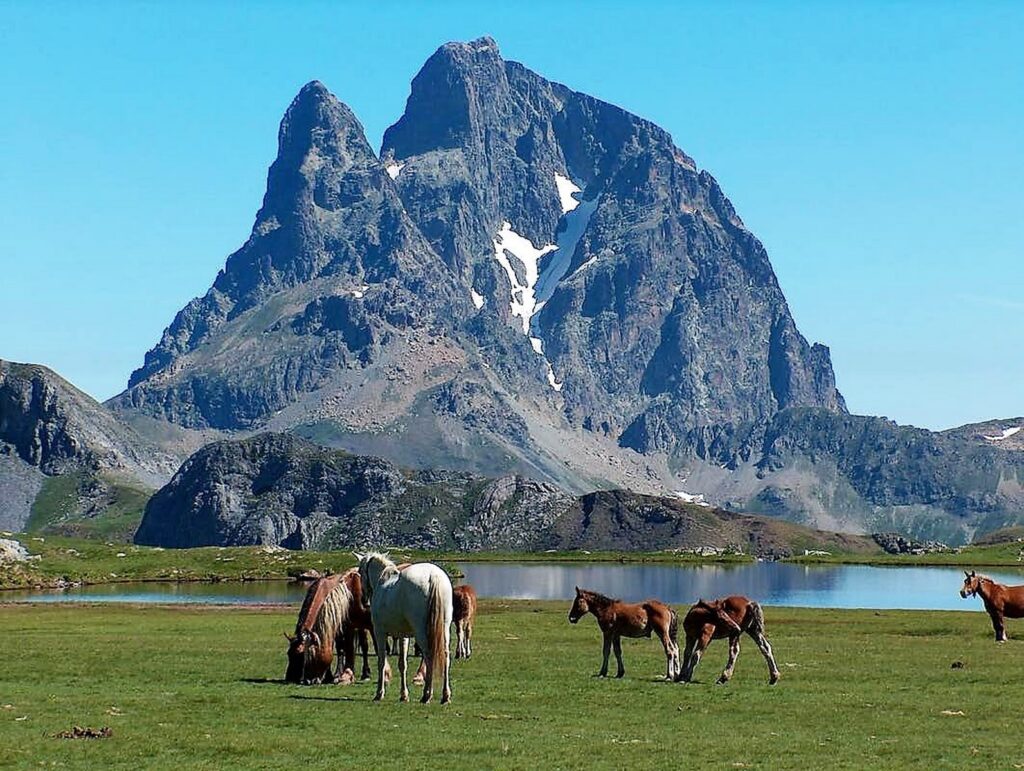
Pic d’Ossau, Béarn
In several regions of France, the people attribute to the mountains a soul, a will of their own — a form of animism that likens them to giants or <strongliving beings. In Béarn, tall men are often compared to the Pic d’Ossau:
“Lou pic d’Ossau” — a tall and powerful man. And when the snow falls in heavy flakes, the peasants of the plain say: “Ossau que plume las auques” — “Ossau plucks the geese.”
In other words, Pic d’Ossau makes it snow, like a deity “plucking the geese” from the sky. Similarly, in Savoie, locals claim that Semnoz has a bad temper, as winds and storms always seem to rise from its summit. A personification noted by Arnold Van Gennep, symbolizing a capricious and living mountain.
Une légende bretonne évoque des montagnes fabuleuses situées hors du monde réel, qui se heurtent entre elles comme deux béliers en colère. Un voyageur en route vers le Paradis voit surgir à chaque extrémité de l’horizon deux montagnes géantes. Elles s’élancent l’une contre l’autre, se percutent avec une telle force que l’air s’obscurcit d’une grêle de pierres. Alors qu’il les croit réduites en poussière, le voyageur les voit se dresser à nouveau, prêtes à recommencer leur affrontement. Lorsqu’il raconte cette vision à un prêtre, celui-ci lui répond :
“They are people dissatisfied with their own lot and jealous of that of others. They break themselves while trying to break others.”
In folk tales, the mountain peaks come alive and speak to one another. Two summits of the Montagne Noire exchange this dialogue, passed down in the local dialect:
Noro says to Mount-Aut: “Presto-me toun brisaud.” “Lend me your windbreaker.”
Mount-Aut replies: “Quand tu as fre, ieù n’ai pas caul.” “When you are cold, I am not warm.”
Translate:
“The Noro says to the Montaut: — Lend me your smock. — When you are cold, I am not warm.”
In southern France, peasants often associate the mountains’ mists and clouds with clothing: a hat, a coat, or a veil. From these images, many weather sayings have emerged.
In Provence, they say:
“Quand lou Ventour a soun capeù, E Magalouno soun manteù, Bouié, destallo et vai-t’en-leù.” “When the Ventour has its cape, And the Magalouno its coat, Boilé, scatter, and be gone.”
Translate:
“Quand le Ventoux a son chapeau Et Maguelonne son manteau, Bouvier, dételle et rentre chez toi.” “When the Ventoux has its hat And Maguelonne its coat, Bouvier, untie and go home.”
These lively expressions are found in many regions: Auvergne, Limousin, Languedoc, and Aude. In Maine, a local version even applies to modest hills:
“Quand Rochard a son chapiau Et Montaigu son mantiau, I’ tombe de l’iau.” “When Rochard has its hat And Montaigu its coat, Down comes the rain.”
In other words: if the mountains wear their clouds, rain is not far off.
In several folk tales, those who embark on a journey to a celestial world must cross fantastic mountains that are almost impassable.
A tale tells the story of a little shepherd tasked with delivering a letter to Paradise. To succeed, he must climb a steep mountain overrun with brush. Along the way, he encounters countless children, resembling a human anthill, who climb relentlessly. Near the summit, they constantly fall back, a handful of grass in hand. These are, it is said, children who died unbaptized: they hear the angels’ songs but cannot enter Paradise for lack of holy water.
In another version, a little shepherd reaches the summit alone. Looking back, he sees boys struggling to climb the mountain: these are those who died before their first communion. They will only succeed in reaching the top when Jesus Christ claps His hands three times to call them to Him.
7. Mountains in Tales
In many folk tales, heroes and heroines must climb towering mountains to achieve their goal: to capture a marvelous bird, rescue a captive, or break an enchantment. These ascents are fraught with obstacles: steep slopes, biting cold, snow and hail. Thus, in the story of l’Oiseau de Vérité (Gabriel Milin and Amable-Emmanuel Troude, Le Conteur breton), the daughter of the King of France attempts to climb a colossal mountain. If she falters, she will be turned to stone, like all those who failed before her.
In a Basque tale, the heroine must climb without ever looking back, despite the terrifying cries echoing behind her. In a sailors’ story, the talking bird is found atop a mountain of snakes—a nightmarish vision where nature becomes the guardian of mystery.
Les montagnes abritent aussi les retrouvailles amoureuses et les quêtes initiatiques. Dans le conte de la femme du roi des Corbeaux, c’est encore au sommet d’une montagne que l’épouse vient libérer son mari prisonnier.
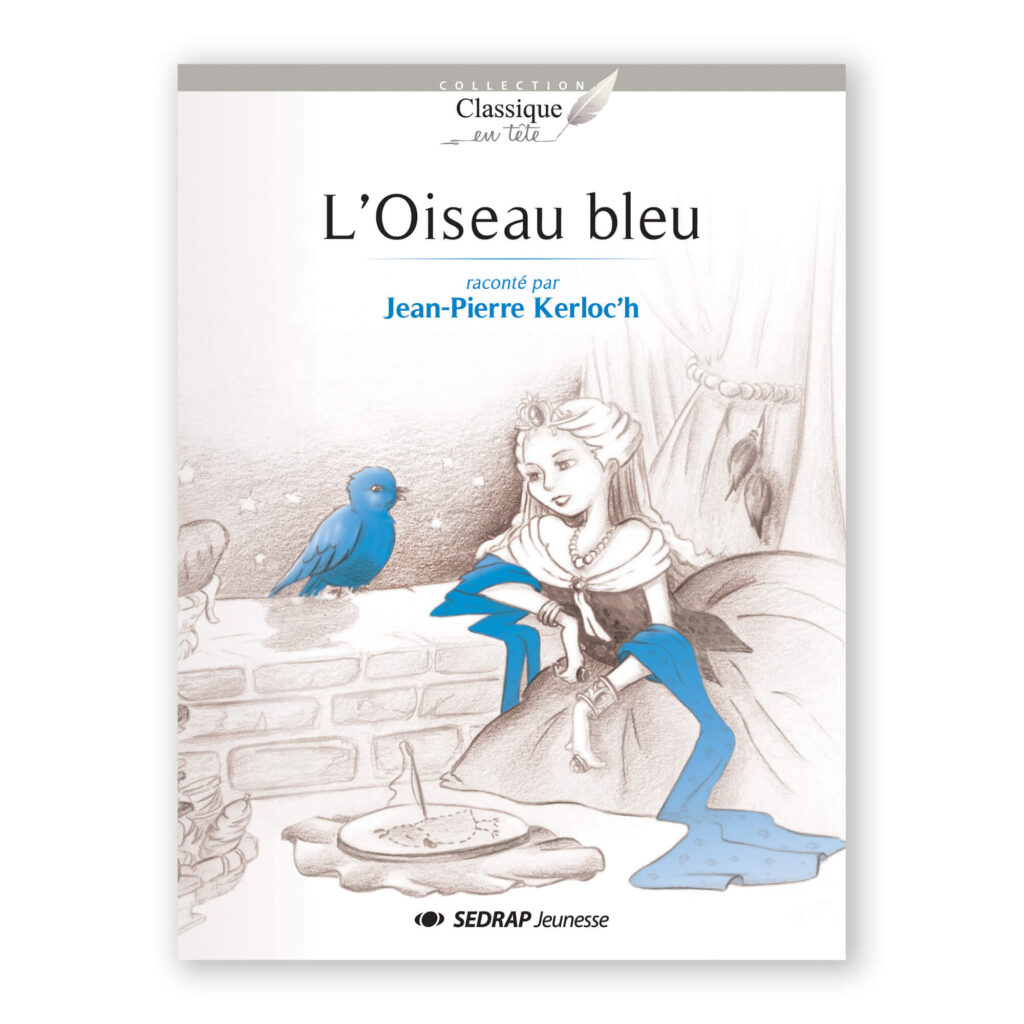
In the famous tale by Marie-Catherine d’Aulnoy, The Blue Bird, Princess Florine wants to find King Charming. But a mountain of ivory rises before her, so slippery that she eventually collapses in despair at its base. Then she remembers the magical eggs given by a fairy. By breaking one of them, she discovers small golden crampons which she attaches to her hands and feet — and finally reaches the summit, where she reunites with her beloved.
A Norman legend, made famous by the Lai of the Two Lovers (attributed to Marie de France), tells the story of a king who refused to part with his daughter. He promised her hand to anyone who could carry her to the top of a mountain without ever stopping. A young man, advised by the princess herself, obtained from his aunt a magical potion to multiply his strength. Yet, despite his beloved’s pleas, he refused to drink a single drop during the trial. Exhausted, he collapsed on the verge of success — dying in the princess’s arms, who in turn died of grief. Their bodies were buried together at the summit, and the mountain was named the Mount of the Two Lovers. A name that medieval poetry has preserved to this day.
Near Monte Incudine in Corsica, a young girl went to gather wood when she heard a mysterious voice calling her from above. Several times, the voice invited her to climb higher. Eventually, she gave in and reached the summit, where a <strongstrange castle stood. A man welcomed her there and told her that she could only return home after wearing out seven pairs of iron shoes. Otherwise, she would be turned into a statue. Here, the mountain is no longer a refuge: it becomes an enchanted trap, symbolizing temptation and loss.
Certaines montagnes sont le domaine du Soleil, des Vents ou du Diable.C’est là que le démon aurait son château — et que doivent se rendre ceux à qui il a jadis rendu service, à la date convenue. En Picardie, on la nomme la Montagne Noire ; en Upper Brittany, la Montagne Verte or la Montagne d’Or.
In tales, mountains can also appear by enchantment. They suddenly rise to protect a fugitive or slow down an ogre. When the Pearl strikes the ground with her magic wand, a mountain immediately rises between her and her pursuer with seven-league boots.
Dans d’autres récits, les filles du diable qui fuient leur père jettent sur la route une étrille ou une éponge, qui se transforment en montagnes infranchissables. En Upper Brittany, c’est parfois la jeune fille elle-même qui se change en montagne — si haute et si escarpée que le diable ne peut la franchir.
Certaines herbes miraculeuses poussent seulement sur les cimes. Dans un conte de Upper Brittany, l’herbe à trois coutures, dotée d’un grand pouvoir de guérison, pousse au sommet du mont Blanc. Mais elle est gardée par un chat-huant, et d’innombrables obstacles empêchent les chercheurs d’y parvenir. Le sommet devient ici un lieu sacré, où nature et magie s’unissent.
In other stories, the hero does not have to climb the mountains, but flatten them. The Queen with Silver Feet only allows the godson of the King of England to marry her daughter on the condition that he level a high mountain — an impossible task that he accomplishes with the help of grateful giants. The Princess of Tronkolaine, meanwhile, agrees to follow her savior only when he succeeds, with the aid of the King of Hawks, in destroying a gigantic mountain and making the ground as flat as a plain.