Rocks thrown or placed: Gargantua’s stone discs, the mischief of the Jetins, the malice of the Devil, and the work of the saints
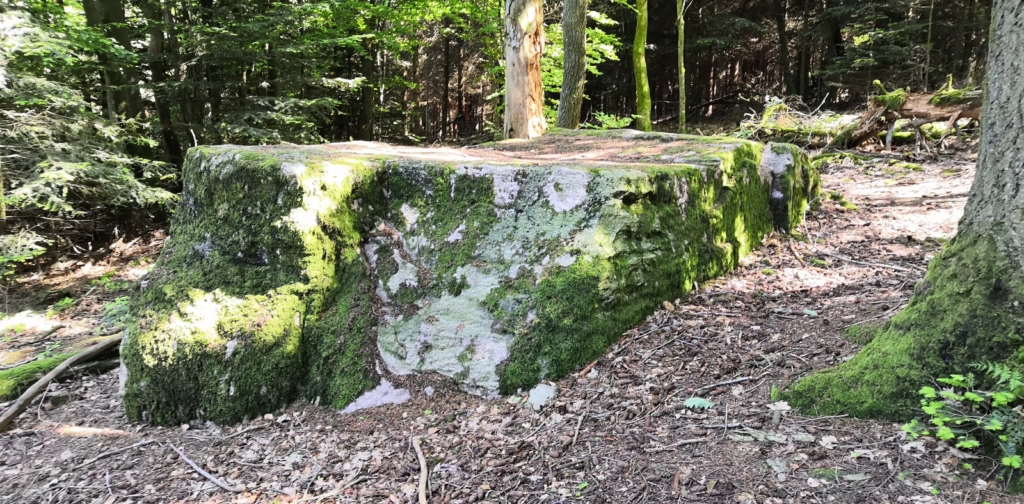
Gargantua’s Stone, Rieupeyroux (Aveyron)
1. Gargantua’s stone discs and their legends
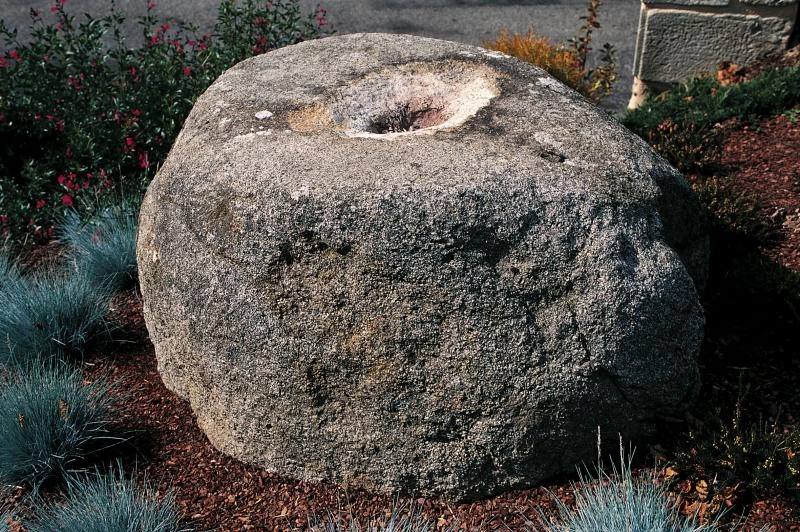
Gargantua’s Stone Disc, Charnizay (Indre-et-Loire)
Some natural boulders with a flat, rounded shape are intriguing. Their appearance almost instinctively brings to mind gigantic projectiles left behind after titanic games. These stones very often bear the name of the most famous of French giants: Gargantua. Known as Gargantua’s Stone Discs, these rocks can be found in many regions, sometimes without any specific legend being told about them, as their presence seems self-evident within the popular imagination.
Thus, one points out Gargantua’s Stone Discs:
in Luynes (Indre-et-Loire), where a smaller stone is said to have served as a stopper for it,
in the Garrigues of Clansayes in the Drôme,
in Ymeray (Eure-et-Loir),
at the Sathonay camp, near Divonne-Arbères, in the Pays de Gex.
From the top of Mount Ceindre, Gargantua was playing stone disc when he hurled the Pierre fite all the way into the Dauphiné plain, near Vaux-en-Velin. On another day, he grabbed an erratic boulder from one of the hills between which the Furans flows, near Arbignieu (Ain), and threw it as far as Thoys, where the stone is still known as Gargantua’s Ball.
From the summit of Mount d’Alaze (Saône-et-Loire), Gargantua relentlessly attacked the Château de Cruzilles. A first rock failed to reach its target. A second fell only a little closer. A third attempt was hardly more successful. These projectiles, now known as the Stones of Gargantua, can still be seen along a path near the castle, silent witnesses to these legendary feats.
When he passed through Brittany on his way back from Paris, Gargantua was warmly welcomed by the Léonards, while the Cornouaillais offered him only crêpes and porridge. At that time, Léon was cluttered with mountains that troubled the inhabitants. Indignant at the lack of courtesy from the Kernévotes, Gargantua took advantage of a stone disc game to hurl all the stones covering the southern part of the Léon region, scattering them from Plougastel to Huelgoat. According to another legend, if the northern coast of Plougastel is studded with strange, broken, piled-up rocks, it is because after an indigested meal, Gargantua felt sick and vomited them.
The giant’s exploits do not stop there:
In Ille-et-Vilaine, to defend himself from a pack of dogs chasing him, he hurled the Perrot rocks, which can still be seen on the edge of a ravine near Gahard.
In Sallanches (Haute-Savoie), Gargantua kicked a flat, pancake-shaped rock, which still clings to the mountain.
2. Discus-Throwing Dwarfs
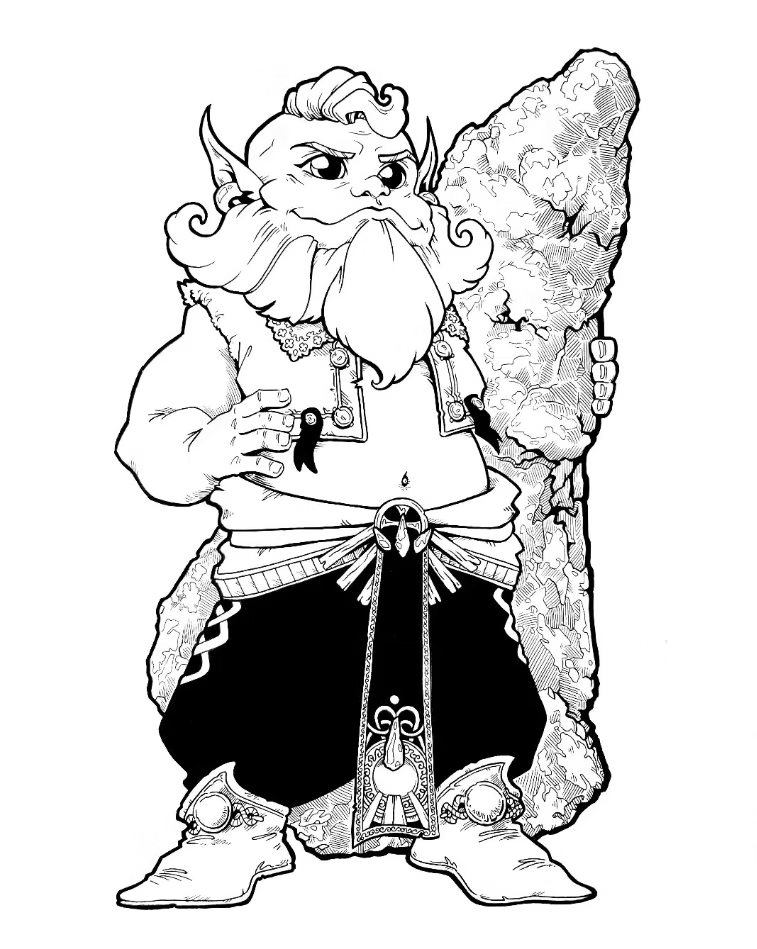
A Jetin, drawing from Folklore Dracques
Giants are not the only ones to have left their legendary mark on the landscape. In some popular traditions, it is rather beings of very small stature, yet endowed with prodigious strength, who explain the presence of scattered boulders in the fields.
On the banks of the Rance, people speak of the Jetins, tiny dwarfs capable of astonishing feats. According to tradition, they amused themselves by throwing large stones into the fields, thus explaining the presence of these isolated rocks in the landscape. It is even said that their name comes directly from this activity: Jetins, derived from the verb jeter (to throw), would recall their favorite pastime and their extraordinary strength, disproportionate to their size.
In Lower Brittany, other legendary creatures appear in similar stories: the Courils. They too are said to have played stone disc, not with ordinary pebbles, but with huge boulders, hurled across the fields as if they were mere toys.
3. The Devil Hurling Stones
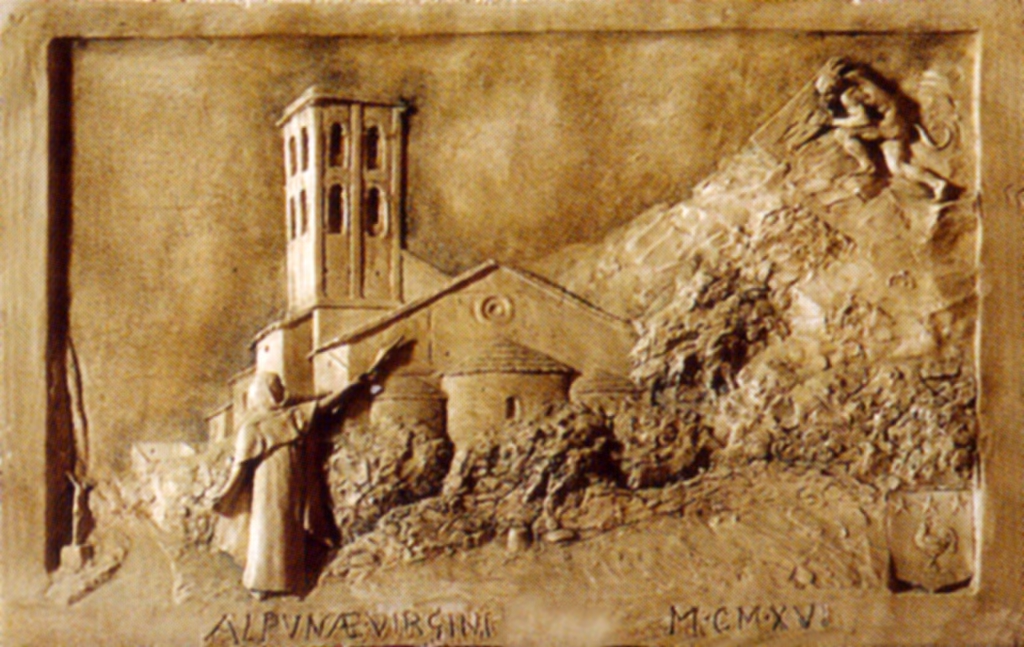
The Virgin Mary stopping the rock hurled by the Devil, engraving from the legend of Aubune
The Devil appears as a builder, a destroyer, or a challenger… but very often also as the victim of his own arrogance. Throughout France, many isolated boulders are thus explained by his failures, his fits of anger, or his accidents, sometimes under the direct intervention of the Virgin or protective saints.
The two Stones of Alban (Tarn) are said to be the result of a challenge the Devil posed to the Virgin. Each hurled a stone, but the Virgin’s far outdistanced the Devil’s, thus marking his defeat.
In the Vaucluse, the Devil’s Stone is a rock located on the ridge of the mountain overlooking Notre-Dame d’Aubune. Furious to see the church being completed, Satan tried to crush it under this mass. But the Virgin stopped him just as the stone was about to fall, leaving it frozen in place.
Near Montsurs (Sarthe), flat stones bear the evocative name of Devil’s Stone Discs, recalling his dangerous games and oversized throws. In the Ardennes, another legend tells that the Devil once tore two enormous chunks of rock from the mountain and hurled them at Roland, shouting: “Run, Roland!” But Roland did not budge an inch, and the two Auchamps boulders came to rest at his feet.
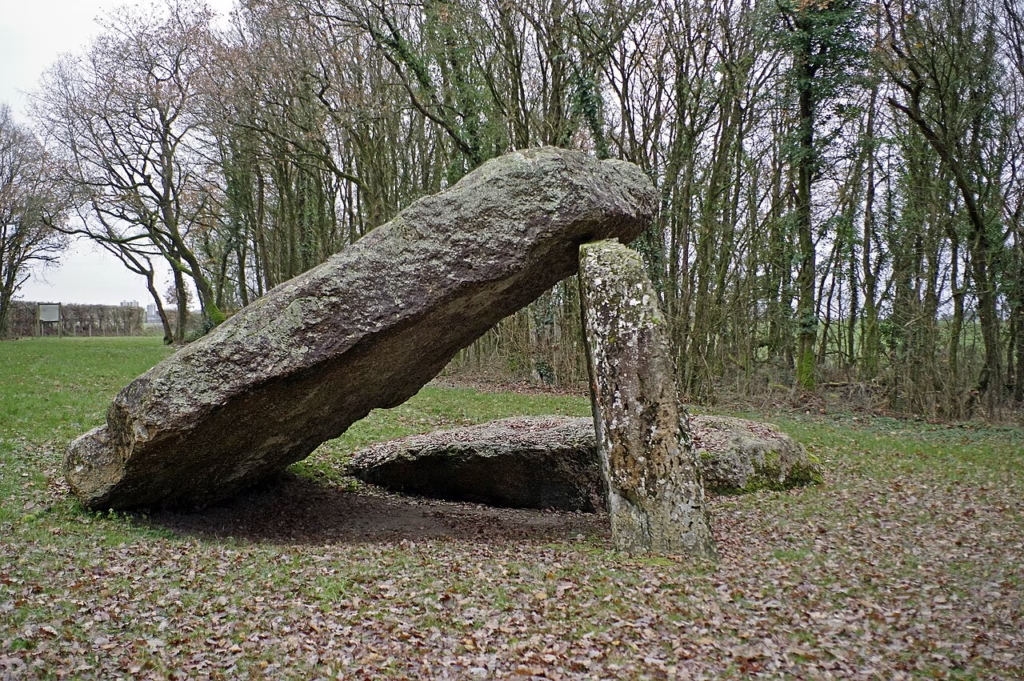
Some colossal boulders are attributed to characters who overestimated their strength or suffered a setback. A tower-shaped rock, called Pierra Metta, dominates a long ridge opposite the Grands Plans. According to Savoyard traditions, it was carried by a giant named Gargantua. Exhausted by this burden, he set it down for a moment, but found himself unable to lift it again.
Most often, it is the Devil himself who becomes the victim of his schemes. While building the Orthez Bridge, he dropped a gigantic stone near Villenave called Peyradanda. When he tried to retrieve it, a force stronger than his own prevented him. On another occasion, he had promised to carry an enormous granite rock to Saint-Léger-Vauban (Yonne) between Mass and Vespers. He hurried along, the stone on his back, but upon reaching the spot where its remnants can still be seen, he heard the vespers bells. He immediately abandoned the rock and fled.
In Saint-Martin-du-Puy (Nièvre), the Devil’s Burden consists of three granite blocks. He had brought them to close the three church doors during Mass: the largest on his head, the other two under his arms. But half a kilometer from the village, seeing the parishioners leaving, he abandoned his burden in frustration. On another occasion, while carrying stones to the top of Mont des Eguillettes (Rhône), Saint Martin mocked him, claiming they were hardly heavy. Provoked, Satan took a huge boulder from the valley and began the climb. Almost at the summit, he slipped and dropped his load.
Finally, the presence of numerous scattered puddingstone boulders in the Hoyoux Valley and on the hillsides is said to be due to a causeway the Devil had built to flood the Château de Roiseux. His work remained unfinished: the rooster, awakened by a stone thrown at the fortress gate by the Sire de Roiseux returning from a pilgrimage, crowed prematurely, forcing the Devil to abandon his undertaking.
4. Characters who are forced to abandon them or drop them
The Saint-Martin Stone, Monts des Eguillettes, Rhône
Many supernatural characters—saints, fairies, giants, or demons—carry colossal stones… but for various reasons, they are forced to abandon them along the way or let them fall. These stories explain the presence of erratic boulders and monumental rocks scattered across the landscape.
In Savoie, an erratic boulder near the Château de Boisy is said to have fallen at this exact spot during a symbolic duel. The Devil, who was jousting with Saint Martin, tried to hurl the stone at the rectory of Nernier. But a sign of the cross traced by Saint Martin paralyzed him, forcing him to drop his projectile.
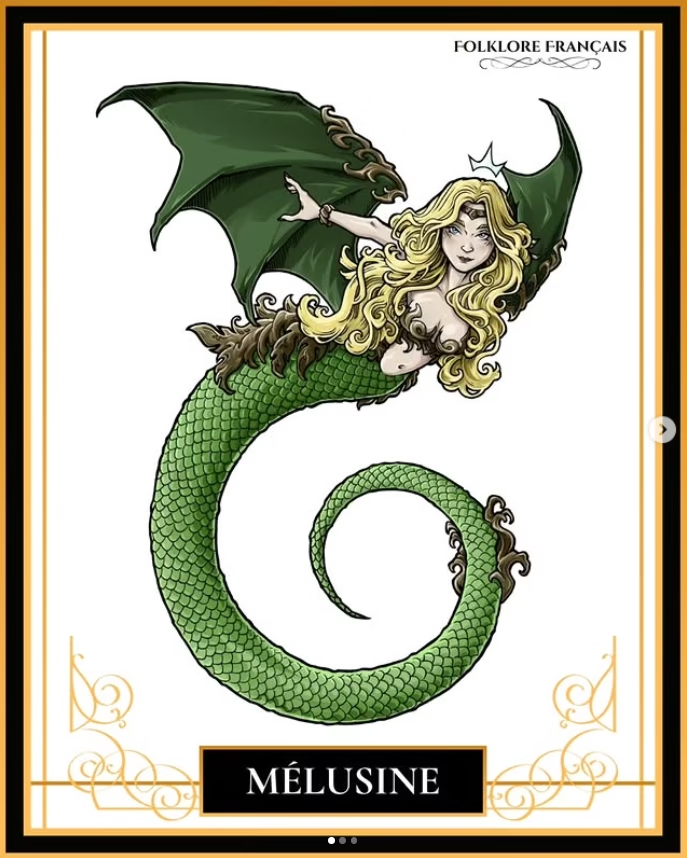
Several boulders in the vicinity of Semur (Côte-d’Or) are said to have fallen from the apron of Saint Christine, whose fastening broke. An accident that tradition considers common among fairy builders of prehistoric monuments. Similarly, Mélusine, caught by daylight, dropped the stones she was carrying for the walls of Château Salbar:
a large stone, which she carried in her dorne, fell into the Champ-Arnauld plain,
two smaller ones, held under her arms, slid a few hundred meters away.
Some remarkable rocks, notable for their size, are attributed to Christian or pagan figures. In Vauxrenard (Rhône), the Saint Martin Stone is said to have been brought by Jesus Christ on a cart drawn by two calves. In a valley near the village of Pierre-Folle in Janaillat, boulders piled over a large area are said to have been transported by the Holy Virgin. In Monterfil (Ille-et-Vilaine), the Big Rock and its neighboring stones were placed by two fairies, who carried them from afar, supporting them in their aprons. A huge granite block, now the object of a pilgrimage, was placed in the Grisière Woods by Saint Maurice, whose name it bears.
The Devil, in a rare show of gratitude, transported the rocks that were once in Léon to the territory of Plougastel, in order to aid a poor widow who had offered him hospitality. Two Basque legends recount that the Lamignac, to take revenge on the peasants, covered their fields with enormous boulders, much like Gargantua taking revenge on the Cornouaillais.
Near the Chéran River, a plain is strewn with countless small stones that the farmers have never been able to remove. They say these are the bones of a fairy, who died at the Château de Bramafan and was buried nearby, continuously turning into stone.
In several uncultivated regions, the abundance of gigantic boulders is attributed to Gargantua, who is said to have removed them from his shoes or clogs. This is how the numerous stones of the Cojou heath in Saint-Just and those of the Haut-Brambien in Pluherlin, in the French Morbihan, are explained. Other isolated boulders are said to have the same origin:
Gargantua’s Gravel, in a plain between Dourdan and Arpajon,
a very tall rock in the center of the small town of Pierrelate.
In the Jaunais Woods in Avessac, a huge mass is said to be a grain of sand removed from the shoe of the Wandering Jew. The Pierre à Morand, in Pourtoué-sur-Ayze, is said to be a limestone fragment carried on the shoulders of the giant Morand.
A few years before the mid-19th century, in Saint-Pierre-du-Champ, there was a gigantic upright slab called La tsadaïre de la Damma, said to have been brought by invisible spirits. On winter nights, when travelers lost their way and risked being swallowed by the snow, a woman dressed in white would come and sit on the slab. She sang while accompanying herself on a harp. Her voice, rising at intervals, rose above that of the Loire and carried, beyond the river, a cry of mortal despair.
5. Explaining the Color of Rocks
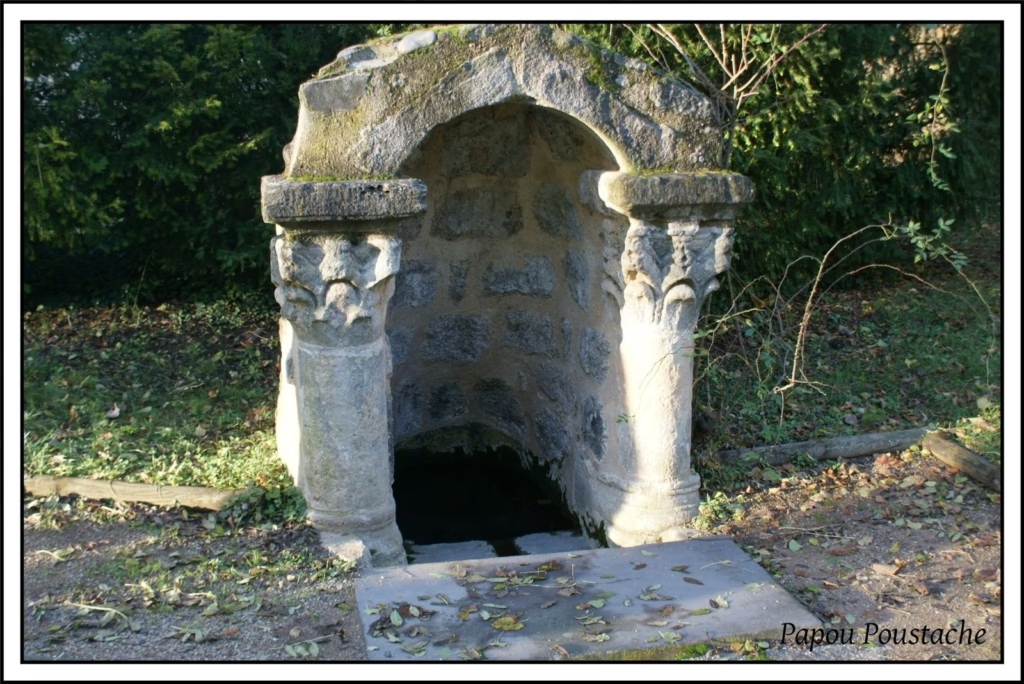
Saint-Julien Fountain, Brioude (Haute-Loire)
The unique color of rocks is never left to chance. Coastal stories often explain the particular hues of sea cliffs, while the interior regions have only a few explanatory legends, rarer but equally evocative. These tales associate the stone with sacred events, acts of saints, or divine manifestations, transforming the rock into a memory bearer.
In Brioude, red stains visible on one of the stones of a fountain are interpreted as the drops of the blood of Saint Julien. The legend recounts that he was beheaded at this spot, and that his blood permanently stained the stone. Near Moncontour de Bretagne, a white mark on a rock is attributed to a drop of the Virgin’s milk. This pale trace, contrasting with the surrounding stone, has thus become a symbol of protection and sacredness in the local tradition.
In Saint-James, a polishing stone known as the Saint Benoît Stone shows pink veins. Some peasants see in them the veins of the saint, who is said to have been petrified at this spot, leaving in the rock the imprint of his transformed body. In Touraine, one can still see the stains of Saint Martin’s blood on a stone, with precise stories of how they were formed.
While tending a farmer’s oxen near a fountain called Saint-Martin Fountain, in the commune of La Chapelle-Blanche, Saint Martin was confronted by carpenters from Ciran, who sought to pick a quarrel. The saint pursued them to their homes, but the carpenters, armed with slats, pushed him back and beat him so violently that he had to stop at the fountain to wash his wounds. The blood he spilled there is said to have permanently stained the stone.

Leave a Reply