The Legendary Winds: Witchcraft, Spirits & Ancient Rituals
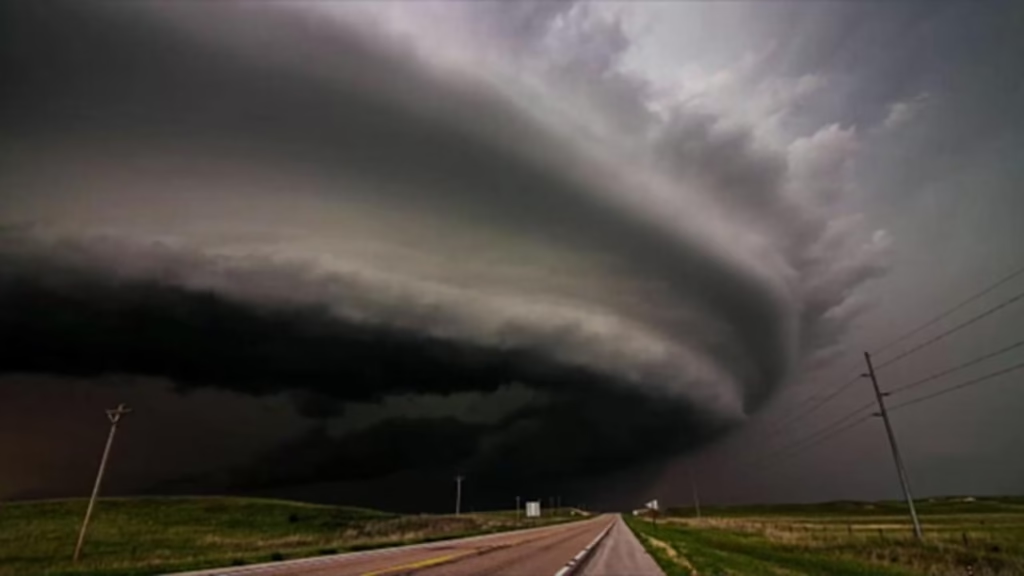
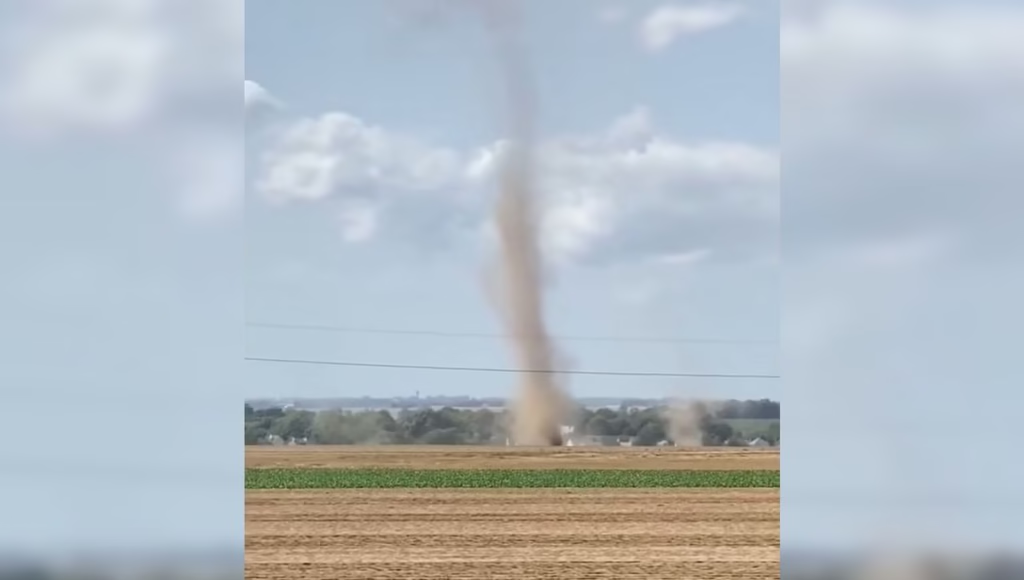
Gigantic tornado
1. Their names
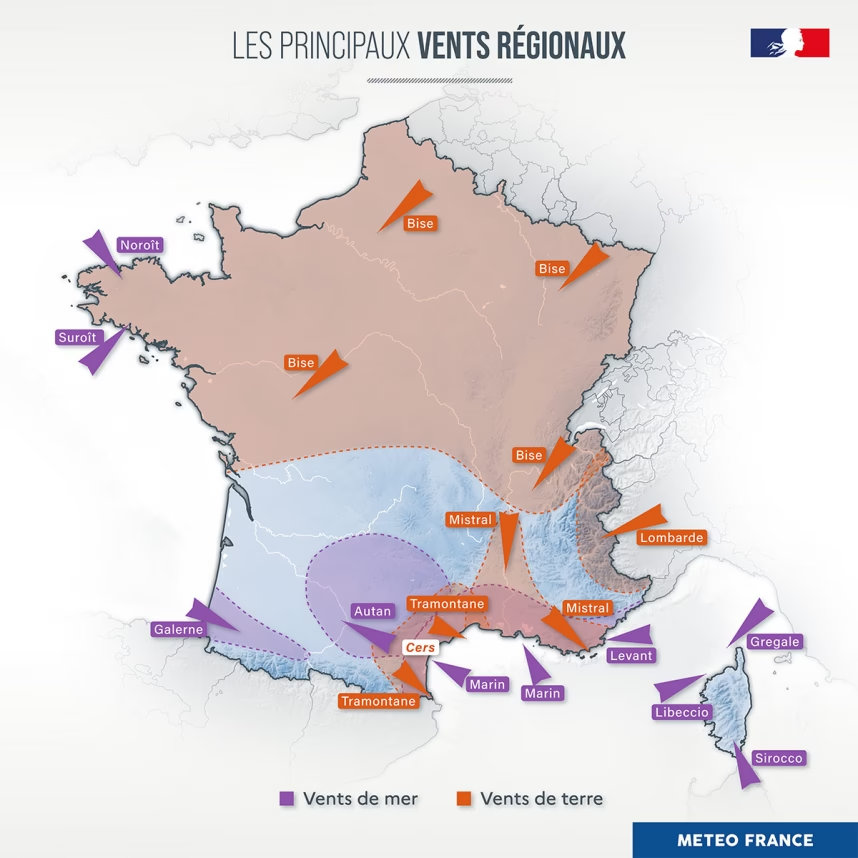
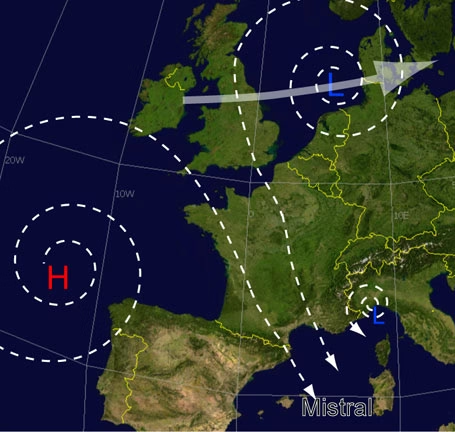
Wind map, Météo France
In many rural regions of Europe, the wind is not just an anonymous breeze. It is “someone”, with a proper name, often masculine (but not always), and a strong personality.
In Laroche (province of Liège),it is known by the name of Dj’han d’à Vin - Jean of the Wind.
In Somme-Leuze,it becomes Mister Durand Dj’han di Bîh, Jean of the North Wind.
In Corrèze, Dzan d’Auvergne (or Jean d’Auvernha) refers to the north wind.
In Forez, there is talk ofJeanna Paou, a plaintive wind that moans through chimneys in winter.
In Genève, the Lady of Lausanne blows from the north, while the Mister of Port de l'Écluse comes from Midi
The sirocco, it, takes on the ominous name of la Vaudaire – literally “the Witch” – in the Upper Rhône Valley.
In the Côtes-d’Armor, the west wind is none other than Père Banard, a robust male figure, accompanied by his partner… la Mère Banard, who is none other than the rain. A figurative way to describe these two inseparable elements of the Breton climate.
In the Poitou, when the wind blows strongly in winter, the elders say: “Dalu is outside.” Dalu is not just a gust of air: it is a full-fledged entity, also present in Berry, where it embodies frostbite, that cold that bites the fingers. Children play with it while fearing it: “Here comes Dalu.”
In Gascogne, the wind is invoked with a traditional rhyme sung during its gusts:
Bouho biso, bent d’autan ; / (Blow, breeze, southern wind,) Doubris la porto, qu’entreran ! / (Blow, breeze, southern wind, open the door, we will come in!)
Une manière poétique et collective de donner une identité à ce vent chaud venu du sud.
In Normandy, the wind becomes the famous bonhomme Hardy, a character who forces open windows and shows up unannounced. He even appears in French naturalist literature, portrayed affectionately in a novel (not named here, but likely inspired by Émile Zola or an author of his era):
“The window was open; there was a draft, and the wind, rushing down the corridor, nudged the door with gentle shakes: ‘It’s Mister Hardy,’ said the little girl. ‘Do come in, Mister Hardy, please take the trouble to enter.’ And she bowed, greeting the wind.”
2. They come from the sea
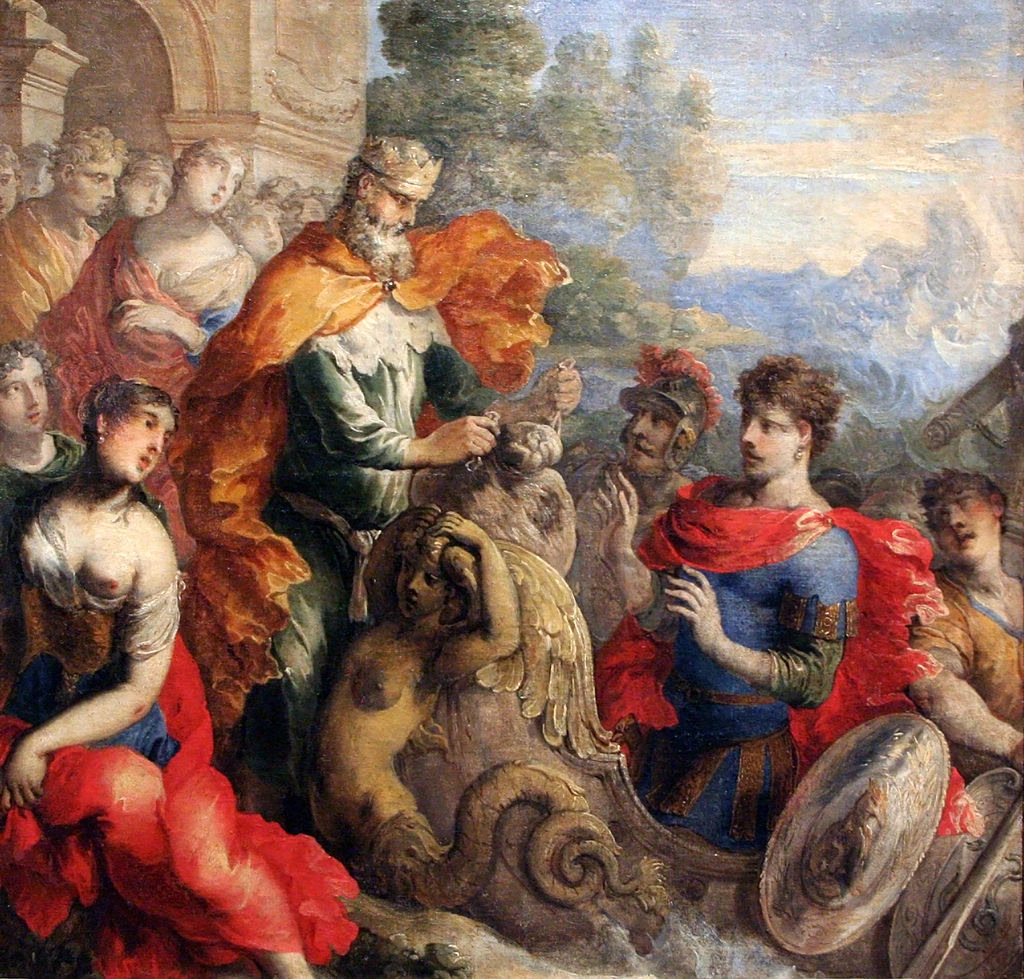
Aeolus Giving the Winds to Ulysses, painting by Isaac Moillon
In the traditional stories of the coast of Upper Brittany, the winds did not always blow as they do today. Several legends explain how they came to the sea, which was once still and breathless.
One of the most famous stories echoes Homer’s Odyssey and Aeolus’ bags of winds. It tells of a captain who, having landed in the land of the Winds, managed to trap them in tightly sealed sacks, which he then brought aboard his ship. He forbade his men to open them, but during his sleep, curiosity prevailed: a sailor untied a sack, and Surouâs (the southwest wind) violently escaped. The ship was wrecked, and the other sacks burst, releasing the seven Winds, which from that day forward blow freely over the ocean.
In another version, a shipowner, desperate to see his vessels stuck in port, makes a pact with the devil. The devil reveals that on an island live the Winds, powerful creatures capable of moving ships without oars. A captain follows the instructions, reaches the island, and invites the Winds aboard. While they feast in the cabin, the ship quietly sets sail. Furious at the trick, the Winds blow with rage on the sails, propelling the ship — and all who follow. Since then, forgetting the way back, they continue to blow relentlessly over the ocean.
Another tale features Saint Clement (of Rome), invoked as master of the seas and winds. Saved from a shipwreck by sailors, he thanks them by granting a supernatural power. He blows into the captain’s mouth to transmit mastery over the wind. Upon reaching the land of the Winds, the captain is initially repelled. But by following the saint’s instructions, he whistles strongly, and the Winds submit to his will, becoming “as gentle as sheep.” Since that day, it is said, sailors no longer need to row.
Along the coast, it is also said that the Winds are former inhabitants of the sea, who rebelled against it. Cursed for their defiance, they are condemned to blow ceaselessly until the Last Judgment. This notion of an eternal curse echoes many medieval beliefs, where natural elements become instruments of cosmic justice or penance.
Outside Brittany, traditions are no less rich. In Dauphiné, during the Middle Ages, the origin of a local wind is attributed to Saint Caesarius, bishop of Arles. According to Gervais de Tilbury, this saint, saddened by the barrenness of a valley near Nyons, went all the way to the sea to fill a glove with wind. On his return, he threw the glove against a rock, which miraculously opened to let a current of air pass through: the wind of Ponthias. This sacred breath still emerges today from this fissure, born from the saint’s gesture.
3. Residences and Gestures
Hawa Mahal, Palace of the Winds, Jaipur
According to many legends collected in Brittany (notably by François-Marie Luzel and Paul Sébillot), the Winds do not reside out on the open sea, but rather far from humankind: at the tops of mountains, in the deepest forests, or within caves hidden in inaccessible regions. This idea echoes a universal belief: in many cultures, the Winds are supernatural beings dwelling in isolated and sacred places.
The mariners of Tréguier, in Brittany, speak of a mysterious “cave of the Winds” located in the Bro an Hanter Noz (the Land of the North). But the accounts remain vague: their home is never described precisely, and it is neither an imposing castle nor a monumental cavern (Paul Sébillot, Sea Legends, vol. II). In a High-Breton tale, however, a Palace of the Winds appears. And elsewhere, a feudal castle overlooks seven rustic huts: dwellings that reflect their daily existence—humble, almost human.
In popular tales — whether they come from the English Channel, Gascony, or the Basque Country — the Winds do far more than blow. They eat with gluttony, drink until they’re drunk, play cards, and stand guard on the mountain like sentinels of the world. Their leader? The North Wind, captain of the gusts, who orders them to head toward land or sea. But sometimes, they rebel. A Gascon tale describes them wearing coats and great boots, reinforcing their image as rural giants, both unsettling and familiar.
When their work is finished — often at sunset — the Winds return home exhausted. Like ordinary day laborers, they need rest… and food. But beware: in some Breton or Basque tales, they behave like ogres. Back in their hut, if they find a man inside, they want to devour him. Popular imagination here flirts with horror, highlighting the wild, untamed power of the natural elements.
But mighty as they are, the Winds are not invincible. The Channel sailors say they are sensitive to noise and sometimes even fearful. They can be wounded, strangled, or even threatened by sailors pushed to their limits by storms. In such moments, they become conciliatory: to earn forgiveness, they offer magical talismans to their visitors — objects with wondrous powers, capable of granting any wish their owner desires.
4. In family
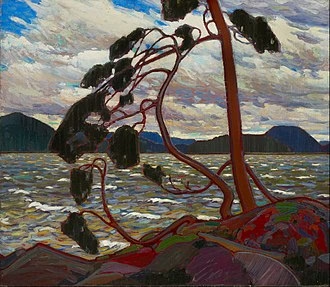
The West Wind, painting by Tom Thomson, 1917
In many tales from Upper and Lower Brittany, the Winds are bachelors, except for one notable exception: in Upper Brittany, the West Wind is married to the Rain. But in most stories, they have a mother who waits for them every evening, prepares their meals, keeps their house, and watches over their behavior. Depending on the version, she is the mother of three Winds — January, February, and March (F.-M. Luzel, Contes de Basse-Bretagne) — or more often of seven unruly sons. She lives in an isolated cabin, deep in a forest, on a mountain, or sometimes in a plain, and leads a harsh life, just like her children.
This mother of the Winds is rarely charming. She displays the signs of extreme old age: a beard, large teeth, or even a single enormous tooth. In a Breton tale, she is described as a giant; in a Basque tale, as a tiny old woman. Despite these differences, she sometimes possesses the same powerful breath as her sons, capable of unleashing the elements.
Although her sons are giants with explosive tempers, they obey her. If she grants hospitality to a human, she forbids them from eating him. And to command respect, she does not hesitate to use strong measures:
She threatens her sons with a stick; ;
She hits them with a holm oak pulled from her garden; frappe avec un ormeau arraché de son jardin ;
Or locks them in a large sack suspended from a beam, in the manner of Aeolus and his wind-filled bags
She thus embodies a benevolent yet strict authority, a parental figure capable of restraining the excesses of the natural world..
In some tales — notably in Gascony — this mysterious mother is not merely a guardian or an ogress. She also holds magical talismans, which she can offer to those who cross her path. A female inheritance, both domestic, protective, and supernatural.
The father, on the other hand, is almost entirely absent from folklore. He appears only in an enigmatic proverb:
“Old Wind goes to see his sick father and returns crying.”
A poetic evocation, suggesting that the past, like the wind, always returns laden with emotion.
5. Visits to the Winds
In several tales from the Breton coast, characters—often naïve or “simple-minded”—attempt to confront the Wind as if it were a visible enemy. Rather than climbing the fabulous mountain where the Wind resides, these popular figures:
strike the trees shaken by the breeze, believing they are reaching it.
go all the way to the edge of the cliff to attack it with blows from a stick ;
or set up feeble traps, convinced that they can capture it.
An an episode full of irony, a fisherman, seeing the wind suddenly stop blowing, even imagines that he has killed it !
A tale from the inland regions describes a peasant knocked over by a hurricane, who begins striking the air with a flexible pitchfork. With each movement, the tool makes a sound: « Zoug! zoug! » The peasant, hearing this noise, believes that the Wind is groaning in pain — evidence that popular animism still attributes human-like sensitivity to natural elements.
Paul Sébillot, a keen observer of rural beliefs, recounts a striking scene that took place in 1880: while the ships of Newfoundland remained stalled by a persistent headwind, the men expressed their frustration in a very direct way. They spat in the direction of the wind, insulted it copiously, and even brandished their knives at it, threatening to gut it. This behavior was not reserved for adults: children, imitating their elders, repeated the gestures and insults, in a true scene of collective ritualized anger against the invisible.
Another tale from inland regions gives the Wind an even stranger role. In many stories, it waits near the cathedrals, solitary, seeking a traveling companion. The latter, having entered the church to try to reconcile the canons, has never emerged since… for several centuries. Once again, the Wind is not a mere draft of air: it is a patient being, persistent, frozen in time, bound to an absurd and poetic quest.
6. Localization of winds; internal struggle
In several regional traditions, it is believed that the Winds engage in an annual struggle to determine who will rule over the entire year. This belief, strongly rooted in Eastern France, is precise about the date of the battle: In Franche-Comté, the contest takes place on January 25 at midnight; in the Walloon country, it happens on December 31 or around January 25, at the Crossroads of the Four Paths: the Wind that blows at midnight wins; in the Marne, the battle begins on the Feast of the Conversion of Saint Paul and ends only on Saint Blaise’s Day (February 3). The one that blows on that day is the winner. These mythical battles are meant to explain the seasonal dominance of certain winds.
Some legends explain why a wind blows only a little, or on the contrary, why it is so violent. In Gerzat (Puy-de-Dôme), it is said that the East Wind never blows for more than three hours in a row, and even then only very rarely. Why? Because it was the one blowing when Jesus was on the cross. Christ, thirsty, asked it for a little water. But the Wind refused. So Jesus cursed it:
“You shall blow from now on only rarely and briefly.”
In Saint-Cast (Côtes-d’Armor), the Sweden Wind (South-East), known for its destructive force, is said to have become furious ever since a woman showed it her buttocks in the middle of a gale. An act perceived as an insult, which would explain its recurring devastation.
In other tales, particularly in Brittany, the Winds are used as instruments by demonic forces:
In the Côtes-d’Armor, a violent whirlwind means that the demon is carrying someone away. If the person resists, the devil causes enormous destruction along its path.
In Poitou, it is said that Satan hides in the wind whirlwinds that lift the hay. He leaves only after uprooting one or several trees.
In Léon, every hurricane is a sign that the devil has come to claim a lost soul.
Near Dinan, if a storm breaks out during Carnival, it means that the devils are fighting among themselves. They uproot trees with their forked feet until God intervenes to silence them.
Around Fougères, a violent wind means that a hanging or drowning has occurred nearby: the demon comes to claim the deceased victim.
Finally, in Upper Brittany, it is said: “When the winds rage, the damned are happy, because all the devils are outside.”
In the most widespread beliefs, the Winds are no longer autonomous entities, but forces tamed by supernatural beings: devils, fairies, elves, magicians. These beings are capable of:
stirring up the winds,
calming them,
sending them wherever they wish.
This vision marks a transition between animist mythology and magical folklore, where the supernatural holds the reins of nature.
7. Wind-guiding spirits
In Lower Brittany, an old belief holds that the priest has the power to release condemned souls, called the conjured — those who died without absolution. During purification rituals, the priest opens a window and commands the spirits to leave the house; immediately, they soar away like a furious wind, carrying with them plaintive voices, which the living mistake for thunder. It is not a meteorological storm: it is the farewell cry of the tormented souls, expelled toward the unknown.
In Léon, people fear these sudden gusts of wind, said to be caused by the whirlwinds of the damned. These infernal souls, furious at their fate, are believed to torment the living out of sheer vengeance. When they appear, one must immediately throw oneself face down on the ground, otherwise these winds can envelop you, daze you, and carry you away with them to hell. This protective reflex, passed down from generation to generation, reflects a very ancient fear: that of being torn from the land of the living.
In Albret, the wind’s breath can also be quieter, yet just as tragic. It is believed that sudden gusts of wind are caused by the souls of children who died unbaptized. These beings, deprived of a Christian burial, wander the world in the form of unpredictable blasts. Sometimes, their passage leaves stains of blood on laundry left out to dry — a sign of their lingering pain.
Beware of anyone who tries to stop them: a mocker who had fun blocking their path saw a ghostly young man appear in the whirlwind, saying to him: “Why do you stop me?” He fell ill and then died within the year.
8. Whirlwinds and spirits
In popular imagination, the wind is never alone. With every sudden gust, with every whirlwind that sends dust flying or bends the trees, something — or someone — passes. It is not just a force of nature; it is an invisible procession of fairy or demonic beings, sometimes mischievous, sometimes fearsome.
In Beauce, the sprites sometimes take the form of capricious whirlwinds that ravage the harvests. They are said to delight in knocking over sheaves, stirring up dust, or frightening horses. In Upper Brittany, a mischievous elf slips into the meadow whirlwinds, invisible yet playful. In the Forez, peasants call the dust clouds lifted by the wind along the paths foullet (or follet). This word refers both to the phenomenon and the being inhabiting it. In Lower Brittany, a rarer belief holds that these whirlwinds contain a group of fairiesmoving their dwelling, carried by the wind like passengers of the ether.
In Guernsey, it is none other than Héroguias, the queen of witches, who leads the summer whirlwinds. In even stronger winds, there is talk of a hidden sorcerer inside — as if the breath had a will of its own, malevolent or vengeful. Around Saint-Brieuc, when a large whirlwind rises, the elders exclaim: “Here come the werewolves!” Once again, the wind is inhabited, charged with a hybrid and unsettling power.
But the most terrifying of these wind beings are undoubtedly the dragons. In the Trégor and Finistère, sailors fear these air serpents, these whirlwinds called “wind dragons”, which slither over the sea, sweeping everything in their path. Their tails drag along the water, and everything they touch is engulfed, sucked in, gone. A man brushed by such a whirlwind is seized and thrown into the sea, never to be seen again. An unlucky ship is carried under, unless it has been baptized — for a vessel without blessing has no chance of survival. Some even say that these wind dragons can swallow an entire ship, as easily as a man swallows an egg.
9. Oaths and forbidden acts
Origin of the Mistral
In the ports of Provence, sailors do not hesitate to swear by the Wind, as if to seal their word with a vow stronger than the foam. One can still hear: “May all the mistrals strangle me!” (The Ship’s Cat, Ernest Capendu.)
The Mistral, a typical north wind of the region, both feared and familiar, becomes an invisible interlocutor to whom people submit — or whom they challenge. This popular expression reflects an ambiguous relationship, almost intimate, between humans and the wind that shapes their daily lives.
In Lower Brittany, when the wind ravages crops or disrupts sowing, farmers do not hesitate to curse it openly. It is said that they “give it to the gust” — in other words, they wish for its own undoing or destruction, as if it were a being to punish. This type of expression is typical of agricultural regions where the wind is both indispensable and devastating: a capricious partner, whom people try to appease… or insult.
A widely held superstition in Upper Brittany and Saintonge attributes to the Wind a very tangible influence… on faces! It is said that:
“If you make a grimace or yawn while the wind is shifting, your mouth will stay that way!”
This saying, well known to both children and elders, combines magical caution with disguised rural common sense. It warns against invisible changes, the pivotal moments when the Wind, shifting, could leave a lasting mark — even on faces.
10. Omens
In Mons, it is said that a particular whistling of the wind in a lit fireplace foretells… imminent news: “If the wind whistles in a certain way in a fireplace with a fire, we will receive news during the day.” But in Hainaut, the same phenomenon inspires a very different fear. As Alfred Harou notes, when the wind blows in the fireplace, it means the devil has made it his home. Thus, the same sign can be perceived either as a promise or as a threat, depending on local tradition.
In the 15th century, strong winds were seen as bearers of ill omens. In the countryside and along the English Channel coasts, people believed that: “When the wind blew strongly, it was a sign of betrayal or, at the very least, bad news.” This type of interpretation, between political fear and basic superstition, shows how the wind could be a messenger beyond mere weather.
11. Human power over them
Certain luminous or colored phenomena, such as the aurora borealis, rainbows, St. Elmo’s fire, or lightning, are considered beyond human reach. They appear only by the will of superior beings, sometimes deities, sometimes unidentified powers, but always beyond the world of the living. Similarly, lightning, though imposing and feared, is perceived as controlled by these invisible powers. Humans are never its master, but they can sometimes sense or redirect its anger.
While lightning escapes all control, the same is not true for other elements. In many regions, it is believed that certain men have the power to summon rain or even hail, especially during storms. “The people believe that some men, through practices or conjurations, can exert real power over the weather.” Mist can be caused, though this is rarer. Snow, on the other hand, remains an untamable phenomenon — it comes without any mortal being able to call it forth.
The winds and storms are perhaps the meteorological phenomena over which human intervention seemed most plausible to the ancients. A large number of ritual gestures, formulas, or maneuvers — sometimes magical, sometimes purely symbolic — were believed to make them blow or calm them. Notably, these practices were not always reserved for sorcerers or magicians. They could be performed by peasants, sailors, or travelers, to call the wind, divert a storm, or chase away a threatening tempest.
12. Stirred up or calmed winds
Priestesses of the Île-de-Sein
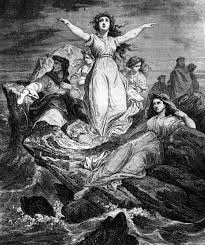
Since Antiquity, texts report that the priestesses of Sena, on the Île de Sein, were capable of unleashing winds and storms by enchantment. Similarly, the fairies of the Rance were said to possess this mysterious power. In sailors’ tales, this idea appears in various forms: a fairy-witch grants a cabin boy the ability to choose the direction of the wind, while Saint Clement himself bestows this gift on a captain.
The devil also appears as master of the winds. In several tales, he boards ships disguised as an ordinary sailor, providing the crew with favorable wind throughout the voyage. A bargain that, very often, comes at a price…
The idea that an object could command the wind is also widespread. In Lower Brittany and Saintonge, sorcerers were reputed to manipulate the winds, although the methods were rarely described. A 17th-century account mentions a sorcerer-shepherd from Brie who, by spinning a stone on the bridge with his foot, could summon a breeze. In the past, knotted ropes, sold by witches in northern countries, allowed one to release the wind knot by knot: the first for a breeze, the second for the wind, the third for a storm. This tradition, now disappeared from France, survives in another form: sailors of the English Channel sometimes accuse the priest of Cancale of possessing the rope to turn the wind. In Wallonia, it is said that a priest can divert the wind by pointing the tip of his tricorne in the right direction.
In Beauce, it is said that children are sent to fetch the wind rope, a way of embedding this myth into childhood games. According to Amand Joseph Dagnet(1899) and Félix Chapiseau (1903), this legend was still very much alive at the beginning of the 20th century.
Faced with calm seas, sailors developed a repertoire of gestures and words to bring back the breeze: In Trégor, it is believed that Saint Anthony, patron of the wind, is either asleep or angry. To wake him? Sailors whistle at the top of their lungs or insult him. In Upper Brittany, Saint Clement is invoked to make the wind turn… but he is cursed if he does not grant the prayer. The privateers of the Pays de Caux even plunged a statuette ofSaint Anthony into the sea while reciting a not-so-pious prayer.
Whistling to call the wind is a worldwide tradition, even more widespread than shouting. The Newfoundland sailors used to gather on deck to pronounce aloud the name of the desired wind. Some Channel captains even fired bullets at the clouds to compel the skies to blow.
Even more surprisingly: until the 17th century, on state ships, cabin boys were whipped to break the calm. This brutal ritual did not disappear entirely: in Saint-Malo, it persists on board ships, with cabin boys whipping each other while shouting the name of the wind. On Trégorrois fishing boats, the ritual took place at the bow, with the same fervor.
On the Normandy coasts, sailors’ wives burn new brooms to hasten the return of their husbands. In Ille-et-Vilaine, a broom is stolen, burned, and the ashes are thrown to the wind so that it blows in their favor. And when the wind becomes too violent? Sailors sing in chorus, hoping to appeaseSaint Anthony.
A colorful anecdote from the Côtes-du-Nord tells of a woman, exasperated by Nordée, the north-east wind, who ended up showing it her backside. The wind, struck with shame, immediately stopped blowing.
13. Conjurations of whirlwinds and winds
Field whirlwind near Caen
In several European countries, wind whirlwinds that lift sheaves of wheat or bundles of hay are interpreted as the passage of a spirit, often mischievous. Faced with them, workers resort to ancient formulas:
In Geneva (1635), when a “foulet in a whirlwind” strikes the harvests, the reapers lay down their sickles, throw themselves to the ground, and shout: “Bo, Bo, Ponti, Ponti.” In Franche-Comté, the reapers sing: Air des moissons, fourre-toi sous mon cotillon. In the Auxois, when the whistle of a “follet” is heard disturbing the haystacks, they shout: “Stop it!” In Yonne, a cross is drawn with handfuls of wheat, held high while saying: “Esterbeau, estourbillon malin, je te conjure, comme Judas conjurait Jésus le jour du vendredi saint.” In the Bagnères valley, a simple insult suffices: “Cu-pelat! cul pelé!”
In several regions, the devil himself is associated with sudden whirlwinds: In Lower Languedoc, he hides at the center of the whirlwind. To make him appear, a shot must be fired into the eye of the whirlwind. To drive him away: “Turn away, devil!” In Upper Brittany, to combat him, one throws a pitchfork or pointed object into the center of the gust. One account even reports that after striking a whirlwind in this way, a voice emerged: “Thank you, you have freed me.” Another young girl, having thrown her knife, saw the cloud immediately dissipate. The knife vanished… but she later found it in the hands of a washerwoman — the same one the devil was carrying off.
In certain regions, such as Lower Brittany, whirlwinds are accused of carrying off women sold to the spirit of evil, condemning them to wander endlessly in the world. They can be freed by throwing a curved blade or knife into the center. On the Tréguier coast, whirlwinds are called dragons, and they are formed by sorcerers or the devil himself. If one draws a cross on the ground beneath their path, or slashes them with a scythe, one may see fall: a claw, a horn, or a part of the devil’s body.
In Berry, reapers call the gusts of wind… “priests’ servants”. In some cantons of the Cher, they are even called “whores”. To protect the sheaves, the first two cut sheaves of wheat are placed at the head of the furrow. In Finistère, a talisman is kept in an oak chest: two tightly bound twin apples, to which a series of ritual formulas two pages long are addressed!
« Quant aucune tempeste levera en l’air, vous devez tantost faire du feu de quatre bastons de chesne en croix au-dessus du vent, et lui faire une croix dessus ; tantost la tempeste se tournera de costé et ne touchera à voz biens. » “When a storm rises in the air, you must immediately make a fire of four oak sticks in a cross above the wind, and place a cross upon it; then the storm will turn aside and will not touch your belongings.”
In the Loiret, children have their own way of warding off strong gusts. They recite in chorus:
Stabat mater, Derrière saint Pierre Il y a une femme Qui n’a qu’une dent Quand il fait vent.
"Stabat mater, Behind Saint Peter There is a woman Who has only one tooth When the wind blows."

Leave a Reply