The Sky of France: from the Fabulous Realm to the Enchanted Clouds
1. What is the sky ?
Magical Birds Flying All the Way to Paradise
The sky is seen as a solid, infinite vault, made of some mysterious substance. Its blue color is associated with time itself: people once said that the sky is “time,” temporality made visible.
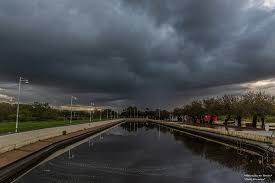
A particular weather phenomenon draws the attention of country folk: when a patch of sunlight breaks through a thick blanket of clouds, revealing a fragment of blue sky, they say one is catching sight of the “old sky”. A poetic expression—like a tear in modernity—that lets an earlier world show through.
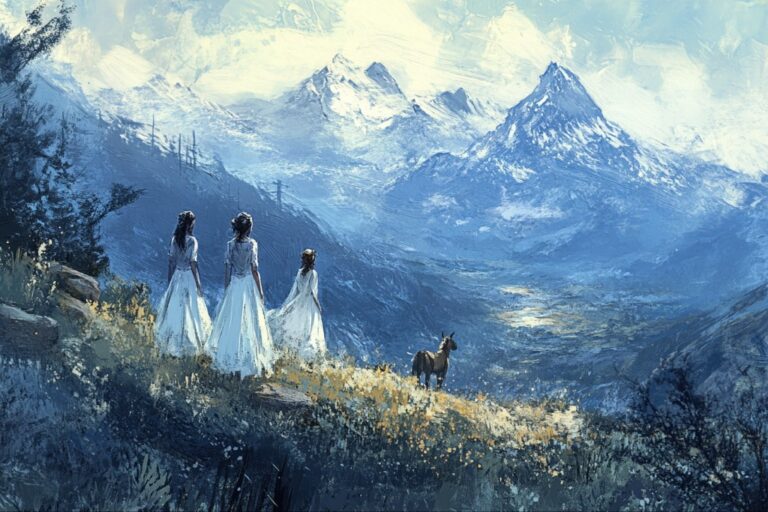
On the coast of Finistère, people traditionally believe that the sky contains real landscapes: mountains, valleys, meadows, forests… In Breton, the word glaz refers to both the green of the meadows and the blue of the sky — as if they were simply two faces of the same suspended world.
In Upper Brittany, some say that the blue sky contains an invisible liquid, held in suspension by atmospheric pressure. The stars would float there like boats, on this celestial sea whose equilibrium depends on nothing more than a breath. A cosmic vision filled with poetry and wonder.
In Vendée, the elders used to say that legendary birds knew the path to that upper sea. Passed down from father to son, this belief evokes a time when the boundaries between sky and earth seemed porous, reachable only to certain initiated creatures.
Finally, the mariners of Tréguier claimed that the sea once bathed the firmament. This primordial contact was said to have ended after the biblical Creation, allowing the sky to rise, abandoned by the waters. A powerful local cosmology, in which the separation of the elements remains etched in collective memory.
2. Substance of the Clouds
City on an Aerial Island
In popular imagination, clouds are not mere condensations of water vapor, but mysterious entities, rich in symbols and magical functions. From Brittany to the English Channel, and in medieval writings, they are described as aerial islands, invisible realms, or supports for celestial navigation. Here is an overview of the traditions and stories that elevate clouds far beyond mere weather.
Unlike the modern idea of clouds as diffuse mist, rural traditions describe them as agglomerations of undefined elements, solid or nearly so, capable of carrying beings and objects. They form aerial islands in which genies, magicians, or sometimes even captive princesses reside. These entities hide within them, move through them, or use them to carry out their mischief.
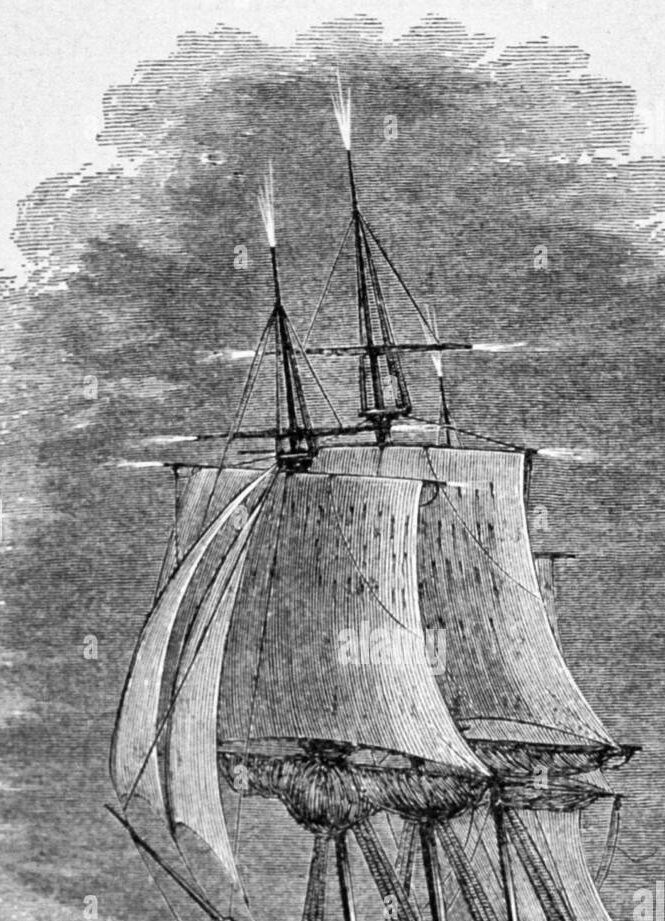
The most famous belief associated with clouds comes from the Traité de Grandine, written in the 9th century by Agobard, Archbishop of Lyon. In it, he denounces the superstitions of his time but accurately records the belief that flying ships emerge from the clouds, particularly during storms. These vessels were said to collect grain destroyed by hail and carry it to a distant land: the fabulous realm of Magonia.
This strange idea finds an echo in the account of Gervais of Tilbury (1152–1223), an English cleric and knight. In his work, he recounts that an anchor once fell from the sky in England, its chain disappearing into the dark clouds. The sky, once again, is conceived as a <strong<navigable space, a suspended parallel universe.
A maritime tale from the English Channel tells of a captain besieged by pirates. Through a magical prayer, he makes appear a rope fallen from a cloud inhabited by a genie. The sailors attach the rope to the main mast, and the ship rises into the air, carried by the cloud to a safe harbor. The vessel is then gently set down, “without a jolt,” near the docks.
Sailors also speak of wondrous castles suspended in the clouds, held by golden chains, between sky and earth. These celestial dwellings, inhabited by captive princesses, appear as a blend of mirage, dream, and Arthurian legend.
In a similar version, imps aboard a ship unfurl an enchanted ladder up to a cloud. There, they set up a pulley, run a cable, and lift the ship to move it away from its enemies. A scene that blends supernatural engineering with aerial strategy.
Across all these traditions, the sky is conceived as a gigantic inverted bell, whose base brushes the Earth, while its apex rises to the firmament. It thus becomes the stage for fantastical interactions, where the laws of gravity are suspended, and the heavens take on the appearance of fairy realms.
3. Heaven and Hell
Gates of Heaven
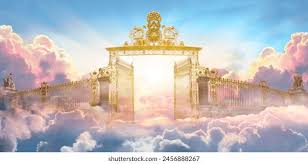
In European popular traditions, the sky is not merely a celestial backdrop: it is a gateway to the beyond, a structured spiritual space, populated with powerful symbols and heavenly figures. Beyond the clear blue of the celestial vault, heaven lies hidden, where the Trinity, angels, and the elect souls reside.
According to these beliefs, to reach Heaven, souls must pass through three layers of clouds:
the black clouds (often associated with doubt or trial),
the gray clouds (a transitional zone),
the white clouds (the gateway to the divine).
This symbolic structure evokes a progressive spiritual ascent, marking the passage from shadow to light.
The heavenly realm is not cut off from the world of the living. There are said to be viewpoints, “windows,” from which the elect can watch the living. Charles Deulin, in Les Contes du roi Cambrinus, describes these openings between the clouds as “judas,” similar to those in ancient doors. From up there, God, seated on his golden throne, watches over humanity.
In Le Chemin le plus court by Alphonse Karr, a novelist influenced by the maritime tales of Étretat, the blue points visible in stormy weather are said to be precisely these windows through which the prayers of the faithful rise, and through which God watches over the Earth. In Franche-Comté and Normandy, it is said that lightning, by tearing the clouds apart, reveals a fragment of Heaven, as if a breach in the celestial vault offered a fleeting access to the other world.
In several regions—particularly the Val de Saire, Lower Normandy, and Ille-et-Vilaine—popular cosmology places Heaven, Purgatory, and even Hell in the celestial heights. The sky thus becomes a complete space, a centralized realm of the afterworlds.
But the sky is not exclusively divine. Some legends claim that the Devil himself prowls there, capturing the souls of criminals to take them to a suspended Hell. He grabs them by the hair, it is said, tearing them from the world of the living to cast them into celestial flames. A rural legend tells of a farmer who wanted to obtain a receipt from his deceased lord: he placed his foot on the Devil’s, and was transported to the heights. There, in an infernal chamber, the demon showed him, through a half-open door, his lord burning in the eternal flames.
4. Clouds and Apparitions in the Air
Clouds of the “Way of Saint-Jacques (St. James)”
Clouds are not merely formations of vapor in the sky. In popular traditions, they are sometimes seen as mysterious entities, capable of hiding supernatural beings or revealing messages from the heavens. Their shape or hue is often the subject of ancestral interpretations passed down through generations.
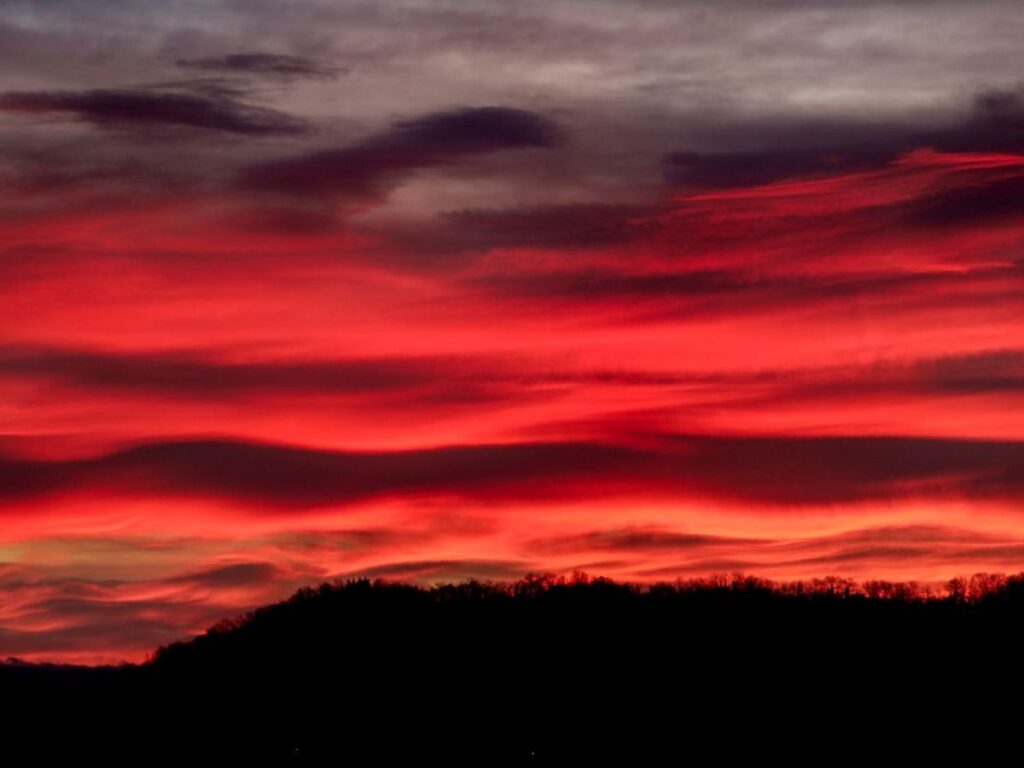
In the French part of the Côtes-d’Armor, a celestial phenomenon is known as the “Way of Saint James.” These are mysterious red spots that can sometimes be seen in the sky, whose origin is linked to an ancient legend.
Long ago, a wealthy woman asked her three sons to undertake a pilgrimage to Santiago de Compostela after her death. The two older brothers, jealous of their youngest sibling favored in the will, stabbed him, tied a stone around his neck, and threw him into a river. But when they arrived at the sanctuary, they were astonished to find their brother kneeling before the altar, his wounds still bleeding.
After receiving forgiveness, the brother mysteriously disappeared. The two murderers, overwhelmed with remorse, dipped their fingers into the blood remaining on the altar. When they shook their hands, the blood rose into the sky, forming red spots visible above Brittany. These celestial marks are said to reappear whenever a heinous crime is committed somewhere in the world.
In Wallonia, the glowing clouds are associated with the preparations of Saint Nicholas, the patron saint of children. In Pépinster, they say in Walloon:
« S’è sin Nikolè ki kù » (« C’est saint Nicolas qui cuit »). (“It’s Saint Nicholas who is cooking”)
In Liège, it is said that the saint lights his oven to bake the pastries meant for children on his feast day. In Seraing, he bakes large dough figures for them. Thus, the red hues of the evening clouds are seen as a fortunate omen, heralding the arrival of these treats.
On the English Channel, sailors observe a very particular celestial phenomenon. When a white cloud, flanked by two darker clouds resembling small embankments, appears on the horizon, they also call it the Way of Saint James.
According to belief, it is along this path that the holy pilgrim would have ascended to heaven. This sign brings good fortune to those who take to the sea, as the saying goes:
“The Way of Saint James brings good luck To all sailors.”
Sailors watch for this sign with hope, as it is seen as an omen of calm seas and a smooth voyage.
5. Legendary Names of Clouds
In Fourmies in the Nord region, children call the small fluffy clouds “angels”, though the true origin of the name is unknown. A similar belief exists in Albret, where a small white cloud seen in front of the sun is nicknamed “the angel of Videau-des-Bourns”. According to legend, this angel searches for a cruel miser who disappeared into a bog.
Clouds "angels"
In many regions, cloud formations are compared to trees. In Hesbaye, they speak of the Tree of Abraham; in Condroz, of the Saint Barnabas Tree: a fan of clouds with blurred edges. When this tree appears to “have its feet in the water” (pointing toward a river or stream), rain is foretold.
The Blois region knows the Abrecâbre, a cluster of light, tree-shaped clouds that promises the continuation of fair weather.
In the East, in Burgundy and the Ardennes, these large celestial branches are called the Tree of the Maccabees or Poéri Machabé, and also Poirier des Macchabées in the Metz region.
In the Vosges, the mountain folk speak of the méquébé, a cloud resembling a gigantic fern branch.
In Anjou, large clouds shaped like oaks are called the Oak of Montsabran and herald storms and tempests. Conversely, the Sea Oak, an inverted version, foretells fair weather.
Clouds are sometimes associated with defensive structures: around Valenciennes, storm-signaling clouds are called Fleurs d’oradge. On the island of Sein, a stationary white cloud visible above the Baie des Trépassés is named Boquet Yan gô or Bouquet de Jean le Vieux. On the coasts of the English Channel, sailors call large, threatening black clouds Castles. In Provence, these clouds take the names of defenses (emparo), ramparts (bérri), turrets (tourello), dungeons (tourrougat), and finally castles (castèu) when the sky bursts into storms.
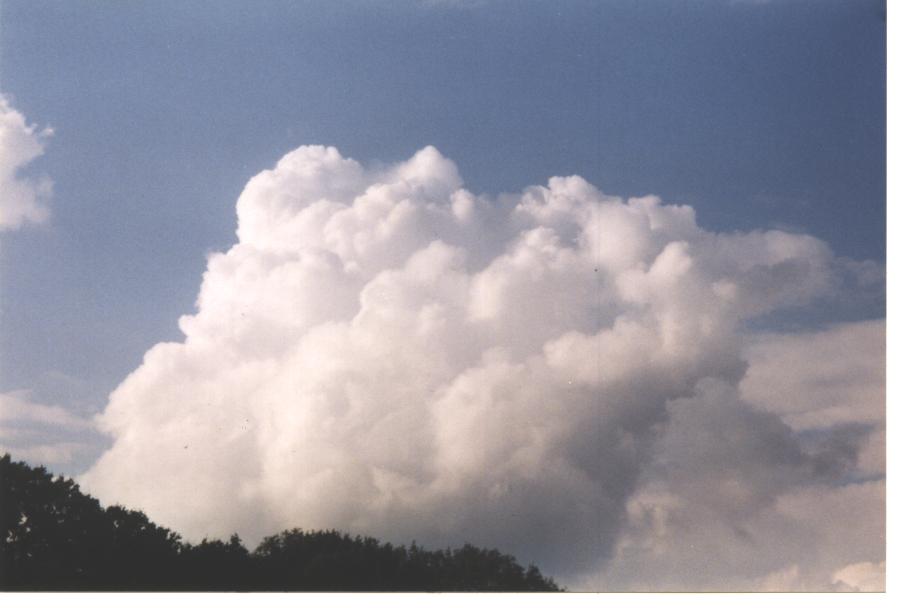
In the Lauragais (Haute-Garonne), massive cumulus clouds are called Rocs. They are categorized as follows:
The Roc de Saint-Estapi reference to Dourgne in the Tarn),
The Roc de Saint-Ferréol or Barboblanc (white beard)
The Roc de Fouis (Foix),
The Roc del Canigou, connected to the famous Pyrenean massif.
Clouds "Roc"
On the coast of Tréguier, in fair weather, clouds called Berniotrez or “piles of sand” can be observed. In Anjou, the huge black clouds carrying hail in spring are nicknamed la Nuée de Navarre, a name perhaps linked to memories of Navarrese incursions in the Middle Ages. Fishermen of the English Channel sometimes say that “the fish are moving house” when clouds cover the sky—a figurative way of announcing a sudden change in the weather.
Clouds "Navarre"
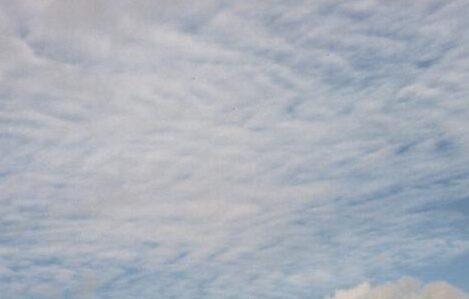
Cirrus clouds are often associated with flocks of sheep. Sailors on the English Channel say that “the sheep go up to the sheepfold” when they see these clouds rising. Feather-shaped clouds that signal wind are called Cat’s Whiskers.
In the Lauragais, cirrus clouds evoke bird feathers or spider webs. In Provence, small white clouds are called li Telo d’iragno (the spider webs), and when the mistral blows, they are called li Balo de lano (the balls of wool) that seem to race across the sky. This latter name is also used in Haute-Bretagne.
Clouds "Li Bano de lano"
At Île de Batz, the yellow-red circular clouds that foreshadow bad weather are called Lagadou touill, or fruit bat eyes (sea dogs).
Clouds "Roussettes"
6. Personifications of Clouds
In Provence, several strange and threatening clouds are personified, especially those that foretell bad weather:
The Laundry Wowan (la Bugadiero) : This cloud appears around Mont Ventoux. It is imagined crouching at the summit, twisting an immense laundry of rain that pours down in torrential showers. An image both poetic and terrifying.
The Accablé (MatablatFeared by the harvesters, this cloud symbolizes the end of fair weather and the threat of a storm.
The Galagu : Literal translation: the glutton, the hog. In Provençal mythology, Galagu is a sort of celestial Gargantua capable of straddling the Rhône and drinking from it with his hands. This name was given to gigantic clouds with a fantastic appearance.
In the Lauragais, some cumulus clouds are humorously nicknamed: Vudo-coujos (“pumpkin-emptier”), or Jardinié: names likely linked to the damage these clouds cause to crops.
In Poitou, popular belief holds that clouds “go fetch water from the sea with buckets,” a figurative way of explaining how rain forms.
On the coast of the Hague, children are shown the bouenhoumards—little figures formed by the cumulus clouds that, in local imagination, gather the rain to pour it more effectively onto the land.
In Vendée, it is the Bête faramine that serves as a scarecrow: parents point out to children the twisted shapes of storm clouds, presenting them as the head or body of this monster sent to punish little ones who misbehave.
Finally, in Hainaut, a proverb illustrates this personification of threatening skies:
« Temps couvert, Diable en l’air. » “Overcast weather, Devil in the air.”
When the sky darkens, it is as if the devil himself takes possession of the clouds.
7. Names in the tales
Cormorant
In several popular tales, clouds are depicted as malevolent entities that unleash storms and tempests. Yet the heroes often find ways to get rid of them.
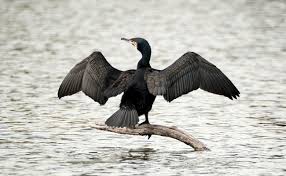
In a Basque legend, Mahistruba, caught in the midst of a terrible storm, sees a large black bird appear in the sky. He calls upon the best marksman of his crew, who shoots down the bird with a single shot. At that moment, the storm ceases. The bird, likely connected to the threatening clouds, embodies the evil that must be defeated to restore calm. Another version recounts that sailors even aimed at a gigantic cloud crossing the sky in an attempt to stop the bad weather.
Later, in more modern tales, some sailors took unusual measures to ward off storms. A captain would blow his horn to drive away the large black clouds called “the Castles”. Others went so far as to shoot at these storm clouds as if they were visible enemies.
Gaps of blue in a gray sky have also inspired sayings full of poetry or popular humor: in Wallonia, after a storm, people watch for the return of good weather with this charming expression:
"As soon as one sees enough blue to make a cloak for the Virgin Mary and stockings for the Baby Jesus, the storm has passed."
In Brittany, the view is more down-to-earth:
"The blue must be as big as a policeman’s breeches" or, along the coast: "…as big as a customs officer’s."
Here, the appearance of a small patch of clear sky is enough to reassure: the worst is over.
8. Appearances in the Clouds
Icon of Saint Ronan
In Lower Brittany, an old belief holds that one can see the shadows of the deceased appear in the clouds. The famous researcher Jacques Boucher de Perthes mentioned this phenomenon in the early 19th century. In 1823, upon the death of the bishop of Quimper, the peasants of the Monts d’Arrée claimed to have seen him wandering for several days among the clouds. Gathered in small groups, they would scan the sky, shouting at each supposed sighting of the deceased.
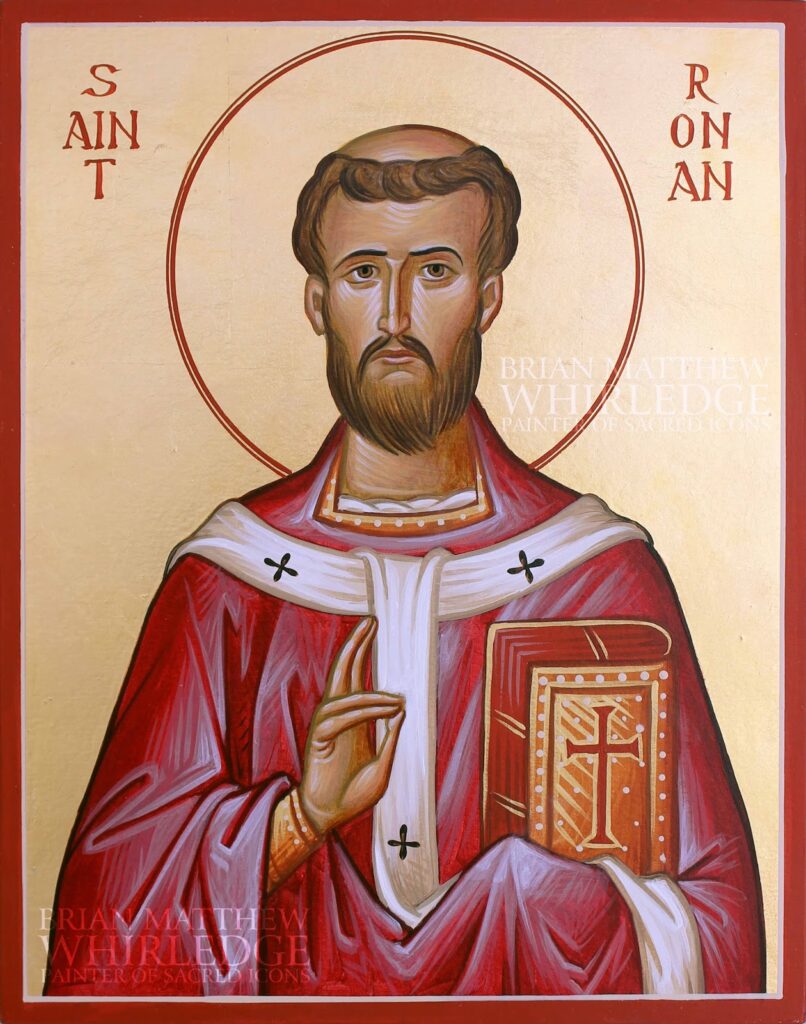
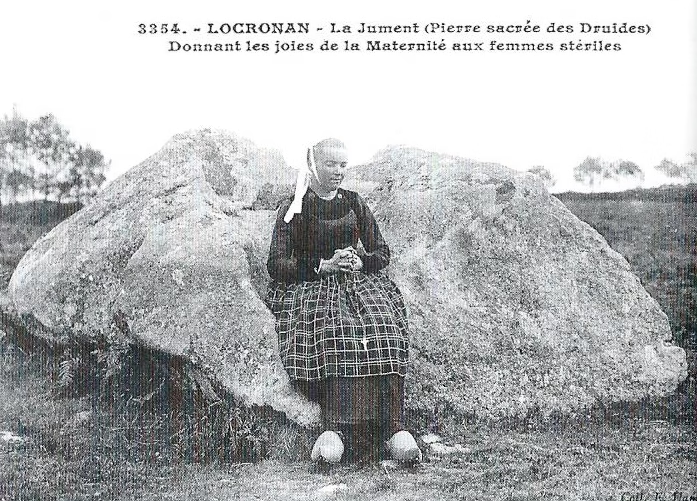
Still in Brittany, a persistent legend surrounds the great procession of Locronan. When bad weather prevents the sacred parade from taking place, mysterious bells begin to ring in the sky, and a spectral procession forms among the clouds. These are the souls of the dead, continuing the ceremony regardless, led by Saint Ronan himself, recognizable by his iron bell.
In the Norman Bocage, an old belief holds that, on the eve of major social upheavals, one can see ghostly riders in the sky, riding horses with wild manes and engaging in furious battles above blood-red or livid clouds. It is said that the revolutions of 1789, 1830, 1848, as well as the great wars, were preceded by such terrifying visions.
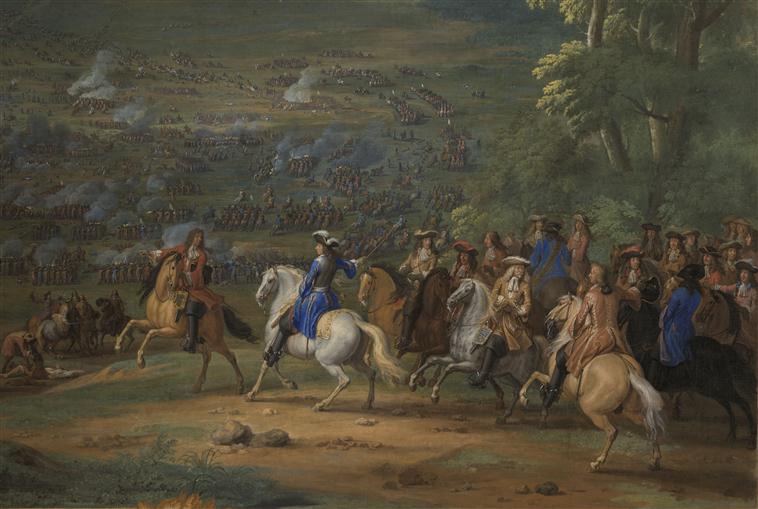
In the Rocroi region (Ardennes), every May 20, the anniversary of the famous Battle of Rocroi between the French and Spanish in 1643, a strange vision is said to still haunt the area. At dawn, standing to the west of the battlefield, one might see the shadows of the two armies slowly rising from the ground and ascending into the sky. Up there, they engage in a spectral battle, mingling in a horrifying melee before vanishing into mist above the plain.
The Duke of Enghien at the Battle of Rocroi, painting by Sauveur Le Conte, 1686–1694
Even in the 20th century, these beliefs persisted. Shortly before the death of Pope Leo XIII, peasants near Rennes spotted a balloon crossing the sky. Convinced that it was a supernatural sign, they rushed to the nearby castle, shouting:
« Venez bien vite voir, le pape est mort ; il y a un grand signe dans le ciel ! » "Come quickly and see, the pope is dead; there is a great sign in the sky!"
In this region, it is said that the pope can only enter heaven after flying over all the Catholic countries in the form of a spirit.
9. Invocations to the clouds
In an old tale from Lower Normandy, a portion of the sky—probably a cloud—was said to descend upon the chosen one whom Jesus would select to lead His Church as pope. This heavenly vision, both simple and majestic, evokes the divine blessing descending from above to designate a spiritual guide.
In Brittany, a tale tells the story of a magician descending from a crescent-shaped cloud to abduct a young girl. This fantastical apparition illustrates how the sky could be perceived as a realm from which supernatural beings emerge, capable of interacting directly with the human world.
Invocations to the clouds are extremely rare in French folklore. Paul Sébillot reports only a single example, from the Aosta Valley, where a French dialect is spoken. This ancestral formula addresses the cloud directly to call for the return of good weather:
Nebbia, nebbia, va per haout Pria lo bon Dieu qué foatsa tschaout. « Nuage, nuage, élève-toi bien haut, Prie le bon Dieu qu’il fasse chaud. » "Cloud, cloud, rise up high, Pray to the good Lord to make it warm."






Leave a Reply