The Moon: A Punishing Star and Beloved by Women
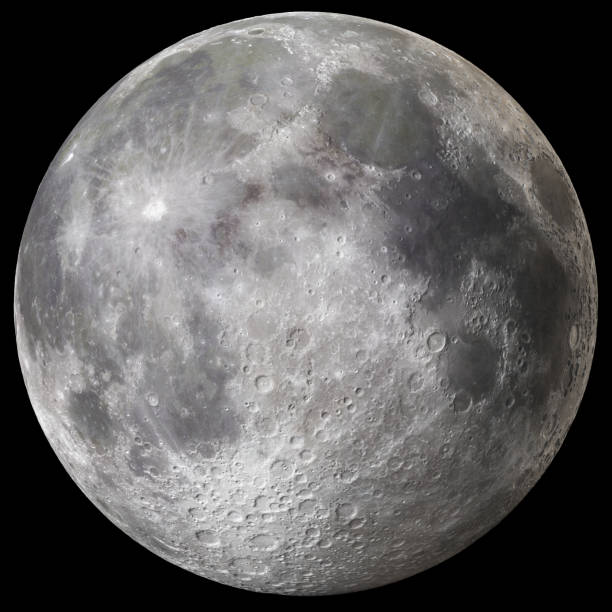
1. Its Similarities with the Sun

In several traditions, people personify the Sun and the Moon by assigning them a gender: the Sun is masculine, the Moon feminine. Their stars are considered the children born from their union.
In the Limousin and in Belgian Luxembourg, a tale recounts that God created these two celestial bodies and declared them husband and wife. The Sun was to shine in the morning, the Moon in the afternoon. But the Moon, too ambitious, gradually took more and more of the daytime hours, which led God to punish her by confining her to the night.
In the Midi of the 1830s, it was said that the Moon was originally a second Sun that God transformed into a nocturnal star to remove it from the daytime sky. In Rouergue, in Languedoc, and in the Comtat Venaissin, the Moon is seen as a worn-out sun, as summed up in the Occitan proverb:
The Moon was once an old sun:
When it was worth nothing for the day,
They put it in the night.
(The Moon was once an old sun: when it was no longer useful for the day, it was placed in the night.)
In the Hainaut, it is considered a sun incapable of performing its task during the day but still useful at night. The old soldiers, with humor, call the Moon: “the retired Sun.” In Nîmes, it is playfully said that the Moon is a sun that has lost its wig — its rays.
For the peasants and sailors (notably in Ille-et-Vilaine), the Sun and the Moon are seen as two flat discs, of equal size but smaller than the Earth. During eclipses, they fit perfectly together, thereby depriving the world of light.
In Lower Brittany, it is believed that the Moon is pressed against the sky: it has mountains and valleys where the Sun’s rays never penetrate. In the Côtes-d’Armor, a darker legend claims that on the far side of the Moon hides a huge maw that sucks up the blood spilled on Earth.
In several regions, it is said that the Sun and the Moon are in constant struggle: in the Maine, the two celestial bodies fight at three o’clock in the morning on Saint John’s Day. In Poitou, tradition holds that if one looks into a bucket of water on Easter morning, one can see the Sun and the Moon fighting or dancing in their reflection.
2. Its Spots
The spots are anthropomorphic (France and Wallonia). They often represent the Man in the Moon, carried to this celestial body as punishment, exposed to the eyes of the world as if on a pillory, serving as a warning.
According to certain beliefs, the face of the Moon is not that of the Man in the Moon, but rather that of a female deity. In the Perche region, for example, the Moon is associated with the Virgin Mary, while the Sun is perceived as the face of God.
This symbolism has its roots in an ancient heritage, where the Sun was considered the head of a man, and the Moon that of a woman, in reference to the pagan deities Apollo and Diana. These Latin or Celtic figures were likely replaced over time by Christian entities, namely God and the Virgin Mary.
3. Its Non-Anthropomorphic Spots
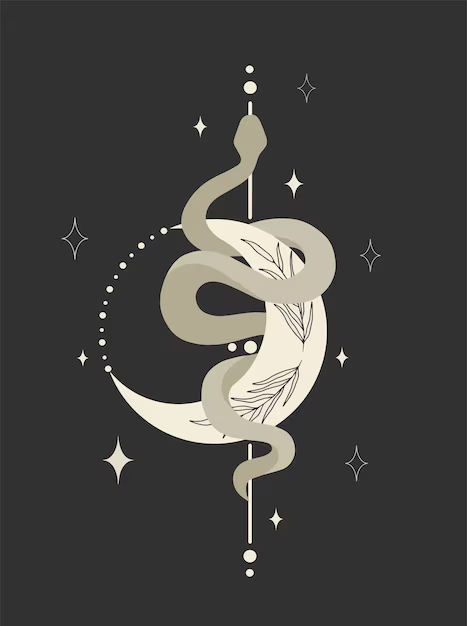
In several regions of France, the Moon is associated with animals exhibiting varied behaviors, sometimes whimsical, sometimes symbolic. In Bourbonnais, a rat, a cabbage thief, is depicted on the Moon, pulled by the tail of the hand of the Man in the Moon. An anecdotal image, but one that remains vivid in local memory.
A children’s rhyme, recited in many places, humorously evokes:
“I saw in the Moon
Three little rabbits,
Eating plums
While drinking wine.”
This little rhyme probably has no connection with the many legends featuring hares or lunar rabbits in other cultures, but it reflects the old habit of seeing animal shapes in the celestial body.
This imagination is not recent. In the Middle Ages, celestial bestiaries were common, and the Moon served as a canvas for fabulous creatures.
In the famous Roman de la Rose, written by Guillaume de Lorris and Jean de Meung, there is an astonishing description of a beast that would inhabit the dark side of the Moon:
And the dark part of the Moon
Shows us the figure
Of a most marvelous beast:
It is a serpent holding its head
Tilted toward the west.
Its tail narrows toward the east:
On its back stands a tree,
Its branches pointing eastward:
But extending its limbs,
Upon these limbs rests
A man supported on its arms,
Who has fallen toward the west.
Its feet and thighs spread out
As best as they can in their likeness.
Which can be translated as:
And the dark part of the Moon
Shows us the image
Of a very strange beast:
It is a serpent holding its head
Turned toward the west, always inclined.
Its tail ends in the east:
On its back stands a tree,
Whose branches stretch toward the east;
But by spreading the branches apart,
On this cluster of branches rests
A man, leaning on his arms,
His face turned toward the west.
His feet and both thighs
Are positioned roughly in place.
The Moon is thus described as the stage for a strange serpent, carrying a tree on its back, upon which rests a man leaning on his arms. A striking image, blending nature and the fantastic.
Beyond animals, the Moon is above all a luminous circle lending itself to all metaphors: in the valley of the Moselotte (Vosges), the locals see it as a pan without a handle suspended in the sky.
These rustic images reflect a collective imagination that seeks to give a familiar shape to what is distant and inaccessible.
4. As a Deity

According to certain beliefs, the face of the Moon is not that of the Man in the Moon, but rather that of a female deity. In the Perche region, for example, the Moon is associated with the Blessed Virgin Mary, while the Sun is perceived as the face of God.
This symbolism has its roots in an ancient heritage, where the Sun was considered the head of a man, and the Moon that of a woman, in reference to the pagan deities Belen-Apollo and Diana. These Latin or Celtic figures were likely replaced over time by Christian entities, namely God and the Blessed Virgin.
5. Its Place in Fairy Tales

From the earliest comic tales, the Moon is perceived as a fabulous object, notably because of its impressive brightness.
In Upper Brittany, the hero La Perle steals from a giant a Moon that shone in his fireplace and lit up seven leagues around. In a Breton tale, a giant takes from the King of France a half-moon that illuminates an entire territory over ten leagues from the highest tower of a castle. The giant Hok-Bras, in his adventures, climbs up to the Moon and places it on the steeple of Landerneau. In Vire, the locals blame the Moon for gnawing at the stones of their steeple and set up a giant wolf trap in an attempt to catch it.
These tales illustrate the ingenuity of people in explaining the inexplicable or mocking human limitations in the face of the inaccessible.
The expression « vieilles lunes » is still used today to refer to outdated ideas or bygone memories.
In Tales of a Beer Drinker by Charles Deulin, the Moon is compared to a golden apple that God picks when it is ripe, then keeps in “His great wardrobe of the world.” This poetic vision is also found in Journey to the Harz by Heinrich Heine, reflecting the influence of Germanic traditions.
At Cap Sizun (Finistère), there is a belief in the plurality of moons: each one illuminates a country for seven weeks before joining the “old moons.”
The full Moon, reflecting on calm water, has inspired many stories. In the Roman de Renart, a Breton tale features a fox threatened by a wolf. Cunningly, he shows the wolf the Moon’s reflection on a lake, persuading him that a young girl is bathing there. The wolf, deceived, dives in and drowns.
Medieval tales abound with animals and simple-minded creatures fascinated by the Moon’s reflection, trying to fish it out or eat it: in a fable by Marie de France, a wolf mistakes the Moon for a cheese, drinks a puddle of water to reach it, and dies from drinking too much. A tale from the Landes recounts how a fox convinces a wolf that he swallowed the Moon by drinking an entire lagoon. In Lower Languedoc, a wolf accuses the fox of devouring the Moon after seeing it disappear behind a cloud.
The absurd attempts to catch the Moon are the origin of many nicknames in France: the people of Montastruc are called Pesco-luos for having tried to fish the Moon from the waters of the Gers. Those from Lunel are the Pescolunos. In Mèves (Nièvre), they are called the Batleux de lune, and in Bailleul-le-Soc, the Pékeux de leune.
In Dinant, drunkards try to catch the Moon’s reflection by hanging onto each other, just as in Clerval in the Doubs. In some stories, the disappearance of the lunar reflection is attributed to a donkey that supposedly swallowed it; naive locals even go so far as to open the animal’s belly to retrieve it.
The expression « happer la lune », found in a 15th-century tale, refers to the idea of catching the Moon with one’s teeth, in other words, attempting the impossible. Even today, saying that one asks for the Moon or promises the Moon refers to unrealistic promises or unattainable wishes.
L’expression « happer la lune », présente dans un conte du XVe siècle, désigne l’idée d’attraper la lune avec les dents, autrement dit, de tenter l’impossible. Toujours aujourd’hui, dire qu’on demande la lune ou qu’on promet la lune renvoie à des promesses irréalistes ou à des souhaits irréalisables.
6. Personified Moon: Names and Epithets
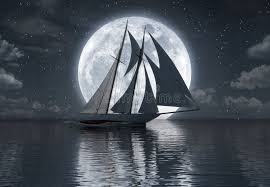
Among the most unusual maritime legends of the Breton coasts, the one reported by fishermen around Saint-Malo stands out for its originality.
Un jour, la Lune, furieuse qu’un naufrage ait eu lieu sous sa surveillance, décide de punir la Mer en l’avalant tout entière. Sans mer, les bateaux restent à quai, les pêcheurs et les navigateurs sont désespérés.
Faced with this dramatic situation, a brave captain decides to go meet the Moon. He explains the sailors’ plight: without the sea, it is impossible to sail or to live. Moved by this complaint, the Moon agrees to spit the Sea back out, but on one condition: that it be forever subject to her.
Thus arises the poetic idea that the Sea obeys the Moon, a vivid and touching explanation of the tides that govern the lives of seafaring people.
7. Its Descents to Earth
In Morbihan, a legend without parallel in France tells how the Moon, taking the form of an old woman, descended to Earth one evening. A miserly housewife, eager to save light, was working at her laundry at night when, suddenly, her utensils began sliding toward the open door, as if drawn by a mysterious magnet.
She immediately reacted and slammed the door shut. It was then that an invisible force tried to open it. A sinister voice rose: it was the Old Woman of the Moon, who declared to her:
« You are quite fortunate to have kept your door shut, for otherwise I would have killed you tonight. I am jealous of your light, and I do not intend for anyone to profane the night by working.
This strange tale conveys an ancient warning against the excesses of night work and the failure to respect the natural cycle of day and night.
At the summit of a mountain, in a legend from the Dauphiné, resides the Moon. Far from being a mere celestial light, it is depicted as a powerful and fearsome entity that swallows everything threatening the order of things.
Thus, one day, it devoured Bazin, a reckless thief. The mountain became the sanctuary of this sovereign Moon, guardian of divine justice.
A Basque tale transports us into a world where the Moon is, surprisingly, male. A hero, setting out in search of his missing wife, arrives at the Moon’s dwelling and there meets the mother of the celestial body.
The old woman warns him: her son has the unfortunate habit of devouring human beings. By luck, the Moon spares the hero and tells him to continue his journey to the Sun, wiser and better informed about the fate of his wife.
These legends remind us how the Moon, depending on the region and tradition, can take very different forms: a threatening old woman, a vengeful entity, or a male deity. All these stories share a common theme of linking the Moon to taboos, boundaries not to be crossed, and the mysterious forces of nature.
8. Seen as a bogeyman
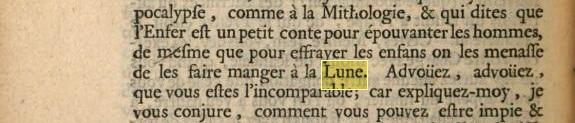
As early as the 17th century, parents used the Moon to discipline their children. In France, as reported by Savinien de Cyrano de Bergerac (Œuvres diverses), children were told they would be devoured by the Moon if they misbehaved. In Saint-Brieuc, the threat went further: by looking at the Moon, the little ones could see it grimace.
In Walloon Belgium, the full moon was used as a pretext to frighten children, with the claim that it would come to take them away.
In the Arles region, nurses would sing an old nursery rhyme while pointing at the moon for the children:
La Luno barbano,
Que mostro li bano :
Sant Pei, sant Pau,
Pico lou babau
Which can be translated as:
The Moon, like a ghost,
Shows its horns;
Saint Peter, Saint Paul,
Strike this boogeyman.
Upon reaching the word babau (boogeyman), the nurse would hide the Moon with an apron to finish frightening the child. In the same tradition, the “Bearded Moon” was even accused of stealing wool.
In several traditions, notably in Wallonia, the Moon is personified as a malevolent man. Children are warned with the phrase:
Volà Bazin qui v’louke (“here is Bazin spying on you”).
Around Tournai, it is said that one should not stare too long at the man in the moon, lest he become angry and hurl stones from the sky.
In Loire-Inférieure, the Moon even becomes a playful character. Children sing in unison:
Hello, Madam Moon,
Do you have any children to give us?
The nicknames of the Moon vary depending on the region and how it is perceived. Positive names refer to it with affectionate terms: Madam Moon; Moon, my little mother; the Bété or the Beauty in Wallonia: el Bel, The Beautiful, or L’Beautiful in Normandy.
But it can also be mocked or disparaged through popular expressions: “To be as foolish as the Moon,” Kouyon kom li lœn (idiot like the Moon).
The Moon is sometimes seen as cowardly, because it hides behind the clouds.
Other stories focus on the vulnerability of the Moon itself. Rabelais and Noël du Fail report the playful proverb: « God protect the Moon from wolves! » This idea, as explained by Edward Burnett Tylor in Primitive Culture (1871), likely stems from the belief that during an eclipse, the Moon risks being devoured by a monster, such as a griffin, as in the legends of the Limousin.
In the Forez, when a cloud hides the Moon, it is said that the wolves have devoured it. However, in the Hainaut, it is given a friendlier nickname: the Sun of the wolves. Similar expressions appear in the Morbihan and in Provence, where it becomes the Souleù di lèbre (Sun of the hares) or the Sun of the foxes (Côtes-d‘Armor).
Finally, it is common in several regions to say that the Moon loves to devour the clouds. When it is full and rises in the sky, the small surrounding clouds split apart or disappear, as if they were being eaten by it.
9. The Moon punishes indecency and its influence on pregnancy
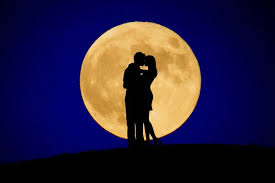
In the countryside of Lower Brittany, it is said that a young girl who goes out at night to urinate must never, once squatting, turn toward the Moon—especially when it is in its first quarters or in its waxing phase, when it is said to be horned. If she does, she risks being loaret or lunée: in other words, impregnated by the night’s celestial body.
This myth gives rise to the idea of children of the Moon, those celestial bastards recognized by their moody nature.
Another widespread belief around Morlaix holds that if the rays of a full moon touch a woman’s intimate parts, she will conceive under the influence of this celestial body and give birth to a monster. The writer Paul Sébillot draws a parallel with a 17th-century superstition reported by the missionary Hans Egede in Nouvelle Description de l’ancien Groenland (1729) (Det gamle Grønlands nye Perlustration)), who stayed in Greenland. There, young girls feared meeting the gaze of the Moon, lest they too become pregnant under its influence.
But these warnings do not concern only women. In the Cap Sizun (Finistère), it is believed that the Moon can also take revenge on men: if she catches them in a position deemed inappropriate, she would mock them with hideous grimaces and even make their future children foolish.
Mais ces avertissements ne concernent pas que les femmes. Au Cap Sizun (Finistère), on croit que la Lune peut aussi se venger des hommes : si elle les surprend dans une position jugée inconvenante, elle se moquerait d’eux par d’ignobles grimaces et irait jusqu’à rendre idiots leurs futurs enfants.
10. Its influence on conception and birth
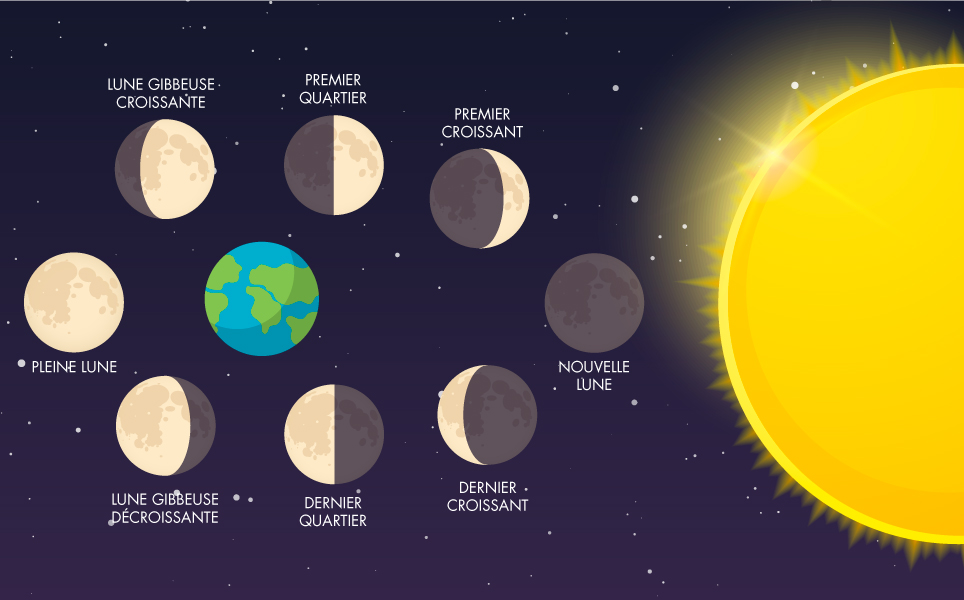
Since time immemorial, the Moon has been seen as a powerful symbol of fertility, destiny, and transformation. In Brittany, the Vosges, Gironde, and Béarn, the lunar phases were believed to determine not only the sex of the child to be born but also its character, health, and even the way it would die.
Many traditions assert that the waxing Moon favors the birth of a boy, while the waning Moon signals the arrival of a girl. This belief is reported both in the Vosges and in the countryside of Gironde or Upper Brittany.
In the village of Hamoir, boys are born during the first quarter, and girls during the waning phase.
Children conceived under the Red Moon, during the lunar cycle following Easter, are said to be tall and vigorous, but also jealous, sly, treacherous, and destined to fail in their endeavors.
Be careful not to confuse the Red Moon (Lune rousse) with a Red Moon (Lune rouge): here, it refers to a specific lunar phase, not an apparent color.
In Lower Brittany, childbirth is said to be more difficult when the moon is waning. It is also under certain lunar configurations that a child’s health is thought to be at risk: in the Morbihan, a child born during the décours is doomed not to survive. Along the coast of Côtes-d’Armor or in Normandy, it is the girl born under these conditions who is threatened. In Béarn, it is believed that a baby born during a waxing moon will have a better chance of thriving.
The aspects of the moon are not limited to the sex or vitality of children: they also influence their destiny.
A Breton proverb claims that those born under the crescent will be lame, cross-eyed, hunchbacked, or one-eyed. In the south of Finistère, it is said that a child born under the new moon will die violently — by drowning, hanging, or another tragedy.
Furthermore, it is said that a child born under a hanging moon (when the moon seems suspended from the tip of a cloud, with one horn above and the other below) will die by hanging. Those born when the moon is submerged by dark clouds are at risk of drowning, the image of the clouds evoking stormy waters.
In some Breton tales, a monk begs a woman to delay her childbirth to avoid the hanging moon. He even goes so far as to kneel before the moon to implore it.
A child born under a bad moon is called a loariet: unfortunate both physically and mentally, and said to be destined for a premature or tragic death.
Even the position of the moon relative to the clouds at the time of birth carries omens: if the clouds smother or hide the moon, tradition holds that the child may end up hanged or drowned.
11. Influence on the body, the mind, health, and happiness
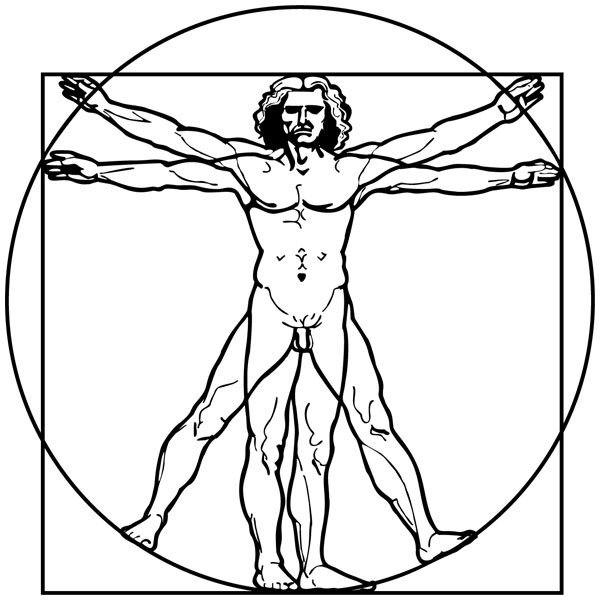
In many regions of France, the phases of the Moon are closely linked to health and bodily changes.
The marrow in the human body is said to vary according to lunar positions.
Regarding hair, tradition says it grows faster when cut during the waxing moon, slows down at the full moon, and shortens if trimmed during the waning moon. In Saint-Brieuc and Gironde, farmers prefer to cut their hair on the day of the full moon for better results.
As for nails, in several regions, people avoid cutting them during the waning moon for fear they might not grow back.
The connection between the moon and the body also appears in women: menstruation is said to be influenced by the Moon, reinforcing the idea that the lunar cycle shapes life.
In Ille-et-Vilaine, it is believed that warts appear during the waxing moon and disappear during the lost moon.
The well-known expression “lunatic” comes from the belief that the Moon made women hysterical or mad. As early as the 16th century, “One who belongs to the moon” referred to a lunatic person, and in the 18th century, a whimsical man was said to “have moons” or be “subject to moons.”
In Gascogne, to “have the moon” meant being lunatic, while in 1640, “to be lodged at the moon” meant not being of sound mind. Even today, a distracted man is said to be “in the moon,” and a bad-tempered man is described as “moody.”
In the 16th century, it was common to believe that sleeping under the moon’s rays was dangerous. The poet Claude Gauchet wrote:
“They only fear that by sleeping one night under the darkness, they might suffer some harm from the moon’s rays.”
Many sailors, such as Pierre Loti and Jules Dumont D’Urville, were convinced that the moon could cast spells on those who slept in its light, harming their health.
The idea that the moon influences illnesses is very old, accepted as early as the time of Claude Galien and echoed by Renaissance physicians. A 17th-century comedy mentions:
“We are in the waning phase, and as the moon declines, the sick decline.”
In Lower Brittany, the August moon is reputedly fatal to tuberculosis patients. In Wallonia, the March moon is said to be particularly harmful to the sick.
To protect themselves, in the 17th century, people recited prayers at the first crescent, also believing that looking at the moon could cure warts.
In the Deux-Sèvres, one must pick up an object at the first sighting of the new moon and rub their warts while saying twice: “Do it to the moon!”
In Lower Brittany, a chant is sung as a moon conjuration:
“Salud, loar gan – Hail, full moon
Kass ar re-man – carry these away with you (the warts)
Gan-ez ac’han – far from here.”
According to a 19th-century Breton book, the moon influences the body’s strength. A wrestler claimed:
“Is it not allowed to go breathe in the moon’s rays to gain strength?”
In Provence, young girls comb their hair in the moonlight to have beautiful hair and attract a husband.
The moon is said to be responsible for the deterioration of certain materials: in Normandy, it is believed to eat away at stones and consume thatched roofs. In the Vosges, it makes glass iridescent and dulls the colors of fabrics. In Lower Brittany, people fear it might poison the water, hence the practice of covering wells with a pointed roof for protection.
In the 15th century, it was believed that a woman should not marry during the waning moon to benefit from the good omen of lunar renewal. In Lorraine, moving in with her husband during the first quarter of the moon is considered a sign of happiness and luck.
In the past, when cutting wood for ships, it was preferred to fell trees during the waning moon. Finally, in the Vaud region, one should not start building a house when the moon’s horns are turned downward.
12. Drawn omens
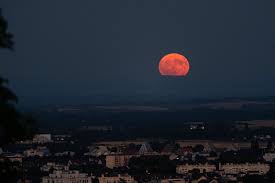
In Franche-Comté, at the beginning of the 19th century, it was believed that a moon surrounded by a blood-red halo foretold major upheavals for the state.
In Upper Brittany, the blood moon is a sign of imminent catastrophe: either a great war or the end of the world. If this phenomenon occurs during a war, it foretells a decisive battle. This red color symbolizes the blood shed by soldiers, which the “children of the moon” are believed to draw through the moon’s hidden face—a fascinating belief linking the moon to human conflicts.
Peasants and sailors observe the lunar halos to forecast the weather: during the siege of La Rochelle (17th century), a large white circle appearing next to the moon caused an outburst of joy, as a similar siege had been lifted after a comparable phenomenon in Metz in 1591.
According to the peasants of Poitou, the moon is always accompanied by two stars:
Sailors from several regions (such as Audierne, the English Channel, or the Boulogne region) tell that the moon is accompanied by a small boat — l’canote d’leune — a star brighter than the others. This is actually the planet Venus. In good weather, this star tows the moon forward; in bad weather, it lags behind. When the moon is “embarked” (hidden by clouds that obscure the star), it is a bad omen. Picard sailors call it the pilot. These signs guide fishermen on their outings.
In Poitou, if the moon does not change position within eight days following a birth, the next child will be of the same sex, unless conceived during the waning moon. In Anjou, Normandy, and Loire-Inférieure, this period is three days. A woman who gives birth during the waning moon will also have her next child of the same sex, unless the moon changes phase quickly (within 24 hours or three days).
This collection of ancient proverbs recalls rules concerning the moon:
« Se quelque personne marchande à une aultre en tournant le dos, certes jà ne lui prouffitera le marchié. »
« Nul qui veult gaignier au jeu de dez ne se doit jamais asseoir, pour jouer, son dos devers la lune, où qu’elle soit lors, ains lui doit tourner le visage, ou se ce non, jamais il n’en levera sans perte. »
« Cellui qui n’a point d’argent n’a en sa bourse se doit abstenir de regarder la nouvelle lune, ou autrement il n’en aura guère tout au long de d’icelle. »
« Cellui qui perchoit le croissant à plaine bourse, il le doit saluer et encliner devotement et pour certain il multipliera toudis celle lunaison. »
« Qui vœult avoir toute une lune de l’argent en bourse, si la salue reveramment le propre jour qu’elle appert nouvelle et le jour ensievant, si se perchevra moult tost de bon secours. »
which translates as:
“If someone trades with another while turning their back, the deal will certainly not benefit them.”
“No one who wishes to win at dice should ever sit with their back to the moon while playing, wherever it may be; they must face it, otherwise they will never gain without loss.”
“Anyone who has no money in their purse should refrain from looking at the new moon, or else they will have little throughout that month.”
“Anyone who catches the crescent with a full purse should greet it and bow devoutly, and surely they will always multiply their wealth during that lunar month.”
“Whoever wishes to have a full moon’s worth of money in their purse, if they reverently salute it on the very day it appears new and the following day, they will soon receive much good fortune.”
Finally, in Gironde, it is believed that looking at the new moon will turn the money in one’s pocket into… lunar rock, a strange metaphor for the risk of losing one’s possessions.
13. Respect for the moon
In the mountains of the Black Mountain, an old belief holds that one should never stand fully upright upon first seeing the new moon. Such behavior is thought to bring misfortune. To ward off bad luck, The Gospel of the Distaff instead recommends bowing to the moon, a gesture of humility believed to attract luck and protection.
In the southwest, in Gironde, it is believed that one must not look at the moon on the first day of its full light, lest they bring disgrace upon themselves. A similar superstition exists in the southern part of Finistère: staring at the moon for too long is said to risk being literally “swallowed” by it.
The Gospels of the Distaff, a precious 15th-century collection, offers several pieces of advice for benefiting from the powers of the stars. Here are some of the recommendations it contains:
« Cellui qui souvent bénist le soleil, la lune et les estoilles, ses biens lui multiplieront au double. »
He who often blesses the sun, the moon, and the stars, his possessions will be doubled.
« Quiconque salue la lune lorsqu’elle est nouvelle, et quant elle est pleine, et quant elle est en décours, pour vray elle envoie santé et bon heur. »
« Whoever greets the moon when it is new, when it is full, and when it is waning, truly it sends health and good fortune.»
« Cellui qui point d’argent n’a en sa bourse se doit abstenir de regarder la nouvelle lune, ou autrement il n’en aura guère tout au long d’icelle. »
« Anyone who has no money in their purse should refrain from looking at the new moon, or else they will have little throughout that month.»
In Gironde, another belief directly links the Moon to financial prosperity. If one looks at the new moon while having money in their pocket, it will turn into lunar rock for eternity.
A belief reported by the Gospels of the Distaff emphasizes this point:
« Qui vœult avoir toute une lune de l’argent en sa bourse, si la salue reveramment le propre jour qu’elle appert nouvelle et le jour ensievant, si se perchevra moult tost de bon secours. »
« Whoever wishes to have a full moon’s worth of money in their purse, if they reverently greet it on the very day it appears new and the following day, will soon receive much good fortune.. »
14. Dreams of young girls
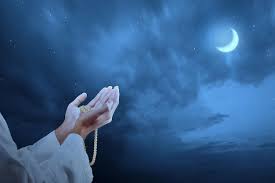
The Moon is personified and honored with tender and flattering names. The phrases addressed to it to obtain a vision in a dream are often simple and poetic, composed of three to six lines. Among the most famous: “Show me in my sleeping, in my dreaming – Who I will have in my living.”
Regional variations are numerous: in Yonne, before going to bed, one must look at the moon and repeat three times: “Hello, my beautiful crescent, – Show me in my sleeping, in my dreaming – Who I will have in my living.”; in Upper Brittany, one recites five Our Fathers and five Hail Marys facing the moon, then throws a random object toward it while saying: “Little crescent, – White word, – Show me…” One must then lie down on the left side, enter the bed with the left foot first, and recite prayers for the souls in Purgatory until falling asleep.
In Poitou, lovers of all ages go out for seven consecutive evenings to gaze at the moon in its first quarter, whispering to it: “Moon, my little mother, I who am your child, – Show me…”
In French Flanders, young girls must arrange their toiletries in a cross during the entire waxing phase of the moon, and, kneeling at the foot of the bed, say: “Crescent, crescent, show me…”
The rituals vary depending on the location and the time of year:
Certain times of the year are considered particularly favorable for consulting the moon:
15. Invocations and conjurations
The Moon thus became a receptacle for the hopes of the people, and each appearance of the celestial body was an occasion to address it with wishes, invocations, or prayers.
In Gironde, at the sight of the moon and la Lugan, the first visible star, the peasants recite:
Bédy la lune et lou lugan,
Lou boun Diou qui es avou mitan
La sinte Bierge qui es aou hort
Qué prégus Diou pour tous lous morts.
Translation:
I see the Moon and la Lugan,
Good God who is in the center,
The Holy Virgin who is at the edge,
Praying to God for all the dead.
In Languedoc, the moon is invoked as a divine feminine figure:
Luna, bela Luna, filhola de Dieu,
Tres douns vous demande, ieu :
L’ounou, la sagessa et la crenta de Dieu.
Translation:
Moon, beautiful Moon, daughter of God,
Three gifts I ask of you:
Honor, wisdom, and the fear of God.
Still in Gironde:
At the appearance of the new moon, some recite a simple and hopeful prayer:
Beautiful Moon, I see you in your return,
May God grant me His holy love,
Glory, peace, and health,
And Paradise when I die.
In Corrèze, the moon guides the gathering of simples (medicinal plants). The lunar phases are carefully chosen before harvesting, according to ancient knowledge.
In several French rural areas, it was believed that if one became lost—by day or by night—due to a spell, there was a remedy: cut a branch of hazel, make three signs of the cross, and face east while saying: “Moon, I command you to disenchant me, in the name of the great Devil Lucifer.” Then strike the hazel trunk. Tradition holds that one would then find their way, and at the same time, the magic wand would brush the face of the responsible sorcerer.
In certain Walloon traditions, sorcerers could even bring the moon down to Earth for magical purposes. In the Vaud Alps, a feared power was to inflict the “male nuit”—a restless, sleepless night—simply by staring at the Morning Star and pronouncing the formula:
“I greet you, luminous star! I conjure you to go and give the evil night to (name of the victim), according to my intentions; go, little one!”
This practice is confirmed by Pierre Le Brun in his Critical History of Superstitious Practices, where he reports a similar formula said at sunset, directed toward the brightest star.
16. Prayers to the Moon
Une prière du Poitou fait allusion au pouvoir de la lune :
Beautiful Moon, I see you,
On the left side and on the right,
You who each evening wear
Your beautiful purple cloak,
Keep me safe from three things,
The encounter with wicked dogs,
The temptation of Satan,
The bite of the serpent.The author of the biography of Michel Le Nobletz, published in 1661, stated that during the apostolate of this missionary (1624) in Lower Brittany: “it was a customary practice to kneel before the new moon and recite the Lord’s Prayer in its honor.” This practice was likely a Christianization of an earlier pagan rite.






Leave a Reply