The Wild Hunt: When the Sky Resonates with Popular Fears
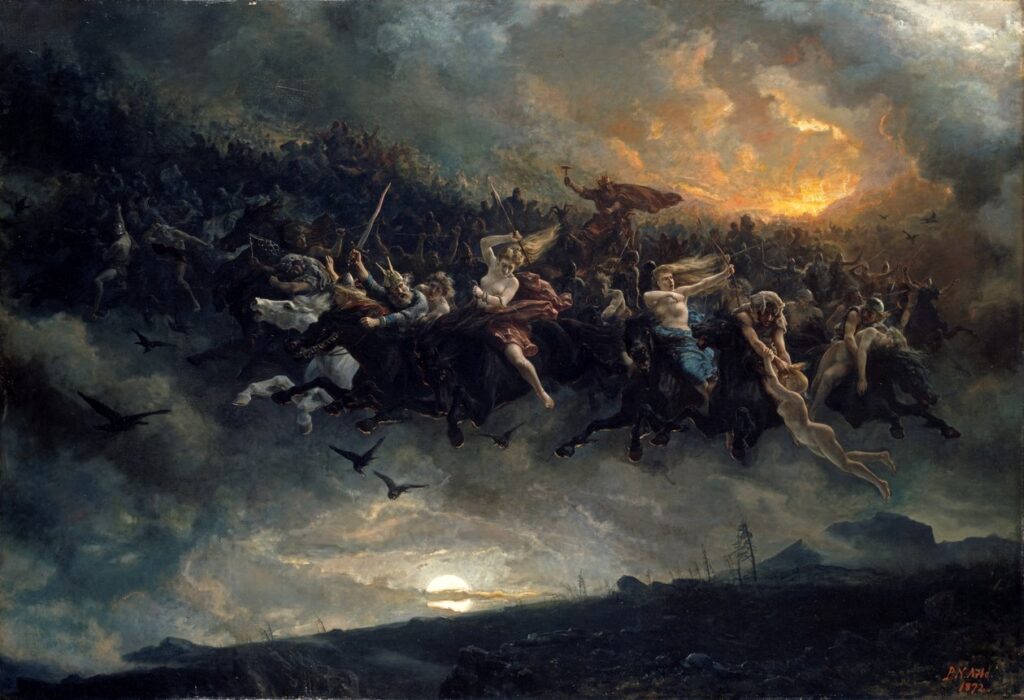
1. Explanations of the Legend
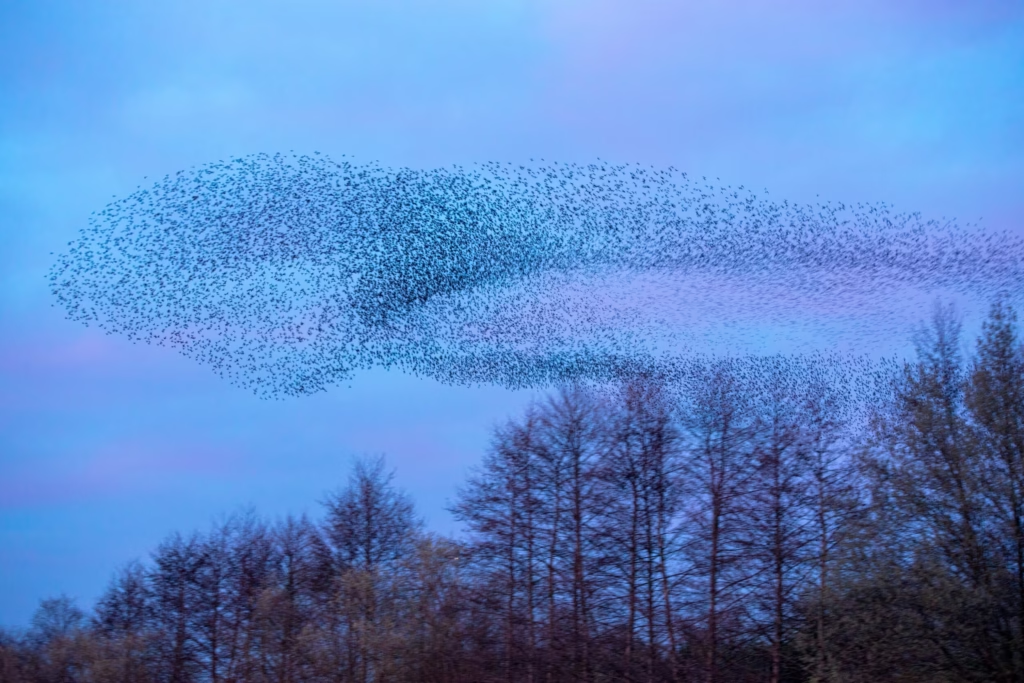
As already suggested by a priest from Villedieu in Lower Normandy, in the Bibliothèque physico-économique of 1789, the legend of the fantastic hunts could be explained by migrations of passing birds. In winter, curlews, geese, and wild ducks traverse the sky in large, noisy battalions. Their cries and formation flights could be interpreted as mysterious signs from another world. In summer, other migratory birds, flying at very high altitudes, produce sounds resembling dog barks or predator yelps, reinforcing the idea of a supernatural hunt.
These tales of fantastic hunts exist throughout Europe, but are particularly vivid in the North and Central regions. In France, the stories vary:
Terrestrial versions are rarer and have fewer names. They retain a less pronounced supernatural character than the celestial hunts, which impress more through their mystery.
The belief attributing a mysterious origin to nocturnal sounds in the sky is very old.
In reality, these tales seem linked to natural phenomena: the wind, bird flights, or acoustic resonances. But, amplified by fear and imagination, they have over the centuries fueled one of the most fascinating legends of European folklore.
2. Names of the Fantastic Hunts
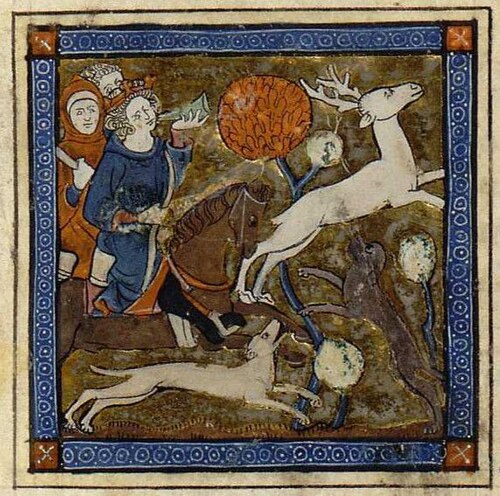
The most famous remains King Arthur:
In Caorsin, when the flying hunt is heard, people say: “It’s King Arthur”, or “lou rey Artus”. A local legend related to his hunt is also told there.
Other names, often linked to cursed characters or difficult to classify:
Some emphasize their noisy and fast nature: :
In Alsace, the night hunter takes on various names:
3. Acts Atoned for by Its Riders
In both peasant and forester beliefs, the riders of the fantastic hunts are not mere legendary figures: they are damned souls who atoned for their sins. Their crime? Loving the hunt so much that they violated the laws of the Church to satisfy their passion. Some did not hesitate to ravage standing crops, thus depriving communities of food.
They are condemned to be punished through the very sin they committed. Their punishment takes the form of an eternal hunt:
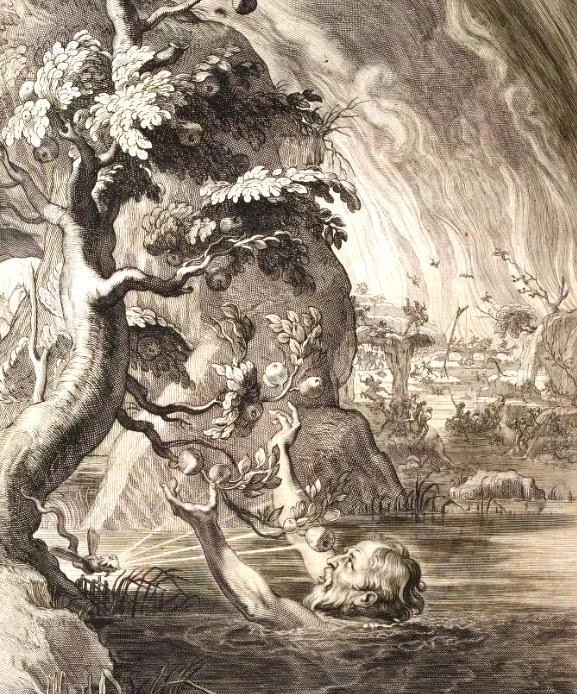
This endless chase recalls the torment of Tantalus, condemned in Greek mythology to suffer eternally from hunger and thirst, never able to eat or drink.
4. Violation of Sunday Rest and Religious Offenses
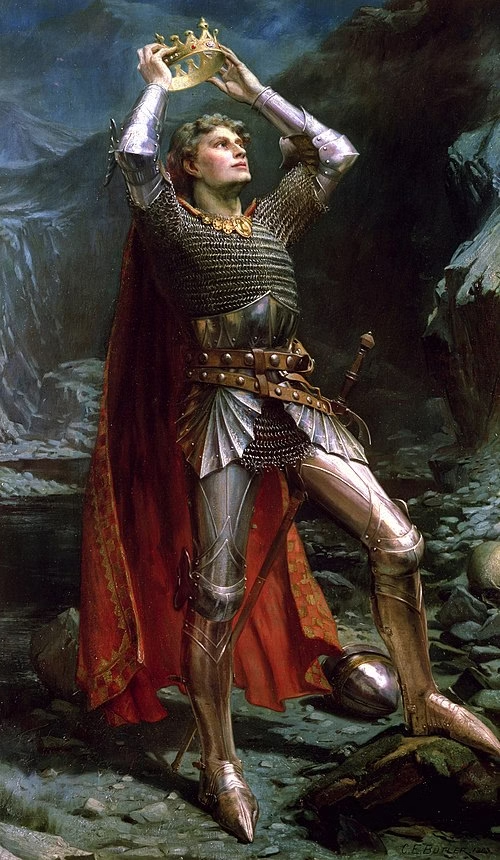
Many local legends associate the fantastic hunts with lords or kings who, through their irreverence, were condemned to pursue an eternal hunt. King Arthur is the most well-known example:
In Landes like in Fougères region, it is still said that Arthur runs endlessly, hunting an elusive prey.
Other stories feature lords whose pride and cruelty toward peasants result in an eternal punishment:
Sometimes, the offense is not related to Sunday rest but to other prohibitions:
5. Restless Souls, Witches, or Demons
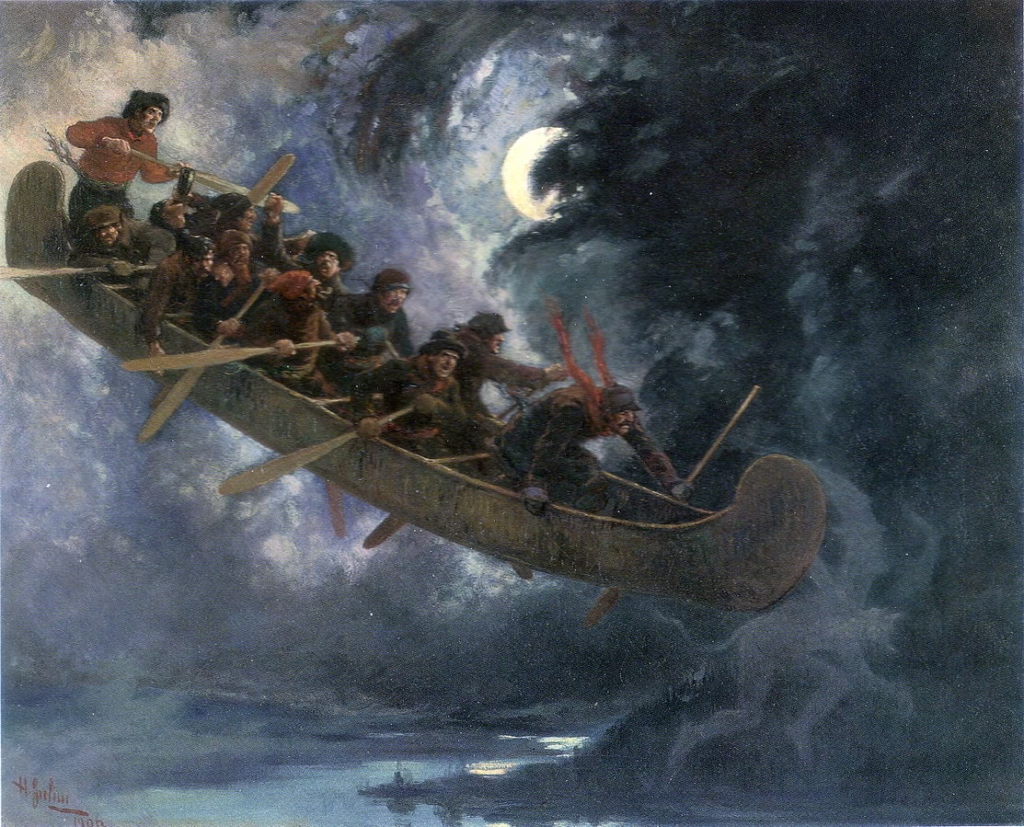
The fantastic hunts are not always led by cursed lords or legendary heroes. In many regions of France and even in Canada, they are associated with restless souls, witches, or demons. These tales, deeply rooted in popular memory, transform nocturnal sounds into supernatural and frightening processions.
Traditions sometimes associate the fantastic hunts with unbaptized children or tormented souls:
In the Middle Ages, the Mesnie Helquin was directly led by Satan, surrounded by devils on horseback. This theme endures in many regions:
Some variants emphasize the punishment reserved for illicit loves. In Lower Normandy, it was believed in the 19th century that when a priest and a nun died without penance, their souls would rise from their graves each night, pursued by demons and the damned.
Not all figures are diabolical. In some regions, a White Lady leads the aerial hunt:
In the Maine, the Arthur Hunt is sometimes interpreted not as a pursuit of game, but as a true witches’ sabbath, marked by tumult and confusion.
Although Brittany has few tales of fantastic hunts, an exception exists near the Bay of the Dead. After the March storms, aerial yelps are heard there: the Chass an Gueden, or dogs of the equinoxes. Spirits risen from Hell, they try to return to the sky. But in the depths of the Valley of the Dead, the elders tell children that they are rather angels weeping.
The Saintongeais and Poitevins settlers, who went to New France, brought with them the legend of the Flying Canoe, which took on an original form in Canada. Here, it appears as a flying bark canoe, filled with possessed people. Guided by Beelzebub, they would go to see their “sweethearts” through the air. To activate the canoe, one had to promise one’s soul to Satan, with one condition: not to speak the name of God or touch a cross during the journey. The boat would then fly faster than the wind before returning its passengers to the starting point.
6. Ominous Omens
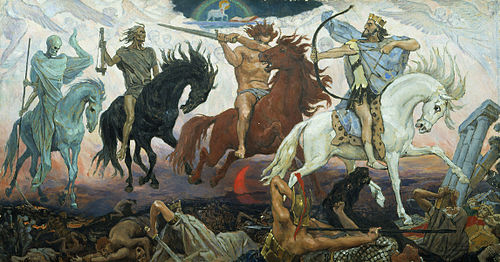
The fantastic hunts, or aerial hunts, did not merely frighten peasants with their clamor in the skies. They were also perceived as harbingers of imminent misfortune: wars, famines, epidemics, or sudden deaths.
In the past, peasants were deeply fearful of hearing the fantastic hunt. Its arrival was rarely innocuous: it always foretold a dire event for the community or for a family.
In Saintonge, the Gallery Hunt was considered a certain omen of catastrophes:
Fear intensified when the hunt descended to the ground. Testimonies report that it was heard at the very beginning of the French Revolution:
In Périgord, the appearance of the Huntsman Herod was seen as a sign of tragic events, especially when it drew closer to the ground. According to some accounts, it was said to have skimmed the earth twice, shortly before the Revolution.
In Normandy, the Chasse Caïn, particulièrement signalée autour d’Orbec, annonçait toujours un malheur proche, et plus encore la mort d’une personne déjà en danger.
7. The game they pursue
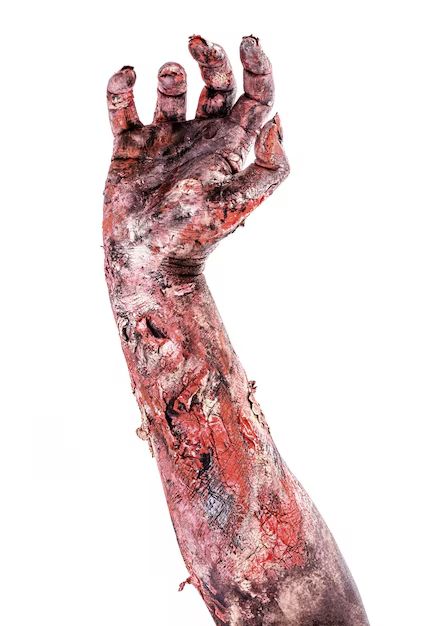
If the phantom hunts were already frightening because of their noises in the sky and their supernatural apparitions, they inspired even greater terror through the game they brought back. For it was not always wild animals… but very often human remnants or corpses torn from the grave.
In several regions of France, people believed that anyone who asked for a share of the hunt risked receiving a macabre gift.
Folk tales abound with examples of horrors delivered at the doorstep of the reckless:
In Morvan, a peasant who had witnessed the hunt unwillingly received this terrible warning:
« You have endured the toil, here is your share of pleasure. »
Shortly after, the half of a woman’s body crashed into his cart.
In Poitou, asking for a share might earn you a human limb dropped straight onto your head. Firing at these processions was just as dangerous, even with a blessed bullet. In Poitou, a hunter who tried his luck saw a large beast fall at his feet… but a voice immediately warned him:
“Give me back my kill!”
In Alsace, the Nocturnal Hunter froze the valleys with his cry “houdada,” followed by the horn and a stormy wind. Woe to anyone who repeated his cry: they would then receive a poisoned prey along with these fateful words:
“Who hunts with me eats with me.”
A sentence that meant there was nothing left to do but prepare to die
8. How does one protect oneself from the dangers of the hunt?
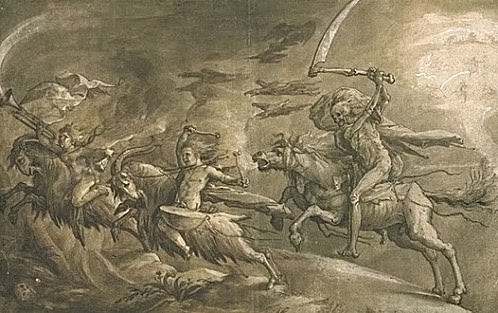
Phantom hunts, those supernatural processions crossing the sky, have long inspired fear and superstition among the inhabitants of many regions of France.
In the Vosges, if the Maisnieye Hennequin, a troupe of invisible musicians, passes over someone in the open countryside during summer nights, they must lie flat on the ground and invoke Saint Fabian. Otherwise, they risk being suffocated, crushed, or swept away in a whirlwind to an unknown land. If the person is at their window, they must close it quickly to avoid being hit by pieces of wood, stones, or even bones from cemeteries. Once the window is closed, it is possible to observe the Maisnieye safely.
Alsatian travelers who encounter the nocturnal hunter must lie down in the middle of the road. Those who neglect this precaution may be cut in two or carried into the air. One legend tells of a man who was swept away from the Lerchenfeld near Saint-Gangolf to Bollenberg, but was saved after entrusting himself to the Holy Virgin.
A priest from Lower Normandy, accompanied by his sacristan, heard the Annequin Hunt near the castle of Crèvecœur (Orne). He drew a circle with his cane, invited his sacristan to enter it, and shouted: “Join the hunt!” A hail of human bones then fell. The spirits revealed that they were about to take the soul of a woman who had sinned with a priest. The priest intervened, and thanks to the Virgin Mary, the victim was saved.
9. Other figures whose sounds are heard in the air
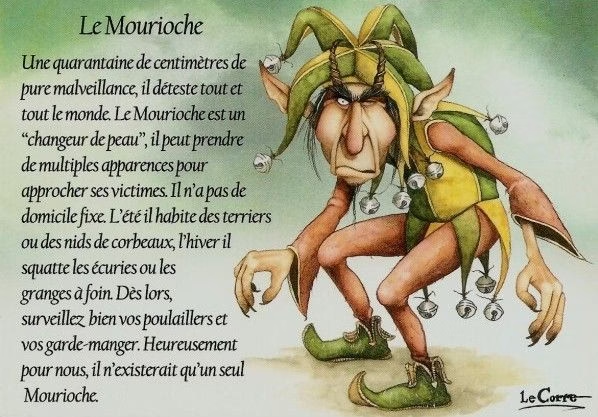
While collective phantom hunts are numerous in French folk traditions, there are also solitary figures who roam the sky alone. These figures, often associated with mysterious sounds or ominous omens, are particularly present in the imagination of regions such as Franche-Comté, Ille-et-Vilaine, and Brittany.
In Franche-Comté, legend speaks of the eternal hunter of Scey-en-Varais (Doubs). During the dark nights of All Saints’ Day and Christmas, his mighty oliphant resounds throughout the Loue basin. This racket once filled the air with a formidable noise, depriving both the elderly and children of sleep. It was believed that this tumult came from the aerial hunter of the valley, condemned to roam the sky for all eternity.
In Ille-et-Vilaine, locals recount that on beautiful summer nights, the David’s Chariot crosses the skies, as swift as the wind, accompanied by a great crash. In the Breton-speaking part of the Côtes-d’Armor, it was believed in the 19th century that the Chariot of Death sometimes flew through the sky, drawn by funeral birds. Unlike the Kar ann Ankou, a Breton figure who always walks on the ground, the Mill Cart – its equivalent in Upper Brittany – could rise into the air before mysteriously disappearing.
At the beginning of the 19th century, the peasants of Voiteur (Jura) spoke of a fairy who runs through time, that is, who traverses the skies. She is said to have given her name to the famous “days of the old woman”: the last three days of March and the first three of April. According to belief, this fairy exerts a harmful influence on the crops, reflecting the role of ancient agricultural calendars in rural superstitions.
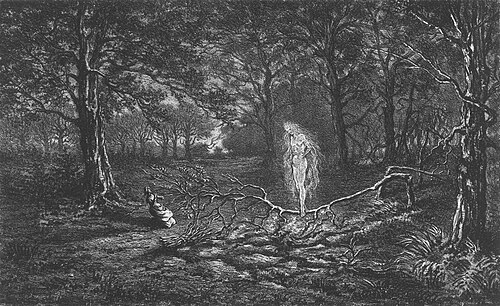
In Bruz (Ille-et-Vilaine), it is said that a white ghost inhabits a cave but can sometimes be heard in the air, producing a strange and unsettling noise.
Brittany is particularly rich in legends related to supernatural beings of the sky:
-
Merci pour ce fabuleux dossier sur les chasses et légendes 💕☺️💕!
-
Merci du commentaire
-



Leave a Reply