Illustration of children searching for a treasure, Mes histoires du soir
1. Forgetting Time
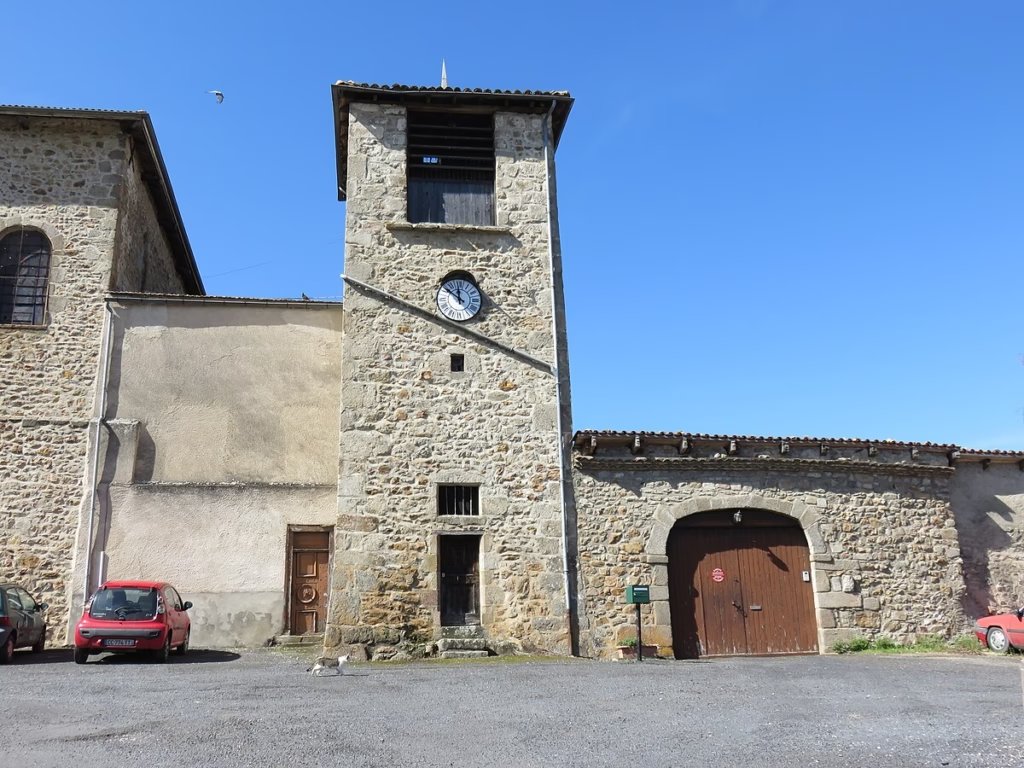
Former Priory of Chaumont-le-Bourg, Puy-de-Dôme
Since the Middle Ages, legends have told of contemplative spirits, drawn by the peace of the woods, who would lose themselves there to the point of forgetting the outside world. In these tales, the forest is not merely a landscape: it becomes a timeless space, capable of erasing years, sometimes even centuries, without those who traverse it noticing.
One of the most famous stories is recounted by Maurice de Sully. He tells of a “man of religion,” eager to glimpse the joy promised by God, who saw an angel appear in the form of a bird. Enchanted by the beauty of its plumage and the sweetness of its song, the monk followed it into a marvelous wood. There, absorbed by this heavenly vision, he lost all sense of time. When he thought he heard noon strike and returned to his abbey, everything had changed: the porter did not recognize him, nor did the abbot or the prior. By naming his brothers, he learned with astonishment that they had died “more than three hundred years ago.” Thus he realized that a few hours spent listening to the bird equaled, on earth, several centuries passed.
A more recent version of this legend is recounted in a monograph of the Puy-de-Dôme. A monk named Anselme, who went to meditate in the forest near the former convent of Chaumont, was likewise drawn to a bird with dazzling plumage and an enchanting song. When he decided to return to the monastery — convinced he had been away only a few hours — he discovered a transformed world: the Benedictines had vanished, replaced by Minims. The superior, intrigued by the names he mentioned, realized that Anselme was the monk who had disappeared… two centuries earlier (see legend).
2. The Magical Bird
Male Chaffinch
Several legends from the Norman Bocage feature the fascinating motif of the magical bird, whose enchanting song makes years pass as if they were mere minutes. In the first, a simple traveler, sitting at the edge of a wood, hears a melody so captivating that he remains… a hundred years listening, unaware of the time. For him, the moment feels as light as a pause, but when the song ends, everyone around him has changed.
Another version tells the story of a monk tasked with felling a tree in the forest. As he prepares to raise his axe, a small bird begins to sing in a bush. Enchanted, he suspends his work to listen to this miraculous song. When the bird finally flies away, the monk believes he has lost only a moment… but the handle of his axe is now rotten, and the tree he was to cut seems three times larger. Gripped by anxiety, he returns to the monastery, unrecognizable and exhausted. No brother recognizes him. The porter, then the abbot, inform him that a monk of the same name disappeared… a hundred years earlier. “This name is mine,” admits the old man, realizing that the bird’s song had suspended time.
A third tale, originating from Beaucourt, features a devout Templar named Brother Jean. One day, retreating to the woods to pray, he hears “the voice of a chaffinch” so melodious that he wishes to stay there “listening for two hundred years.” God grants his prayer. A thick canopy grows all around him, isolating him from the world. Two centuries later, when the chaffinch ceases to sing, Brother Jean naturally resumes his path to the convent, convinced he has been gone for no more than an hour. At the door, the brother porter — wearing unfamiliar clothing to the Templar — questions him. Upon hearing his name, the monks search the archives: before the persecution of the Templars, a certain Brother Jean had suddenly disappeared. His return, two hundred years later, seals the strange wonder granted by the bird’s song.
3. Herbs of Bewilderment or Teleportation
Herbes d’égarement
While the magical bird now belongs to the realm of legends, the idea of a plant capable of bewildering travelers survived in several regions. In the woods of La Madeleine, it is said that anyone who steps on the “tourmentine” — a herb of forgetfulness — walks in circles without even realizing it. They repeat the same path a hundred times, unable to recognize themselves or find their way, until they come across the parisette. Locals claim that the seeds of this plant, when falling, indicate the direction to follow. Around Besançon, people speak of the “herbe à la recule”: if a walker familiar with the trails suddenly gets lost, it is because they have stepped on it. In Normandy, as well as in the woods of Meudon near Paris, there is also the “herb that bewilders,” discreet but formidable.
At the beginning of the 19th century, young people frequently got lost in a part of the Chûtrin Forest. They claimed to be drawn by herbs endowed with charms, from which they could only escape by reciting certain prayers. Many believed that supernatural beings, “undoubtedly fairies,” used these plants to divert the curious from their meeting place. The Chanteloube Forest was also considered dangerous: no one ever entered after nightfall. Strange noises, apparitions, oppressive sensations… and above all the fear of approaching the Devil’s Pit. Anyone who ventured there was doomed to walk in circles until dawn, endlessly retracing their own steps despite all efforts to move away.
Some forests were also said to harbor plants with far more extraordinary powers. One of them, still mentioned in the woods of Saint-Denoual (Côtes-d’Armor), grows only in hollow oaks. Whoever eats it, “holding a sprig of mistletoe and some verbena,” could become invisible and teleport from one place to another.
4. Gifts of the Spirits
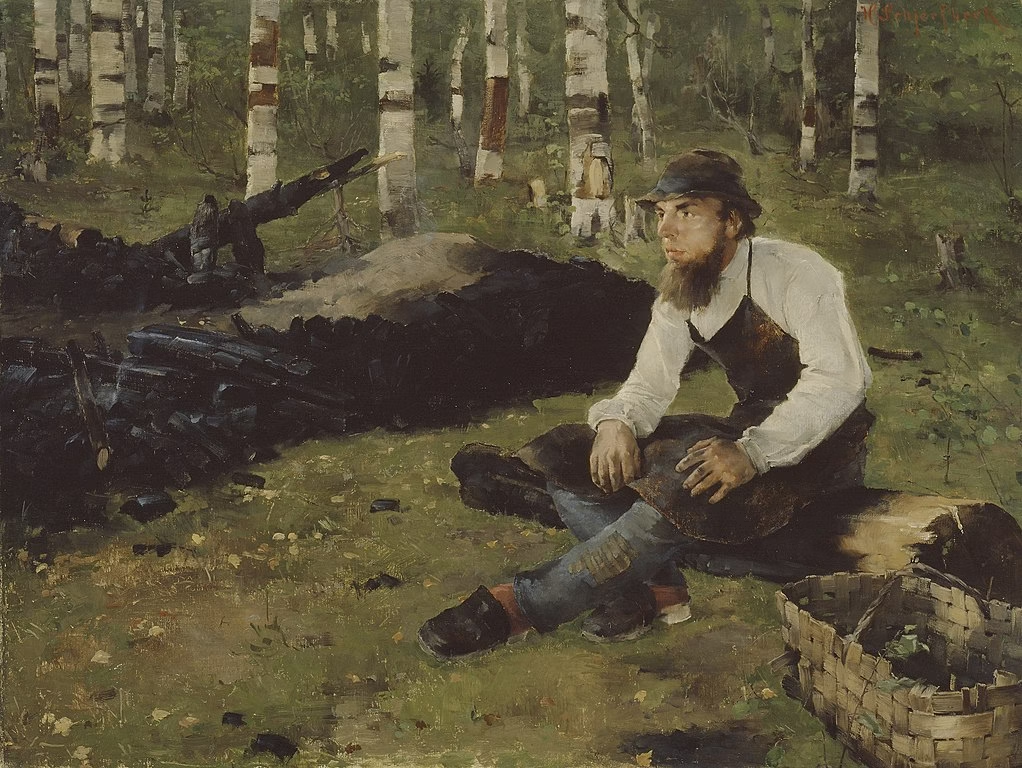
A Charcoal Burner by Helene Schjerfbeck, painting
The spirits of the forest sometimes reward humans they wish to help. One of the most vivid stories takes place near Paimpont. A young charcoal burner, tasked with tending his brothers’ kiln, falls asleep and lets the fire die out. While searching for embers elsewhere, he sees immense colored flames floating above the trees. Guided by their glow, he arrives at the Crezée of Trécelien, where nymphs and the “oak god” gather each night. The deity, hearing of the boy’s mishap, tells him: “Pick from the fire, take a log, do not return, and use it well.” Back at his kiln, the log reignites the fire, and the next day a huge gold ingot appears under the ashes. Though he becomes wealthy, the charcoal burner eventually falls into ruin, and when he returns to the Crezée to request another gift, the flames consume him. From the spot where his ashes fell grows a small stunted oak, now called “the charcoal burner’s tree.”
Another story, set near Lectoure, tells of a young boy, fatherless, who encounters a group of silent men dressed like lords, warming themselves by a large fire. Three times he asks them for embers, but they extinguish as soon as he reaches his family’s cabin. The third time, one of the strangers hands him an ember, signaling him not to return. At dawn, the men vanish — and the embers from the previous day have turned into gold.
The ladies of the woods, too, sometimes offer enchanted gifts. In Franche-Comté, fairies attending a wedding place fir branches with the bride and her companions. The next day, the bride’s branch has turned to gold, while the bridesmaids, having thrown theirs on the road, never recover them. In another story, a fairy drops beech leaves into her goddaughter’s apron, which turn into gold leaves once she returns home. Romandy in Switzerland also recounts the tale of a young boy gathering pinecones, to whom “the fairy of the mountains” promises to turn them into gold, provided he has “no evil thoughts” until he returns.
Finally, a legend from Brent tells of a group of villagers who, while cutting wood near the fairies’ domain, discover that their bag of provisions has turned into a sack full of beech leaves. Disappointed, they throw them to the wind. But upon arriving home, they realize that the few leaves left at the bottom of the bag have transformed into beautiful gold coins — a sign that the fairies, as always, give only to those who take without disdain.
5. Hidden Treasures
Lake Lucelle
In forest traditions, the “boisiers” like to tell how old woodcutters sometimes unearthed real treasures while felling ancient trees. According to these tales, chests filled with coins were hidden among the roots, as if the trees themselves had been chosen to guard secrets buried for generations. It is also said that a few years ago, in the Haute-Sève Forest (Ille-et-Vilaine), strangers came to dig at night at the base of a large oak. The next day, locals discovered freshly turned earth and the rotting boards of a chest, suggesting it had been a long-hidden stash of precious valuables.
These stories are not isolated. It is said that during the events of 1789, the treasure of Lucelle Abbey was buried beneath a tree in a small forest of the Bernese Jura. Unfortunately, when the monk who had hidden it returned a few years later, he could never find it: the tree had been cut down, along with all the surrounding ones. Legend has it that his soul still wanders the forest, condemned to endlessly search for the treasure he himself buried. (see legend)
Unlike other tales where dragons and fantastic creatures jealously guard fabulous treasures, these treasures often seem abandoned. However, in Lower Normandy, in the mid-19th century, a rumor told of an invulnerable fox guarding access to a mysterious treasure hidden in the Gouffern Forest. A fleeting, elusive presence that added a touch of mystery to this forest already famed for its shadows and secrets.








Leave a Reply