French forests carry a deep memory. Alongside the legends of penitent revenants — who reveal themselves through the sounds of instruments or hunting cries — other stories are told: those of former forest guards, of lords jealous of their lands, and of silhouettes emerging to demand justice in the heart of the night.
Some lords, passionate hunters or fierce protectors of their trees, seem never to have truly left their forest. Such is the case of the Marquis Alphonse Alexandre de BOITOUZET d’ORMENANS, known in his lifetime for roaming his woods every single day. It is said that after his death, he continued his watch. At midnight, he would appear seated on a mound overlooking the village, observing the movements of the women who went to gather wood or carry off the bundles secretly prepared. His terrible gaze and his raised finger were enough, they say, to petrify them with fear.
Stories of gamekeepers returning to fulfill their duty are numerous, particularly in the Morvan.
In a forest of the region, a gamekeeper murdered by a poacher would return every year, on the anniversary of the crime, to make his rounds. That night, no poacher dares to venture into the forest.
In the forest of Charnouveau, another guard, killed and buried at the foot of an oak, can be heard on moonless nights, calling his oxen. His voice is enough to deter anyone from approaching the area.
In Bas du Mort-Bois, Franche-Comté, a mysterious friar would only come out at night, wandering around the houses. Many believe he was imagined to frighten those who once abused the rights to deadwood that burdened the forest.
The All Saints’ Day, after sunset, a voice would still tear through the Great Coppices of Montigny-aux-Amognes : "Give me back my child!" Witnesses claim to see a headless woman, her arms outstretched toward passersby. She is said to be the shadow of a lady falsely accused of infidelity and beheaded by her husband, who had previously killed the child he believed to be illegitimate.
In the forest of Breyva, near Belfort, prudence requires a ritual: always keep a pinch of salt in one’s pocket. Without it, an invisible force would lure the traveler off their path to bring them face-to-face with the ghost of the lady of Breya, holding a red-hot key between her lips, inviting him to take it… with hers.
Other accounts speak of even stranger scenes.
In the forest of Bonlieu, a great bloodied lord sometimes appears after sunset. One night, he is said to have been attacked and strangled by cats during a sabbath.
In the forest of Caslou (Ille-et-Vilaine), one sees a priest wandering in search of a host: the spirit of a chaplain killed by his own lord at the moment of consecration.
In the forest of Parcs, municipality of Sainte-Laure, the shadow of a priest holding his breviary has been seen even in recent times, once a victim of odious violence.
2. The Templars and Their Victims
Shield bearing the Templar cross
Among the darkest tales linked to military religious orders, that of the Templars still haunts the woods of Beaucourt. Here, the revenants do not limit themselves to quiet whispers: they return every night in a terrifying uproar, condemned to eternal penance
According to local tradition, in the woods of Beaucourt one can hear the long moans and confused cries of the Red Cross knights, condemned to return to the site until the end of time. Their lamentations mingle:
with the sound of furtive footsteps,
with snapped branches,
with frantic gallops,
and with howls echoing among the trees.
For the locals, there is no doubt: these manifestations recall the unforgivable wrongdoing committed long ago by the Templars.
When the moon shines at its fullest, the spectacle becomes even more striking. One would then see thousands of ghosts emerging, dressed in a long blood-red robe. These wandering figures seem to flee in constant panic. But what chills the blood most are those who pursue them: young girls in white dresses, ghosts of the victims who, long ago, are said to have drowned themselves in despair in the Hallue after suffering the violence of the Templars. The specters of the young girls relentlessly hunt those of the knights, perpetuating a ghostly chase that repeats night after night.
3. The Murdered Cries
Popular tales speak of woods where the dead find no rest. Cries, lamentations, the clanking of chains… and so on. Here are some of the most striking accounts.
Since a murder committed at the beginning of the Revolution in the woods of La Perraudière, horrible cries seem to erupt from the undergrowth, especially on the eve of major holidays. Strangely, when mass is held once a week in the castle chapel, the clamor ceases. If the service is delayed, it resumes with even greater intensity. Many witnesses claim to have heard the “Crieux” at nightfall. In Etrépigny, it is said that the demoiselle of La Garenne would return at night to retrieve a slipper lost in the woods, letting out terrible cries.
The tales of howling revenants do not end there:
In Woods of Hell, near Guéret, one hears every night lamentations and sounds of chains.
Near of Gréolières,a spirit manifests with cries of « Ah ! Ah ! », sometimes followed by eerie apparitions.
In the forest of Varengrou, a headless man wanders with a bottle in his mouth and goes off shouting: “Alas! Alas!”
In the forest of Bredoulain, a wandering soul repeats endlessly: “Do you have it?”It is called the huyeux. According to legend, it was a sacristan who, one evening, while accompanying his priest carrying the host, had strayed to chase a hare. The priest had shouted at him: “ Do you have it ”— and at that moment, the sacristan vanished in a red glow, letting out a scream. Since then, he is said to endlessly repeat the priest’s words.
In the Woods of the Great Names, the complaints and frightening noises intensify especially on Saturdays and the eve of major holidays. People avoid entering, even in broad daylight when the coppice is tall. A peasant who ventured there suddenly heard a formidable voice shout: “Where should it be placed?” Another, just as powerful, replied: “Place it wherever you want!” In the Vaud region, it was said that those who had wronged the workers by exploiting the timber would return to haunt the forests, letting out this cry of effort familiar to lumberjacks lifting logs: “Yohouh!”
At the crossroads of the Loudéac Forest (Côtes-d’Armor), a pink oak was said to be haunted. One day, a local boy promised a servant girl a pair of fine shoes if she agreed to go, at midnight, and shout something under the oak. The young girl set off… but never returned. In the morning, her headdress stained with a drop of blood and her clogs were found at the foot of the tree. Since then, it is said that one can sometimes hear a voice from the oak shouting: “Give me back my shoes!” A similar legend is told in the Puy-de-Dôme: a young girl, challenged to go to a dangerous part of the Forest of the Tree, disappeared. A statuette on a stone cross, depicting a woman in prayer, keeps the memory of her ordeal alive.
Around Pontarlier, a spirit nicknamed the Weeper of the Woods is said to emit plaintive sounds, sometimes taken for the cries of a person in distress at the edge of a cliff, and other times for the lamentations of a lonely soul wandering in the depths of the forest.
4. The Whistlers
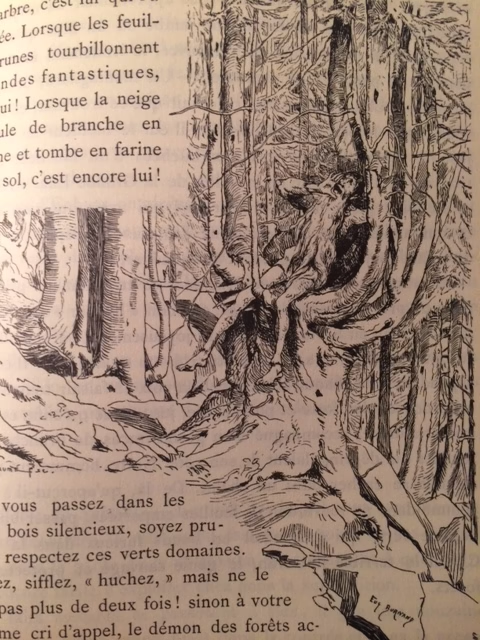
The Hutzeran as depicted by the painter Eugène Burnand
Some creatures make themselves known by their shrill calls, mysterious cries, or echoing games. They are called “hucheurs”, from the verb hucher, meaning to call out loudly. These beings, sometimes playful, sometimes dangerous, inhabit the deep forests of Switzerland and France, where their memory remains vivid.
The Hutzeran, whose name in the local dialect comes from hutsi (to call out), is described as a tall fellow entirely dressed in green, hiding within the thick woods. His voice, sometimes clear and resounding, sometimes muffled, echoes through the valleys, makes the echoes vibrate, and awakens the fairies slumbering beneath the canopy. He is said to be:
lying on the moss,
or perched atop the tallest firs.
Every strange phenomenon seems to be attributed to him: whether a dry branch falls, a whirl of brown leaves rises in the wind, or a light snow drifts from branch to branch, it is still him. Advice from the elders: in the great silent woods, sing, whistle, or call — but never more than twice. At the third shout, the Hutzeran rushes… and he is not known for his gentleness.
In the Eagle and Oron mountains, his memory has been perfectly preserved. In Panex, it is still said that this temperamental spirit could go so far as to seize a traveler, tear off an arm or a leg, which would nevertheless be found the next day… gently placed at their doorstep. This creature is therefore not only noisy: it is also fearfully capricious.
On the wooded hill of Beauregard, an old path — the Comme-du-Vau — was once avoided at night because of the apparitions seen there. Terrible voices would rise from the thicket, shouting: “Comme-du-Vau, y seu!” Or: “If you had neither bread nor salt, in the Comme-du-Vau you would remain.”Bread and salt were considered essential protections against malevolent spirits. Those who carried none risked remaining trapped in the place.
In the woods of Warnecourt, another figure is mentioned: a sprite dressed entirely in red, dancing at night while singing “Ah! oh!”, set to the notes la – fa – ré. He was nicknamed the bauieux of the Bois de Prix. A spirit more playful than dangerous, yet equally mysterious.