Master Huntsman and Fantastic Noises
1. Sounds of traveling spirits

Since the Antiquity, certain strange phenomena in the woods have been attributed to supernatural forces. Lucan, in his description of the Forest of Marseille, already spoke of trees bristling and shivering without the slightest breath of wind. (read Camille Jullian’s article)
In the 19th century, these events still stirred fear among peasants. Around 1840, in the Bugey region, the inhabitants of a village were terrified when they saw the trees of a small woodland twisting and producing terrifying noises, while other trees remained motionless. The owner tried to explain the phenomenon as a whirlwind, but the villagers remained convinced that a legion of spirits had invaded the woods, uttering cries of pain and casting sadness over the valley.
A woman from Les Abrets (Isère) confirmed a similar experience to Désiré Monnier in 1843. Two years earlier, while she had gone to cut wood, the trees around her had bent and twisted without any wind. She attributed this phenomenon to traveling spirits. In Alsace, people told that the giant of the Forest of Kasten caused hurricanes that shook trees and bushes, reminding everyone of the mysterious power of the forests.
The sound of the wind in the trees has inspired strange legends. When this breath intertwines with the sounds of distant instruments, it seems as though the forest comes alive. Long ago, in the woods surrounding Cithers, people said that after dusk, one could hear the sound of a mysterious lyre.
According to the stories, one had to flee quickly, plugging their ears, away from the magical chords, lest they be irresistibly drawn in by the melody. Those who succumbed to this enchantment saw astonishing visions: the forest moss would be covered with flowers sparkling like diamonds, and women of supernatural beauty would emerge from trees with branches of gold and silver. But this wondrous world vanished with the first rays of daylight, leaving only mocking laughter and sometimes a mishap: finding oneself in the middle of a pond or trapped among brambles.
A revenant, who about a century ago lived in the communal woods of La Motte, played the flute and blew the horn. It was said that at the Sabbath, he conducted an infernal orchestra, especially on the night from Friday to Saturday. At midnight, everyone would come out to listen, but no one dared approach the burrow.
In the Forest of Long-Boël (Seine-Inférieure), when the wind blows melodiously through the branches, it is believed that one can hear the horn of the ancient greenfinches, whose souls still haunt these places. Near Dôle, a beautiful White Lady makes the echoes of the Forest of Serre resound with her oliphant. Some traditions, however, depict her as a mischievous, wrinkled dwarf, bent over her hazel staff, capable of troubling unwary travelers.
2. The Grand Huntsman and his kin
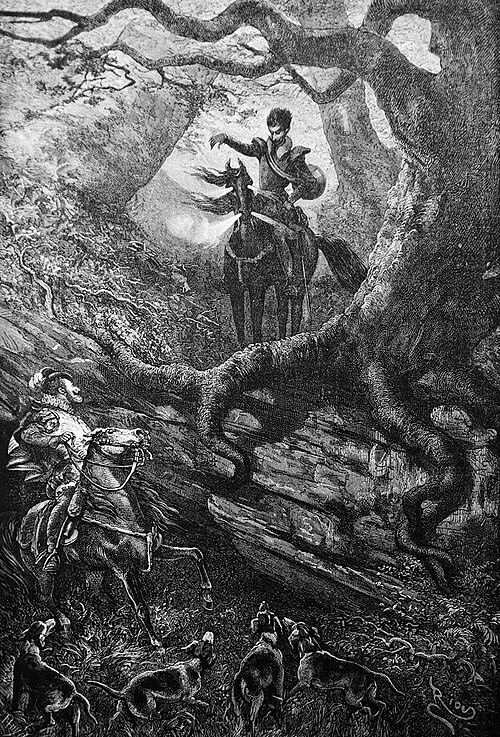
Somes French forests are reputed to be haunted by noisy characters from the otherworld. These specters sometimes appear alone, sometimes in packs, blowing into loud instruments and accompanied by fantastic dogs. The most famous among them is The Grand Huntsman, sometimes called Monsieur de Laforêt. The historian Mathieu and several of his contemporaries mentioned him, and Dom Augustin Calmet also cites him. According to him, based on the Memoirs of Sully (written by <a href="https://fr.wikipedia.org/wiki/Maximilien_de_Bthune_(duc_de_Sully) " target="_blank
« C’étoit un Phantôme environné d’une meute de chiens dont on entendoit les cris, et qu’on voyoit de loin, mais qui disparoissoit lorsqu’on s’approchoit. »
“It was a Phantom surrounded by a pack of dogs whose cries could be heard, and which could be seen from afar, but vanished when approached.”
The editor of the memoirs, M. de l’Écluse, notes that M. de Pèrefixe mentions this specter, who uttered in a hoarse voice one of these three words:
“Do you wait for me, or do you hear me, or do you command me?”
It was then thought to be the work of sorcerers or the Evil Spirit.
The Journal of Henry IV and the Seven-Year Chronology also report this phenomenon, which is said to have frightened Henry IV and his courtiers. Pierre Mathieu, in his History of France, and Jacques Bongars also mention this ghostly huntsman, asserting that he was a hunter “killed in this forest” during the time of Francis I. Today, the specter seems to have disappeared.
Yet, according to local traditions, the Grand Huntsman was not completely forgotten: he is said to have reappeared shortly before the tragic death of the Duke and Duchess of Burgundy, predicted the end of Louis XVI, and then that of the Duke of Berry. After the Revolution of 1830, he reportedly appeared much more rarely, although some guards recounted that he would sometimes blow his horn during stormy nights.
3. Fantastic Hunts
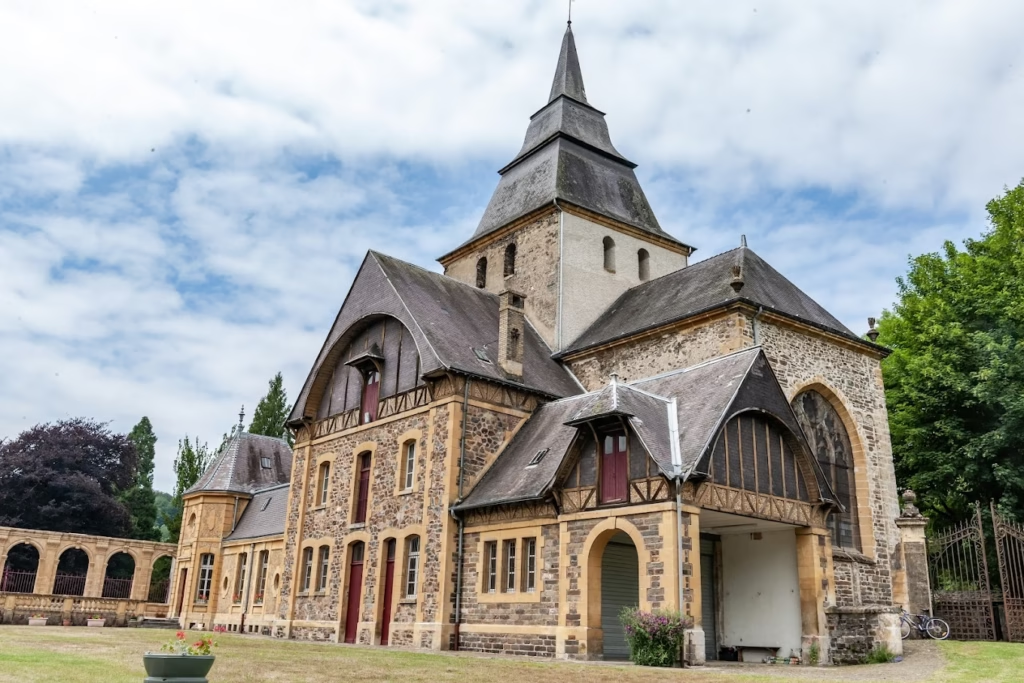
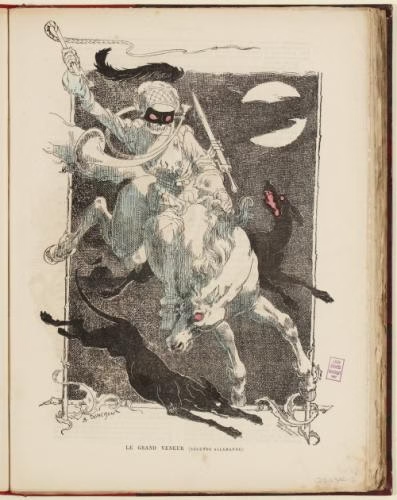
Certain French and Ardennes forests are reputed to be the scene of appearances by fantastic hunters, noisy and fearsome specters who emerge at nightfall. Near the Cure, the Rock of the Grand Huntsman is associated with a legend similar to that of Fontainebleau, and its appearance is said to coincide with major national events. In Grivegnée, in the 14th century, it was said that a fantastic hunter rode through the woods at a furious gallop, accompanied by two dogs that he distinctly called: “Tah! Pouah!” (read the legend)
In the Forest of Escombres, a huge giant hunted with tiny dogs. Anyone who touched one of his dogs was severely punished by the master, who would say: “The day belongs to you, men; but the night belongs to me!” Between Cornet and Châtel, in the Ardennes, the inhabitants heard—especially during storms—the barking of dogs, the sounding of horns, and an infernal fanfare, accompanied by cries: “Tally-ho!” Fleeing was impossible: an invisible force pinned witnesses in place. Then, a thousand little white dogs bearing bells would appear, followed by a hundred gigantic mastiffs, and finally a halberdier wearing a red sash, surrounded by his huntsmen, on foot and horseback, pursuing an imaginary quarry. After crossing rivers and streams, the vision would vanish, and the noise would die away.
About two hundred years ago, a monk from the Laval-Dieu convent, passionate about hunting, let himself be drawn into the forest and saw a fox cub, which he killed, thinking it was a wolf. At that moment, the devil appeared to him and offered a deal: to sign a parchment in exchange for a sum of money. The monk refused, but the devil warned him:
« Soit ! j’emporte ton âme et ton corps. Si tu signes, ton âme seule m’appartiendra et ton corps te restera ; mais tu feras toutes les nuits treize fois le tour des Grands Bois en criant : Taïaut ! taïaut ! et en excitant les chiens comme si tu étais à la chasse. »
“Very well! I will take both your soul and your body. If you sign, only your soul will belong to me and your body will remain yours; but every night you will circle the Great Woods thirteen times, shouting: Tally-ho! Tally-ho! and urging on the dogs as if you were at the hunt.”
The monk accepted and became the famous Ouyeu, the nocturnal crier of the forest, roaming the Great Woods each night shouting: “Ouh! ouh! ta! ta! tally-ho! tally-ho! tally-ho!” In the 19th century, his procession was still heard in the Forest of Illzach, accompanied by the barking of imaginary dogs. (read the details)
Around 1835, in the Forest of Gâvre, there was talk of the Maupiqueur, a spectral hunter holding his black dog on a leash. The presence of the Maupiqueur signaled the great hunt of the damned, a sign of imminent death for anyone who crossed his path. Nicknamed the “Harbinger of Sorrow”, his eyes would blaze when he uttered these words:
« Fauves par les passées,
Gibiers par les foulées,
Place aux âmes damnées ! »
“Beasts through the passes,
Game through the tracks,
Make way for the damned souls!”
4. Wicked lords
Some fantastic hunts in the forests were led by damned lords, condemned to wander eternally for their cruel deeds toward their vassals. These cursed nobles are often compared to the chorus leaders of aerial hunts, endlessly returning to pursue imaginary prey.
The damned soul of the Sire de Coët en Fao, a Huguenot gentleman known for his licentious life and cruelties toward Catholics, still haunts the Forest of Teillay. It is said that he appears sometimes on foot, sometimes on horseback, or even in a carriage, hunting, calling his dogs, and vanishing in the blink of an eye. At times, only the sound of his horse’s bridle or the tone of his voice testifies to his presence.
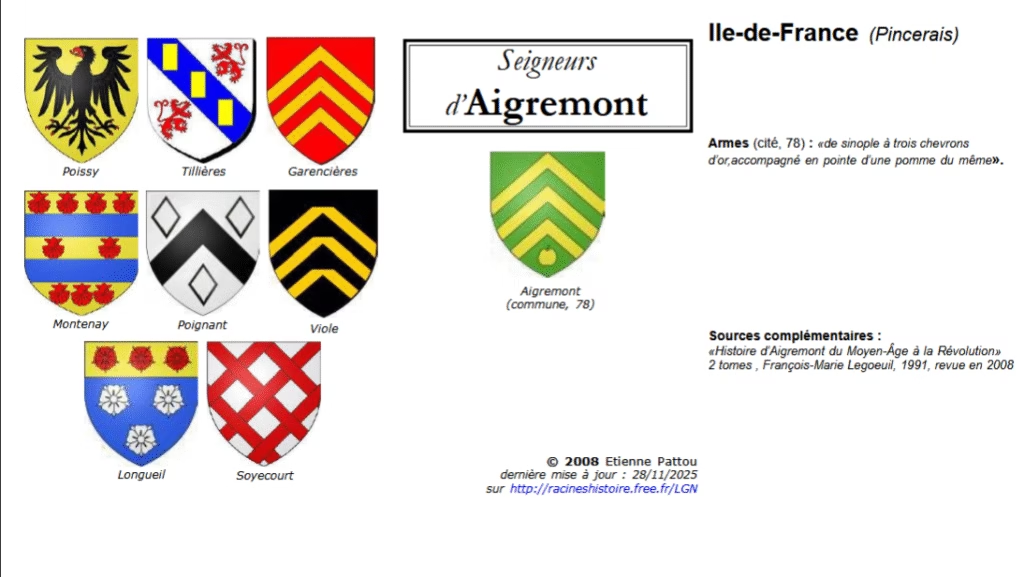
Similarly, long ago, the Barons of Aigremont terrorized the poor inhabitants. A legend tells that a peasant who had caught a hare with a snare to feed his sick wife was hunted down by the lord’s dogs and torn to pieces in seconds, leaving only bloody scraps. The next day, the baron’s hounds drove a large wolf, unknown to these woods, and the hunt began. The wolf, fast and powerful, sometimes outpaced the dogs; only the baron could keep up, surpassing his huntsmen. When the last dog lay down, the lord’s horse stopped as well. But the wolf returned to his trail and charged straight at the baron. Terrified, the hunter was hunted in turn and could neither stop nor be rescued. This supernatural chase is known as the Hunt of the Baron of Aigremont:
« Pendant mille ans, lui et ses ancêtres ont rançonné le pays, égorgé ses habitants ; pendant mille ans il sera chassé par le loup, sans trêve ni merci. »
“For a thousand years, he and his ancestors have ransomed the land, slaughtered its inhabitants; for a thousand years he will be hunted by the wolf, with no respite and no mercy.”
It is said that the wolf’s voice still sometimes echoes through the woods, in the silence of the night, reminding the inhabitants of the curse of the cruel lords.
5. The Impious

Impious lords and hunters are condemned to wander for eternity because of their excesses and profanations. In Bohan (Semois), around 1870, the story was told of a lord from the previous century who, after a trial over communal woods, returned to hunt in the Forest of La Fargne until the day of his destruction.
An inhabitant of Sugny, boastful at the tavern, claimed he would not fear the revenant and would even invite it for a drink if he encountered it. But when he entered the forest around eleven o’clock, he heard the sound of a horn and approaching barking. Terrified, he fell face down and then saw hundreds of dogs appear, followed by hunters mounted on horses whose nostrils spewed flames, and at the center, the Lord of Bohan, with a cadaverous face and eyes of fire. The hunt swept through the forest for an hour, leaving the poor man pinned to the ground, before he could make his way home, bruised and sick with fear, remaining for several weeks between life and death.
Other stories of impious hunters abound in local traditions. The Hunter of Lomont, for example, had profaned the Sabbath by sending his pack into a widow’s field. He is condemned to pursue, day and night, a stag he will never catch. This legend belongs to the cycle of aerial hunts, where the coryphée is punished for having violated the Church’s holy days.
Thus, along the banks of the Semois, it is said that a Count of Herbaumont (Belgian Luxembourg), hunting on a Sunday despite warnings from a guardian angel, pursued his game into a chapel and insulted the hermit, only to be immediately confronted by Satan himself:
« Aussitôt Satan apparaît au milieu des éclairs, tord le cou du blasphémateur, de façon à le lui tourner vers le dos, au même instant, une meute infernale sort de la terre qui s’était entrouverte, et ils le poursuivront jusqu’à la fin du monde. »
“Immediately, Satan appeared amidst the lightning, twisted the blasphemer’s neck so that it faced backward, and at the same moment, an infernal pack emerged from the earth, and they will hunt him until the end of the world.”
In the Vosges, the Bois des Baumes near Vittel is haunted by the soul of Jean des Baumes, who, having hunted on Sundays and feast days, is condemned to pursue game eternally, his voice urging on the dogs. In Pagny, it is said that Admiral Philippe Chabot hunted before Christmas despite the midnight Mass, but his curse seems to have ended today. In Alsace, the nocturnal hunter sometimes takes the form of a headless giant or carries his head on his arm, chasing a disheveled woman before his pack.
To protect themselves from these aerial hunts, certain methods were considered effective, although few have been preserved and they were specific to particular forests. Pierre de Ronsard mentions in his Hymns a conjuration in which iron—a metal abhorrent to spirits—is used to drive away apparitions:
« Si fussé-je estouffé d’une crainte pressée
Sans Dieu qui promptement me meit en la pensée
De tirer mon espèce et de couper menu
L’air tout autour de moy avecques le fer nu ;
Ce que je feis soudain, et sitost ils n’ouyrent
Siffler l’espée en l’air que tous s’esvanouyrent,
Et plus ne les ouys ni bruire ni marcher. »
“I would have been smothered by a pressing fear
Had not God, who swiftly came to my aid, put it in my mind
To draw my blade and finely cut
The air all around me with the naked steel;
This I did at once, and as soon as they heard
The sword whistle through the air, they all vanished,
And I heard them no more — neither rustling nor walking.”
6. The Meal After the Hunt
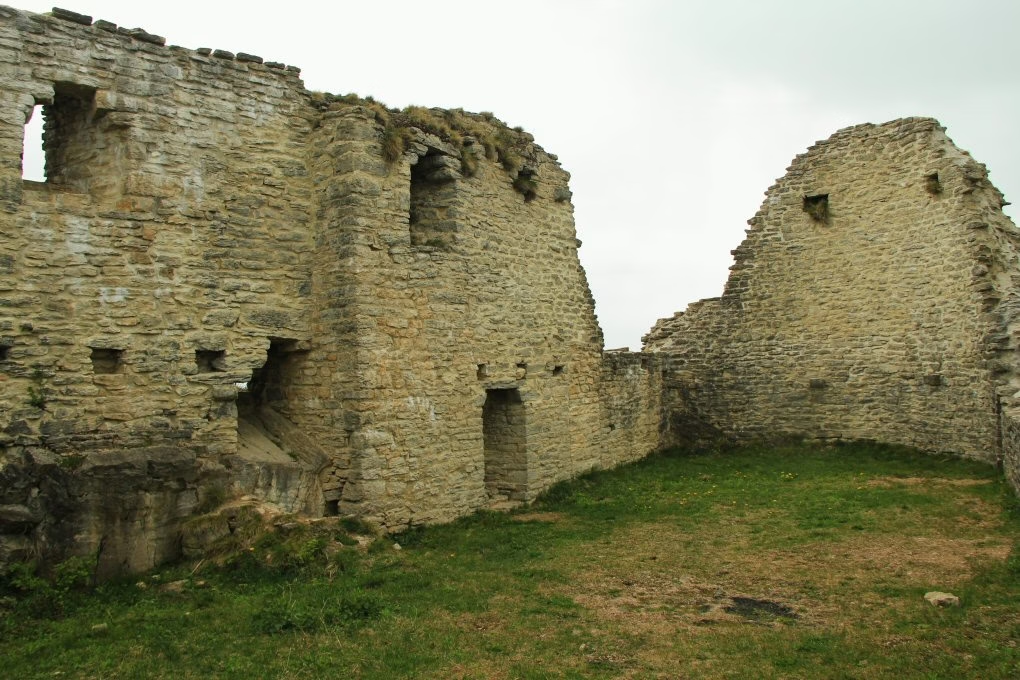
Sometimes, legends tell that the ghostly hunters do not disappear immediately after the hunt, but take part in actual forest feasts. One account, unique until now, attests to this. A forest ranger recounted that one morning, while walking through the woods of his district, at the foot of the mountain near the ruins of Oliferne Castle, he suddenly heard the sound of hunting horns. Intrigued, he followed the noise to a clearing, where he discovered an extraordinary scene: beneath a large oak, lords, ladies, and servants seemed engaged in a meal in the middle of the forest. Some ate on the grass, others tended the horses or fed an impressive pack. Astonished but fascinated, the ranger stepped back to avoid being seen and took a slanted path to move away from the group. However, unable to tear his eyes away, he continued to admire the spectacle… and when he dared to look again, everything had vanished, as if the clearing and its inhabitants had never existed.
References :
Croyances, mythes et légendes des pays de France, Paul Sébillot
CII. Lucain historien, la forêt sacrée du terroir Marseillais, Persée, Camille Jullian
Mémoires de Sully, Maximilien de Béthune – duc de Sully
Journal de Henri IV, Pierre de l’Étoile
Chronologie septennaire
Histoire de France, Pierre Mathieu
Hymnes, Pierre de Ronsard