Even in houses said to be haunted, where the dead sometimes return or elves lurk, the dangers of the night were less feared than those awaiting those who dared go outside once the earth was shrouded in darkness. For some, the risk began even before darkness was complete: twilight was already a time of threats.
In Saintonge, great care was taken not to let children linger at dusk, for fear that witches would abduct them to take them to the sabbath. In the region of Fougères, a rule persisted: children under seven years old were not to venture outside alone after the Angelus had rung. On the coast of Upper Brittany, the danger took another form: elves or fantastic animals could seize young fishermen lingering on the shores. Elsewhere, inland, children were still threatened by the mischief of twilight spirits. Today, these stories are mainly used to scare the young and prevent them from wandering too far from home.
But at the onset of true night, fears became far more serious. Nocturnal hauntings were considered real by many adults. Countless spirits then populated the countryside, some even claiming the night as their exclusive domain. They wandered relentlessly until the rooster crowed, the messenger of dawn, calling them back to their mysterious dwellings.
2. Spirits of the night
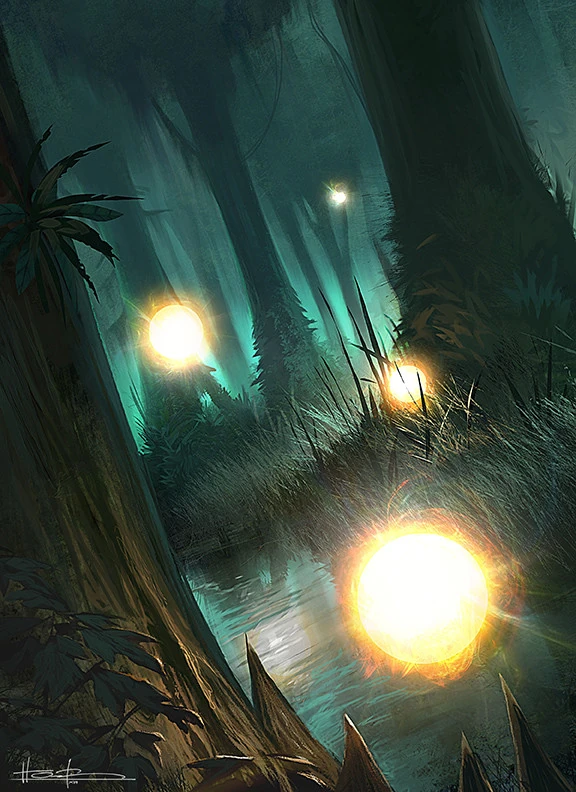
Will-o’-the-wisps
Contrary to what one might imagine, the darkness doesn’t really have a single “spirit” uniquely associated with it in popular tradition. The mysterious Master of the Night appears only in a Gascon tale, where he is simply described as wielding “great power between sunset and sunrise.” But his role remains anecdotal and has never truly fueled the collective imagination.
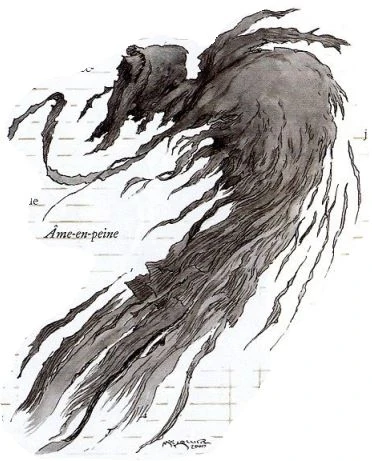
According to legends now almost forgotten, fairies sometimes appeared at dusk or by moonlight. They hardly frightened humans, unless someone ventured too close to their places of entertainment. Sprites, on the other hand, appeared more often. In the form of dwarves, will-o’-the-wisps, or strange quadrupeds, they were said to haunt rivers, forests, rocky outcrops, and even megalithic monuments. Yet, there is another category: wandering spirits of the night, without a fixed residence, roaming paths and fields once night falls.
The most feared apparitions remained those of the Devil, Death, or the departed. A widely held belief was that the earth belonged to them as soon as darkness fell. Certain hours were considered particularly auspicious: in Lower Brittany, the revenants appeared mostly between ten o’clock at night and two in the morning. In Upper Brittany, the same time frame was regarded as when the Devil held sway. As for the Breton coasts, his influence extended from midnight to dawn, a period feared by the inhabitants.
3. Hours of Greatest Danger
Nearly Midnight
European folklore attributes a special power to midnight. It is “the witching hour”, the time when wonders are revealed but also when terrors roam. In Brittany, it was believed that the dead opened their eyes at this exact moment, while elsewhere, it was the time when one was most likely to encounter nocturnal powers.
In the Mentonnais region, however, evil spirits were even more active during the half-hour leading up to midnight. This magical hour also had a revealing power: it was said that the land and sea could then part to reveal buried treasures or submerged buildings.
In Gironde and Beauce, tradition held that the odd hours, between dusk and dawn, were the most dangerous. In Lower Brittany, they marked the time when the sprites unleashed their mischief and when the mysterious night washers went out to perform their supernatural tasks. Paradoxically, these same hours allowed one to cross cemeteries safely. The dead themselves seemed to favor certain days of the week: in Picardy, it was said that they returned mostly on Saturday at midnight, while in Upper Brittany, a specific night was reserved for them.
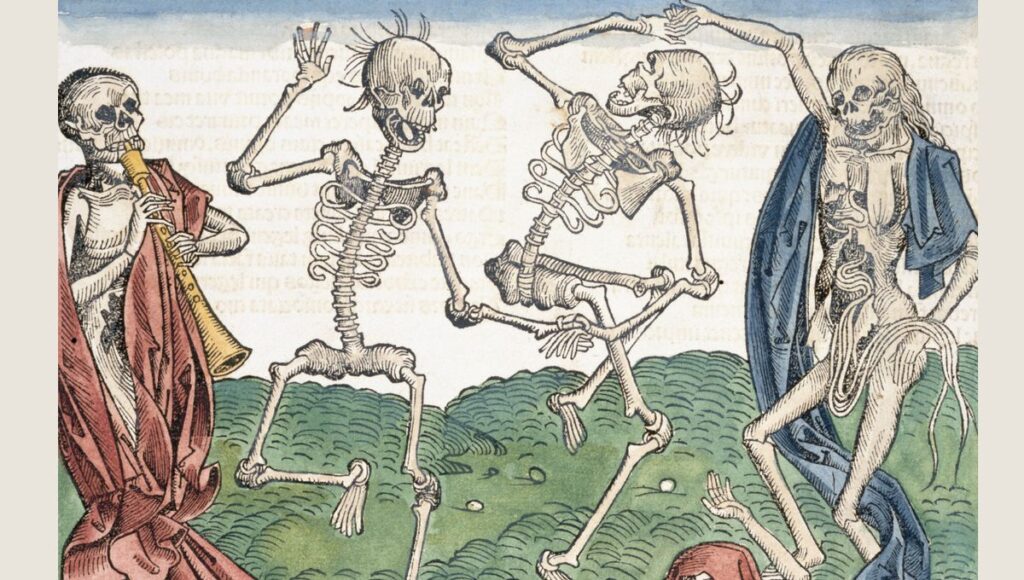
Nocturnal apparitions were far from abstract. The departed appeared in their familiar form: face, posture, and clothing almost intact. Those who appeared draped in a shroud had generally been dead for a long time or revealed themselves to strangers. Rare were the revenants in skeletal form. Some tormented dead rose from their graves to atone for their sins. They could be seen kneeling on tombs, gathered at the foot of calvaries, or even dancing macabre rounds around crossroads crosses. Their penance sometimes lasted for years, and if a living person had the imprudence to interrupt them, they were forced to start over… taking cruel revenge in the process.
In Armorica, where this folklore was best documented, the revenants retained their old passions: jealousy, anger, grudges. Some went so far as to frighten or harm the living, unable to find peace. In Lower Brittany, people even believed in the existence of evil dead, guilty souls whom only a conjuration could release from the community.
4. Screaming Dead; Boundary Shifters
A deildegast, the Norwegian boundary-shifter
Unlike the hostile ghosts of legend, some revenants do not seek to frighten nighttime travelers. On the contrary, they call for compassion. Their torment often consists of repeating, with an accent of anguish, the same phrase or exclamation meant to draw the attention of the living. Only by receiving an appropriate response or gesture can they finally end their wandering.
Among these tormented souls is a very particular category: that of the boundary-shifters. Tradition, noted in Auvergne, Lower Brittany, and the Côtes-d’Armor, holds that anyone who fraudulently moved a boundary stone is condemned to carry it endlessly – on their shoulder, in their arms, or on their head – while vainly searching for the exact spot to replace it. Their heart-wrenching cry, « Where shall I put it? », echoes through the night. Deliverance comes only when a Christian responds: « Put it back where you took it from. » But the conditions vary by region: in Ille-et-Vilaine, only the wronged owner could indicate the precise location, whereas in the Côtes-d’Armor, the answer had to be given on the hundred-and-first year…
In Morbihan, it was believed that the stone had to be replaced in the presence of a witness, just as in a proper boundary-marking ceremony. In Belgian Luxembourg, a revenant who had moved the boundary of a forest would scream his despair every night. The villagers ended his suffering by gathering together and shouting three times in unison: « Put it back where you took it from! » From then on, he was never heard again. These legends sometimes add a striking visual touch: in the Ardennes, the replaced stone would appear blackened and marked with red spots, as if burned by the culprit’s fiery fingers. In Romandy, Switzerland, finally, the boundary-shifter did not appear in human form, but as a strange light, a wandering fire.
5. Souls in Distress
In the country of Lannion, tradition tells that a wandering spirit is actually the soul of a young man lost because he loved dance, gambling, or the tavern too much. Invisible, he crosses the countryside, crying in a heart-wrenching voice: « Ma Momm! ma Mère! » Only a prayer recited on the spot, such as the De profundis, can bring him rest. Another revenant, condemned to endlessly repeat « Sed libera nos a malo! » (Deliver us from evil!), could find peace only when a charitable soul dared to respond: « Amen! » (François-Marie Luzel, Christian Legends, vol. II, pp. 339-340).
In the Vosges, accounts are plentiful as well. A benevolent revenant used to guide lost travelers back onto the right path. He spoke only a single word: « Kyrie ». One day, a passerby said to him: « You would do well to say Kyrie eleison once. » Immediately, the spirit vanished and never returned. Another Vosgian ghost, condemned to repeat the same word, finally found deliverance thanks to a drunkard. The latter, singing « Kyrie eleison » as he passed by, triggered the soul’s release, which declared: « For a hundred years I had awaited these good words to be freed from Purgatory. » (Léopold-François Sauvé, Folklore of the Upper Vosges, pp. 304-305).
These accounts show that tormented souls are not always malevolent. Their wandering is often linked to a spiritual lapse or a minor fault, and their only desire is to receive help from a living person: a prayer, a response, or a sacred word.
6. Children of Limbo
Children of Limbo, picture
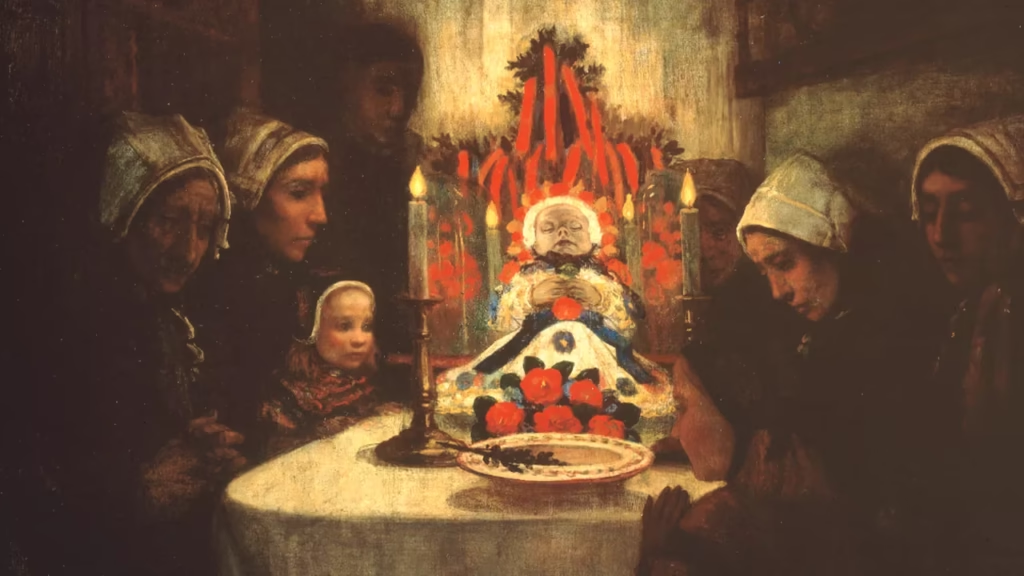
According to a belief still alive in some regions of the Center of France, children who died unbaptized emerge from limbo each night. They return to earth, hoping that a living person will agree to become their godfather or godmother and finally grant them baptism, the only key to enter Paradise. A story from the Puy-de-Dôme recounts that a vintner, setting out early to his vineyard, was suddenly surrounded by a multitude of children dressed in white, « even smaller than newborns ». They cried insistently: « He is not your godfather, he is mine! » Understanding their distress, the man took water from a nearby stream and sprinkled it on them, saying: « I am your godfather to all of you, my children! » Immediately, the little souls disappeared, shouting: « Many thanks, godfather, many thanks! » (Paul Sébillot, Oral Literature of Auvergne, pp. 107-108).
Another version, reported in Limousin, tells the story of a man crossing a chestnut wood on a moonless night. He heard plaintive voices above his head: « He is my godfather! — No, he is mine! — He is not yours! » Moved by these calls, he replied: « I am the godfather to both of you! » By uttering these words, he freed the souls of two unbaptized children (Joseph Roux, in Lemouzi, March 1894).
In Lower Brittany, the belief takes another form: the souls of unbaptized children wander in the sky in the guise of birds. Their faint cries resemble those of an infant. In the Autunois, as Christmas approaches, peasants say they hear the moans of children three times, accompanied by the rustling of wings. These are said to be the same little tormented souls, condemned to wail until a living person offers them eternal rest.
7. Apparitions of Coffins
Christian Coffin
In popular beliefs, encountering a coffin at night is as feared as seeing a dead person. In Lower Normandy, around 1840, it was said that a damned soul rested there. In Upper Brittany, the coffin housed a tormented soul, condemned to wander until its deliverance was achieved. These visions are not mere omens: they are directly connected to the idea of Purgatory and the souls seeking relief there.
The first form of apparition is that of a stationary coffin, often located near cemeteries or fields. In Lower Normandy, they were seen balanced on the cemetery steps. In Upper Brittany, coffins appeared on the field steps. To pass safely, one had to respectfully turn the coffin over and place it back exactly where it had been.
Around Dinan, this phenomenon was explained as follows: these coffins were occupied by the deceased, compelled to go and atone for their sins at a specific location. When they reached fences, they could not cross without the help of a living person. Whoever had the charity to turn the coffin and place it on the other side would then hear a voice whisper: « You did well. »
The gesture, however, was not without consequence: the charitable passerby would die shortly afterward, but was assured entry into Paradise, for having freed a tormented soul. In Ille-et-Vilaine, the belief took a slightly different nuance: seeing a coffin was an omen of death. However, the apparition would disappear as soon as the shroud covering the coffin was properly tucked in.
8. Coffins on Steps and Moving Coffins
Group of Coffins
The French countryside is full of tales in which paths, fields, and even steps become the stage for strange visions. Among them, coffin or bier apparitions hold a special place: mysterious obstacles, ominous signs, or messengers from the world of the dead, they have been recounted for generations. From Brittany to Provence, passing through Normandy and Berry, these nocturnal visions feed local traditions, hovering between spiritual warnings and popular superstitions.
In the Côtes-d’Armor, some steps were reputedly haunted. Paul Sébillot himself recounts a night when, by moonlight, a vertical stone surrounded by trees appeared to him as a coffin draped in a white shroud. From a distance, the illusion was perfect: the shadow of the branches traced the shape of a coffin. A natural explanation, yet enough to feed the belief in these unsettling apparitions.
In many regions, coffins appear on paths to block the passage of travelers.
In Provence, a “death chest” adorned with four candles appears to those who make the sign of the cross at the sight of a will-o’-the-wisp.
In Lower Normandy, a “death chest”, adorned with four candles, suddenly appears to anyone who makes the sign of the cross upon seeing a will-o’-the-wisp.
To pass safely, one had to act with respect:
in Provence, set the coffin down at the side of the path;
in Lower Normandy, carefully turn it over;
in Berry, Auvergne and Upper Brittany, accompany the action with a prayer. A voice would sometimes rise: « You did well! »
Some apparitions vanished after a simple prayer. In the Creuse, a coffin flanked by candles disappeared at the end of an oration, returning to a nearby chapel.
But beware those who acted with disrespect:
In Berry, jumping over a coffin condemned the traveler to become hopelessly lost.
In Lower Normandy, peasants were beaten by invisible hands.
In Upper Brittany, a young man who kicked a coffin saw it rise and follow him, repeating: « Oh my head! »
In Lower Brittany, the superstition takes another form: the coffins are not placed on the steps, but carried by ghosts. They announce the imminent death of a resident, or take their place in a cart followed by a spectral procession.
A particularly striking legend recounts the vision of an impending funeral: a man sees a cart drawn by four black oxen, guided by the Ankou, the personification of Death. The coffin, draped in a white shroud, sets itself down in front of the church. When the coffin opens, the man discovers… his own double inside. He died two months later.
The accounts of phantom coffins illustrate how deeply the countryside associated nighttime paths with the unseen. Between moonlit illusions, supernatural warnings, and traditions tied to respecting the dead, these apparitions form a fascinating part of French folklore.
They remind us that, in folk beliefs, the line between the living and the dead can be as delicate as a shadow cast on stone.
9. The Ankou and His Chariot of Death
The Ankou on His Death Cart
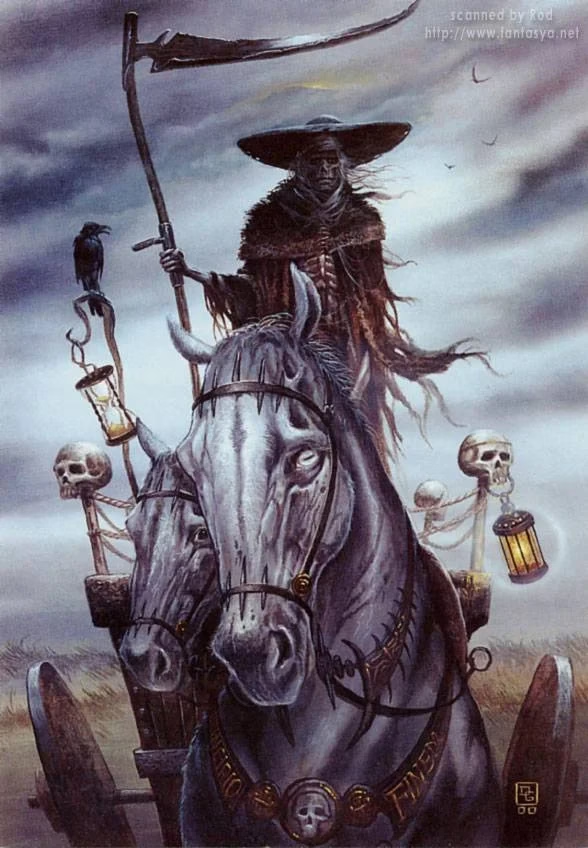
The Lower Brittany region is the setting of one of the most fascinating and unsettling tales in French folklore: the Chariot of Death, driven by the Ankou, an emblematic figure of death personified. Known by several names, this funerary cart was reported as early as the end of the 18th century. Around Morlaix, people spoke of the Wheelbarrow of Death or Cariquel-Ankou, a vehicle covered with a white cloth, sometimes driven by skeletons, whose passage could be heard as a sign of an impending death.
The earliest mentions, such as those by Cambry at the beginning of the 19th century, describe a cart or a wheelbarrow carrying the dead, without a clearly identified single driver. But over time, the Ankou becomes a powerful, speaking character — a sort of male divinity of death, the executor of divine will according to Léon Marillier and Anatole Le Braz. Representations of the Ankou can still be found in the rural churches of Landivisiau, Bulat, Cléden-Poher, and in Plumilliau, where he once stood upon the altar of the dead.
The Ankou’s chariot, or Karr an Ankou, is often described as a small cart covered with a white shroud, drawn by horses — black or white depending on the version — and accompanied by skeletons or walking companions who open doors and gates along its path. The sound of the creaking axle is universally reported, sometimes attributed to the cry of a toad.
In the Trégor region, the chariot is pulled by two horses aligned in tandem: one thin and gaunt, the other fat and well-fed. The Ankou stacks the dead he has reaped, while his team and companions make transport easier. In Morbihan, the Wheelbarrow of Death may simply warn of an inhabitant’s imminent passing, or carry the souls of the deceased.
This belief extends beyond Brittany: in Ireland, the dead coach is a black carriage drawn by four headless horses; in Cornwall, it is a coach heard around midnight. Even in the Grand Duchy of Luxembourg, a carriage drawn by four black horses and driven by a dwarf foretells an approaching death.
The Ankou appears primarily as a harbinger of death or a conveyor of the dead. In certain parishes, he is identified with the last deceased person of the year, a role that grants him local and specific attributes. In Lower Brittany, material traces are said to bear witness to his passage: wheel marks on calvaries or ruts on rocks.
Sometimes the chariot appears in surprising forms: a creaking miller’s cart drawn by twelve pigs, or a small vehicle pulled by dogs, as in Pontchâteau or Malestroit, whose passage foretells the death of a local inhabitant. In the Dinan district, the Grand’Cherrée transports the dead of a given area, though rarely, and only when they are not buried in their own parish.
Outside the Armorican peninsula, traditions linked to the funerary cart are found mainly in neighboring Lower Normandy. There, the Cart of the Dead, drawn by black oxen, travels only along old abandoned paths, never across blessed fields. It carries a coffin covered with its white cloth and surrounded by lit candles.
If a traveler happened to be in its path, they had to step aside without saying a word, make three signs of the cross, then recite a Pater and an Ave to avoid any danger. Investigations carried out at the request of Paul Sébillot in other regions — Lorraine, Bourbonnais, Nièvre, Lauragais, Languedoc, Champagne — revealed no comparable tradition, confirming the localized nature of this folklore.
In certain communes of the Côtes-d’Armor, the Miller’s Cart is sometimes assigned a particular role: it is said to be driven by the devil, who shouts: “Beware the passage of the ditcher!” and carries off or kills those who do not step aside in time. It is also said that people captured by this diabolical vehicle had to “turn into beasts” each night and run until they were wounded and bleeding. In this context, the cart seems to function as a tool for recruiting new followers of lycanthropy.
In several regions of France, funerary vehicles associated with the Chariot of Death appear at specific times of the year, announcing the death of certain inhabitants. In Donges (Loire-Inférieure), located on the former border between Breton and French-speaking areas, the Charrizot appears every Christmas Eve. This ox-drawn cart stops in front of the house of the person destined to die within the year. Those lucky enough to see it can even predict the exact appearance of the funerary cart that will carry off the deceased, down to the color of the oxen pulling it.
Around 1840, in a suburb of Dieppe, a similar funerary cart roamed the streets at midnight on All Souls’ Day. Drawn by eight white horses and preceded by white dogs, it allowed people to distinguish the voices of the deceased of the year. The inhabitants, warned by the passage of the cart, hurried to close their doors, aware that those who glimpsed the vehicle were destined to face imminent death.
In Malestroit, the Charretée appears on All Saints’ Eve, also announcing upcoming deaths, though no further details are always conveyed. In the center of the Côtes-du-Nord, tradition holds that Death in person, mounted on a horse, goes to the church during the midnight mass and touches with his staff those who are destined to die within the year.
10. Summoning Spirits
Night Washerwomen, Painting
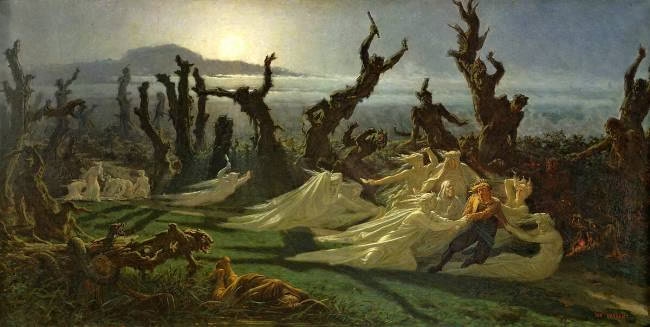
In French folklore, certain dark spirits, such as summoning elves, fire-bearers, or night washerwomen, are closely tied to specific locations. They are often found by the water’s edge or near notable natural features, their preferred domain. They rarely stray from these places and generally do not attack those who keep their distance. One can almost “read” their gestures in what some elders called the Book of the Earth or the Book of Fresh Waters.
Other spirits, just as numerous, have no fixed residence. They wander through fields, along paths, and at crossroads, places often associated with the devil, revenants, and witch beasts. These spirits sometimes appear unexpectedly, visible or not, and announce their presence through noises or cries. In Lower Brittany, for example, the hoppers, or houpeurs, and in Picardy the houpeux, imitate the human voice to deceive travelers, sometimes toppling those who respond. In the Pas-de-Calais, the “Criards” called out to passersby at night and dragged them by the hair if they were careless.
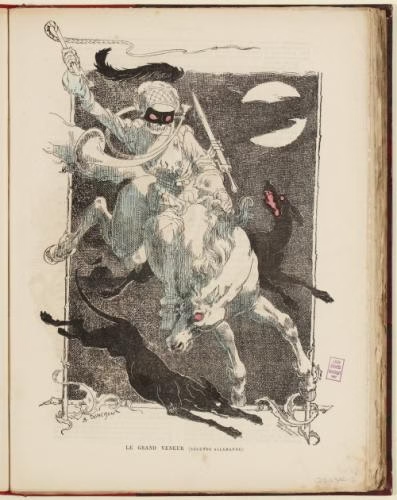
At the beginning of the 19th century, certain regions feared specific figures: in Lower Brittany, the Scrigérez nooz, the night crier, would pursue the careless, letting out plaintive cries. In Alsace, a lone passerby who responded to the Wild Hunt was seized by the powers of darkness and forced to wander through the forest all night. In the Mentonais, caution dictated never to answer those who spoke to you in the dark.
11. Acts Forbidden to Night Travelers
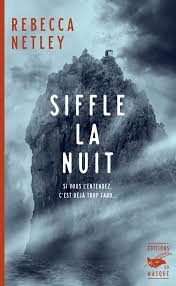
Whistling at Night is Forbidden, cover of the novel Whistle at Night, Rebecca Netley
En Bretagne et dans d’autres régions de France, de nombreux interdits encadrent les comportements des voyageurs nocturnes. Parmi les plus connus, siffler est particulièrement dangereux : en Upper Brittany, c’est le diable lui-même qui répond, tandis que dans la partie bretonnante des Côtes-d’Armor, il est strictement interdit aux chrétiens de siffler après le coucher du soleil. Un récit illustre bien ce danger : un homme voyageant seul oublia cette consigne. Chaque fois qu’il sifflait, un sifflement plus fort et parfait que le sien résonnait derrière lui, accompagné de petits pas imaginaires. Convaincu qu’on voulait lui jouer un tour, il répondit par des sottises… que l’écho répétait aussitôt. En arrivant près de sa maison, il fut emporté par le diable, qui imitait ses paroles. En Lower Brittany, siffler la nuit expose également au courroux des morts.
Le danger ne se limite pas aux sifflements. Dans le Val-de-Saire (Manche), chanter attire le diable, tandis qu’en Upper Brittany, un chanteur solitaire peut voir soudain un être gigantesque surgir à ses côtés. En Lower Brittany, il est conseillé de ne jamais se retourner, même si l’on entend un bruit étrange, sous peine de voir son malheur ; dans le pays de Menton, un regard en arrière suffit pour qu’un mauvais esprit s’en prenne au voyageur imprudent. Il est également interdit de suivre les lueurs visibles sur le chemin, souvent des feux follets conduisant à des précipices, et, dans le Morbihan, fixer un feu follet peut entraîner la perte de la vue. Les cierges errants, portés par des filles en blanc condamnées à errer pour avoir mal utilisé les cierges bénits de la Chandeleur, représentent un autre danger : un garçon qui frappa un de ces cierges vit apparaître une forme blanche couronnée de roses, tenant un cierge brisé… et mourut le lendemain.
Certain beliefs also require specific religious gestures. In some parts of Ille-et-Vilaine, failing to make the sign of the cross in front of a cross exposes one to visions; elsewhere, making the sign of the cross after sunset is reserved for the devil and disturbs the souls in Purgatory. In Dinan, it is believed that the dead think they are being called and follow the careless traveler. In Provence, it is advised not to make the sign of the cross in front of a will-o’-the-wisp or to greet anything after dusk, as some nocturnal spirits refuse to be acknowledged.
Travailler dans les champs la nuit complète est également dangereux. En Lower Normandy, on risque de croiser des hommes sans tête, of follets, ou comme dans le Val-de-Saire, « des mauvaises gens qui font peur et mal ». En Upper Brittany, le diable accompagne le laboureur et peut même l’emporter s’il persiste. Parfois, des esprits avertissent : un paysan d’Ille-et-Vilaine, sciant du blé noir après le coucher du soleil, entendit deux fois : « Faut laisser la nuit à qui elle appartient ! » Dans les Ardennes, un géant disait : « Le jour est pour vous, la nuit est pour moi. » D’autres interdits surprenants existent : en Upper Brittany, sortir tête nue après le coucher du soleil fait perdre son baptême ; dans le nord de l’Ille-et-Vilaine, on ne doit pas éteindre le feu allumé dans les champs le soir, afin que la Vierge puisse y cuire la bouillie de l’Enfant Jésus.
12. People Particularly at Risk; People Unharmed
Woman Walking Alone at Night
At night, some people are more exposed than others to spirits and supernatural forces, depending on their sex, age, or purpose of travel. In the Perche, at the beginning of the 19th century, women never dared to go out alone after sunset. In Normandy, pregnant women also avoided venturing outdoors, fearing that the devil might seize their unborn child. Around Fougères, it was recommended that pregnant women stay at home between the evening and morning Angelus, to avoid encountering “large black beasts.”
Men were not spared: according to a widespread belief, anyone who set out alone at night to fetch a midwife could suffer the worst misadventures. In Lille, it was said that an invisible hand would slap him. In the region of Fougères, mothers before their postpartum recovery and children before their baptism remained particularly vulnerable, even when carried to the church for the ceremony: the evil spirit prowled between two Angelus, unless a man aged twenty-one or older was present in the company.
In Normandy, a woman was never to go out alone after sunset with a child under one year old or an unweaned infant: the devil could twist the child’s neck, crush its head, or carry it off. Children under seven risked being abducted by witches or old men, who would then eat them. The power of these creatures began at nightfall. In Lower Brittany, it was also forbidden to go alone at night to fetch a priest or a doctor, but no more than two people should go together.
Certain professions enjoyed a form of protection. In the Perche, around 1820, cattle merchants and millers were reputedly exempt from apparitions, elves, and will-o’-the-wisps. This professional immunity is not reported elsewhere. In Lorraine, those who, after receiving communion at midnight mass, attended three masses on Christmas Day were protected from ghosts and revenants. In Wallonia, attending the first mass of Christmas, called the Messe de Missus, offered protection against spells for the entire year.
13. Talismans and Conjurations
Bottle of Holy Water
In many regions of France and Wallonia, night travelers used conjurations and talismans to protect themselves from spirits, elves, and revenants. These traditional practices reveal a great regional diversity and deeply rooted beliefs.
In Languedoc, when a person doubts the intentions of a passerby, they must confidently address them with:
« Se sè de l’autre, avalisca Satanas ! Se sès bona causa, parlas ! »
« Si tu es de l’autre (le malin), avale, Satan ! Si tu es pour une bonne cause, parle ! »
“If you belong to the other (the evil one), swallow, Satan! If you are for a good cause, speak!”
In Lower Brittany, ghosts can be warded off in the following way:
“If you come on God’s behalf, express your wish; if you come on the devil’s behalf, go your way as I go mine.”
In Upper Brittany, le lutin Mourioche, souvent sous forme animale, est repoussé par :
« Mourioche – Le Diable t’écorche ! » “Mourioche – May the Devil flay you!”
In the Vaudois Alps, a specific conjuration protects those who cross dangerous gorges at night, while in the Ardennes, tearing paper into small pieces and scattering them along the road diverts spirits: they amuse themselves by picking up the pieces and forget the passerby.
In Wallonia, men going alone at night to fetch a midwife use holy water. In Lannion, the inhabitants also carry a small bottle of holy water, and in Bigorre, women sprinkle a few drops on their dress before going out.
In Upper Brittany, tenir son rosaie à la main suffit pour faire disparaître les esprits malins. En Lower Brittany, les paysans s’assurent d’avoir leur rosaire à portée de main pour repousser le diable et ses servants.
Other regional protections include:
A sprig of vervain near Dinan to ward off elves and the dead
Midwives in Liège turn their stockings or skirts inside out to avoid will-o’-the-wisps.
The inhabitants of Dinan sing at the top of their lungs to ward off apparitions, contrary to the belief that singing at night is dangerous.
In Lower Brittany, an elf or revenant can only harm two people, never three, provided they are baptized and of the same sex and roughly the same age. A single person cannot question a troubled soul, but a group of three can do so safely. Travelers often avoided insulting the dead, as some beliefs hold that touching or offending a revenant could be fatal. For example, the dead from the Auray battlefield, walking their path in a straight line at night, could kill any careless traveler they encountered (Émile Souvestre, Les Derniers Bretons).
14. Musical Spirits
Musical Spirits
Some popular legends recount the presence of musical spirits, capable of producing supernatural sounds at night. These manifestations, mostly reported in Breton forests and mountain ranges, remain rare elsewhere.
Around 1830, in Brittany, it was reported that at midnight, on the mountains of Aré or on the deserted islands along the coast, a bagpipe plays by itself:
« Ses sons n’ont rien de terrestre ; jamais on n’a pu voir celui qui en joue, mais elle annonce que les aïeux vous attendent. »
“Its sounds are unlike anything earthly; no one has ever seen who plays it, but it announces that your ancestors are waiting for you.”
The spirits of ancestors generally gather at the foot of an oak tree or around a druidic stone. A glowing ember is said to indicate the exact location of these mysterious guests.
In Wallonia, the night can also be enlivened by supernatural music. Around midnight, some inhabitants hear a choir of witches, called the dames chanoinesses. In Mont-sur-Marchienne, several witnesses report that this diabolical orchestra can be heard above the houses where women give birth during the night.
In the Bessin, foggy nights are particularly feared: anyone who cannot find their way through the tall grass has likely stepped on a mysterious herb. The peasants then say that the person is anfôtomé or bewitched.
In Lower Brittany, this plant, called Ar Iotan, is inhabited by a spirit capable of causing travelers to lose their way. At night, it emits a glow similar to that of fireflies, signaling its presence and magical power.