In the popular beliefs of Upper Brittany, nature is not solely the work of God: it is also influenced by the Devil. This ancient dualism, which contrasts beneficial and malevolent forces in explaining natural phenomena, is still noticeable in certain oral traditions. According to these beliefs: God makes the rain, the Devil makes the hail; God makes the wind, the Devil makes the storm.
This division between good and bad weather elements illustrates how rural societies interpreted the whims of the sky. Rain, beneficial for crops, was seen as a divine gift. In contrast, hail and storms, destructive, were associated with infernal powers.
2. Celestial phenomena of God and the Devil
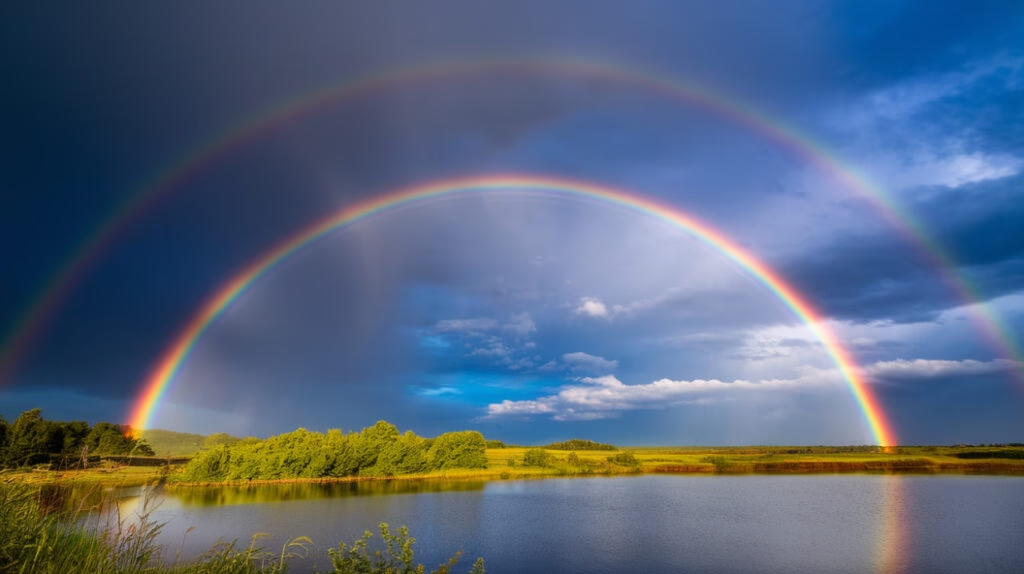
Double Rainbow
In these regions, when a double rainbow appears in the sky, it is seen as two distinct signatures: the brighter one, perfect in its colors: God’s rainbow; the paler, incomplete one: the Devil’s.
A Comtois legend illustrates this story: "God created a splendid rainbow. Jealous, the Devil wanted to do better. He placed two pillars even farther apart, intending to form a gigantic arch of fire. But his work remained unfinished: the pillars rose, dull, never meeting. The bridge of light did not form." Since then, any construction without a visible end is compared to "the Devil’s rainbow."
In Côte-d’Or, the rainbow is nicknamed the “Crown of Saint Bernard”. Here too, the Devil is not far away…
When a second arc forms beneath the first and seems to break, it is said: "The Devil, jealous of Saint Bernard’s glory, tries to make himself a crown… but fails. He breaks it." This is a figurative way of explaining the imperfection of the second arc, which science simply calls the secondary reflection of light, but which folklore interprets as a failed challenge.
In the Manche, this second rainbow is sometimes called “the old woman’s mark”, without anyone really knowing its origin. The ethnologist Paul Sébillot mentions it but does not provide an explanation. Perhaps a forgotten echo of an old myth or a fallen deity?
3. The rainbow
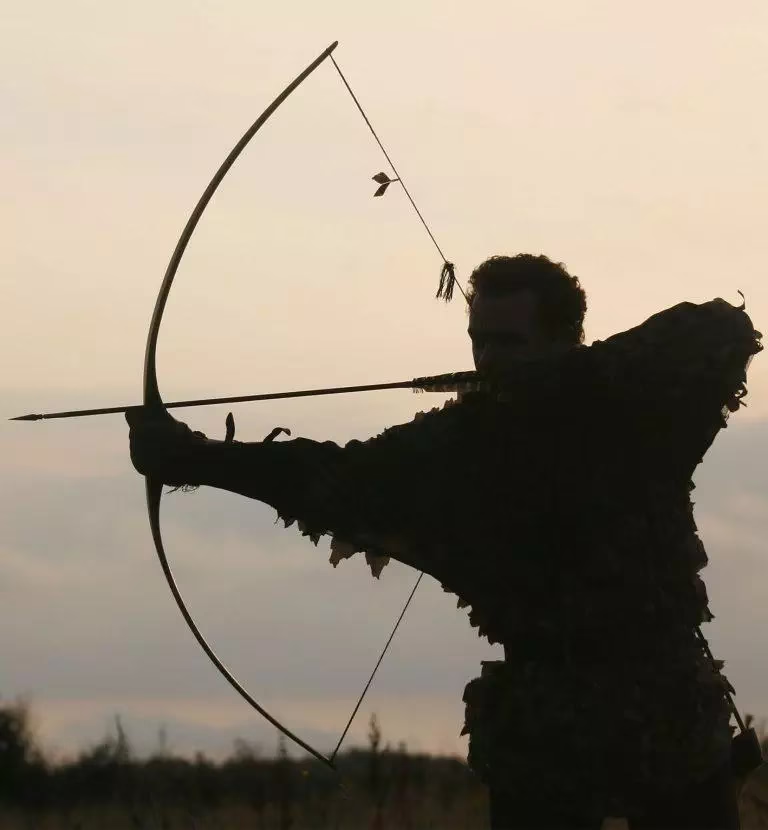
Archer drawing his wow
In the Middle Ages, the rainbow was seen as a true war bow, held by the personified clouds, those invisible celestial entities that govern the elements. A medieval manuscript describes this almost epic scene:
Ansinc cum por aller chacier, Un arc en leur poing prendre seulent, Ou deux ou trois, quand eles veulent, Qui sont apelés arc celestes, Dont nus ne sait, s’il n’est bon mestre… »
French: « Ainsi, comme pour aller chasser, Elles prennent en main un arc, Un ou plusieurs, quand elles veulent, Appelés arcs célestes, Dont nul ne comprend la nature s’il n’est maître… »
Translation: "Thus, as if going hunting, They take a bow in hand, One or several, whenever they wish, Called celestial bows, Whose nature no one understands unless they are a master…"
This passage evokes an ancient belief: the rainbow was considered a weapon used by celestial forces to hunt or fight. The text also reflects on its mysterious structure — its colors, its shape — inaccessible to ordinary mortals.
In popular languages and regional dialects, the rainbow bears poetic or sacred names:
Rainbow of Time in Picardie, perhaps suggesting a connection between the sky and weather cycles.
Arcas dóu cèuin Provence, literally "arch of the sky."
Er-Dyè orAr-Dî in Wallonia and other French-speaking countries, either "bow of God", directly inspired by biblical texts — particularly the Old Testament, where the rainbow symbolizes the covenant between God and humanity after the Flood.
The rainbow also becomes a object attributed to certain local saints, as if they were its guardians or creators:
Saint Martin’s Rainbow in Picardie, Doubs, Languedoc, Provence, Béarn (where it takes various dialectal forms: Arquet de Sant Marti, Arc de Sent Martii, etc.).
Saint Del's Rainbow or Arçon de Saint Del in Franche-Comté, in relation with saint Del, abbot of Lure
Saint Michael’s Rainbow, around Tournai and in Pas-de-Calais, refers to the warrior archangel, often depicted with a sword or a scale, here accompanied by a celestial bow.
4. Names of the Rainbow in Relation to Its Shape
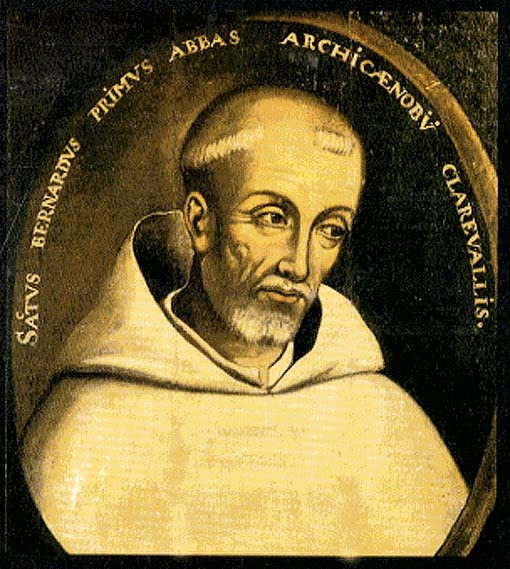
Bernard of Clairvaux, Engraving
Its arched shape evokes a crown for many, which has earned it numerous names related to saints and the sacred:
Saint Bernard’s Crown (Messin region, Vosges, Côte-d’Or)
Saint Giracque's Crown, of Saint Léonard, or of Saint Denies (around Belfort)
God’s Garter, The Virgin’s Garter (Haute-Loire, Puy-de-Dôme)
God's belt, Saint Leonard’s Strap or Amarou-lerou ar potr koz("the old bachelor’s garters", Finistère)
Parisian slang also called it Cravate, likely echoing the colorful scarf of the goddess Iris among the Greeks, messenger between heaven and earth.
Another common interpretation: the rainbow is a celestial bridge or walkway. This image appears throughout France:
Poent of Saint Bernard (Provence, Dauphiné)
Holy Spirit Bridge (Ardèche)
Poent de sèro or Poent de sedo (Provence, Languedoc)
In Lavedan, it becomes the Pourtaou de Saint Martii — Saint Martin’s portal. In Wallonia, people even speak of the Pwèt’ de Paradi, literally the Gate of Paradise: children dreamed that by climbing a rainbow, they would reach the Kingdom of Heaven.
The Romantic writer Émile Souvestre, in Les Derniers Bretons (1836), recounts a rare and poetic Norman belief: the rainbow is “the shadow of a bridge between heaven and earth”, a distant memory of Norse mythology and the Bifröst, the rainbow bridge linking Asgard to Earth.
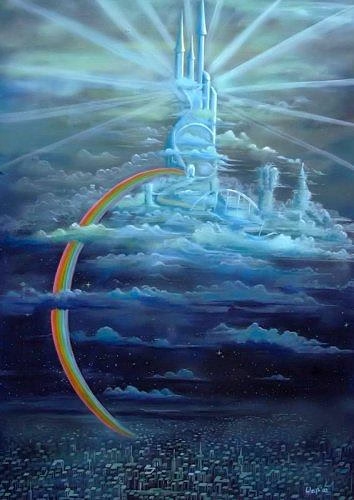
Other beliefs, darker or more mystical, describe the rainbow as a vehicle of souls: in Upper Brittany, it is made of ladders for suffering souls climbing or descending from one star to another. In Valenciennes, it becomes the Bourdon Saint Miché; elsewhere, the Line of Saint John (Belgian Luxembourg), or the Róy sin Dj’han — names that do not reference the arc’s shape, but an invisible function.
The colors of the rainbow also inspired more modern metaphors: in the Centre region, it was nicknamed the Banner, as evidenced by the fifth verse of a song by Casimir Delavigne, La Parisienne, composed in 1830, the national anthem of France under the reign of the country’s last king, Louis-Philippe I:
Les trois couleurs sont revenus, Et la colonne, avec fierté, Fait briller à travers les nues L’arc-en-ciel de sa liberté, Ô jour d’éternelle mémoire ! Paris n’a plus qu’un cri de gloire : (refrain)
The three colors have returned, And the column, with pride, Makes shine through the clouds The rainbow of its freedom, O day of eternal memory! Paris has only a cry of glory: (chorus)
In the North, some storytellers said it represented the flame of the ship Grand Chasse Foudre, a mythical vessel made of all colors and belonging to all nations. In Languedoc and Provence, people were simply amazed by lou Bel (the Beautiful, Aveyron), Arc de sédo, or Arc de soie, in the same vein as the moon, often called la Belle. Its appearance after a shower naturally made it a sign of past or coming rain: in Brittany, it is called Guarek ar glao (“rainbow of the rain”) or Kloarec ar glao (“rain cleric”), names steeped in meteorological legends. The name Los tar bleiz (“wolf’s tail”) suggests that the rainbow contains a fabulous animal, or is an animal. This name is often cited in formulas intended to make the rainbow disappear.
5. Animism
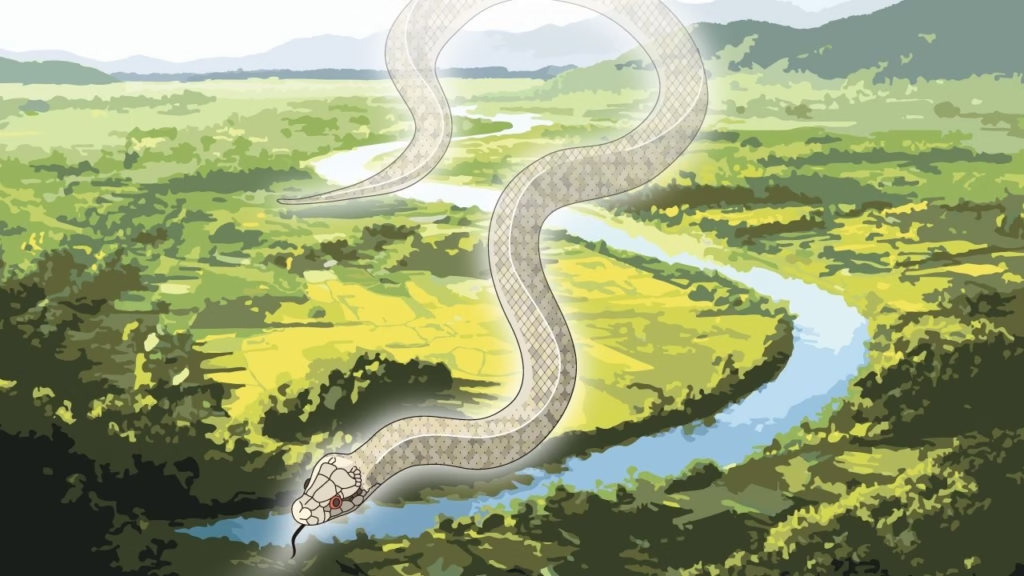
Giant Flying Serpent, Allegory of the Rainbow
Since Antiquity, some writers claimed that the rainbow plunged toward the horizon to quench its thirst. This idea is vividly found in the oral traditions of several French regions.
Around Lannion, in Lower Brittany, peasants claim that the rainbow is a giant serpent. It descends from the sky to drink from rivers, ponds, or streams when it is thirsty. People then say: “It drinks from such a stream”, or “it drinks from the pond of…”. Some go further: this serpent is said to have a flaming head, eyes of fire, or even a bull’s head, like the Iris described by Plutarch, or a cow’s head, as in Estonian legends.
In Corsica, it is said that when the rainbow appears, the Devil descends to drink from the sea or river. A dark and powerful vision, where the arc is no longer a bridge but a gaping mouth turned toward the waters of the world.
Breton traditions go even further. In the Finistère, the rainbow is said to be invisible if it is not forced to drink. It sometimes sucks up the water of entire lakes, causing their sudden drying.
Sailors from the two Bretagnes say it drinks from the sea, because it appears there more clearly than in the sky. In Ille-et-Vilaine, the water it draws is said to extinguish the clouds to prevent them from burning, forming <stronglarge boils where its ends touch a pond or stream. In Corrèze, it is said to form over the sea, arrive pushed by the wind, and keep one leg in the streams to pump their water.
These beliefs do not stop at the simple phenomenon. They are often linked to weather signs: In Lower Brittany, if one foot of the rainbow rests on a hill near a river, it will go there to drink, and rain will follow to replace the water it has taken. In Saintonge, if it plunges into the Charente or the Atlantic Ocean, it is said to fish. Depending on the location of this “fishing,” fair weather or rain is predicted.
In the Bocage Vendéen, it is said that the cerne (another name for the rainbow) removes water from ponds, and that it falls while raining fish. An almost biblical image. In Lower Brittany, the rain following its passage can even contain frogs or small fish, living proof that the arc has drunk… and redistributes what it has taken.
6. It changes sex
Individual waving a “rainbow” flag; in front of the sun
In certain regions of France, the rainbow acts as a silent scourge. In the Mentonnais, it is said that if one of its columns touches a tree, the tree dies. In the Lot and Haute-Garonne, not only does it wither trees, but it also destroys the crops in the fields where it lands. In the southern Finistère, the rainbow is blamed for continuously pumping water, causing sudden gusts, violent showers, and harsh winds.
The sailors of the Manche tell a disturbing story:
If a ship passes under one of the rainbow’s feet while it is drawing water, the boat could be carried away with it.
Un avertissement maritime transmis de génération en génération, empreint d’une poésie sombre, presque biblique.
One of the most fascinating, and perhaps the strangest, beliefs is that the rainbow has the power to change the sex of those who pass beneath it. This idea, now forgotten, was widespread enough in the 16th century to appear in popular tales and comedies. The Burgundian poet Tabourot humorously referred to these “Ladies and Gentlewomen so delicate and refined that they would not have dared to strangle a fart or change it from male to female without passing under Saint Bernard’s rainbow.”
A delightful excerpt from Tromperies de Larivey (Act I, Scene 5) presents this dialogue:
CONSTANT. — You are not a woman, what are you complaining about? ROBERT. — And if I were to pass under the rainbow and some strange accident were to change me someday?
The legend does not end there. In Haute-Loire, it is believed that a person passing beneath becomes the opposite sex. Near Belfort, another version says that if a girl manages to toss her bonnet over the rainbow, she will be immediately transformed into a boy.
7. Wealths It Brings
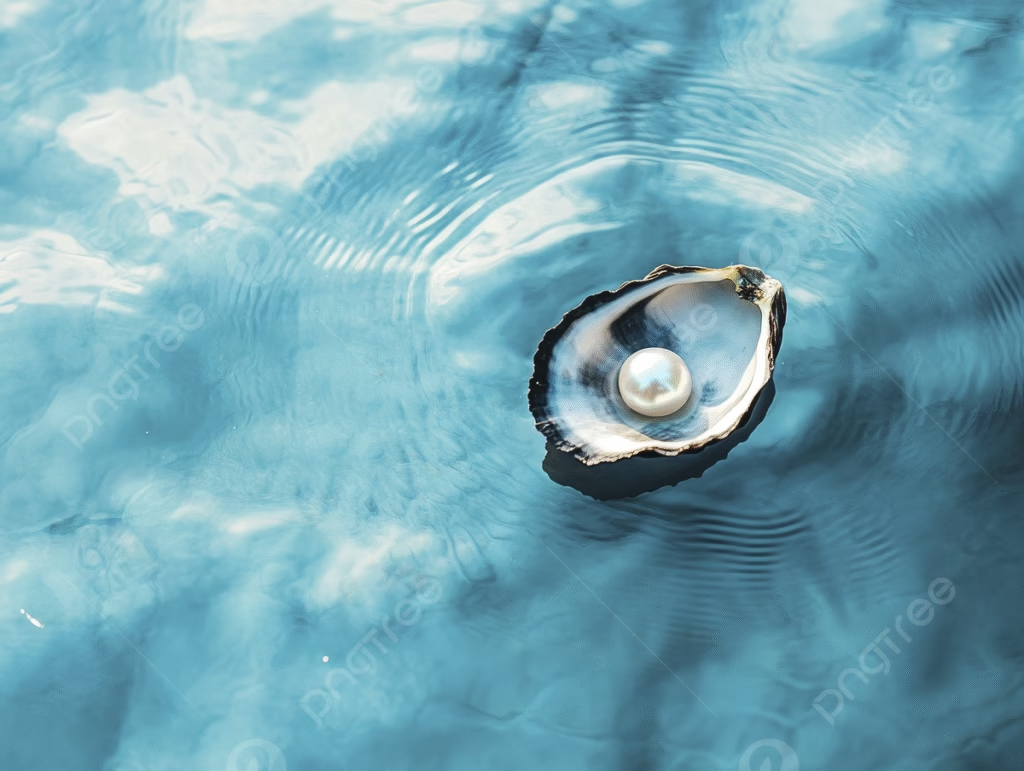
Oyster Pearl
In several provinces of France, it is said that where the rainbow touches the ground, a fairy places a magical pearl, an object so precious that it alone would be an invaluable treasure. Some shepherds even claim to run to these spots in hopes of finding it before it disappears.
The stories vary by region, but the theme of treasure left at the end of the rainbow remains constant:
In Vosges, it is believed that if its pillars rest on a hill, the one who manages to place a basket there will find it full of gold.
In Auvergne, it is a silver basket awaiting the bold.
In Wallonia, a silver dish is spoken of. d’un plat en argent.
In Lot, the reward is a small stack of gold coins.
In Corse, it is said that a treasure is hidden at the exact spot where the rainbow drinks.
And when children realize they will never catch it in time, they tease it with humor, striking their knees with crossed hands and shouting: “Here, bring the treasure!”
In the Haute-Loire, after it has “drunk” from a river, one sometimes finds a bowl or a wooden or metal spoon at the spot where one of its ends dipped. It is assumed that it used them to scoop the water, just as in Swabian or Bulgarian traditions, where the rainbow drinks with bowls or cups made of precious metals.
In Pont-l’Abbé, the colored mist rising from the ground after rain is interpreted as the rainbow’s last breath, finishing its water-sucking. In the Cap Sizun, this mist is seen as a sign that a hidden treasure is rising to the surface, to dry in the sun.
When one sees the rainbow, one must run to the colorful field and throw a blessed object (holy water, cross, medal…). If done quickly enough, the silver remains on the ground and can be collected. If one arrives too late or without a blessed object, the treasure disappears into the ground or turns into dry oak leaves.
It is also found on stage, in a vaudeville by Félix Auguste Duvert, Le Marchand de Marrons, where a character exclaims emphatically: “If I know where to go, so be it that the rainbow serves me as a cravat!” It is a figurative way of surrendering to fate or mocking the seriousness of a situation. The rainbow, usually a symbol of peace or hope, becomes a prop for bravado.
In other regions, it is not the rainbow but the wind that is invoked in curses: in Provence, sailors swear, “May all the mistrals strangle me!” Among Lower Breton peasants, one curses an enemy by consigning them to the wind: “I give you to the gust!” Here, the breath of the elements becomes an outlet, a punishment, or sometimes a judgment. These expressions reflect the symbolic power of the climate in popular culture.
In certain provinces, pointing at the rainbow with one’s finger is strictly discouraged, even considered dangerous:
In Auvergne, it is un geste interdit, unexplained but carrying an implicit taboo.
In Picardie, the pointed finger can be cut off,literally or symbolically.
In Wallonia and in Vosges, it is asserted that a panaris– this painful finger infection – will come to punish whoever dares to point it out.
9. Omens and dreams
Illustration of the Scandinavian Bifröst, connecting Earth and sky
In the small village of Gras-Avernas, near Liège, a persistent belief holds that a rainbow always appears above the house of someone who has recently passed away. A celestial phenomenon, in this context, becomes a sign of the passage to the afterlife, a kind of luminous bridge between the world of the living and that of the dead, much like the Bifröst of the ancient Scandinavians. The sky thus becomes a messenger of mourning.
In the Bourbonnais region, the dream of a rainbow is not as poetic as one might imagine. Dreaming of having a rainbow above one’s head is seen as a bad omen: a change of fortune, imminent danger, or even a death in the family. This interpretation can be found in Onéirocritie or the Dictionary of Explained Dreams (Paris, 1859), written by the bibliophile Paul Lacroix, who compiled numerous beliefs from ancient works on dream interpretation, particularly regarding meteorological phenomena.
Among the works that popularized these meteorological superstitions is La Clef des Songes, a small chapbook, often reprinted and still in circulation in the 19th century, at the time of Paul Sébillot. This popular manual, sold at markets and fairs, greatly contributed to spreading “meteorological” interpretations of dreams throughout the French countryside. It contains interpretations as precise as they are varied… with the notable exception of this one:
Unlike the rainbow, often seen as a warning in dreams, dreaming of rain in Marseille is considered a harbinger of happiness.
10. The power of humans over themselves
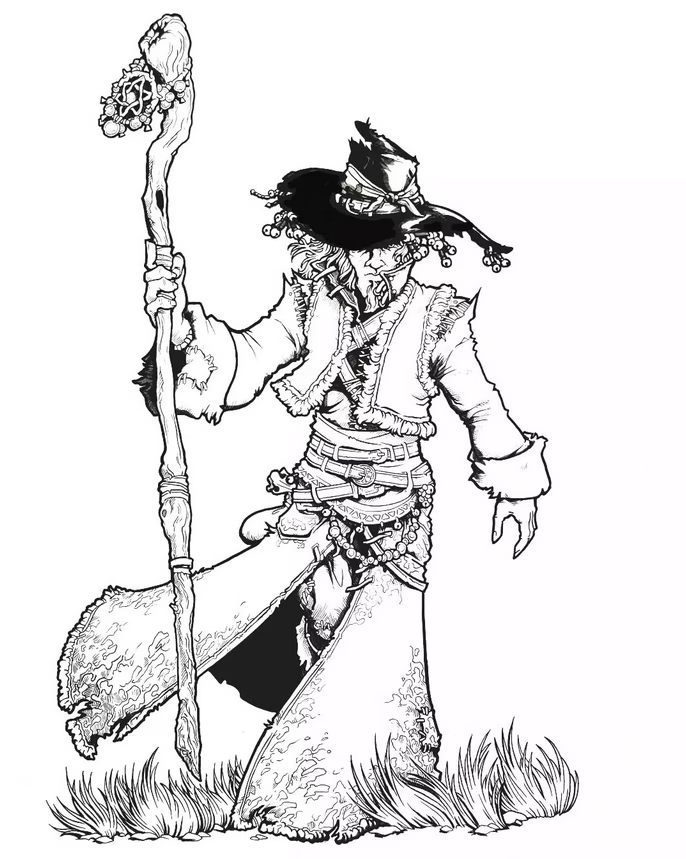
A tempestaire, illustration from Folklore Dracques
Among these spectacular phenomena are the aurora borealis, the rainbow, St. Elmo’s fire, the lightning bolt, and thunder. These elements, by their brilliance and colors, are considered beyond human reach: no mortal could make them appear at will. They are therefore thought to be under the dominion of deities, or at least of higher powers, who control these celestial wonders.
Nevertheless, while humans cannot create these meteorological phenomena, they seem to have some power over certain aspects of the weather: they can bring about storms that produce hail; they can make it rain; and, more rarely, they can cause fog. But they can never make it snow.
Regarding winds and storms, popular belief attributes to certain gestures, rituals, or particular maneuvers the ability to stir up or unleash them. These are not necessarily practices of witchcraft or black magic, but sometimes simply popular ritual gestures—often little known or forgotten today—that, according to tradition, allow one to “guide” or influence these natural forces.
A famous example, though now rare in contemporary tradition, is the belief in snow-conducting sorcerers, mentioned by the writer Savinien de Cyrano de Bergerac. This myth describes beings capable of controlling snow, making it fall or vanish at will. However, this idea has almost completely disappeared from modern popular stories and practices.
11. The severed rainbow: acts and little formulas
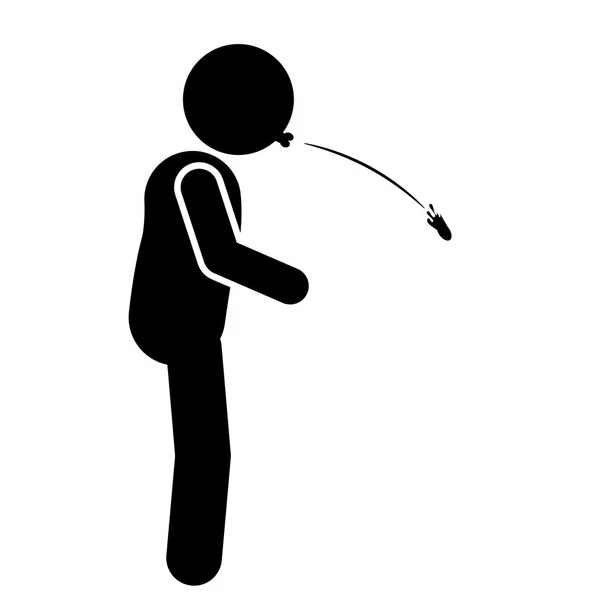
Depiction of a spit, an ancient conjuration
The rainbow, often seen as a powerful being capable of exerting sometimes harmful influence over things and beings, is the subject of numerous practices aimed at driving it away, dissipating it, or neutralizing its effect. These rites, although mostly recorded in the modern era, likely have roots in ancient beliefs. The writer Charles Renel notes that Greek peasants contemporary with the Trojan War or Pericles were already performing similar gestures to ward off this phenomenon.
The most widespread in France, and particularly in Brittany, is the custom of “cutting” the rainbow, an idea probably linked to the belief that this meteor is a living being. Saliva is frequently used in this magical ceremony, often associated with a cross-shaped gesture. This practice, unknown in pre-Christian times and among non-civilized societies, seems to be a Christianization of an older rite. In Auvergne, the rainbow is “cut” by spitting into the left hand, then striking the saliva with the edge of the right hand to form a cross, without any special formula. In Poitou, the rite is similar, but the conjurer must not have seen the meteor; a local formula even begins with: “Rainbow that I have not seen…”. On the coast of the Côtes-d’Armor, a blade of grass is placed in the hand with the saliva, a cross is formed, then the following is recited:
“I cut you in a cross, You shall not return.”
Other practices, sometimes Christianized, complement or replace the use of saliva: in Audierne, two stones are placed in a cross while saying: “Rainbow, food of the water, Go to the shore, break your neck.”
Near Lorient, two pieces of wood are placed in a cross on the path, accompanied by a formula:
“Hurry, hurry, Cut the wolf’s tail.”
In the Bocage Vendéen, they say:
“Little peta, cut the cat’s tail.”
On the coast of the Côtes-d’Armor, a grain of wheat is held in the hand while reciting:
“Arcancié, arcancié, By the power of my little grain of wheat, I want you to be cut.”
In the Finistère, a cross is sometimes traced in the air with a knife or a thread while reciting formulas, notably in Douarnenez:
“The rainbow on its horse Carries a knife in its pouch: Cut, cut, or I will cut it.”
At the Pointe du Raz and on the Île de Sein, stones are erected in a row, their tops symbolically “cutting” the rainbow until it disappears. In some regions, threats are addressed to the rainbow to protect crops or prevent its “livestock” from passing through it: in the Côtes-du-Nord and Ille-et-Vilaine, it is threatened:
“Ergancié, Ergancié, If you put your cows in my wheat, I will cut you in half.”
In Berri, on the contrary, gifts are promised to it to appease its anger: