In popular imagination, wolves—whether guided by masters skilled in witchcraft or temporarily transformed men—hold a prominent place. They undoubtedly dominate the pantheon of mythical creatures associated with forests. But the old woodsmen, guardians and workers of the woods, also recounted stories of other animals with supernatural or astonishing behaviors. Among them: the wild boars.
Although less numerous than those concerning wolves, the stories about wild boars are no less striking. In Savoie, a tradition tells that the Devil himself took the form of a huge wild boar to ravage the region. According to this legend, Amédée II, the Red Count, set off in pursuit in the Lones Forest. A terrible struggle ensued. Amédée II’s horse, seized with panic, reared and plunged into the heart of the forest. During the fall that followed, the count was severely injured—a wound from which he died.
Another story tells of Lord Louis de Langin, who also faced a wild boar that spread terror: it devastated the lands, attacked travelers, and, as in the previous tale, represented a manifestation of Satan. During a hunt, the lord encountered the beast. But the monster killed the squire and the huntsman, and struck the lord with a violent goring blow. Overcome, yet still alive, the lord then made a solemn vow: if he escaped death, he would erect a chapel at the very spot where the boar had struck him.
2. Horses and Goats
Among the most feared creatures was the headless horse of the Commenailles Wood. According to tradition, it would suddenly appear behind walkers, silently placing its two hooves on their shoulders. At other times, it would appear belly to the ground, knock its victim over, carry them on its back, and gallop through fields and forests with no chance of escape.
Another supernatural animal, the Three-Legged Horse, haunted the surroundings of Besançon. This strange horse obeyed only if equipped with a bit. As soon as it managed to free itself, it would flee at full speed, darting like an arrow and resuming its spectral gait deep within the woods.
Quieter but equally mysterious, the Gauvin Horse crossed the Vernois Stream every evening. It would make its way to the village square before vanishing into the Chaux Forest, leaving behind a scent of supernatural presence.
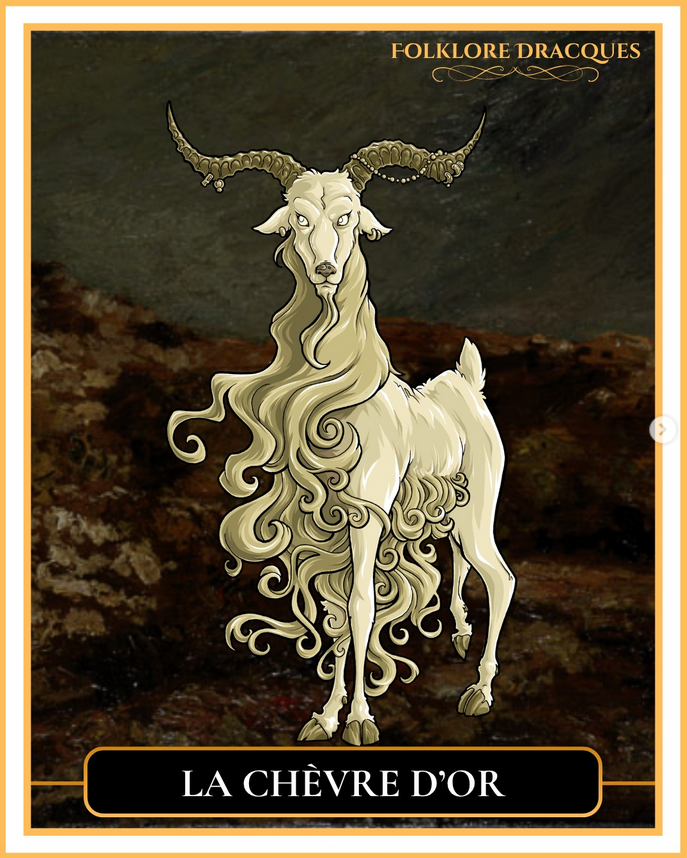
In the Ardennes, another legend stood out: that of the Golden Goat, so named for the two golden horns adorning its forehead.
“She lived in the Auchamps woods, and even hungry wolves respected her. One night, she was captured by a tinkerer, and since then, the sheep and goats became prey for the wolves.”
3. Reptiles and Wyverns
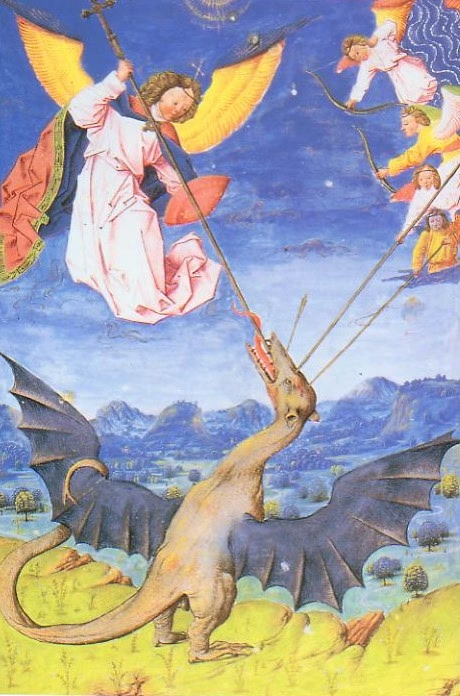
Saint Michael and the angels confront the Wyvern, from Liber Floridus, Lambert of Saint-Omer, c.1448
In the forests of the Luchon region, there were once tales of large serpents bearing on their heads a shining stone, as mysterious as it was precious. Rare and swift, they moved while making a powerful noise. Legend holds that whoever managed to kill one of these reptiles could claim the stone, regarded as a talisman of priceless value.
Unlike traditional wyverns, the one that haunted the forests of Mont-Bleuchin did not possess a diamond. Yet, it inspired a deep fear. No one dared cross these woods at night, and even by day, people feared encountering it.
A lord of Moustier eventually confronted it and managed to pierce its heart after a terrible battle.
In Auvergne, in the 14th century, some claimed to have heard “the old serpent of the forest” lamenting before departing for Rome to prepare the chrism—a belief as strange as it was fascinating.
In Laigle, the ghost of Lady Nicole, known for her unjust deeds, is said to haunt the Bois de la Pierre. She would transform into a wolf or a fierce dog to frighten travelers.
Near the ruins of the Montfort Castle, a white doe regularly appears. Locals call her the Baroness. She is said to be the soul of Amélie de Montfort, who went mad after learning of her father’s death and threw herself from the top of a tower.
In Brittany, the doe of Saint Ninoc’h appeared in the woods in the southern part of the region. Legend held that any young man who saw her at dusk would die on the day of his wedding.
One evening, a lumberjack from Chaumercenne encountered a magnificent rooster. He tried to catch it, then to decapitate it with his axe, but the rooster resisted, taunted him, and led him on until dawn.
In the Boulzicourt Forest, one could see a hen and her chicks pecking under an oak, near a cliff hidden by branches. Strangers, deceived by this apparition, tried to catch them. Each time, the animals would lead them to the void, where they fell to become the prey of malevolent fairies hiding at the bottom of the chasm.
Some forests were said to be off-limits to certain species, not by nature, but by divine or supernatural intervention. Thus, in the Gâvre Forest (Loire-Inférieure), no magpies are seen anymore. God is said to have driven them away to punish their greed. According to tradition, while Duchess Anne, pursued by the English, was about to be captured, her page killed a horse and hid the duchess inside the carcass to save her. The enemies were about to leave when magpies, attracted by the animal, revealed her hiding place by tearing the carcass apart. Since that day, they have been banned from the forest.
4. Forests Forbidden to Certain Animals
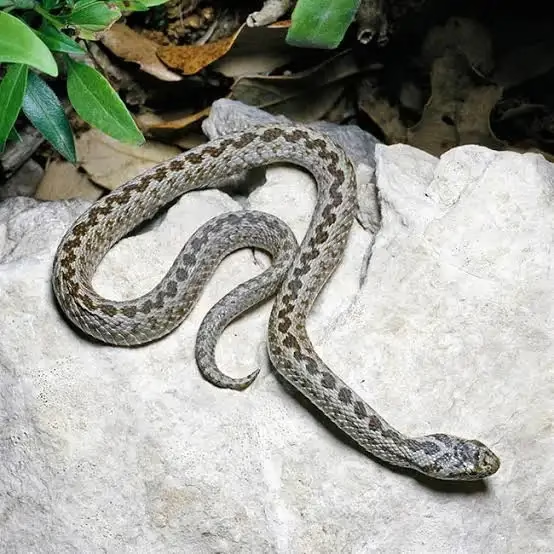
A viper, photograph by Giuseppe Mazza
In the famous Paimpont Forest, a unique privilege granted in 1467 to one of its sections was long forgotten. The charter of the time described the place as follows:
« Item entr’ autres brieux de ladite forêt, il y a un Breil nommé le Breil au Seigneur, où qu’il jamais n’habitte et ne peut habitter aucune bête venimeuse ne portant venin, ne nulles mouches, et quand on y apporteroit au dit Breil aucune bête venimeuse, tantost est morte et ne peut avoir vie, et quand les bestes pasturantes en ladite forest sont couvertes de mouches, et en se mouchant, s’elles peuvent recouvrer ledit Breil, soudainement lesdites mouches se départent et vont hors icelui Breil. »
"Among other parts of the said forest, there is a grove called the Breil au Seigneur, where no venomous beast may ever live or dwell, nor any flies; and if any venomous beast were brought into this grove, it would immediately die and could not survive. Moreover, when grazing animals in the said forest are covered with flies, and if they stray into this grove, the flies immediately leave and go outside the Breil."
The Breil au Seigneur was thus considered a miraculously protected area, safe from venomous creatures and biting insects—a pocket of purity in the heart of the forest.
The inhabitants of the Sève Forest (Ille-et-Vilaine) claim that vipers are never seen there. Yet these reptiles abound in the Saint-Fiacre Woods, just across a simple road from Sève. This tiny boundary thus becomes a mystery: why would one forest be devoid of them while the other is infested?
A tale passed down by a 17th-century traveler offers a surprising glimpse into former forest customs. In a small Béarn wood called Gelot, local inhabitants had the right to freely collect firewood… but under a very particular condition. To exercise this right, they had to enter the woods wearing only a shirt, count the wood they wanted, and then leave in the same state. If they wore their ordinary clothes, these were immediately confiscated.